
Grammar is the correct spelling when you mean the rules and structure of a language. Grammar is a common misspelling, usually caused by pronunciation, typing mistakes, or confusion with English words that end in -er. If you have ever paused before writing “grammar” in an assignment, email, blog post, or message, you are certainly not alone.
The distinction is simple, but there is more to it than changing one letter. Grammar is a noun, while words such as grammatical and grammatically are related forms with different jobs in a sentence. Understanding those differences can prevent more than a spelling error—it can help you choose the right word when discussing sentence structure, language rules, or writing quality.
This guide explains grammar vs. grammar, why the incorrect spelling is so tempting, where the word comes from, how to use it naturally, and how it differs from related terms. You will also find practical examples, a quick comparison table, spelling tricks, common mistakes, and answers to questions people frequently ask about the correct spelling.
Grammar or Grammer: What Is the Correct Spelling?
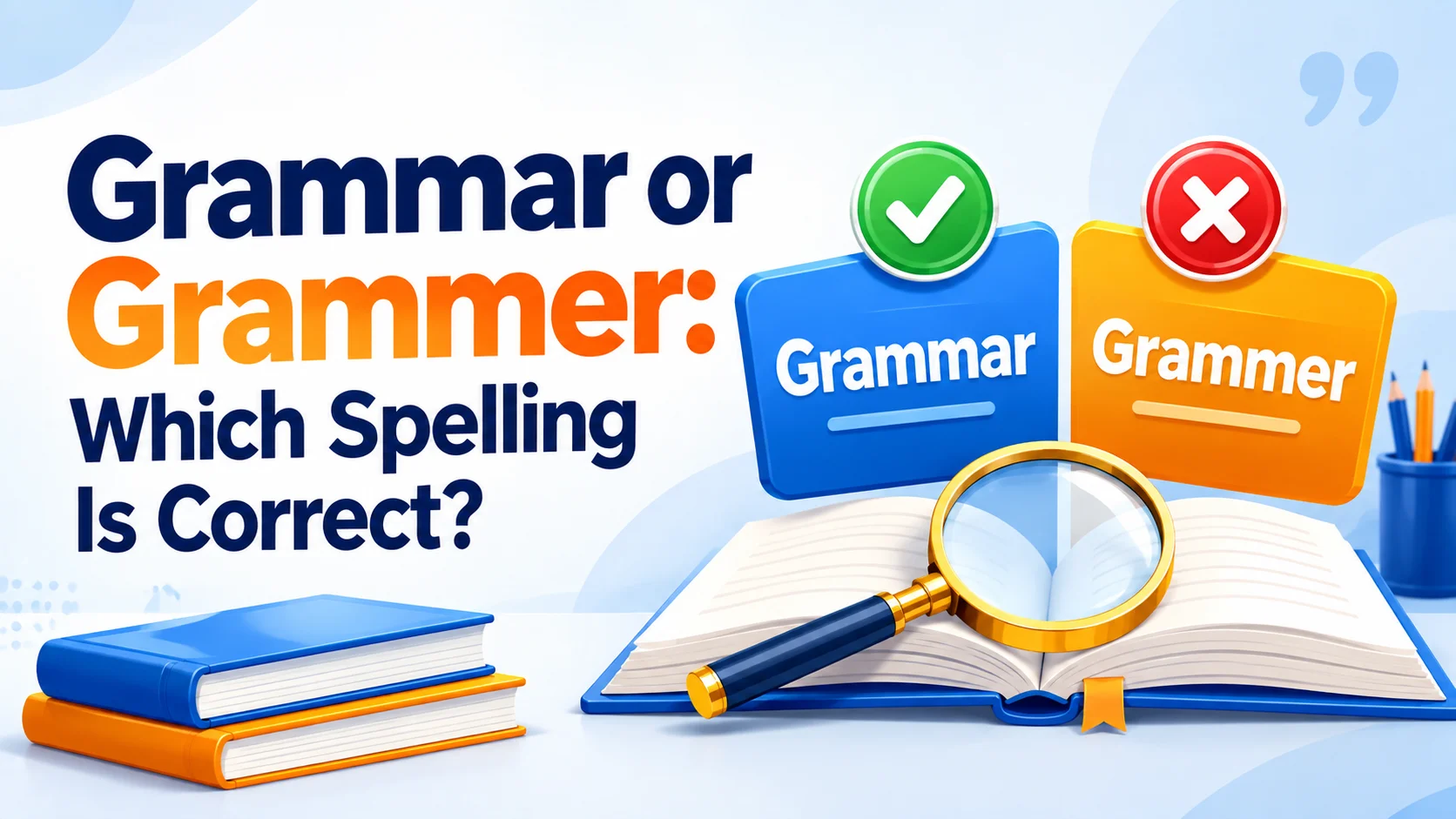
The correct spelling is grammar.
When referring to the rules and patterns that determine how a language works, write grammar, with -ar at the end.
Correct: I need to improve my English grammar.
Incorrect: I need to improve my English grammar.
“Grammer” is generally not an alternative spelling of the English language term. In ordinary English writing, it should be treated as a spelling mistake.
This applies whether you are talking about English grammar, Spanish grammar, grammar lessons, grammar rules, or the grammar of another language.
Grammar vs. Grammar at a Glance
| Feature | Grammar | Grammer |
| Standard spelling? | Yes | No for the language term |
| Meaning | Rules and structure of a language | Usually a misspelling of “grammar” |
| Word type | Noun | Not the standard noun in this context |
| Example | She studies English grammar. | She studies English grammar. |
| Correct ending | -ar | -er |
The most useful thing to remember is that grammar is not spelled according to how the final syllable may sound. English spelling often does not map perfectly to pronunciation, and this is one example.
What Does Grammar Mean?
Grammar refers to the system of rules and patterns that governs how words combine to communicate meaning.
It includes areas such as:
- Sentence structure
- Word order
- Verb forms
- Tenses
- Pronouns
- Articles
- Subject–verb agreement
- Clauses
- Parts of speech
For example:
She walks to school every morning.
The sentence follows recognizable grammatical patterns. The subject, verb, and other elements are arranged in a way that English speakers understand naturally.
Grammar is therefore not simply a list of strict rules that students memorize for exams. It is also a description of how language is structured and used.
What Grammar Includes
Consider the sentence:
The students are preparing for their examination.
Several grammatical choices are working together:
- The students function as the subject.
- are preparing uses a particular verb form and tense.
- there is a possessive pronoun.
- The words appear in an understandable English sentence structure.
That is why grammar matters beyond spelling. Spelling concerns how words are written; grammar concerns how words and structures function together.
Grammar in Everyday Communication
Grammar is present whenever people communicate through language.
You use it when you:
- Ask a question
- Tell a story
- Write a message
- Explain something
- Give instructions
- Write an assignment
- Send an email
- Create online content
You may not consciously think about grammar while speaking, but you rely on grammatical patterns constantly.
Why Do People Spell “Grammar” as “Grammer”?
If “grammer” is incorrect, why does the mistake appear so frequently?
There is no single reason. Several factors can make the wrong spelling seem natural.
Pronunciation Confusion
The final sound in grammar can make the spelling difficult to remember, particularly for English learners.
When people learn unfamiliar vocabulary primarily by hearing it, they may try to reconstruct its spelling from its pronunciation. That approach works for some words but fails for many English words.
Confusion With Words Ending in “-er”
English contains many common words ending in -er, so writers may unconsciously apply a familiar pattern.
For example:
- teacher
- writer
- learner
- computer
That does not mean every similar-sounding word uses the same ending. “Grammar” has its own established spelling.
Typing Mistakes
A quick search, text message, or draft may contain “grammar” simply because the writer typed too quickly.
The problem becomes more noticeable when an incorrect spelling is repeatedly used. Once a person has seen or typed the same mistake many times, it can begin to look familiar—even though familiarity does not make it correct.
Early Learning Habits
Students often remember vocabulary visually. If they first encounter a misspelled version in notes, messages, social media posts, or informal material, they may absorb that version.
A useful habit is to verify uncertain spellings before repeatedly using them, especially in formal writing.
Is “Grammer” Ever a Correct English Word?
For the ordinary language term, no: “grammer” is not the standard spelling of grammar.
However, context matters when you encounter an unusual word online. A similar-looking spelling could potentially occur as part of a proper name, surname, username, organization name, or title. In such a case, changing it automatically would be inappropriate because proper names follow their own conventions.
That exception does not change the main rule:
If you mean the rules and structure of a language, the correct spelling is “grammar.”
So if you are writing an English assignment and want to say that you need to improve your language skills, use grammar, not “grammer.”
Where Does the Word “Grammar” Come From?
The spelling of grammar makes more sense when you look briefly at its history.
The word ultimately traces back to Ancient Greek, where a term connected with letters and writing developed into the Latin grammatica. The word then passed through Old French before becoming part of English vocabulary.
Over time, its meaning became strongly associated with the study and description of language.
The important lesson for modern writers is not the entire historical journey. It is that grammar has a long-established spelling, so changing the ending to “-er” is not an accepted alternative spelling.
Why Etymology Can Help With Spelling
Learning where a word comes from can sometimes make an unusual spelling easier to remember.
In this case, knowing that grammar belongs to an older family of language-related terms can help explain why its spelling does not follow the most obvious pronunciation-based pattern.
You do not need to memorize Greek and Latin history to spell the word correctly, though. A simple visual association is usually more useful for everyday writing.
Grammar, Grammatical, and Grammatically: What’s the Difference?
One reason people become confused about grammar is that English uses several related forms of the word.
Grammar
Grammar is a noun.
It refers to the structure or rules of a language.
Good grammar makes the sentence easier to understand.
Grammatical
Grammatical is an adjective.
It describes something that relates to grammar or follows grammatical rules.
There is a grammatical error in the sentence.
Notice the difference:
- grammar = the language system or its rules
- grammatical = relating to grammar
Grammatically
Grammatically is an adverb.
It describes something in terms of grammar.
The sentence is grammatically correct.
Quick Comparison
| Word | Part of speech | Basic meaning | Example |
| Grammar | Noun | Rules and structure of language | Grammar can be difficult to learn. |
| Grammatical | Adjective | Related to grammar | That is a grammatical mistake. |
| Grammatically | Adverb | In relation to grammar | The sentence is grammatically correct. |
A useful rule is to look at what the word is doing in the sentence before choosing its form.
How to Use “Grammar” Correctly in a Sentence
The easiest way to understand a spelling is to see it working naturally in context.
Everyday Examples
- I am trying to improve my grammar.
- Her grammar is easy to understand.
- We discussed grammar in class.
- This book explains English grammar clearly.
School and Academic Examples
- Our teacher gave us a grammar exercise.
- I made several grammar mistakes in my essay.
- The students are studying English grammar.
- Good grammar can make academic writing clearer.
Professional Examples
- Please check the grammar before sending the report.
- The editor reviewed the article for grammar and clarity.
- The application contains a few grammatical errors.
- We use a grammar checker when reviewing long documents.
Common Expressions With “Grammar”
You will frequently see grammar combined with another word:
- English grammar
- Grammar rules
- Grammar lesson
- Grammar exercise
- Grammar practice
- Grammar mistake
- Grammar checker
- Grammar book
- Grammar guide
- Grammar test
These combinations can help reinforce the correct spelling because you repeatedly see grammar in meaningful contexts.
Grammar or Grammatical? How to Choose the Right Word
A simple substitution test can help.
If you are naming the system, subject, or rules, you probably need grammar.
I am studying grammar.
If you are describing something related to those rules, you probably need grammar.
I found a grammatical error.
If you are describing how something is done in relation to grammar, use grammatically.
The sentence is grammatically correct.
A Practical Decision Table
| What do you want to describe? | Use | Example |
| The language system | Grammar | English grammar takes practice. |
| Something related to grammar | Grammatical | This is a grammatical problem. |
| The manner in which something follows grammar | Grammatically | The sentence is grammatically correct. |
This distinction is more useful than simply memorizing three definitions because it gives you a way to choose the word while writing.
Common Spelling and Usage Mistakes Related to Grammar
“Grammar” vs. “Grammer”
This is the main spelling problem addressed in this article.
❌ I need to improve my grammer.
✅ I need to improve my grammar.
“Grammar” vs. “Grammatical”
These words are related but cannot always replace one another.
❌ There is a grammar mistake in this sentence.
✅ There is a grammatical mistake in this sentence.
The first version can occur in ordinary conversation, but grammatical is the more precise adjective when describing the mistake itself.
Grammar vs. Punctuation
- Grammar and punctuation are connected, but they are not identical.
- Grammar concerns language structure and relationships between words and phrases. Punctuation uses marks such as commas, periods, quotation marks, and parentheses to organize written text.
- A sentence can have:
- A grammatical problem
- A punctuation problem
- A spelling problem
- More than one type of problem at once
Knowing the difference makes editing much more precise.
“Good Grammar” vs. “Perfect Grammar”
Another common misconception is that every piece of communication must follow exactly the same grammatical patterns.
Context matters.
Formal academic writing generally requires greater attention to standard written conventions than casual conversation. Informal speech, dialogue, regional varieties, and creative writing can intentionally use structures that differ from formal written English.
Correctness should therefore be judged in context, not simply by whether a sentence sounds like formal textbook English.
How to Remember That “Grammar” Is the Correct Spelling
If you frequently write “grammer,” use a memory technique rather than relying on repeated correction.
Remember the “-ar” Ending
The simplest reminder is:
Grammar ends in -ar.
When uncertain, stop before writing the final two letters and consciously check them.
Connect It to “Grammatical”
Think of the word family:
grammar → grammatical → grammatically
Seeing the shared beginning can reinforce the correct spelling.
Write It in Context
Instead of copying the word by itself, write three short sentences:
- I am studying grammar.
- This is a grammatical mistake.
- The sentence is grammatically correct.
Context creates a stronger memory connection than isolated repetition.
A Quick Self-Check
Before submitting formal writing, search your document for:
grammer
If you find it and you mean the language term, replace it with:
grammar
This is particularly useful when proofreading a long assignment or article.
Practical tip: If you repeatedly make the same spelling mistake, add that word to your personal proofreading checklist. Fixing a recurring error once is helpful; building a system that catches it automatically is better.
Why Correct Spelling of “Grammar” Matters
One spelling mistake rarely determines whether a piece of writing is good or bad. Still, repeated errors can affect how readers perceive a document.
Academic Writing
In school, college, or university work, spelling and language accuracy contribute to overall presentation. A misspelled key term can distract the reader and may be especially noticeable when the assignment is specifically about language.
Professional Communication
In applications, reports, formal emails, and business documents, accuracy supports a professional impression.
That does not mean every typo makes someone unprofessional. It means consistent proofreading reduces avoidable distractions.
Online Writing
Bloggers, educators, website owners, and content creators regularly use language-related terminology. Repeatedly spelling a basic term incorrectly can weaken readers’ confidence in the content.
Credibility and Readability
Good editing is not about making every sentence complicated. It is often about removing small obstacles that make readers stop and question what they are seeing.
Correct spelling is one of those basic quality checks.
Grammar in Different Types of English Writing
The importance of grammar changes somewhat according to the purpose and audience.
Formal Writing
Academic papers, examinations, applications, reports, and professional correspondence generally require careful adherence to standard written English.
Informal Communication
Texts, chats, and casual social media posts often use abbreviations, fragments, and conversational structures.
That flexibility does not make “grammer” an accepted spelling. Even informal writing can use the correct spelling when the word appears.
Digital Content
For websites and blogs, clarity matters because readers may arrive from different backgrounds. Straightforward sentences and familiar terminology usually make information easier to scan and understand.
Search Queries
People do not always type the correct spelling into search engines. Someone searching “grammar or grammer” may simply be unsure which version is correct.
That is why spelling questions often include both forms. Understanding the user’s intent is more useful than assuming the misspelled query represents a different subject.
Quick Practice: Grammar or Grammer?
Choose the correct spelling in each sentence.
- I want to improve my English ______.
- Our teacher explained the ______ rule.
- She made a few ______ mistakes.
- This website has useful ______ exercises.
- Good ______ can make writing clearer.
Answer Key
- grammar
- grammar
- grammatical
- grammar
- grammar
The key is not simply memorizing the first answer. Notice how the part of speech changes in sentence 3.
A Simple Editing Checklist
Before submitting an assignment, article, email, or application, take a final pass through these points:
| Check | What to look for |
| Spelling | Is grammar spelled with -ar? |
| Word form | Do you need grammar, grammatical, or grammatically? |
| Sentence structure | Are words arranged clearly? |
| Agreement | Do subjects and verbs agree? |
| Punctuation | Are commas and other marks used appropriately? |
| Context | Does the level of formality suit the reader? |
| Final review | Have you checked recurring mistakes? |
This approach is more effective than relying entirely on a grammar-checking tool. Software can identify many issues, but human judgment is still needed to decide whether a suggested change fits the intended meaning and context.
Conclusion
When the question is “grammar or grammer?”, the answer is straightforward: grammar is the correct standard spelling for the rules and structure of a language. “Grammer” is generally a misspelling, even though it may look or sound plausible. The more useful lesson is to understand the word in context. Grammar is a noun, while grammatical and grammatically perform different roles. Knowing that distinction helps you write more precisely rather than simply memorizing one spelling. One final actionable tip: add “grammar” to your personal proofreading checklist if you frequently confuse its ending. A common mistake to avoid is changing the spelling based only on pronunciation. English contains many words whose written forms cannot be reliably predicted from their sounds. When in doubt, remember the simple rule: grammar ends with -ar
Frequently Asked Questions
Q1. Is “grammar” or “grammer” correct?
Grammar is the correct spelling when referring to the rules and structure of a language. Grammar is normally a misspelling. For example, “I am studying English grammar” is correct. The ending -ar is part of the standard spelling and should not be changed to -er.
Q2. Why do people write “grammer” instead of “grammar”?
The error commonly comes from pronunciation and spelling-pattern confusion. Writers may hear the final sound and associate it with words ending in “-er.” Fast typing and repeated exposure to the incorrect form can also reinforce the mistake. The correct spelling remains grammar.
Q3. Is grammar the same as punctuation?
No. Grammar and punctuation are related but different. Grammar concerns how language is structured, including word relationships, sentence patterns, and verb forms. Punctuation concerns written marks such as commas and periods. A sentence can be grammatically correct but still have a punctuation error.
Q4. What is the difference between grammar and grammatical?
Grammar is a noun referring to the structure or rules of a language. Grammatical is an adjective meaning related to grammar or consistent with grammatical rules. For example, “I am studying grammar” names the subject, while “This is a grammatical error” describes the type of error.
Q5. How can I remember the spelling of grammar?
Use the short reminder: grammar ends in -ar. It can also help to learn the related word family—grammar, grammatical, grammatically. When proofreading, search specifically for “grammer.” If you mean the language term, replace it with the standard spelling grammar.