

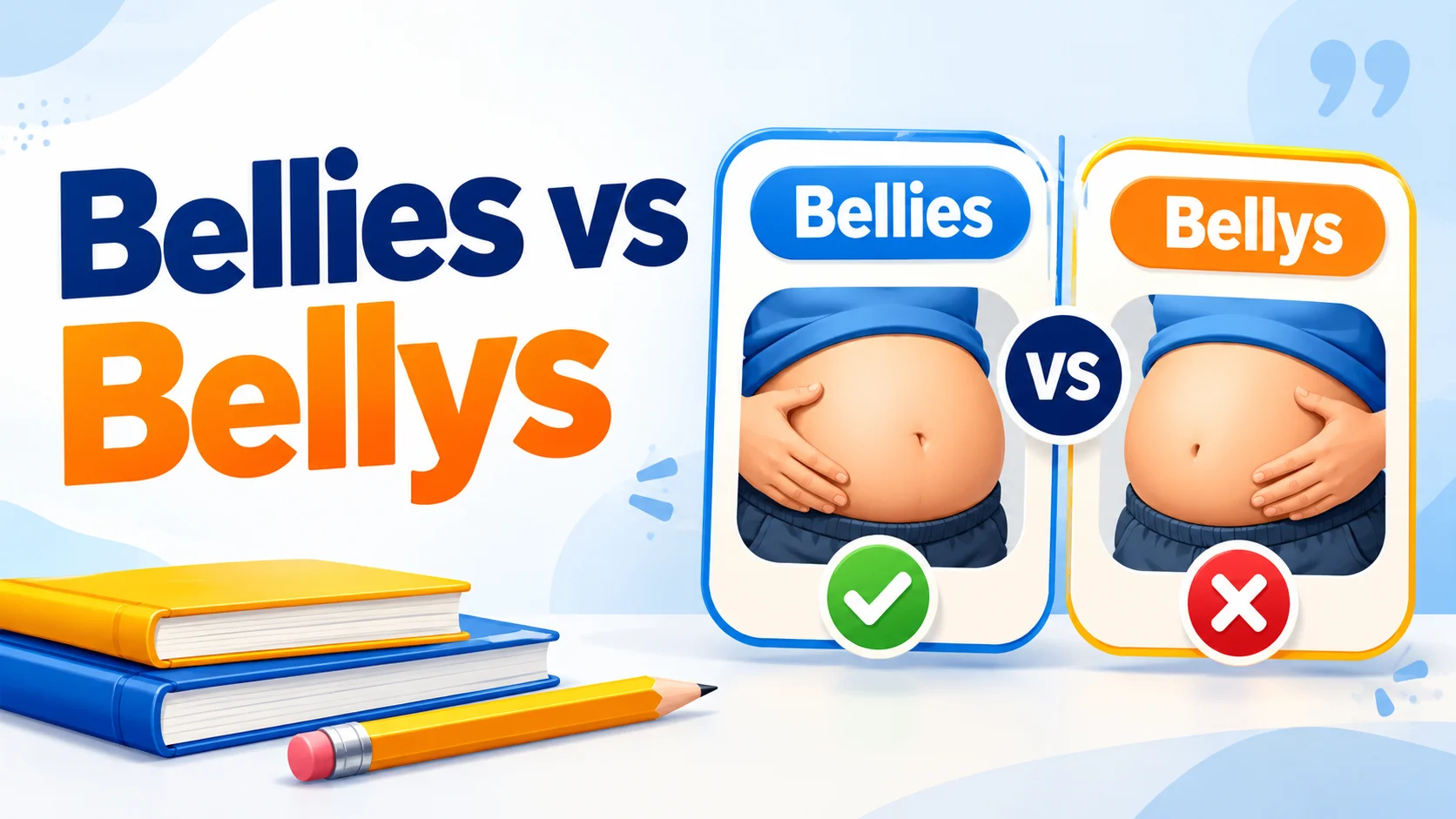
Bellies vs Bellys is a spelling question with a surprisingly useful grammar lesson behind it. If you are wondering how to write the plural of belly, the correct form is bellies. The spelling bellys is not the standard plural form. The reason is a common English plural rule: when a noun ends in a consonant followed by y, the y usually changes to i and -es is added. Therefore, the belly becomes bellies, just as babies become babies and cities become cities.
This small spelling change becomes easier once you understand what happens immediately before the final y. In the belly, the letter before y is l, a consonant. That puts the word into the consonant-plus-y pattern. However, English has another pattern that looks similar: words ending in a vowel + y usually keep the y and simply take -s. That is why we write boy → boys and key → keys, but belly → bellies. Knowing the difference is more useful than memorizing one word.
This guide explains why bellies is correct, what belly and bellies mean, how the plural rule works, when the y stays unchanged, and which mistakes commonly cause confusion. You will also see practical examples for everyday, school, and professional writing. Standard dictionaries such as Merriam-Webster list bellies as the plural of belly, while Cambridge defines belly as an informal word for the front part of the body and also for a rounded or curved part of an object.
Bellies vs Bellys: The Quick Answer
Bellies is correct. Bellys is incorrect as the standard plural spelling of belly.
| Form | Correct? | Use | Example |
| belly | Yes | Singular | The baby has a round belly. |
| bellies | Yes | Plural | The babies have round bellies. |
| bellys | No | Nonstandard spelling | Avoid this spelling in standard English. |
The important transformation is:
belly → bellies
You do not simply add -s. The final y changes to ie, and then the plural ending -s is added.
Merriam-Webster explicitly gives bellies as the plural of belly, providing a reliable dictionary confirmation of the standard spelling.
Why “Bellys” Looks Tempting
Bellys looks logical if you assume that every noun forms its plural by adding -s. That is often true:
- book → books
- car → cars
- table → tables
But English plural spelling has several patterns. Words ending in consonant + y are one of the important cases where the spelling of the base word changes.
That is why the safest approach is not to ask, “Do I just add s?” Instead, look at the letters immediately before the final y.
Why Is “Bellies” the Correct Plural of “Belly”?
The spelling follows the standard plural pattern for nouns ending in consonant + y.
The basic formula is:
consonant + y → change y to i + add es
For belly:
belly → bell + ies → bellies
The pronunciation does not require you to memorize a completely new word. The spelling changes because English uses this established plural convention.
The British Council explains the same general rule: when a noun ends in a consonant and -y, its plural is formed with -ies.
The Consonant + Y Rule
Here are several familiar examples:
| Singular | Plural | What changes? |
| baby | babies | y → ies |
| city | cities | y → ies |
| family | families | y → ies |
| story | stories | y → ies |
| party | parties | y → ies |
| body | bodies | y → ies |
| hobby | hobbies | y → ies |
| belly | bellies | y → ies |
The pattern is consistent enough to be a useful spelling shortcut.
Why the Rule Applies to “Belly”
Look at the ending:
bell-y
The letter immediately before y is l. Since l is a consonant, belly follows the consonant + y plural pattern.
So:
one belly → two bellies
Not:
one belly → two bellys
When Does a Word Ending in “Y” Keep the Y?
This is where many learners make their second mistake. It would be wrong to conclude that every word ending in y changes to ies.
The key is the letter immediately before the y.
When a word ends in a vowel + y, the plural normally keeps the y and adds -s.
For example:
- boy → boys
- toy → toys
- key → keys
- day → days
- journey → journeys
- monkey → monkeys
Compare these with:
- baby → babies
- city → cities
- story → stories
- body → bodies
- belly → bellies
Belly vs Boy: The Easy Comparison
The difference becomes obvious when you put the two patterns side by side.
| Word | Letter before Y | Pattern | Plural |
| belly | l | consonant + y | bellies |
| baby | b | consonant + y | babies |
| city | t | consonant + y | cities |
| boy | o | vowel + y | boys |
| toy | o | vowel + y | toys |
| key | e | vowel + y | keys |
This is the most useful distinction to remember.
Don’t focus only on the final Y. Check the letter immediately before it.
There are exceptions to English spelling rules, so the pattern should be treated as a reliable guideline rather than a universal law. Merriam-Webster notes the consonant + y versus vowel + y distinction while also discussing exceptions and special cases.
What Does “Belly” Mean?
Belly is an everyday, informal English noun. It commonly refers to the front part of the body around the stomach or abdomen. Cambridge defines it as the front part of the body between the chest and legs, and Merriam-Webster includes meanings involving the abdomen, stomach, and the underside of an animal.
For example:
- The child has a full belly.
- She felt movement in her belly.
- The dog was lying on its belly.
In more formal or medical contexts, the abdomen may be preferred. Belly is common in ordinary conversation and informal writing.
Belly When Talking About Animals
The word can also refer to the underside or abdominal area of an animal.
Examples include:
- The puppy rolled onto its belly.
- The cat was sleeping with its belly exposed.
- The fish has a pale belly.
Merriam-Webster specifically includes the undersurface of an animal’s body among the meanings of belly.
Belly as a Description of Objects
Belly is not limited to living things. It can describe a rounded, bulging, or curved part of an object.
For example:
- The belly of the aircraft was visible from below.
- The boat has a rounded belly.
- The container has a wide belly.
Cambridge also records this object-related meaning, including the rounded or curved part of something.
Figurative Uses of “Belly”
The word appears in several idiomatic expressions. For instance, “go belly up” is an informal expression meaning that something has failed or gone badly.
Belly can therefore carry meanings beyond literal anatomy. Context tells the reader which meaning is intended.
What Does “Bellies” Mean?
Bellies is simply the plural form of belly. It means more than one belly, although the exact meaning depends on what is being discussed.
For example:
- The children had full bellies after dinner.
- The puppies had round bellies.
- The aircraft’s lower bellies were inspected.
Merriam-Webster’s entry for bellies identifies it as the plural of belly.
Bellies Referring to People
When talking about multiple people, bellies can describe their stomach or abdominal area:
The children laughed as their bellies shook with laughter.
Bellies Referring to Animals
The same plural can be used for animals:
The kittens slept on their bellies.
Bellies Referring to Objects
The word can also be plural when several objects have rounded or curved undersides:
The aircraft’s bellies were inspected before the demonstration.
The meaning changes with the noun being described, but the spelling remains bellies.
Bellies vs Bellys: Examples in Real Sentences
Seeing the word in context is often more useful than memorizing a rule.
| Incorrect | Correct | Reason |
| The babies have round bellies. | The babies have round bellies. | Consonant + y changes to ies. |
| Their bellies were full. | Their bellies were full. | Bellies is the standard plural. |
| The puppies showed their bellies. | The puppies showed their bellies. | Belly → bellies. |
| Three bellies were visible. | Three bellies were visible. | The standard plural is bellies. |
Everyday Writing
After lunch, the children had full bellies.
School Writing
The animals rested on their bellies after running.
Professional Writing
The lower bellies of the aircraft were inspected for visible damage.
The word itself is not limited to casual writing. What changes with context is often the choice between belly and a more formal term such as abdomen or underside.
Common Mistakes With “Bellies”
Mistake 1: Adding Only “S”
The most direct error is:
belly + s = bellys
That looks logical, but it ignores the consonant + y plural rule.
Correct:
belly → bellies
Mistake 2: Assuming Every Y Becomes IES
This is the opposite mistake.
You should not write:
- boys → boies
- keys → keys
- toys → toies
These words end in a vowel + y, so they normally take -s.
Mistake 3: Confusing Singular and Plural
Use belly for one:
The baby has a round belly.
Use bellies for more than one:
The babies have round bellies.
The spelling and the surrounding grammar should agree with the number being discussed.
Mistake 4: Treating Informal Writing as an Exception
A spelling mistake does not become standard simply because it appears in a text message, comment, or social-media post.
You may encounter bellies online because people make typing and spelling mistakes. That does not make it the accepted plural form.
Does British or American English Use “Bellies”?
Yes. Bellies is the standard plural spelling in both British and American English.
There is no British-versus-American spelling difference comparable to words such as colour/color or centre/center.
| Feature | British English | American English |
| Singular | belly | belly |
| Plural | bellies | bellies |
| Incorrect standard form | bellys | bellys |
| Plural rule | consonant + y → ies | consonant + y → ies |
Cambridge provides British and American pronunciation and usage information for belly, while Merriam-Webster lists bellies as its plural.
So if you are writing for a British, American, Canadian, Australian, or other standard English audience, bellies is the safe spelling.
Words That Follow the Same Pattern as “Belly”
Learning a small group of related words makes the spelling rule much easier to remember.
| Singular | Correct plural |
| baby | babies |
| body | bodies |
| city | cities |
| country | countries |
| family | families |
| hobby | hobbies |
| lady | ladies |
| party | parties |
| story | stories |
| tummy | tummies |
| belly | bellies |
The word tummy is particularly useful as a comparison because it has the same spelling pattern: tummy → tummies. Merriam-Webster lists tummies as the plural of tummy.
A Useful Memory Pattern
Think:
baby → babies
body → bodies
belly → bellies
If you remember those three together, the spelling of bellies becomes much easier.
Words That Do Not Follow the “Y → IES” Pattern
Now compare them with words ending in vowel + y:
| Singular | Plural |
| boy | boys |
| day | days |
| key | keys |
| monkey | monkeys |
| toy | toys |
| journey | journeys |
This contrast matters because simply memorizing “words ending in y become ies” creates more errors than it solves.
The better rule is:
Consonant + y → usually ies
Vowel + y → usually s
English contains exceptions, particularly with proper names and some less-common words, so a dictionary is the best check when a word looks unfamiliar. Merriam-Webster specifically discusses these exceptions in its explanation of noun plurals.
Is “Bellies” a Noun or a Verb?
Most readers encounter bellies as the plural noun form of belly.
However, belly can also function as a verb. Merriam-Webster records belly as a verb meaning to swell or bulge outward, with forms such as bellied and bellying.
This distinction is useful because English words can sometimes have several grammatical roles.
For spelling the plural noun, however, there is no ambiguity:
belly → bellies
How to Choose the Right Form Quickly
If you are proofreading an email, assignment, article, caption, or school exercise and stop at belly/bellies, use this quick process.
Step 1: Decide Whether the Word Is Singular or Plural
One:
belly
More than one:
bellies
Step 2: Look at the Ending
The word ends in consonant + y:
ll + y
More precisely, the final letter before y is l, a consonant.
Step 3: Apply the Plural Pattern
Change:
y → ies
Therefore:
belly → bellies
Step 4: Check the Sentence
Make sure the surrounding words agree.
One belly is visible.
Several bellies are visible.
This four-step check is faster and more reliable than trying to remember whether the belly “looks right.”
Why Dictionaries Are Useful for Spelling Questions
Grammar rules are excellent for explaining why a word is spelled a certain way, but dictionaries are useful for confirming whether a particular form is actually established.
For the belly, the evidence is straightforward. Merriam-Webster explicitly gives the plural as bellies, while Cambridge provides the word’s standard meanings and usage information.
This matters because English contains exceptions. A rule can tell you what normally happens, but an authoritative dictionary can settle cases where a word has an unusual plural or competing form.
A Practical Proofreading Habit
When you are unsure about an uncommon plural:
- Apply the normal spelling rule.
- Check whether the resulting form looks plausible.
- Confirm it in a reputable dictionary if the word matters to your writing.
- Use the dictionary’s listed form rather than relying on search-engine frequency alone.
For the belly, the result is clear: bellies.
Bellies vs Bellys: Quick Reference Checklist
Use this checklist whenever you need the correct form.
- Singular: belly
- Plural: bellies
- Standard spelling: bellies
- Nonstandard spelling: bellys
- Relevant rule: consonant + y → ies
- Similar example: baby → babies
- Another example: body → bodies
- Important contrast: boy → boys
- British English: bellies
- American English: bellies
Remember: The question is not simply whether a word ends in y. The important question is what comes immediately before the y.
Conclusion
When choosing between bellies vs bellys, there is a clear winner: bellies is the standard and correct plural of belly. The spelling follows a broader English pattern in which a noun ending in consonant + y changes the y to i and takes -es. That gives us belly → bellies, just as baby → babies and body → bodies. The important exception to remember is that words ending in vowel + y, such as boy and key, normally keep the y and add only -s. One final actionable tip: whenever a plural ending in y looks uncertain, check the letter immediately before the y. A common mistake to avoid is assuming every word ending in y follows the same pattern. For the belly, the answer is simple: belly → bellies.
Frequently Asked Questions
Q1. Is “bellies” the correct spelling?
Yes. Bellies is the standard plural spelling of belly. The word ends in a consonant followed by y, so the plural normally changes y to i and adds -es. Major dictionaries, including Merriam-Webster, explicitly list bellies as the plural.
Q2. Why is “bellys” incorrect?
Bellys incorrectly treats belly as a word that simply takes -s. Because the final y follows a consonant, standard English changes the y to i and adds -es. The correct transformation is therefore belly → bellies, not bellys.
Q3. What is the singular form of “bellies”?
The singular form is belly. For example, “The child has a small belly” refers to one, while “The children have small bellies” refers to more than one. The change from singular to plural also requires the appropriate grammatical agreement elsewhere in the sentence.
Q4. Do all words ending in “y” change to “ies”?
No. Words ending in a vowel + y generally keep the y and add -s. For example, boys become boys and keys become keys. Words ending in a consonant + y, such as belly, usually change to -ies.
Q5. Is “bellies” used in both British and American English?
Yes. Bellies is the standard plural spelling in both major varieties of English. The difference between British and American English does not affect this word. If you are writing for either audience, use belly for singular and bellies for plural.