

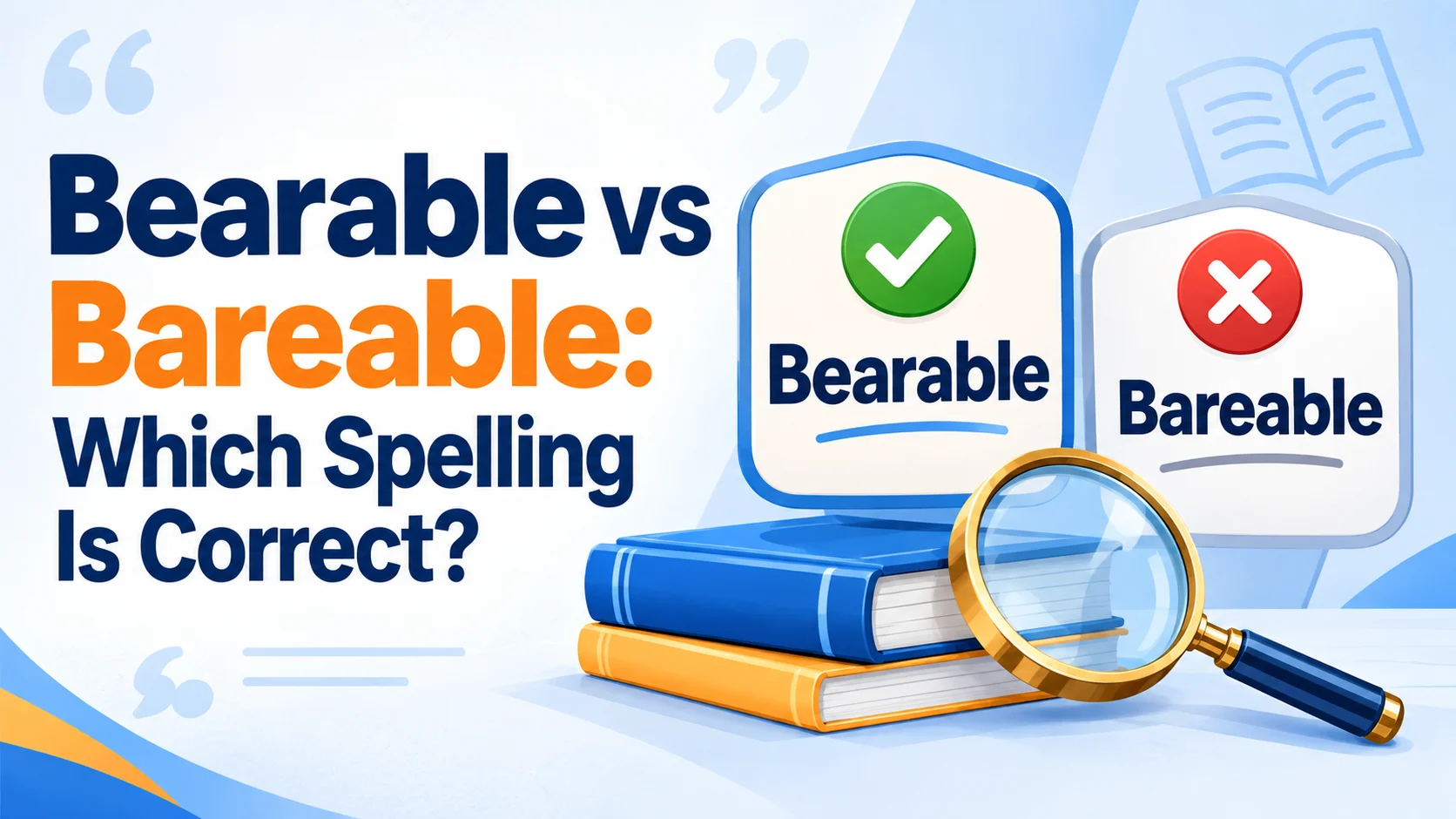
Bearable vs. bareable is a surprisingly common spelling confusion because the two forms sound alike in many varieties of English. The correct spelling is bearable when you mean something that can be endured, tolerated, or dealt with. The word comes from bear, in the sense of “to endure,” plus the suffix -able. Major dictionaries, including Merriam-Webster and Cambridge, recognize bearable as the standard adjective.
The confusion becomes easier to understand once you separate bear from bare. Bear can mean to endure or tolerate something, while bare generally describes something uncovered, exposed, empty, or reduced to the minimum. Because bear and bare are pronounced alike in many English accents, it is easy to choose the wrong spelling when writing. The key is to focus on the meaning behind the word, not just its sound.
In this guide, you will learn exactly when to use bearable, why bareable is normally considered incorrect for this meaning, and how the word is formed. You will also see practical examples involving pain, weather, work, emotions, and everyday situations, along with comparisons such as bearable vs. tolerable, the important phrase barely bearable, and simple techniques for remembering the spelling.
Bearable vs. Bareable: The Quick Answer
If you are deciding between bearable and bareable, choose bearable when you mean “able to be endured” or “tolerable.”
| Word | Standard spelling for this meaning? | Meaning | Example |
| Bearable | Yes | Able to be endured or tolerated | The heat was bearable in the evening. |
| Bareable | No | Not the standard spelling for “able to be endured” | ❌ The heat was bareable. |
| Bare | Yes, but different meaning | Uncovered, exposed, empty, or minimal | The walls were bare. |
| Barely bearable | Yes | Only just tolerable | The noise was barely bearable. |
Merriam-Webster defines bearable as “capable of being borne,” while Cambridge explains it as describing an unpleasant situation that can be accepted or dealt with.
Quick rule: If you mean “able to bear,” spell it bearable.
For example:
- The pain is bearable.
- The workload is bearable.
- The temperature is bearable.
- The wait became more bearable after we found somewhere to sit.
What Does “Bearable” Mean?
Bearable Definition
Bearable is an adjective meaning capable of being endured, tolerated, accepted, or dealt with.
It usually describes something unpleasant or difficult that has not become impossible to tolerate.
For example:
The long journey was uncomfortable but bearable.
The journey was not pleasant, but the speaker could tolerate it.
The word can apply to both physical and nonphysical experiences:
- bearable pain
- bearable heat
- bearable noise
- bearable stress
- bearable workload
- bearable disappointment
- bearable living conditions
Cambridge lists tolerable and supportable among related meanings and gives unbearable as the opposite.
Bearable as an Adjective
Because bearable is an adjective, it commonly appears before a noun or after a linking verb.
Before a noun:
- a bearable level of noise
- a bearable temperature
- a bearable workload
After a linking verb:
- The pain is bearable.
- The situation became bearable.
- The room was finally bearable.
This grammatical point matters because the related form bearably serves a different function.
Bearable vs. Bearably
Bearable is an adjective:
The weather was bearable.
Bearably is an adverb meaning “in a way that is bearable.”
The weather remained bearably warm.
Cambridge specifically identifies bearably as an adverb and gives examples involving conditions that remain tolerable.
Is “Bareable” a Correct Word?
Why “Bareable” Is Usually Incorrect
If you write bearable when you mean “able to be endured,” you are using the wrong root.
The intended word comes from:
bear + -able = bearable
Here, bear means to endure or tolerate.
By contrast, bare has meanings related to being uncovered, exposed, empty, or having only the minimum necessary. Cambridge gives examples such as bare feet, bare floorboards, and a bare room.
So these two words may sound similar, but their meanings are unrelated in the context of bearable.
Why “Bareable” Looks Like It Should Be Correct
The mistake is understandable.
English contains many words formed by adding -able to a base word:
- read → readable
- understand → understandable
- accept → acceptable
- enjoy → enjoyable
A learner may naturally look at bare and assume:
bare + able = bareable
The problem is that English word formation depends on the correct root and established usage, not simply on whether adding a suffix looks possible.
When the meaning is “able to be endured,” the established word is bearable.
Can “Bareable” Ever Appear in Historical or Specialized Sources?
You may occasionally encounter unusual spellings in old texts, informal writing, names, or nonstandard usage. That does not make bearable the appropriate choice in modern standard English for the meaning “tolerable.”
For schoolwork, professional writing, formal communication, and general-purpose English, use bearable.
Bearable vs. Bareable: What Is the Difference?
The easiest way to understand the distinction is to look at the roots.
Bearable Means “Able to Be Endured”
The relevant meaning of bear is “to endure” or “to tolerate.”
Consider:
I can bear the noise.
Turn that into an adjective:
The noise is bearable.
The relationship is direct:
bear something → something is bearable
That connection explains the spelling.
Bare Means “Uncovered” or “Empty”
Bare has a completely different semantic family.
It can mean:
- not covered
- without clothing
- exposed
- empty
- containing only the minimum
Examples include:
He walked across the floor with bare feet.
The room had bare walls.
They had only the bare essentials.
Cambridge also identifies bare as a verb meaning to remove something covering an object or to expose something.
Why “Bareable” Does Not Mean “Able to Be Endured”
Imagine you want to say:
The noise can be endured.
The root idea is bear, not bare.
So:
bear + able → bearable
not:
bare + able → bareable
The spelling becomes much easier once you identify the intended meaning first.
How “Bearable” Is Formed From “Bear”
The Root Verb “Bear”
The verb bear has several meanings in English. It can refer to carrying, supporting, producing, or enduring.
In bearable, the relevant sense is endure or tolerate.
For example:
She could not bear the constant noise.
From that sense comes:
The noise was barely bearable.
Adding “-able” to Form “Bearable”
The suffix -able commonly helps form adjectives expressing possibility or capability.
In this case:
bear + -able = bearable
The basic idea is:
something that can be borne → something that is bearable
Merriam-Webster records bearable as an adjective and traces its first known use to around 1557.
Bear, Bearing, Borne, and Bearable
The wider word family can be confusing because bear has several grammatical forms.
| Form | Typical function | Example |
| bear | Base verb | I cannot bear the noise. |
| bears | Present-tense verb | She bears the responsibility well. |
| bearing | Present participle/gerund | He is bearing the pressure. |
| bore | Past tense | She bore the difficulty patiently. |
| borne | Past participle in many senses | The cost was borne by the company. |
| bearable | Adjective | The conditions are bearable. |
| bearably | Adverb | The room was bearably warm. |
Not every form is interchangeable. Bearable is specifically the adjective you need when describing something that can be endured.
How to Use “Bearable” Correctly in a Sentence
Bearable for Physical Discomfort
“Bearable” often describes something physically unpleasant but still tolerable.
Examples:
- The headache was painful but bearable.
- The temperature became more bearable after sunset.
- The noise was annoying, but still bearable.
- The discomfort was bearable for a short period.
The word does not necessarily mean “comfortable.” Something can be bearable and unpleasant at the same time.
That distinction is useful. If a chair is uncomfortable but you can sit in it for an hour, you might call it bearable. You would not necessarily call it comfortable.
Bearable for Emotional or Difficult Situations
The word also works with abstract experiences.
- The disappointment was bearable.
- Talking to a friend made the situation more bearable.
- The uncertainty became more bearable once we had a clear plan.
- The long separation was difficult but bearable.
Here, bearable refers to emotional or psychological difficulty without requiring a physical sensation.
Bearable for Work, School, and Daily Life
Everyday responsibilities can also be described as bearable.
The new schedule is demanding but bearable.
Breaking the assignment into smaller tasks made the workload more bearable.
The commute is bearable when traffic is light.
Notice that the word expresses tolerability, not necessarily quality. A bearable workload is not automatically a good workload.
Bearable for Conditions and Environments
Environmental conditions are another common use.
- The afternoon heat was bearable.
- The room became bearable after the windows were opened.
- The noise level was no longer bearable.
- The cold was bearable with suitable clothing.
The construction is particularly natural with more bearable:
The weather became more bearable in the evening.
Common Phrases and Collocations With “Bearable”
Some combinations sound especially natural because they reflect common ways English speakers discuss difficult experiences.
More Bearable
More bearable means easier to tolerate than before.
A short break made the workload more bearable.
Barely Bearable
This phrase deserves special attention because it is one of the biggest sources of the spelling mistake.
Barely bearable means only just tolerable.
The heat was barely bearable.
Here, barely and bearable are two separate words.
Do not combine or alter bearable into bareable.
Perfectly Bearable
This means something is completely tolerable despite perhaps being less than ideal.
The room was small, but it was perfectly bearable for one night.
Make Something More Bearable
This is a very common construction:
Music made the long wait more bearable.
A clear schedule made the workload more bearable.
The construction is useful because it highlights a change: something difficult becomes easier to tolerate.
Become Bearable
Use becomes when a situation changes from intolerable or difficult to something that can be managed.
After the noise stopped, the room became bearable again.
Almost Unbearable
This phrase expresses the opposite end of the scale.
The delay was almost unbearable.
It is useful to understand the progression:
comfortable → bearable → barely bearable → almost unbearable → unbearable
The boundaries are subjective, but the scale helps explain how English speakers use these expressions.
Bearable vs. Unbearable
What Does “Unbearable” Mean?
Unbearable means too difficult, painful, unpleasant, or distressing to endure.
The prefix un- reverses the meaning:
- bearable = can be endured
- unbearable = cannot reasonably be endured
Cambridge lists unbearable as the opposite of bearable.
Bearable and Unbearable on a Continuum
These words are not always absolute in everyday conversation.
Something can become:
- slightly more bearable
- reasonably bearable
- barely bearable
- almost unbearable
- completely unbearable
For example, a noisy environment might be bearable for ten minutes but unbearable after several hours.
That is why bearable often depends on circumstances, duration, intensity, and the person’s tolerance.
Examples of Bearable vs. Unbearable
| Situation | Bearable | Unbearable |
| Heat | The heat is unpleasant but bearable. | The heat is unbearable without relief. |
| Noise | The noise is bearable for an hour. | The constant noise became unbearable. |
| Workload | The workload is heavy but bearable. | The workload has become unbearable. |
| Waiting | The delay is bearable with something to do. | The uncertainty became unbearable. |
Bearable vs. Tolerable, Endurable, Manageable, and Acceptable
These words overlap, but they are not perfect substitutes.
Bearable vs. Tolerable
Tolerable is probably the closest everyday synonym.
The heat is bearable.
The heat is tolerable.
Both suggest that the heat can be endured.
However, tolerable can sometimes sound more formal or evaluative, while bearable often emphasizes the person’s experience of enduring something unpleasant.
Bearable vs. Endurable
Endurable is closely related to bearable and is grammatically valid.
The pain was endurable.
The pain was bearable.
The second sentence generally sounds more natural in ordinary conversation.
Bearable vs. Manageable
Manageable focuses on the ability to handle or control something.
The workload is manageable.
Bearable focuses more on whether the experience can be tolerated.
The workload is bearable.
A workload might be manageable because you have enough time and resources, while bearable emphasizes that the burden itself is tolerable.
Bearable vs. Acceptable
Acceptable means satisfactory or permitted according to a standard.
The quality is acceptable.
Bearable means tolerable.
Something can be bearable without being acceptable:
The service was poor, but the delay was bearable.
Merriam-Webster lists several related words, including endurable, tolerable, sustainable, acceptable, and manageable, but these differ in nuance and context.
Bearable vs. Barely Bearable: An Important Spelling Trap
What “Barely Bearable” Actually Means
Barely is an adverb meaning “only just” or “by a very small margin.”
So:
The noise was barely bearable.
means:
The noise could only just be tolerated.
It does not mean that the word bearable should be spelled bareable.
Why “Bareable” and “Barely Bearable” Get Mixed Up
The sequence barely bearable contains both bare and bear visually:
barely + bearable
When someone remembers the phrase by sound rather than spelling, it is easy to turn bearable into bareable.
The solution is simple: treat the words separately.
- barely = only just
- bearable = capable of being endured
Common Mistakes With Bearable
Writing “Bareable” Instead of “Bearable”
Incorrect:
The workload is bearable.
Correct:
The workload is bearable.
The intended meaning is “the workload can be endured,” so the root must be bare.
Confusing Bear and Bare
Use bear when the meaning involves enduring, carrying, or supporting.
I cannot bear the noise.
Use bare when the meaning involves being uncovered or exposed.
The floor was bare.
Confusing Bearable and Bearing
These forms serve different grammatical purposes.
The pressure is bearable.
Here, bearable describes the pressure.
She is bearing the pressure well.
Here, bearing is part of the verb phrase.
Confusing Bearable With “Baring”
Baring comes from bare, meaning exposing something.
He was baring his teeth.
It has nothing to do with whether something is tolerable.
Compare:
- bearable → able to be endured
- baring → exposing or revealing
- bare → uncovered or exposed
- bearing → carrying/enduring or referring to another meaning of “bearing”
These distinctions become much easier when you identify the root word.
Easy Ways to Remember the Correct Spelling
The “Bear the Pain” Memory Trick
Think:
You bear pain, so pain is bearable.
That is the most useful memory connection because it links the spelling directly to the meaning.
bear → bearable
The “Bear → Bearable” Word-Family Trick
Do not memorize bearable as an isolated spelling.
Memorize the relationship:
bear + able = bearable
When you need the adjective, keep bear intact in your mind.
The “Bare Means Uncovered” Trick
Connect bare with familiar expressions:
- bare feet
- bare walls
- bare hands
- bare floor
- bare minimum
None of these involve endurance.
If your sentence means “able to be tolerated,” move away from bare and back to bear.
Bearable in Different Levels of Formal Writing
Everyday Conversation
“Bearable” is completely natural in ordinary conversation:
The traffic wasn’t great, but it was bearable.
The weather is finally bearable.
Academic and Professional Writing
It can also work in formal contexts when the meaning genuinely calls for it:
The revised schedule created a more bearable workload.
However, depending on the subject, a more precise term may be better.
For example, manageable, sustainable, or tolerable might communicate a specific professional meaning more clearly.
Formal Alternatives When “Bearable” Sounds Too Casual
| If you mean… | Consider… |
| Can be endured | Bearable |
| Can be tolerated | Tolerable |
| Can be endured, formal | Endurable |
| Can be handled | Manageable |
| Can continue over time | Sustainable |
| Meets an expected standard | Acceptable |
The best choice depends on what you are actually trying to communicate. Replacing every instance of bearable with a more formal synonym can make writing less precise rather than more professional.
Pronunciation of “Bearable” and Why It Causes Confusion
How “Bear” Is Pronounced
In many standard varieties of English, bear and bear are pronounced alike or very similarly.
Cambridge gives bearable as /ˈber.ə.bəl/ in US English and /ˈbeə.rə.bəl/ in UK English.
Why “Bear” and “Bare” Sound the Same
Words that share pronunciation but differ in spelling and meaning are commonly called homophones.
That is why hearing bearable does not necessarily tell you whether the middle of the word should be spelled bear or bare.
Writing requires you to recover the meaning and word family, not merely reproduce the sound.
Other Common Bear/Bare Confusions
The same distinction appears in related words:
- bear the responsibility
- bare the facts
- bearing the responsibility
- baring the facts
These pairs demonstrate an important English spelling lesson: pronunciation alone is not always enough to determine spelling.
Quick Bearable vs. Bearable Usage Test
When you are unsure, use this four-step test:
- What does the sentence mean?
- Are you talking about enduring or tolerating something?
- If yes, connect the word to bear.
- Add -able: bearable.
Practice
| Sentence | Correct answer |
| The noise was difficult but ___ . | bearable |
| The walls were completely ___ . | bare |
| The heat became more ___ after sunset. | bearable |
| She walked across the floor with ___ feet. | bare |
| The delay was ___ bearable. | barely |
| The workload was heavy but ___ . | bearable |
The important point is that bare itself is a perfectly correct word. The mistake happens when it is substituted for bear in bearable.
Bearable vs. Bareable: Correct and Incorrect Examples
Correct Examples
- The pain was uncomfortable but bearable.
- The weather became more bearable after sunset.
- A clear schedule made the workload bearable.
- The noise was barely bearable.
- Their support made the difficult period more bearable.
- The room was small but bearable for a short stay.
- The delay was bearable because we had plenty to do.
Incorrect Examples
These sentences use bareable where bearable is intended:
- ❌ The pain was bareable.
- ❌ The heat was barely bareable.
- ❌ The workload became more bareable.
- ❌ The noise wasn’t bareable anymore.
Correct them to:
- ✓ The pain was bearable.
- ✓ The heat was barely bearable.
- ✓ The workload became more bearable.
- ✓ The noise wasn’t bearable anymore.
Before-and-After Examples
| Incorrect | Correct |
| The heat was bearable. | The heat was bearable. |
| The pain became more bearable. | The pain became more bearable. |
| It was barely bearable. | It was barely bearable. |
| The workload is not bearable. | The workload is not bearable. |
Conclusion:
The correct spelling is bearable when you mean something that can be endured, tolerated, or dealt with. The reason is straightforward: the word comes from bear, meaning “to endure,” followed by -able. Bare belongs to a different word family involving things that are uncovered, exposed, empty, or minimal. Although bear and bare can sound identical, their meanings and spellings are not interchangeable. One final actionable tip: when you hesitate, replace bearable with “able to be endured.” If that meaning fits, choose bearable. A common mistake to avoid is letting the spelling of bare influence a word that actually comes from bear. Once you connect the adjective to its root, the spelling becomes much easier to remember—and phrases such as barely bearable stop being confusing.
Frequently Asked Questions
Q1. Is “bearable” the correct spelling?
Yes. Bearable is the standard spelling when you mean “able to be endured or tolerated.” It is formed from the verb bear, in its sense of enduring something, plus -able. Bareable should not be used for this meaning in standard modern English.
Q2. Why do people spell bearable as “bareable”?
The main reason is pronunciation. Bear and bare sound the same or nearly the same in many English varieties, so spelling from sound alone can lead to the wrong choice. The familiar word bare also makes “bareable” look visually plausible, even though the intended root is bear.
Q3. Is “bareable” a real English word?
For ordinary modern English, bearable is not the standard spelling for “able to be endured.” If you encounter the form somewhere, context may explain its appearance, but standard writing should use bearable when referring to something tolerable or endurable.
Q4. What is the difference between “bearable” and “barely bearable”?
Bearable means something can be endured. Barely bearable means it can be endured only just. For example, “The heat was bearable” suggests reasonable tolerance, while “The heat was barely bearable” indicates that tolerance was close to its limit.
Q5. What is an easy way to remember “bearable”?
Connect the spelling to the verb bear: “I can bear the difficulty, so the difficulty is bearable.” Then reserve bare for meanings involving something uncovered or exposed, such as bare feet, bare walls, or the bare minimum.