

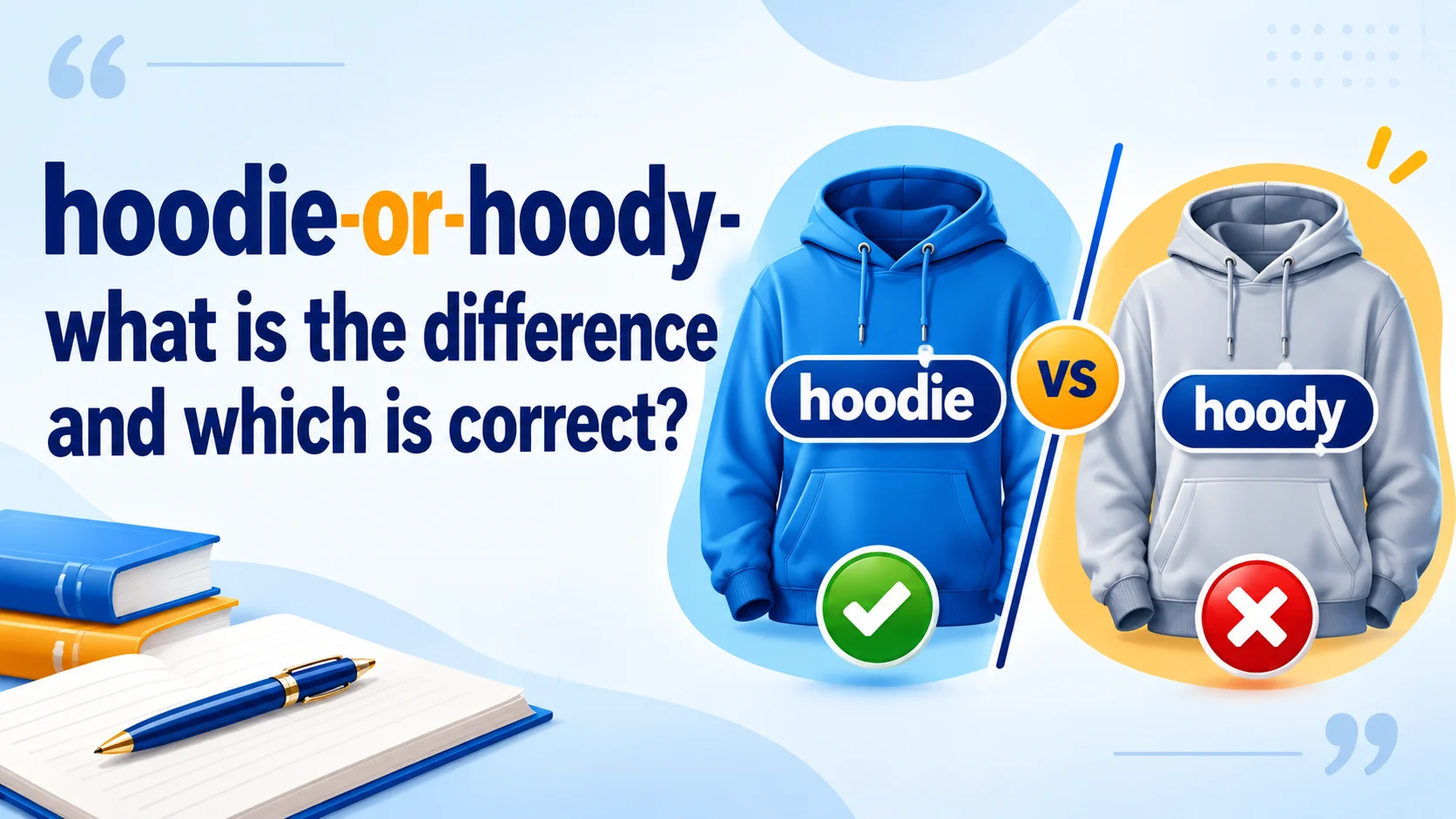
Hoodie or hoody—which spelling should you use? If you have ever typed one of these words and wondered whether the other is technically correct, you are not alone. The good news is that the difference is mostly spelling, not meaning. A hoodie is generally a sweatshirt or jacket with an attached hood, while hoody is a recognized alternative spelling. Major dictionaries, including Merriam-Webster and Cambridge, list hoodie as the main form and hoody as a variant or less common form.
For most readers, writers, students, shoppers, and businesses, “hoodie” is the safest choice. It is the spelling you are most likely to encounter in contemporary fashion writing, product descriptions, everyday conversation, and general English. That does not mean hoody is automatically a spelling mistake. Oxford Learner’s Dictionaries, for example, lists hoody alongside hoodie, while Collins describes hoody as an informal variant spelling.
So why do both forms exist, and when might hoody be appropriate? This guide explains the meaning of each word, their history, pronunciation, grammar, regional usage, relationship to sweatshirts and jackets, common mistakes, and practical situations where one spelling makes more sense than the other. By the end, you will have a simple rule for choosing the right form without second-guessing yourself.
Hoodie vs. Hoody: The Quick Answer
If you only need the answer for a sentence, school assignment, website, or product description, use a hoodie.
Both hoodie and hoody can refer to a hooded sweatshirt or similar hooded garment. The main difference is that hoodie is the established, more common spelling, while hoody is an alternative form that appears less frequently.
Merriam-Webster defines hoodie as a hooded sweatshirt and identifies hoody as a variant or less common spelling. Cambridge likewise gives hoodie as the main entry and notes hoody as an alternative.
The easiest rule to remember
When you are unsure, write “hoodie.”
That recommendation is especially useful in formal writing, educational work, online publishing, fashion content, and general communication, where the most widely recognized form is usually preferable.
| Question | Answer |
| Which spelling is standard? | Hoodie |
| Is “hoody” a real spelling? | Yes |
| Is “hoody” a different garment? | Usually no |
| Do they normally have different pronunciations? | No |
| Which should you use in most writing? | Hoodie |
| What is the plural of hoodie? | Hoodies |
| Is “hoody” automatically wrong? | No |
| Should a brand’s unusual spelling be changed? | Usually no; follow its official wording |
What Is a Hoodie?
A hoodie is a casual upper-body garment with an attached hood. It is commonly made from sweatshirt fabric, cotton, fleece, or a blended material.
Oxford Learner’s Dictionaries defines hoodie as a jacket or sweatshirt with a hood, while Cambridge describes it as a sweatshirt with a hood that can cover the head.
The exact construction can vary. A hoodie may be:
- A pullover
- A zip-up garment
- Lightweight or heavyweight
- Fleece-lined or unlined
- Plain or decorated with graphics
- Loose-fitting or relatively fitted
- Designed primarily for casual wear, sportswear, or streetwear
The important feature is the hooded design, not a particular color, fabric, or brand.
Hoodie Meaning in Everyday English
In ordinary conversation, hoodie usually means a hooded sweatshirt or casual hooded top.
For example:
- “I bought a new black hoodie.”
- “She wore a hoodie on the cold morning.”
- “This hoodie has a zipper.”
- “My favorite hoodie is getting old.”
The word is informal, but it is also completely established in modern English. You do not need to replace it with a more complicated phrase simply because you are writing for a broad audience.
Is a Hoodie the Same as a Hooded Sweatshirt?
Not necessarily in every technical retail context, but the terms overlap heavily.
Hooded sweatshirt is the more descriptive phrase. Hoodie is the shorter everyday term.
For example, a clothing manufacturer might describe a product as a “cotton hooded sweatshirt,” while a customer would naturally say, “I like this hoodie.”
What Is a Hoody?
Hoody can also mean a hooded sweatshirt or hooded garment. The important point is that it is generally an alternative spelling of hoodie rather than the name of a separate garment.
Merriam-Webster lists hoody as a less common spelling of hoodie. Collins similarly defines it as an informal variant spelling.
That means this sentence:
“He bought a grey hoody.”
can communicate essentially the same clothing-related meaning as:
“He bought a grey hoodie.”
The second version is simply the more conventional choice for most modern English contexts.
Why Does “Hoody” Exist?
English spelling does not always have a single perfectly logical route for forming informal words. Speakers and writers sometimes create competing spellings based on pronunciation, word formation, regional habits, or analogy with other words.
The pronunciation of hoodie is roughly “HOO-dee.” Someone unfamiliar with the conventional spelling may naturally choose hoody because the spelling appears to match the sound.
But language does not work like a mathematical formula. A word can have a pronunciation that seems to suggest one spelling while established usage favors another.
Is “Hoody” Incorrect?
Calling hoody simply “wrong” is too strong.
Several reputable dictionaries recognize it as a variant. Cambridge lists hoody alongside hoodie, and Oxford Learner’s Dictionaries also gives hoody as an alternative.
The more useful distinction is:
- Hoodie: preferred and more widely recognized.
- Hoody: legitimate variant, but less common.
This distinction helps writers avoid two opposite mistakes: treating hoody as completely invalid or pretending that both spellings are equally common.
Hoodie vs. Hoody: Is There Actually a Difference?
For the clothing’s meaning, there is usually no meaningful difference in the garment itself.
A retailer selling a hooded sweatshirt could call it a hoodie, while another person might call a similar garment a hoody. The spelling does not normally tell you whether the item has a zipper, kangaroo pocket, fleece lining, or particular fabric.
Same Garment, Different Spelling
Consider these two sentences:
- “I left my hoodie at school.”
- “I left my hoody at school.”
If hoody is being used in its clothing sense, both sentences communicate essentially the same idea.
The difference is therefore primarily orthographic—that is, related to how the word is written.
Do They Have Different Pronunciations?
In the clothing sense, they are generally pronounced alike: approximately HOO-dee.
Cambridge gives the pronunciation as /ˈhʊd.i/ in its English dictionary entry.
So changing the spelling from hoodie to hoody does not normally mean changing how you say the word.
Are They Different Types of Clothing?
No—not simply because of the spelling.
If a clothing website uses hoody instead of hoodie, you should not assume it is describing a special type of sweatshirt.
Instead, check the actual product specifications. Fabric, construction, closure, fit, hood design, and intended use tell you much more about a garment than whether its name ends in -ie or -y.
Which Spelling Is Correct: Hoodie or Hoody?
The best answer is “hoodie” for most situations.
This is not because hoody has no legitimacy. Rather, dictionary evidence consistently shows that hoodie is the principal form, while hoody is treated as a variant or less common spelling.
Why “Hoodie” Is the Better Default
Choose hoodie when:
- You are writing a school assignment.
- You are writing an article or blog post.
- You are creating general fashion content.
- You are writing a product description for a broad audience.
- You are unsure which spelling your readers expect.
- You want the most conventional modern spelling.
Using the dominant form reduces the possibility that readers will pause and wonder whether you made a typo.
When “Hoody” Can Work
There are situations where hoody is perfectly reasonable.
For example:
- A company may officially use Hoody in a product name.
- A publication may have its own spelling preference.
- A quotation may preserve the original wording.
- A writer may intentionally follow an established regional or stylistic convention.
The key is intentional consistency.
If you choose hoody deliberately, use it consistently rather than alternating randomly between hoodie and hoody.
Where Did the Word “Hoodie” Come From?
The modern clothing word hoodie is built from hood plus the suffix -ie. Merriam-Webster gives its first known use in the clothing sense as 1990 and identifies its formation as “hood” plus “-ie.”
That does not mean hooded clothing suddenly appeared in 1990. Hooded garments existed long before the modern word became common. What changed was the development and popularization of hoodie as the everyday name for a particular kind of hooded sweatshirt or jacket.
Why “Hoodie” Became the Dominant Form
Once a spelling becomes established across dictionaries, retailers, publications, and everyday speech, it can reinforce itself.
The spelling hoodie has the advantage of fitting a familiar English word-building pattern involving -ie. Similar informal formations appear throughout English, although individual words do not all follow exactly the same historical path.
Over time, hoodie became sufficiently established that it is now the main dictionary form.
How Common Are “Hoodie” and “Hoody”?
The important distinction is not whether hoody exists—it clearly does—but how it is positioned relative to hoodie.
Major dictionaries consistently put hoodie in the primary position.
| Dictionary | Treatment of “Hoodie” | Treatment of “Hoody” |
| Merriam-Webster | Main entry | Variant / less common spelling |
| Cambridge | Main entry | Alternative |
| Oxford Learner’s Dictionaries | Main entry | Alternative |
| Collins | Main entry | Informal variant |
These dictionary descriptions provide a stronger basis for choosing a default spelling than personal preference alone.
Does Frequency Determine Correctness?
Not completely.
A word can be relatively uncommon without being incorrect. Conversely, something can be widely typed online without being the preferred form in edited writing.
That is why “less common” is more precise than “wrong” when describing hoody.
For practical writing, however, frequency matters because readers recognize familiar forms more quickly.
Hoodie vs. Hoody in American and British English
One common misconception is that hoodie is American English and hoody is British English.
The reality is more complicated.
Cambridge recognizes hoody as an alternative to hoodie, and Oxford also lists both forms.
So it would be misleading to teach a simple rule such as:
American = hoodie
British = hoody
English usage does not divide the two spellings neatly.
What Should International Writers Use?
If your audience includes readers from different English-speaking countries, hoodie is the sensible default.
It is widely understood and recognized across major dictionaries. You do not need to change it to hoody to make the word sound British, nor should you assume hoody is exclusively British.
Hoodie vs. Hoody in Fashion and Retail
Fashion writing introduces an additional issue: brands control their own product terminology.
A clothing company may call a product a hoodie, hoody, hooded sweatshirt, zip hoodie, or another descriptive name.
That does not necessarily mean the brand has discovered a linguistic distinction. It may simply have chosen a particular naming style.
Why a Brand Might Use “Hoody”
Possible reasons include:
- Brand identity
- Product naming conventions
- Regional audience
- Existing catalog terminology
- Marketing preference
- A registered or established product name
For a writer describing another company’s product, accuracy matters more than “correcting” the brand.
Should You Copy a Brand’s Spelling?
Usually, yes—when you are referring to an official product or brand name.
Suppose a manufacturer officially calls an item “Classic Hoody.” Changing it to “Classic Hoodie” in a product title could create confusion.
However, if you are writing general explanatory text, you can use the standard hoodie spelling.
How to Use “Hoodie” and “Hoody” in a Sentence
The easiest way to understand the distinction is to see how each form behaves naturally.
Examples With “Hoodie”
- “I bought a new hoodie for winter.”
- “That black hoodie has a front pocket.”
- “She wore a hoodie over her T-shirt.”
- “The store sells cotton hoodies.”
- “He prefers zip-up hoodies.”
- “This oversized hoodie is comfortable.”
Notice the plural: hoodies, not hoodies with an additional e.
Examples With “Hoody”
- “He was wearing a grey hoody.”
- “The shop sells a lightweight hoody.”
- “She chose a blue hoody for the trip.”
These sentences are understandable because hoody is a recognized variant.
Still, if you are writing for a general audience and have no reason to choose the variant, hoodie remains the better default.
Hoodie, Hooded Sweatshirt, Sweatshirt, or Jacket?
These terms overlap, but they are not interchangeable in every context.
| Term | Basic meaning | Has a hood? | Typical use |
| Hoodie | Casual hooded sweatshirt/top | Yes | Everyday and casual wear |
| Hooded sweatshirt | Descriptive term for a sweatshirt with a hood | Yes | Retail, technical, general |
| Sweatshirt | Soft casual top, usually without a hood | Not necessarily | Casual/sportswear |
| Jacket | Outer garment with many possible constructions | Sometimes | Outdoor, casual, formal, workwear |
| Pullover | Garment pulled over the head | May or may not | Describes construction |
Hoodie vs. Sweatshirt
A hoodie can be considered a type of sweatshirt when it is made in the traditional sweatshirt style.
But not every sweatshirt is a hoodie.
A crew-neck sweatshirt has no hood. A hoodie does.
Hoodie vs. Jacket
A jacket is a much broader category. Some hoodies can be described as hooded jackets, particularly when they have heavier construction or a full zip.
The words are therefore related, but they should not automatically be treated as synonyms.
Hoodie vs. Sweater
In everyday English, sweater often refers to a knitted or woven warm top, whereas hoodie usually suggests sweatshirt-style fabric.
There can be exceptions, especially in fashion, where a knitted hooded garment may be marketed as a hooded sweater.
Common Hoodie and Hoody Spelling Mistakes
Mistake 1: Assuming “Hoody” Always Means a Different Item
It usually does not. In the clothing sense, dictionaries recognize hoody as a variant of hoodie.
Better approach: Look at the garment’s construction rather than its spelling.
Mistake 2: Saying “Hoody” Is Never a Real Word
That ignores established dictionary evidence.
Better approach: Call it a less common or alternative spelling.
Mistake 3: Assuming the Spellings Have Different Pronunciations
They normally do not in this context.
Better approach: Focus on the spelling distinction rather than inventing a pronunciation difference.
Mistake 4: Treating British and American Usage as a Simple Binary
There is not a reliable rule that assigns one spelling exclusively to each variety of English.
Better approach: Use hoodie as the broadly safe default.
Mistake 5: Mixing Spellings Without a Reason
Writing hoodie in one paragraph and hoody in another can look like an editing error.
Better approach: Choose one form and stay consistent unless you are deliberately reproducing an official name or quotation.
When Should You Use “Hoodie”?
Use a hoodie when you want the clearest and most conventional choice.
Use “Hoodie” for Everyday Writing
If you are texting, chatting, writing a social post, or describing your clothes, a hoodie is natural.
Use “Hoodie” for School and Professional Writing
For assignments, reports, articles, and general business writing, the standard form avoids unnecessary uncertainty.
Use “Hoodie” for General Fashion Content
If you are describing a clothing category rather than a specific brand’s terminology, hoodie is the stronger choice.
Use “Hoodie” When You Want the Broadest Recognition
International audiences are likely to recognize hoodies immediately.
Expert tip: When two spellings exist but one is clearly established as the primary dictionary form, use the primary form unless context gives you a reason to do otherwise.
When Should You Use “Hoody”?
Hoody is most useful when there is a specific reason to preserve or prefer that spelling.
Use “Hoody” for an Official Name
If a brand or product officially uses Hoody, reproduce it accurately.
Use “Hoody” When Following an Established House Style
Publications and organizations sometimes maintain their own style preferences. Consistency within that system matters.
Use “Hoody” When Preserving Original Wording
If you are quoting or reproducing a title, name, or other fixed wording, do not silently change the spelling just because hoodie is more common.
Hoodie vs. Hoody: A Simple Decision Guide
| Situation | Recommended spelling | Why |
| School assignment | Hoodie | Most conventional |
| General blog article | Hoodie | Broad recognition |
| Fashion article | Hoodie | Standard default |
| Online product description | Hoodie | Clear to general shoppers |
| Official brand/product name | Follow the official spelling | Accuracy matters |
| Quotation | Preserve original | Do not alter wording |
| Publication with a house style | Follow house style | Consistency |
| Unsure which to choose | Hoodie | Safest general choice |
This decision rule prevents the most common problem: spending too much time worrying about a distinction that usually does not affect the garment’s meaning.
Real-World Usage: Choosing the Right Form
Imagine three different writers.
Writer A: A student
They are writing, “My favorite winter ___ is a black hoodie.”
Best choice: hoodie. There is no reason to introduce the less common variant.
Writer B: A fashion retailer
The retailer’s product database calls a particular item “Classic Hoody.”
Best choice: Keep Hoody in the official product name if that is the brand’s chosen spelling.
Writer C: A blogger
They are explaining different types of casual clothing to an international audience.
Best choice: Use hoodie throughout the article because it is the clearest general form.
The lesson is simple: context determines whether you should follow a standard default or preserve a specific established spelling.
A Practical Checklist for Writers
Before publishing content containing hoodie or hoody, ask:
- Am I referring to the clothing item?
- If yes, have I used a hoodie as my default?
- Is Hoody part of an official brand or product name?
- Am I reproducing someone else’s exact wording?
- Have I kept my spelling consistent?
- Have I avoided claiming that hoody is always incorrect?
- Have I avoided claiming that hoodie and hoody describe different garments?
- If writing for an international audience, have I chosen the clearest widely recognized form?
This takes only a few seconds and eliminates most spelling-related problems.
Hoodie or Hoody: Common Misconceptions
Myth: “Hoody” is completely wrong.
Not quite. Major dictionaries recognize it as an alternative or less common spelling.
Myth: They are two different types of clothes.
Usually not. In the relevant clothing sense, they refer to the same basic category.
Myth: One is always American and the other is always British.
There is no such clean division.
Myth: Using “hoody” changes the pronunciation.
Generally, no.
Myth: A spelling variant is automatically a grammar error.
Spelling preference and grammatical correctness are not exactly the same thing.
Final Verdict
Hoodie is the best default spelling. It is the principal form in major dictionaries and the clearest choice for most everyday, educational, professional, fashion, and online writing. Hoody is not simply meaningless or automatically wrong; it is a recognized alternative spelling, but it is less common. The practical distinction is therefore straightforward: choose “hoodie” when you are free to choose the spelling, and preserve “hoody” when a brand, quotation, publication, or established name specifically uses it. You do not need to treat the two as different garments, and you do not need to invent a strict American-versus-British rule. One final actionable tip: if you hesitate while writing, choose a hoodie and move on. A common mistake to avoid is assuming that a less common spelling must be completely incorrect. Good language advice recognizes both the standard form and legitimate variation. In this case, a hoodie is the clear everyday winner.
Frequently Asked Questions
Q1. Is “hoodie” or “hoody” correct?
Hoodie is the preferred spelling for most modern English contexts. Hoody is also recognized as a variant by major dictionaries, but it is less common. If you are writing for a general audience and have no special reason to choose the alternative, hoodie is the safest option.
Q2. Is “hoody” a misspelling of “hoodie”?
Not necessarily. Hoody is a recognized variant spelling, although dictionaries generally position hoodie as the main form. Therefore, calling every occurrence of hoody a simple spelling mistake would be inaccurate. In edited general writing, however, hoodie is usually the better choice.
Q3. Do hoodie and hoody mean the same thing?
When referring to clothing, they generally do. Both can describe a hooded sweatshirt or similar hooded garment. The difference is primarily spelling and usage frequency. If you need to distinguish garments, look at their design, fabric, closure, and construction rather than whether the label says hoodie or hoody.
Q4. Which spelling should I use in a school assignment?
Use a hoodie. It is the more established general form and is listed as the primary entry by major dictionaries. You could encounter hoody in real-world English, but there is normally no advantage to choosing the less common variant in an assignment unless your teacher or source specifically requires it.
Q5. Why do some brands or people write “hoody”?
People may use hoody because it is an established variant, a regional or personal preference, or part of a brand’s chosen terminology. A company may intentionally use unusual spelling for naming or branding purposes. If you are discussing that exact product or name, preserve the official spelling rather than silently “correcting” it.