

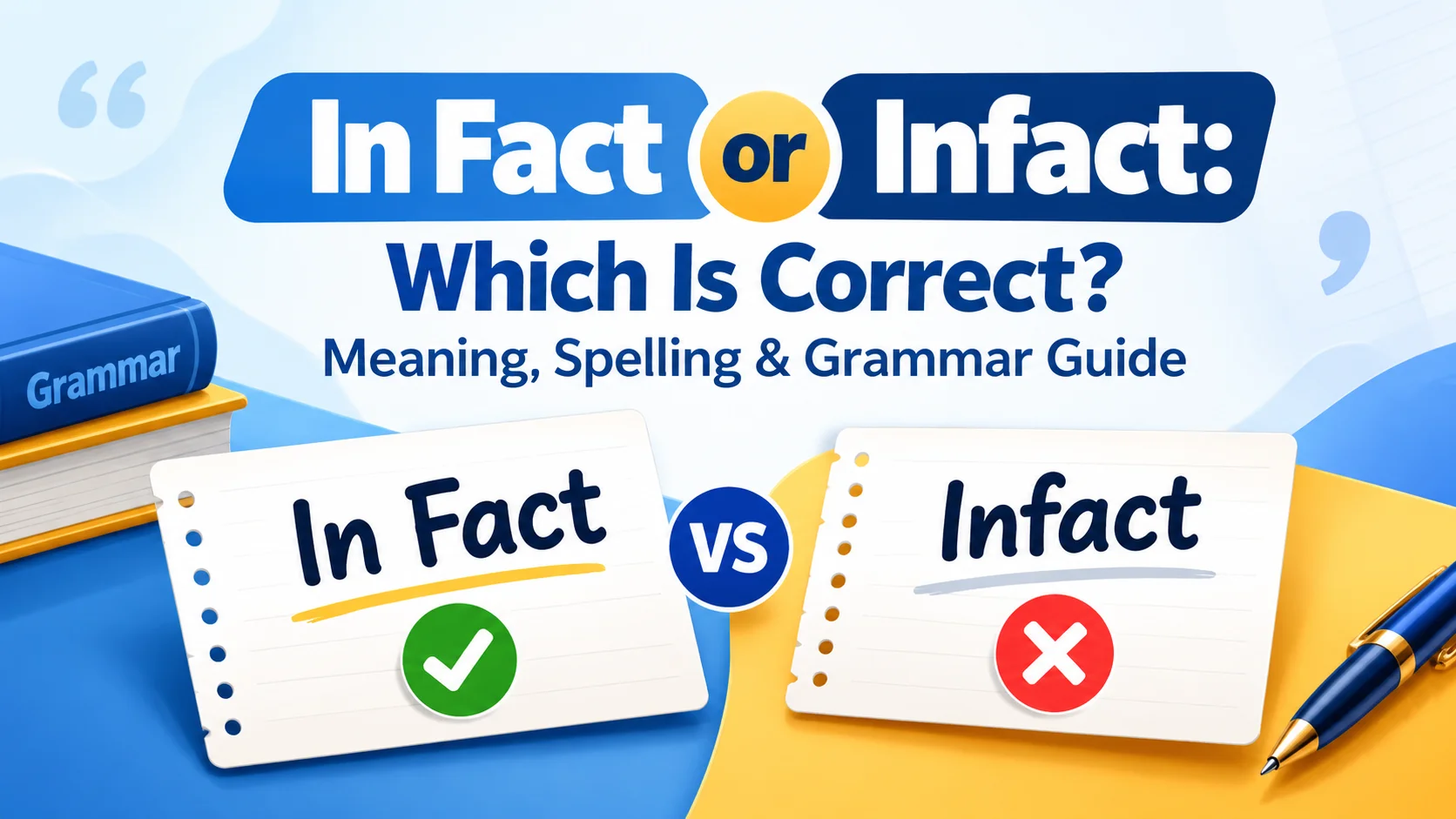
In Fact or Infact is a common spelling question because the two forms sound almost like one unit when spoken quickly. If you have ever typed in fact and wondered whether it is actually correct, the answer is straightforward: “in fact” is the correct standard English spelling, while “infact” is a misspelling when you mean the phrase used to emphasize or clarify information. The important part is knowing more than just the spelling. This guide explains what “in fact” means, how it functions grammatically, where to place it in a sentence, and how to punctuate it naturally.
The phrase appears in everyday conversations, school assignments, professional emails, essays, reports, and online communication. That makes it useful to understand rather than simply memorize. “In fact” consists of two separate words, and joining them together changes a standard expression into a spelling error. You may also encounter questions about whether it can begin a sentence, whether a comma is necessary, or whether “in fact” and “actually” mean exactly the same thing. Those details matter because correct spelling does not automatically guarantee natural usage.
By the end of this guide, you will know when to use “in fact,” when to leave it out, and how to avoid the mistakes that commonly lead people to write “infact.” We will also compare it with expressions such as “indeed,” “actually,” “as a matter of fact,” and “in reality.” Rather than memorizing isolated examples, you will learn the reasoning behind the usage. That makes the rule easier to remember and helps you make the right choice whether you are writing a school answer, a formal email, an article, or a casual message.
In Fact or Infact: The Quick Answer
The correct form is:
In fact ✅
The incorrect standard spelling is:
Infact ❌
“In fact” is always written as two words when it is used as the common English phrase meaning actually, indeed, or as a matter of fact.
Quick examples
- In fact, I finished the assignment yesterday.
- She isn’t new to the company. In fact, she has worked there for five years.
- I thought the shop was closed. In fact, it was still open.
Incorrect:
- ❌ Infact, I finished the assignment yesterday.
- ❌ She has, infact, worked there for five years.
A simple rule solves the spelling problem: never combine “in” and “fact” into “infact.”
What Does “In Fact” Mean?
“In fact” is used to emphasize, clarify, confirm, or correct information. It often signals that what follows is particularly relevant to the statement just made.
For example:
I thought Ali was absent. In fact, he arrived before everyone else.
The phrase introduces information that corrects the earlier assumption.
It can also reinforce a statement:
The test was difficult. In fact, it was the hardest test we had taken that year.
Here, in fact, tells the reader that the second statement provides stronger information about the first.
Depending on context, “in fact” can communicate ideas such as:
- actually
- indeed
- really
- as a matter of fact
- according to the facts
- more accurately
These are related meanings, but they are not interchangeable in every sentence.
“In Fact” for Emphasis
One common use is to make a statement stronger.
The book was interesting. In fact, I read it twice.
The second sentence adds stronger evidence about how interesting the book was.
“In Fact” to Correct or Clarify Information
This is particularly common in conversation.
I assumed the meeting was on Monday. In fact, it is scheduled for Tuesday.
The phrase signals a correction.
“In Fact” to Introduce Unexpected Information
It can also prepare the reader for information that goes beyond what they might expect.
The restaurant looks small from outside. In fact, it can seat more than 100 people.
The phrase creates a contrast between appearance and reality.
Why “In Fact” Is Correct and “Infact” Is Not
The main issue is simple: “in fact” is an established two-word expression in standard English.
The words in fact retain their separate written forms even when they work together closely in a sentence.
English contains many expressions that sound like a single unit when spoken but remain separate words in writing:
- in general
- in reality
- in particular
- in addition
- in detail
- in fact
Because people often hear one smooth sound, it is easy to type in fact. Fast speech can make the boundary between the two words less noticeable.
However, pronunciation does not determine whether words should be joined in writing.
Is “Infact” Ever Correct?
For the ordinary English phrase meaning actually or indeed, no—“infact” is not the standard spelling.
You might occasionally see Infact used as part of a username, company name, website name, product name, or other deliberately stylized name. That does not make it the standard grammatical spelling of the phrase.
So if you are writing an essay, email, article, assignment, or ordinary message, use:
in fact ✅
not:
infact ❌
“In Fact” Grammar: What Part of a Sentence Is It?
From a practical writing perspective, “in fact” functions as an adverbial expression. It can comment on or connect with the statement around it by emphasizing its truth, adding clarification, or introducing a correction.
It is not a verb, noun, or adjective.
Consider:
The project was successful.
Now add in fact:
The project was successful. In fact, it exceeded our expectations.
The phrase helps establish the relationship between the two ideas.
You do not need to memorize complicated grammatical terminology to use it correctly. The more useful question is:
What job is “in fact” doing here?
If it is emphasizing, clarifying, correcting, or strengthening an idea, the phrase may be appropriate.
Can “In Fact” Start a Sentence?
Yes. “In fact” can naturally begin a sentence.
When it is used as an introductory expression, a comma commonly follows it:
In fact, we had already discussed the issue.
In fact, the second option was cheaper.
In fact, nobody knew about the change.
Starting with in fact is particularly useful when the new sentence corrects or strengthens something mentioned previously.
However, I do not feel that every sentence containing in fact needs to begin with it. Its position should depend on the relationship between ideas.
Can “In Fact” Appear in the Middle of a Sentence?
Yes. It can appear in the middle when the writer wants to insert an aside or emphasize part of the statement.
For example:
The solution, in fact, was much simpler than we expected.
Here, the phrase interrupts the sentence and is set off by commas.
Another example:
She is, in fact, the most experienced member of the team.
This construction is grammatically possible, but it should not be overused. Too many parenthetical expressions can make writing feel interrupted.
Can “In Fact” End a Sentence?
It can occur toward the end of a sentence in certain constructions, although this is less common than using it at the beginning or as a parenthetical expression.
For example:
I didn’t expect him to agree, but he did, in fact.
This type of construction is more dependent on context and style. For most learners, the most natural patterns are:
In fact, + statement
or
statement + in fact + additional information.
How to Punctuate “In Fact” Correctly
Punctuation depends on how “in fact” functions in the sentence. There is no rule saying that a comma is permanently attached to the phrase.
| Position of “in fact” | Typical punctuation | Example |
| Beginning of sentence | Often followed by a comma | In fact, she knew the answer. |
| Parenthetical in the middle | Usually set off by commas | She was, in fact, correct. |
| Integrated into a sentence | Depends on sentence structure | The results in fact support the theory. |
| End of sentence | Depends on construction | The answer was correct, in fact. |
“In Fact,” at the Beginning
A comma is natural when in fact introduces the sentence:
In fact, I had already completed the task.
“In Fact” in the Middle
When the phrase interrupts the sentence, commas commonly mark it as parenthetical:
The decision was, in fact, unavoidable.
When a Comma Is Not Required
Do not treat punctuation as part of the phrase itself. The surrounding grammar determines whether commas are needed.
For example, in a sentence where in fact is closely integrated with the statement, punctuation may differ:
The evidence in fact supports the original conclusion.
The key lesson is not “always put a comma after in fact.” The better rule is to look at its position and grammatical function.
“In Fact” vs “Actually”: Are They the Same?
“In fact” and “actually” overlap, but they are not perfect substitutes.
Actually is extremely common in conversation and can introduce a correction:
I thought she lived in Lahore. Actually, she lives in Islamabad.
In fact can perform a similar function:
I thought she was new here. In fact, she has worked here for years.
The difference is often one of emphasis and context.
| Expression | Common purpose | Typical feel |
| In fact | Emphasizes or confirms a fact | Neutral, explanatory |
| Actually | Corrects or contrasts with an assumption | Very common in conversation |
| Indeed | Adds strong confirmation | More formal/literary |
| As a matter of fact | Strong emphasis or correction | More emphatic, sometimes wordier |
| In reality | Contrasts reality with appearance/belief | Contrast-focused |
A useful writing tip is to choose the expression that matches the relationship between your ideas rather than replacing every occurrence of actually with in fact.
“In Fact” vs Similar Expressions
In Fact vs Indeed
Both can strengthen a statement, but indeed often have a more formal or emphatic tone.
The plan was successful. Indeed, it exceeded expectations.
The plan was successful. In fact, it exceeded expectations.
Both work, but the second sounds more conversational and explanatory.
In Fact vs As a Matter of Fact
These expressions are closely related.
In fact, I have already seen the report.
As a matter of fact, I have already seen the report.
The longer expression can sound more emphatic or conversationally deliberate. In many situations, “in fact” is cleaner and more concise.
In Fact vs In Reality
These are not always interchangeable.
In reality is especially useful when contrasting what appears to be true with what is actually true:
The task looked easy. In reality, it required several hours of work.
In fact it can also work, but its function is broader than simply contrasting appearance with reality.
In Fact vs Really
Really has many uses beyond factual emphasis.
I really enjoyed the movie.
Replacing it with in fact would change the meaning:
I in fact enjoyed the movie.
The second sentence sounds more like a factual clarification than an expression of personal enthusiasm.
Where Should You Use “In Fact”?
Everyday Conversation
It is perfectly normal in speech:
“Did you finish the homework?”
“Yes. In fact, I finished it last night.”
It can sound natural when confirming information or correcting an assumption.
School and Academic Writing
In fact, it can be useful in essays and assignments when you are clarifying a claim or connecting related ideas.
For example:
Many students find the subject challenging. In fact, the first few weeks require considerable practice.
However, remember that the phrase itself does not provide evidence. In academic writing, saying “in fact” does not turn an unsupported claim into a fact. Your argument still needs appropriate evidence and sources when required.
Professional Emails and Workplace Writing
It can make clarification straightforward:
I initially expected the report on Friday. In fact, the updated schedule shows that it is due Thursday.
It is usually neutral enough for workplace communication.
Essays, Reports, and Formal Writing
Use it when the relationship between sentences genuinely benefits from emphasis or clarification.
Avoid inserting it simply because you need a transition word. Strong writing does not require every sentence to begin with a connector.
Text Messages and Social Media
Informal communication does not change the spelling.
Even in a casual message:
In fact, I already told him.
not:
❌ Infact, I already told him.
Common “In Fact” Mistakes to Avoid
Writing “Infact”
This is the main spelling mistake.
Wrong: In fact, the answer is correct.
Right: In fact, the answer is correct.
Writing “In-fact”
The phrase does not normally require a hyphen.
Wrong: In-fact, we had already finished.
Right: In fact, we had already finished.
Using “In Fact” Too Often
A grammatically correct phrase can still become a style problem through repetition.
Compare:
In fact, the project was difficult. In fact, it took longer than expected. In fact, the team needed additional help.
The writing becomes repetitive.
A better version might be:
The project was difficult and took longer than expected. The team eventually needed additional help.
The goal is not to remove it completely. It is to use it when it adds a meaningful relationship between ideas.
Using It Without a Clear Purpose
Before writing in fact, ask:
What does this phrase add?
If the answer is “nothing,” remove it.
The meeting starts at nine.
The meeting starts at nine, in fact.
The second version may sound unnecessary unless the phrase has a particular contextual purpose.
Confusing Spelling With Usage
Remember that these are separate questions:
- Is it in fact spelled correctly?
- Is in fact appropriate in this particular sentence?
You can spell the phrase correctly and still use it awkwardly.
“In Fact” in Different Sentence Patterns
Learning a few useful patterns is more effective than memorizing dozens of unrelated examples.
Pattern 1: In Fact + Statement
In fact, the store closes at six.
Use this when the phrase introduces a fact that is relevant to the preceding context.
Pattern 2: Statement + In Fact + Additional Information
The course is demanding. In fact, several students requested extra practice.
This pattern works well when the second point strengthens the first.
Pattern 3: Assumption + Correction
I thought the package would arrive Monday. In fact, it arrived Saturday.
This is one of the most useful everyday applications.
Pattern 4: General Claim + Stronger Detail
She is a talented writer. In fact, she has published several books.
The second statement gives more substantial information.
Practical Examples of “In Fact” in Real Situations
Correcting a Friend’s Assumption
“I thought you didn’t like coffee.”
“I do, in fact. I just don’t drink it very often.”
Explaining Something at School
The experiment initially appeared unsuccessful. In fact, the results showed an unexpected reaction.
Writing a Workplace Email
We expected the shipment to arrive today. In fact, the tracking update shows that it arrived yesterday.
Giving a Factual Clarification
The museum isn’t closed on Mondays. In fact, Monday is one of its busiest days.
Discussing a Product
The phone looks compact. In fact, its screen is larger than the previous model’s screen.
Writing an Essay
Technology has changed how students access information. In fact, online resources have become an important part of modern study.
Casual Online Conversation
I thought you had already watched that movie. In fact, you told me about it last week.
In Fact or Infact: Quick Comparison
| Question | In Fact | Infact |
| Is it standard English? | ✅ Yes | ❌ No |
| Correct spelling? | ✅ Yes | ❌ No |
| Number of words | Two | One |
| Can it begin a sentence? | ✅ Yes | ❌ No |
| Can it appear in the middle? | ✅ Yes | ❌ No |
| Does it normally need a hyphen? | ❌ No | ❌ No |
| Suitable for academic writing? | ✅ Yes, when useful | ❌ No |
| Suitable for professional writing? | ✅ Yes | ❌ No |
| Meaning as the phrase “actually/factually” | ✅ Yes | ❌ Not as a standard form |
A Simple Decision Guide
When you are unsure which form to type, use this quick check:
| If you want to… | Best choice |
| Emphasize a fact | In fact |
| Correct an assumption | In fact |
| Add stronger information | In fact |
| Clarify a previous statement | In fact |
| Write the phrase in an essay | In fact |
| Write it in a text message | In fact |
| Join the words together | Never: infact |
| Add a hyphen | Normally unnecessary |
How to Remember the Correct Spelling
The easiest memory trick is to think about the phrase as two meaningful parts:
IN + FACT = IN FACT
Do not let the way the phrase sounds influence the way you spell it.
You can also connect it mentally with other familiar two-word expressions:
- in fact
- in reality
- in general
- in particular
- in addition
If you are proofreading a long document, use your word processor’s search function to look for “infact.” If it appears, check each occurrence and replace it with “in fact” when the phrase is intended.
Quick proofreading tip: Search for both “infact” and “in-fact” before submitting an essay, report, or professional document.
When “In Fact” Improves a Sentence—and When to Leave It Out
Good writers do not use a phrase simply because it is grammatically correct. They use it because it does a specific job.
Consider:
The store is open. In fact, it stays open until midnight.
Here, the phrase helps introduce useful additional information.
Now consider:
The store is open. In fact, the store is open.
The second sentence adds no meaningful information. The phrase does not improve it.
A practical test
Before using in fact, ask:
- Am I correcting something?
- Am I emphasizing an important fact?
- Am I adding information that strengthens the previous statement?
- Would removing the phrase make the relationship between the ideas less clear?
If none of these applies, you may not need it.
Final Verdict
When choosing between “in fact” and “infact,” there is no difficult spelling exception to memorize: “in fact” is the correct standard form, and it should remain two separate words. Its usefulness, however, goes beyond spelling. The phrase can emphasize a fact, correct an assumption, clarify information, or introduce a stronger point. Its punctuation depends on where and how it appears, so avoid rules such as “always add a comma after in fact.” One final actionable tip: whenever you are proofreading, search your document for in fact and in-fact. This catches two common mistakes immediately. A common mistake to avoid is using in fact in every sentence merely because it sounds polished; strong writing uses transitions purposefully. Once you remember IN + FACT = IN FACT, the spelling becomes easy—and your next essay, email, or article will be cleaner for it.
Frequently Asked Questions
Q1. Is “infact” one word or two?
The standard spelling is two words: “in fact.” Infact is not the accepted spelling when you mean the common English expression. The fact that the phrase may sound connected in rapid speech does not change its written form. Use in fact in essays, messages, emails, reports, and other normal English writing.
Q2. Is “in fact” grammatically correct?
Yes. “In fact” is a standard English expression commonly used to emphasize, clarify, confirm, or correct information. Its position can vary within a sentence, and punctuation depends on how it functions. It can introduce a sentence, interrupt one parenthetically, or appear in other positions when the surrounding grammar supports it.
Q3. Should I write “in-fact” with a hyphen?
No. “In fact” normally has no hyphen. The hyphen is unnecessary because this expression is conventionally written as two separate words. If you see in-fact in informal online writing, do not treat that usage as the standard spelling for ordinary English prose.
Q4. Is “in fact” too formal for everyday conversation?
No. “In fact” is neutral enough for everyday English and is frequently useful when correcting an assumption or adding emphasis. However, conversational speakers may choose actually more often in some situations. The best choice depends on the tone and relationship between the ideas rather than on formality alone.
Q5. Can “in fact” be used at the beginning of an essay or paragraph?
Yes, but purpose matters more than position. Beginning a paragraph with in fact can work when the paragraph directly strengthens, clarifies, or corrects an idea already established. Avoid using it mechanically as a generic transition. A precise transition—or no transition at all—may produce cleaner academic writing.