

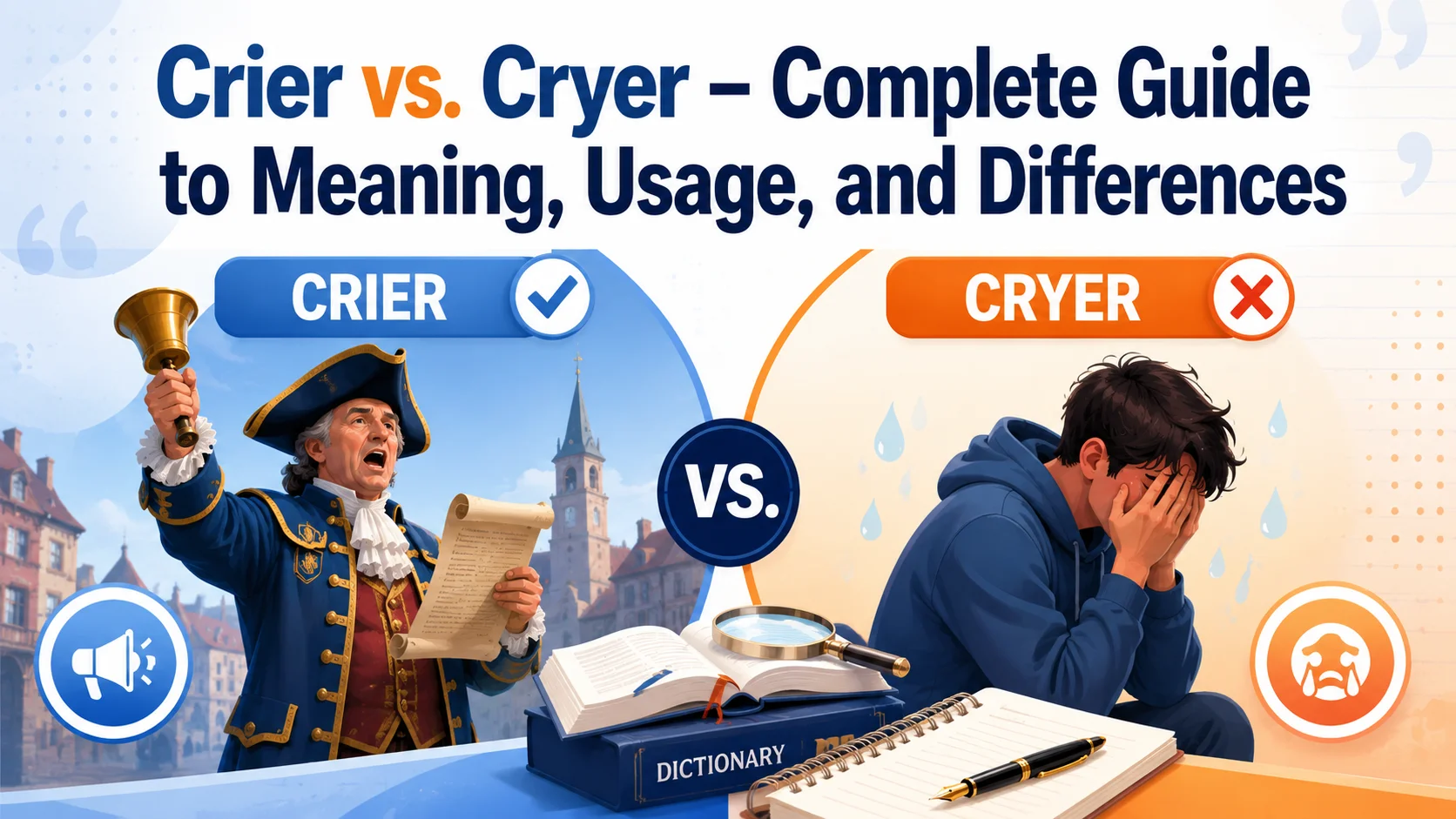
Crier vs. cryer is a common spelling question because the two forms look almost identical and are pronounced the same or nearly the same. If you’re writing about someone who cries, the standard modern spelling is crier. The same spelling appears in the familiar expression town crier, which refers to a person who traditionally announced news or official information aloud.
The confusion is understandable. The verb is cry, so it seems logical to add -er and write cryer. However, standard English uses crier for the ordinary noun. At the same time, cryer isn’t simply a meaningless typo: it can occur as a variant spelling, in historical material, or as a surname. That means context matters when deciding whether a spelling should be changed.
In this guide, you’ll learn exactly when to use crier, when cryer may be appropriate, why the spellings differ, how “town crier” fits into the picture, and which mistakes to avoid. You’ll also see practical examples so you can choose the correct form confidently in everyday, academic, professional, and historical writing.
Crier vs. Cryer: The Quick Answer
For most modern English writing, crier is the preferred spelling.
| Word | Modern status | Main meaning | Example |
| crier | Standard | Someone who cries | “She’s a frequent crier.” |
| crier | Standard | A public announcer | “The town crier made an announcement.” |
| cryer | Variant/uncommon | Variant of crier | May appear in older or variant usage |
| Cryer | Valid proper name | A surname | “Mr. Cryer attended the meeting.” |
The easiest rule to remember
If you’re writing a normal modern sentence and mean a person who cries, use crier.
Correct: She is a frequent crier.
If you mean the historical public announcer, use:
town crier
If Cryer is someone’s actual surname, keep the spelling exactly as it is.
Correct: Dr. Cryer published the article.
So the answer isn’t simply “crier is right and cryer is wrong.” A better rule is:
Use crier as the standard modern common noun; treat cryer as context-dependent, especially when it appears as a variant or proper name.
What Does “Crier” Mean?
Crier is a noun with two closely related meanings. It can describe someone who cries, or it can refer to someone who calls out or announces something publicly.
Crier as Someone Who Cries
The most straightforward modern meaning is a person who cries.
For example:
- “I’m not normally a crier, but that movie made me emotional.”
- “The baby was a frequent crier during the first few months.”
- “He isn’t much of a crier, even during sad movies.”
- “She describes herself as a happy crier.”
In this sense, crier describes a person’s tendency or behavior.
It doesn’t automatically mean the person cries excessively. The tone depends on the sentence.
Compare:
“I’m a crier when I watch emotional movies.”
This sounds casual and neutral.
But:
“He’s such a crier.”
can sound teasing or mildly critical.
The word itself isn’t necessarily negative.
Crier as a Public Announcer
Crier has another important meaning: a person who calls out information publicly.
This is the meaning behind town crier.
Before modern mass communication, people needed ways to spread important information throughout a community. A town crier would publicly announce information, often in a central location where people could hear it.
Announcements could involve:
- official proclamations
- public notices
- laws or regulations
- community information
- important news
- events or civic matters
The word cry historically had a broader sense of calling out or shouting. So a crier in this context is someone who cries out information, not someone who is shedding tears.
That distinction is important.
What Is a Town Crier?
A town crier was a public announcer whose job was to deliver information aloud to a community.
The expression is still widely recognized today, even though the traditional occupation is no longer a normal part of everyday communication.
A town crier might call for people’s attention before making an announcement.
For example:
“Hear ye! Hear ye! The market will close at sunset.”
The exact wording varied by time and place, but the purpose was straightforward: make important information audible to people who might not otherwise receive it.
Why Is It Called a “Crier”?
The word comes from the older meaning of cry as a loud public call.
Think of these two meanings:
- cry = shed tears
- cry = call or shout aloud
A town crier is connected to the second meaning.
That’s why it would be misleading to assume that every historical use of crier has something to do with emotional crying.
Is “Town Cryer” Correct?
In standard modern English, the established expression is:
town crier
Not:
town cryer
This is one of the most common spelling mistakes involving the two words.
What Does “Cryer” Mean?
Cryer exists as a spelling variant of crier, but it is not normally the preferred spelling for ordinary modern writing.
This distinction is important because two opposite claims are both misleading:
“Cryer is always wrong.”
and
“Crier and cryer are always interchangeable.”
Neither is a good rule.
Cryer as a Variant Spelling
Cryer can occur as a variant spelling of crier.
You may encounter it in:
- older texts
- historical records
- variant spellings
- specialized references
- surnames
Its existence as a variant doesn’t make it the best choice for a new sentence written in contemporary English.
If you’re writing:
“The child is a frequent ___.”
the normal modern choice is:
crier
Cryer in Historical Texts
English spelling wasn’t always standardized to the same degree it is today.
Older documents can contain spellings that look unusual to modern readers. If you’re studying, quoting, or transcribing a historical document, you may encounter cryer.
In that situation, don’t automatically “correct” it.
For example:
The original manuscript describes the official as a “cryer.”
Here, the spelling is part of the historical evidence.
That’s different from writing a modern sentence yourself:
The official was a cryer.
For ordinary modern prose, crier would generally be the better choice.
Cryer as a Surname
Cryer can also be a legitimate surname.
This is perhaps the most important reason you shouldn’t treat the spelling as automatically incorrect.
Suppose a researcher writes:
“Professor Cryer presented the findings.”
If Cryer is the professor’s actual surname, changing it to Crier would introduce an error.
Proper names don’t have to follow the spelling rules you would use for ordinary nouns.
A person’s name should be checked, not corrected by guesswork.
Why Do People Confuse Crier and Cryer?
The confusion comes from a combination of pronunciation, spelling patterns, and the structure of the word itself.
The Two Words Sound the Same or Nearly the Same
Both forms can be pronounced roughly as:
CRY-er
That means listening to someone say the word doesn’t reliably tell you which spelling they intend.
If someone says:
“She’s a crier.”
you can’t determine the spelling simply from the sound.
You need to know the word or see it written.
“Cryer” Looks Like a Logical Spelling
The verb is:
cry
So it’s natural for someone to think:
cry + er = cryer
That reasoning isn’t unreasonable.
English, however, doesn’t always form nouns by simply attaching letters to the unchanged base word.
The established spelling is:
cry → crier
That’s the form you should normally use in modern writing.
English Spelling Isn’t Purely Phonetic
This is a broader lesson worth remembering.
English spelling reflects several things at once:
- pronunciation
- historical development
- word formation
- established usage
- conventions that have become standardized over time
As a result, the spelling that looks most logical isn’t necessarily the conventional one.
Why Is “Crier” Spelled With an “I”?
The spelling becomes easier to understand when you look at related forms of cry.
Consider:
- cry → cries
- cry → cried
- cry → crier
The spelling of the final y changes to i in several forms when a suffix is added.
You can see similar patterns in words such as:
- try → tried
- try → tries
- dry → dried
- dry → dries
This helps explain why crier is the established spelling rather than simply cryer.
Why “Cryer” Still Looks Natural
The spelling cryer remains tempting because English also contains many words where adding -er looks straightforward:
- teach → teacher
- sing → singer
- work → worker
- drive → driver
A learner might reasonably assume:
cry → cryer
But the conventional English noun is crier.
The important point isn’t to memorize a complicated formula. It’s simply to recognize crier as the standard form.
Crier vs. Cryer: Which Spelling Should You Use?
For most everyday situations, choose crier.
| Situation | Best choice | Example |
| Someone who cries | crier | “He is a frequent crier.” |
| Someone who cries during movies | crier | “I’m a big crier.” |
| Historical public announcer | crier | “The crier announced the proclamation.” |
| Town announcer | town crier | “The town crier delivered the news.” |
| A person’s surname | Use the person’s actual spelling | “Ms. Cryer spoke first.” |
| Historical quotation | Preserve the original when appropriate | The document says “cryer.” |
| General modern writing | crier | Safest standard choice |
Use “Crier” for Someone Who Cries
If you’re describing a person who cries, use crier.
“My sister is a serious crier during sad movies.”
“The baby was a loud crier last night.”
“He’s not much of a crier.”
Use “Town Crier” for the Historical Role
The established phrase is:
town crier
For example:
“The town crier announced the new royal proclamation.”
Don’t substitute town cryer simply because it appears to follow the spelling of cry.
Use “Cryer” When It Is a Proper Name
If the person is actually named Cryer, keep that spelling.
“Sarah Cryer joined the committee.”
Here, Cryer isn’t being used as a synonym for crier. It’s a proper noun.
Preserve Historical Spellings When the Source Requires It
When reproducing historical material, accuracy may require keeping an original spelling.
If a seventeenth-century document uses cryer, changing it without explanation could alter the historical record.
In edited academic work, you might preserve the original spelling and explain it in a note if necessary.
Crier vs. Cryer in American and British English
You may wonder whether this is simply an American vs. British English difference.
It generally isn’t.
The spelling crier is established in modern English across major varieties of English. The presence of cryer doesn’t create a straightforward regional rule such as:
American English = cryer
British English = crier
That would be misleading.
Why Regional Assumptions Can Cause Problems
English contains many genuine regional spelling differences, so it’s tempting to explain every competing form that way.
But with crier vs. cryer, the more useful distinction is:
- standard modern common-noun usage
- variant or historical usage
- proper-name usage
If you’re writing for an international English-speaking audience, crier is the safest general form.
Crier vs. Cryer: Real-World Examples
Seeing the words in context is often more useful than memorizing a definition.
1 Examples Using “Crier”
- “I’m a terrible crier when I watch animal rescue videos.”
- “The newborn was a frequent crier during the night.”
- “He became an emotional crier after becoming a father.”
- “She isn’t normally a crier, but the farewell ceremony moved her.”
- “My brother is a happy crier at weddings.”
2 Examples Using “Crier” as an Announcer
- “The town crier announced the new proclamation.”
- “The crier called the announcement from the center of the square.”
- “A traditional town crier would make important public information known aloud.”
- “The festival featured a costumed town crier.”
3 Examples With “Cryer” as a Name
- “Professor Cryer delivered the keynote speech.”
- “The book was written by Cryer.”
- “Mr. Cryer joined the organization in 2018.”
In these sentences, Cryer isn’t being selected as an alternative spelling of the common noun. It’s a surname.
Examples of the Common Error
| Common mistake | Better form | Reason |
| “She is a frequent cryer.” | “She is a frequent crier.” | Crier is the standard modern noun. |
| “The town cryer made an announcement.” | “The town crier made an announcement.” | Town crier is the established expression. |
| “Dr. Crier spoke at the conference.” | Check the actual name | The person’s surname may be Cryer. |
| “The old document has a spelling mistake: cryer.” | Not necessarily | Historical spelling may differ from modern usage. |
Crier, Cry, Crying, and Cried: Understanding the Word Family
Understanding the related forms helps make the spelling easier to remember.
Cry
Cry can function as both a verb and a noun.
As a verb:
“The baby began to cry.”
As a noun:
“We heard a loud cry.”
The verb itself has more than one sense. It can refer to shedding tears, calling loudly, shouting, or expressing something forcefully.
Crying
Crying is the present participle of cry and can also function as a gerund or adjective depending on the sentence.
“The baby is crying.”
“Crying can be an emotional response.”
Cried
Cried is the past tense and past participle of cry.
“She cried yesterday.”
“He had cried before the meeting began.”
Crier
Crier is a noun referring to a person who cries or, in a historical context, someone who cries out public announcements.
“She’s a frequent crier.”
“The town crier announced the news.”
Cryer
Cryer may appear as a variant spelling or proper name, but it isn’t the usual modern spelling for the common noun.
Common Mistakes With Crier and Cryer
Mistake 1: Assuming “Cryer” Must Be Correct Because It Comes From “Cry”
This is the most understandable mistake.
The reasoning looks like:
cry + er = cryer
But standard English uses:
crier
Don’t invent the spelling from the base word when the established derived form is already known.
Mistake 2: Writing “Town Cryer”
This is particularly common because cryer looks closely related to the verb cry.
The standard expression is:
town crier
For example:
“The town crier announced the arrival of the king.”
Mistake 3: Saying “Cryer Is Always Wrong”
This goes too far in the opposite direction.
Cryer can appear as a variant and can certainly be a surname.
So the better rule is:
Crier is the standard modern common noun; Cryer can be contextually valid.
Mistake 4: Changing Someone’s Name
Suppose an author’s surname is Cryer.
Changing it to Crier because you think crier is the correct spelling isn’t proofreading. It’s an error.
Proper names should be verified independently.
Mistake 5: Assuming an Old Spelling Is an Error
Historical English didn’t always follow modern spelling conventions.
If you’re reading an old manuscript, newspaper, legal record, or quotation, unusual spellings can reflect the period in which the text was produced.
Crier vs. Cryer in Formal and Professional Writing
The safest approach depends on what you’re writing.
Academic Writing
In academic prose, use crier when you’re using the common noun in modern English.
For example:
“The narrator describes himself as an emotional crier.”
If you’re discussing a historical source that uses cryer, preserve or explain the historical spelling according to your citation and editorial conventions.
Journalism
Journalists should be particularly careful with proper names.
If a source’s surname is Cryer, write:
“Cryer said the report was incomplete.”
Don’t “standardize” the surname to Crier.
Professional Communication
In emails, reports, presentations, and workplace documents, crier is the appropriate general spelling.
For example:
“The employee described himself as an emotional crier.”
However, most professional writing wouldn’t need the noun crier frequently unless you’re discussing emotional behavior, literature, psychology, or a similar subject.
Creative Writing
Creative writers have more flexibility.
If you’re writing historical fiction and want to reproduce period language, you might deliberately use a historical spelling. But intentional historical usage should be distinguished from an accidental spelling mistake.
Crier vs. Cryer vs. Crybaby
These words can overlap in meaning, but their tone is different.
| Word | Meaning | Tone |
| crier | Someone who cries | Usually neutral |
| crybaby | Someone who cries easily or complains excessively | Informal, often negative |
| crier in “town crier” | Public announcer | Historical/formal |
| cryer | Variant spelling or proper name | Context-dependent |
Calling someone a crybaby can be insulting or dismissive.
Calling someone a crier doesn’t necessarily carry that judgment.
Compare:
“She’s a crier during emotional movies.”
with:
“Stop being such a crybaby.”
The first describes a tendency. The second expresses criticism.
How to Remember Crier vs. Cryer
You don’t need a complicated mnemonic.
Memory Trick: Crier = Standard Modern Choice
Associate crier with the two most useful modern meanings:
- crier = someone who cries
- town crier = someone who cries out announcements
If you’re writing ordinary English, crier should be your first choice.
Memory Trick: Cryer = Check the Context
Instead of memorizing cryer as “wrong,” remember:
Cryer = check the context.
Ask:
- Is it a person’s surname?
- Is it part of an old quotation?
- Is it a historical spelling?
- Is it a documented variant?
If none of those apply and you’re writing normal modern English, crier is usually the right choice.
Quick memory tip: If you’re talking about someone who cries, think crier. If you’re talking about a person’s name or an old source, stop and check whether Cryer is intentional.
When Does the Spelling Depend on Context?
This is where many simplified explanations fall short.
| Context | Recommended spelling | Reason |
| Someone who cries | crier | Standard modern noun |
| Emotional person | crier | Standard usage |
| Town announcer | town crier | Established phrase |
| Historical public announcer | crier in modern prose | Conventional modern form |
| Historical source spelling | cryer may be retained | Historical accuracy |
| Surname | Cryer, if that’s the person’s name | Proper-name spelling |
| Modern school essay | crier | Standard form |
| Professional writing | crier | Clear conventional usage |
This approach is more accurate than labeling one spelling “right” and the other “wrong” in every imaginable situation.
Related Terms That Help You Understand “Crier”
Town Crier
A town crier is a traditional public announcer who calls out news or official information.
Herald
A herald historically served as a messenger or announcer, but the word has broader historical meanings than town crier.
Caller
A caller can be someone who calls or announces something, although it isn’t a direct synonym for crier in every context.
Proclaimer
A proclaimer is someone who publicly declares or announces something. It’s more formal than crier.
Crybaby
A crybaby is an informal term for someone who cries easily or complains excessively. Because of its negative tone, it shouldn’t automatically replace crier.
A Five-Second Test for Choosing Crier or Cryer
When you’re unsure, use this quick process.
Step 1: Ask What You Mean
If you mean:
someone who cries
choose crier.
If you mean:
the historical public announcer
choose town crier.
Step 2: Check Whether It’s a Name
If the word is someone’s surname, don’t change it without verification.
Cryer may be completely correct as a proper name.
Step 3: Check the Source
If you’re reproducing an old document or quotation, determine whether the spelling is part of the original text.
Step 4: Don’t Spell From Sound
Because crier and cryer sound alike, pronunciation won’t solve the problem.
Step 5: Choose the Established Modern Form
For ordinary contemporary writing:
crier
That’s the simplest and safest answer.
Conclusion
The crier vs. cryer question becomes much easier once you separate standard modern usage from historical and proper-name contexts. For a person who cries, crier is the normal spelling. It is also the spelling used in the familiar expression town crier, referring to a traditional public announcer. Cryer, meanwhile, can appear as a variant spelling, in historical sources, or as a legitimate surname. One final actionable tip: when you’re writing an ordinary modern sentence, choose crier unless you have a specific reason to preserve Cryer. A common mistake to avoid is treating every unusual spelling as an error—especially when you’re dealing with people’s names or historical documents. When pronunciation can’t distinguish two spellings, let context, established usage, and careful verification make the decision. In modern English, when in doubt about the common noun, crier is the reliable choice.
Frequently Asked Questions
Q1. Is “crier” or “cryer” the correct spelling?
Crier is the standard modern spelling for a person who cries and for the traditional public announcer in town crier. Cryer can occur as a variant spelling, in historical material, or as a surname. Therefore, crier is normally the correct choice in contemporary general writing.
Q2. Is it “town crier” or “town cryer”?
The established expression is town crier. A town crier was traditionally a person who publicly announced news, proclamations, or official information. Although cryer looks logical because the word comes from cry, town crier is the conventional modern spelling.
Q3. Is “cryer” a real word?
Yes. Cryer can occur as a spelling variant of crier, particularly in historical or variant usage. It can also be a legitimate surname. However, that doesn’t make it the preferred spelling for ordinary modern writing. In a standard sentence about someone who cries, use crier.
Q4. Why is “crier” spelled with an “i” instead of “cryer”?
The spelling reflects established English word formation. Forms of cry commonly change the final y to i before certain endings, as in cried and cries. The standard noun has therefore developed as crier, rather than simply cryer.
Q5. Is “Cryer” a valid last name?
Yes. Cryer can be a legitimate surname. Proper names don’t have to match the spelling of ordinary English words. If someone’s established name is Cryer, keep that spelling. Never change a person’s surname to Crier merely because crier is the standard common noun.