
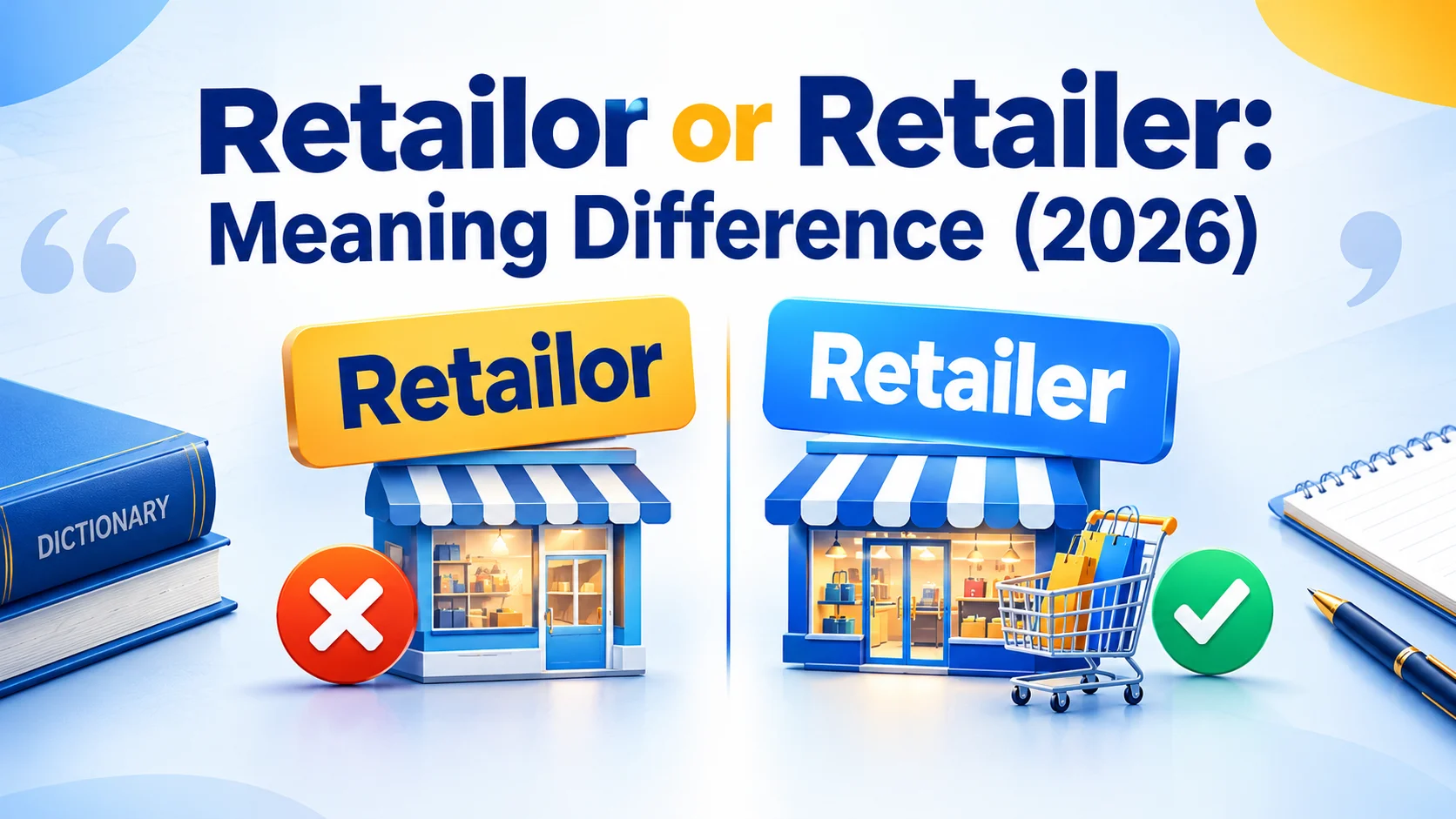
The key to this spelling question is understanding the difference between a word that looks plausible and the word that English speakers conventionally use. Retailer is the standard spelling for a person or business that sells goods to customers. Retailor, by contrast, is not the normal spelling for that meaning. Although the two forms look almost identical, choosing the familiar spelling matters when you write product descriptions, business emails, school assignments, or online shopping content. If you have ever wondered whether retailor is an alternative spelling or simply a typo, the distinction is easier to understand once you look at how the words are formed and used.
The confusion makes sense. English has many nouns ending in -er, such as teacher, seller, and manufacturer. Someone unfamiliar with the conventional spelling of retailer might assume that a similar-looking ending could produce retailor. However, English spelling does not always follow the patterns that seem most logical. In this guide, you will learn what retailer means, why retailor is usually unsuitable, and how to distinguish a retailer from a wholesaler, vendor, distributor, and other businesses involved in selling goods.
Whether you are writing for a business website, studying English, or checking a spelling before publishing an article, the practical rule is straightforward: use retailer when you mean a business that sells products to customers. You will also see how the word works in real sentences, whether its spelling changes between British and American English, and which related terms fit different situations. By the end, you will be able to choose the right word confidently without relying on guesswork or confusing a spelling error with a genuine difference in meaning.
Retailor vs. Retailer: The Quick Answer
Retailer is the correct, standard spelling when you mean a person, shop, or company that sells goods to the public.
Retailor is not the standard alternative spelling for a modern retail business. Some references record it as an obsolete spelling of retailer. However, retailor can also be a verb meaning to alter or restyle clothing for a new person or purpose.
| Question | Answer |
| Which spelling should you use for a shop or business? | Retailer |
| What does retailer mean? | A person or business that sells goods to the public |
| Is retailor the standard spelling? | No |
| Does retailor have another meaning? | Yes, it can be a verb meaning to alter or restyle clothing |
| Is the spelling different in US and UK English? | No; retailer is standard in both |
| What is the plural of retailer? | Retailers |
Simple rule: If you are writing about a store, online shop, or business that sells products, write retailer.
What Does Retailer Mean?
A retailer is a person or business that sells goods directly to the public. The business may operate from a physical shop, an online store, or both. Retailers are an important part of the supply chain because they connect products with the people who buy and use them.
For example, a company that sells laptops directly to customers is a retailer. A clothing shop selling individual shirts to shoppers is also a retailer. The term describes the business’s role, not necessarily its size.
Retailer as a Person or Business That Sells Goods
The word can refer to an individual seller or to the business itself. In everyday business writing, it most often describes the company or shop.
Examples:
- The local retailer sells handmade furniture.
- The electronics retailer offers a two-year warranty.
- Several independent retailers stock the brand’s new collection.
- The retailer expanded its business by opening another store.
Notice that retailer does not tell you whether a business is large or small, expensive or affordable, or independent or part of a chain. It simply identifies the business’s position in selling goods to the public.
Retailer in Online Shopping and E-Commerce
A retailer does not need a physical storefront. Businesses that sell products through websites or shopping apps are also retailers.
Consider a company that sells skincare products through its own website. If customers browse the products, place orders, and buy directly from the company, it operates as an online retailer.
Common expressions include:
- Online retailer
- Clothing retailer
- Electronics retailer
- Grocery retailer
- Independent retailer
- Discount retailer
Example: “The online retailer offers free delivery on orders over $50.”
This usage is particularly common in product descriptions, consumer news, business reports, and e-commerce content.
Retailer in Business and Marketing
In professional settings, retailer helps distinguish the company selling a product to consumers from other organizations involved in producing or distributing it.
For instance, a furniture manufacturer may make tables, a distributor may supply them to shops, and a retailer may sell them to households. One company can sometimes perform more than one of these roles, so the distinction depends on what it actually does.
Example: “The manufacturer is looking for retailers to stock its new product line.”
This sentence means the manufacturer wants businesses that will sell its products to customers.
What Does Retailor Mean?
The spelling retailor needs a little more context than a simple right-or-wrong label suggests.
When someone intends to describe a shop or business selling goods to the public, retailor is not the spelling to choose. The conventional word is retailer. Some references preserve retailor as an obsolete spelling of the noun rather than a standard modern alternative.
There is another use worth knowing: retailor can be a verb meaning to tailor clothing again, alter it, or restyle it for a different person or purpose.
Why Retailor Looks Like a Reasonable Spelling
The confusion is understandable because English has many words that end in -er and -or. Both endings appear in nouns and other word forms, and spelling by analogy can seem sensible.
Someone might see retail and assume that retailor is the natural spelling for someone who sells retail products. But the accepted noun is formed as retail + -er = retailer. A spelling that looks logical is not necessarily the conventional one.
Compare:
- Sell → seller
- Teach → teacher
- Retail → retailer
The lesson is not that -or is always wrong. Words such as actor and operator are standard. The point is that you should learn the established spelling of each word rather than choosing a suffix based on appearance alone.
When Might You Encounter Retailor?
You may encounter retailor in a few different situations:
- An old text: It may appear as an obsolete spelling of the noun retailer.
- A spelling mistake: A writer may have confused the two endings.
- A clothing-related verb: It may describe altering or restyling clothing.
- A specialized or unusual context: The intended meaning should be established from the surrounding sentence.
For example, “The retailor sells shoes” probably intends to use the noun retailer. By contrast, “The tailor will retailor the jacket” may intend the verb meaning to alter the garment, although alter or retailor should be chosen according to the intended meaning and the audience’s familiarity with the term.
Practical advice: Do not automatically replace every occurrence of retailor without reading the sentence. If it refers to a shop, use retailer. If it describes changing clothing, check whether the verb sense is intended.
Why Is Retailer the Standard Spelling?
The noun retailer comes from retail, with the suffix -er identifying a person or business associated with the action. The word has a long history in English, dating back several centuries.
Modern usage has established retailer as the normal noun for a business selling goods to the public. It is the familiar spelling used in general, commercial, and professional writing.
How the Word Retailer Is Formed
The relationship between the words is straightforward:
- Retail: The activity of selling goods to consumers.
- Retailer: A person or business that carries out that activity.
- Retailing: The activity or business of selling goods to the public.
For example:
“The company plans to expand its retailing operations by opening three new stores.”
“The retailer expects demand for winter clothing to rise.”
Both sentences are natural, but the words have different grammatical jobs. Retailing refers to the activity, while retailer identifies the person or business.
Does the Suffix -Or Ever Make Sense?
Yes. English uses -or in words such as editor, director, and distributor. However, the existence of those words does not make retailor the preferred spelling of the retail-business noun.
Spelling conventions develop through history and established usage, not through one universal rule. When you are unsure, consult a reputable dictionary and check the meaning, part of speech, and example sentences.
Retailor or Retailer in British and American English
The standard spelling of the retail-business noun is retailer in both British and American English.
Unlike spelling pairs such as colour/color or organise/organize, this word does not have a standard UK-versus-US spelling difference.
| Context | British English | American English |
| A business selling products | Retailer | Retailer |
| More than one retail business | Retailers | Retailers |
| The activity of selling goods | Retailing | Retailing |
| An online shop selling to consumers | Online retailer | Online retailer |
| Retailor as the business noun | Not the standard form | Not the standard form |
If you are publishing a website for an international audience, you can confidently use retailer without changing the spelling for British or American readers.
Which Spelling Should International Businesses Use?
Use retailer in product catalogs, supplier agreements, business presentations, customer-facing pages, and marketing materials when referring to a business selling goods.
Consistency matters because a company’s wording appears across many places: product pages, invoices, contracts, help articles, and marketing materials. A familiar spelling makes the text easier to recognize and avoids unnecessary editing.
If you are quoting an older document, preserve its original wording when accuracy requires it. In your own explanation, however, use the standard modern spelling.
Retailer in Real-World Sentences
The best way to remember a word is to see how it works in context. These examples show how retailer appears in everyday communication, professional writing, and online commerce.
Retailer in Everyday Conversation
In ordinary conversation, retailer is useful when you want to refer to a shop or business without naming a particular company.
Examples:
- “The retailer has a great selection of winter coats.”
- “I bought the headphones from an authorized retailer.”
- “That retailer offers discounts to regular customers.”
You might use shop or store in casual conversation instead. However, retailer is more useful when the business’s role in selling goods matters.
Retailer in Business Emails and Professional Writing
In business communication, the word helps identify who sells, stocks, or supplies products to customers.
Example:
“Please confirm whether the retailer has received the updated product catalog.”
Another example:
“We are looking for retailers interested in carrying our new range of kitchen appliances.”
In both sentences, retailer communicates the intended business relationship clearly. Use the same spelling throughout reports, proposals, and other professional documents.
Retailer in E-Commerce and Product Descriptions
Online businesses frequently use retailer when describing where a product is sold or who handles the sale.
Examples:
- “Contact the retailer if your order arrives damaged.”
- “The retailer provides tracking details after dispatch.”
- “Choose an authorized retailer to ensure that the product comes from an approved seller.”
Be careful with the phrase authorized retailer. It suggests that a business has permission or approval to sell a brand’s products. Do not use it merely because a store carries those products.
Retailer in Academic Writing and Student Assignments
Students may encounter the word in economics, marketing, business studies, and supply-chain management.
Example:
“A retailer purchases products from suppliers and sells them to consumers.”
If your assignment compares different types of businesses, define the term clearly before discussing how retailers interact with manufacturers, wholesalers, or distributors.
Retailer vs. Related Business Terms
Several words are connected to retail, but they are not interchangeable. Choosing the right one helps readers understand what a business actually does.
| Term | Meaning | Example |
| Retailer | Sells goods to consumers | A shop selling shoes to customers |
| Retail | The activity or sector of selling goods to consumers | The retail industry |
| Retailing | The process or business activity of selling goods | Online retailing is growing |
| Seller | A person or business that sells something | The seller confirmed the order |
| Vendor | A person or business offering goods or services for sale | A market vendor sells fruit |
| Wholesaler | Typically sells goods in bulk to other businesses | A wholesaler supplies cases of drinks to shops |
| Distributor | Moves or supplies products through a distribution network | A distributor supplies products to regional stores |
| Manufacturer | Makes products | A manufacturer produces kitchen appliances |
Retailer vs. Seller
A seller is a broad term for anyone selling something. A retailer is a more specific kind of seller that sells goods to consumers.
For example, someone selling a used bicycle privately is a seller. A business selling new bicycles to the public is a retailer.
Retailer vs. Wholesaler
A wholesaler typically sells products in larger quantities to retailers or other businesses. A retailer generally sells products to the final consumer.
For example, a wholesaler might supply 200 notebooks to a stationery shop. The shop then sells individual notebooks to students.
These roles can overlap in some business models, but the distinction is useful when describing ordinary supply chains.
Retailer vs. Distributor
A distributor usually helps move products from manufacturers or suppliers to other businesses or markets. A retailer sells goods to consumers.
However, business arrangements vary. Some distributors also operate retail channels, and some retailers purchase directly from manufacturers. Describe the actual role rather than relying on a company’s label alone.
Retailer vs. Retail
The distinction is grammatical as well as semantic.
- Retailer is a noun for a person or business.
- Retail can function as a noun, adjective, or verb.
- Retailing is a noun referring to the activity.
Correct: “The retailer expanded its retail operations.”
Incorrect in the intended sense: “The retail expanded its operations.” Use retailer when referring to the business itself.
Common Mistakes When Choosing Between Retailor and Retailer
Assuming Retailor Is Correct Because It Looks Logical
English spelling does not always follow a predictable formula. Even if a word looks plausible, check whether it is the established form.
Better approach: Remember retailer as a complete word rather than trying to reconstruct it from a suffix rule.
Treating Retailor as a Regional Spelling
Retailor is not the standard British alternative to retailer, nor is it the normal American spelling. Switching between the two based on a country’s spelling conventions is unnecessary.
Better approach: Use retailer for the retail-business meaning in both varieties of English.
Confusing a Retailer With a Wholesaler
A retailer typically sells to consumers, while a wholesaler usually sells in bulk to other businesses. Confusing the two can make a business description inaccurate even when the spelling is correct.
Better approach: Identify who buys the product and how it is sold before selecting the business term.
Replacing Every Instance of Retailor Automatically
An unusual spelling can be a mistake, but context matters. Retailor may appear in an old text or as a verb referring to clothing alterations.
Better approach: Read the sentence first. Correct the spelling when it means a retail business, but investigate before editing a historical quotation or specialized usage.
How to Remember the Correct Spelling of Retailer
A simple memory technique is to connect the word with its familiar business meaning:
Retail + er = retailer.
Think of a retailer as the person or business responsible for selling products at the retail stage.
You can reinforce the spelling with common expressions:
- Retailer
- Online retailer
- Clothing retailer
- Grocery retailer
- Retailer agreement
Another useful technique is to read your sentence aloud and ask: “Am I talking about a business that sells goods, or am I describing an action involving clothing?” If you mean the business, choose retailer. If the sentence describes altering clothing, check whether retailor is the intended verb.
For important documents, run a spelling check and review the surrounding sentence. Spellcheckers can catch many typing errors, but they cannot always determine which word fits your meaning.
Conclusion
When deciding between retailor and retailer, focus on the meaning you want to communicate. If you are referring to a shop, an online business, or a company selling products to consumers, retailer is the standard spelling in both British and American English. The unusual form retailor may appear in older material or serve as a verb relating to clothing alterations, so context matters more than appearance alone. One final actionable tip: Before publishing an article, business email, or product description, check whether the word identifies a retail business. If it does, use retailer consistently. A common mistake to avoid is assuming that a plausible spelling must be the accepted one. English contains many historical and less familiar forms, but effective writing depends on choosing the word readers will understand in the intended sense. Remember the distinction, and you can write with greater clarity and confidence.
Frequently Asked Questions
Q1. Is Retailor or Retailer Correct?
Retailer is correct when referring to a person or business that sells goods to consumers. Retailor is not the standard modern spelling for this meaning. Some references preserve it as an obsolete variant, and it can also be used as a verb relating to altering clothing.
Q2. Is Retailor a Real English Word?
Retailor does appear in some English references, but its meaning and context matter. It may be recorded as an obsolete form of retailer or as a verb meaning to alter or restyle clothing. For a shop or business selling products, use retailer.
Q3. What Is the Plural of Retailer?
The plural of retailer is retailers. Add -s to the singular form, as in “Several retailers stock the same product.” The spelling does not change in British or American English. Avoid writing retailors when you mean multiple retail businesses.
Q4. Can a Manufacturer Also Be a Retailer?
Yes. A manufacturer that sells products directly to consumers can also perform a retail role. For example, a furniture company may manufacture tables and sell them through its own website. The terms describe different business activities, so one company can legitimately occupy both roles.
Q5. Should I Use Retailer or Vendor in a Business Document?
Choose retailer when you specifically mean a business that sells goods to consumers. Vendor is broader and may describe someone selling products or services, depending on the context. If the distinction matters in a contract or report, define each party’s role clearly.