

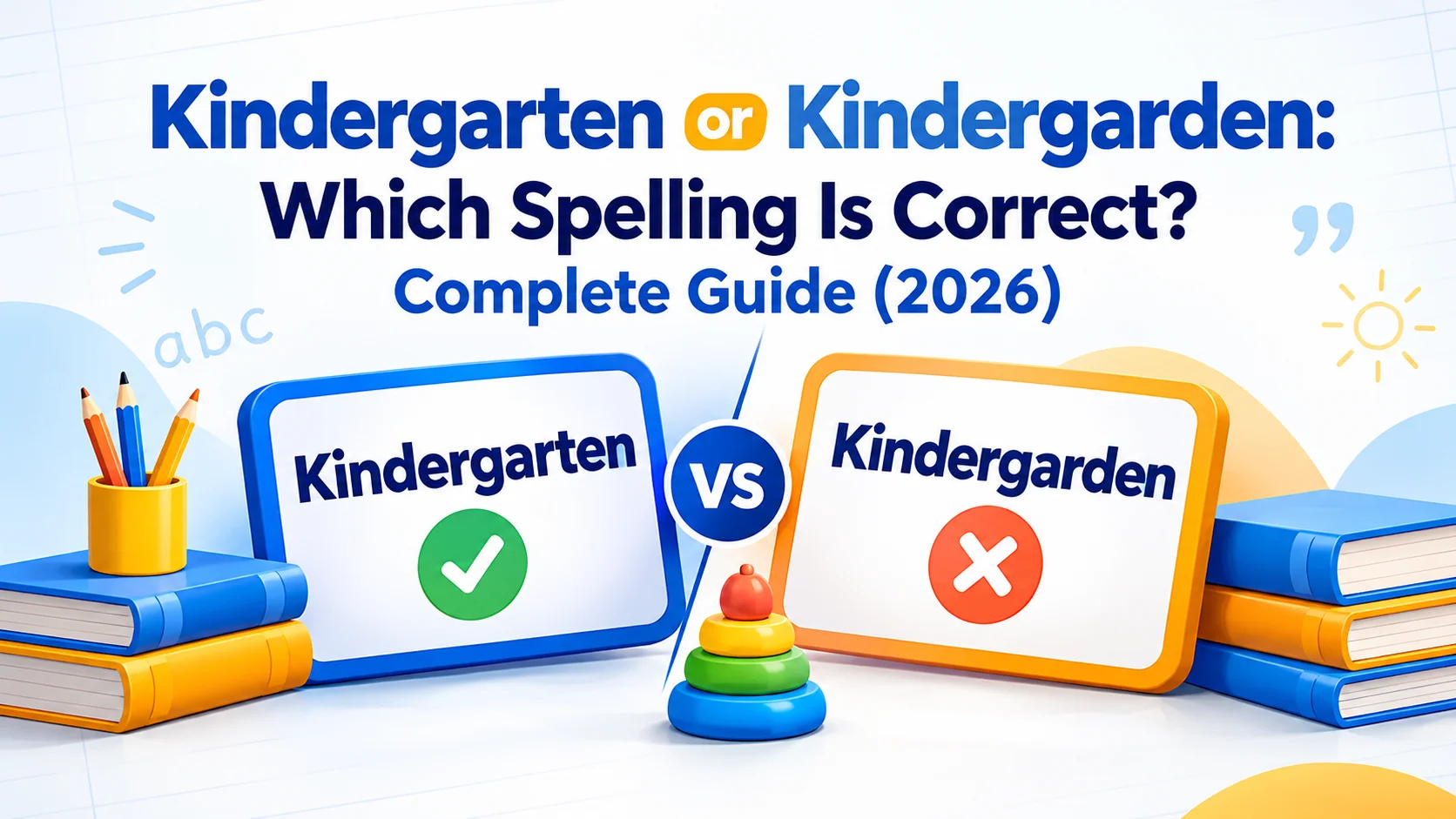
The spelling difference between kindergarten and kindergarden can be surprisingly confusing, especially when the word sounds as though it contains the familiar English word garden. If you have ever typed kindergarden and wondered whether it was correct, the answer is straightforward: kindergarten is the standard spelling. It refers to an early stage of education for young children, although its exact meaning varies by country. Understanding why the word contains a t instead of a d will help you remember its spelling and use it confidently in school assignments, parent-teacher emails, educational articles, and everyday conversations.
The confusion comes partly from the word’s German origin. Kindergarten combines German words associated with children and a garden, an image traditionally used to describe an environment where young children grow and learn. Because Garten resembles the English word garden, writers sometimes replace the original t with a d. Pronunciation can contribute to the mistake, too, particularly when the middle consonants sound less distinct in rapid speech. However, familiar-looking English words do not always reveal the correct spelling of borrowed words. The word’s history provides a much more reliable clue.
In this guide, you will learn the correct spelling, meaning, pronunciation, and origin of kindergarten, along with the reasons kindergarden is a common error. You will also discover how the term differs across American, British, and international education systems, where kindergarten fits among terms such as preschool, pre-K, reception, and first grade, and how to use it naturally in sentences. Whether you are a student, parent, teacher, or English learner, these practical explanations will help you avoid spelling mistakes while understanding the word beyond its basic definition.
Kindergarten or Kindergarden: The Quick Answer
Kindergarten is the correct standard spelling. Kindergarden is generally a misspelling of the word, not an accepted alternative for the educational term.
| Feature | Kindergarten | Kindergarden |
| Standard spelling | Yes | No |
| Meaning | An early childhood educational setting or school grade, depending on the country | Usually an attempted spelling of kindergarten |
| Origin | German | A spelling influenced by the English word garden |
| Correct in school documents | Yes | No, unless reproducing a specific name or quotation |
| Memory clue | Keep the t in -garten | Do not replace the t with d |
For example:
- Correct: “My daughter starts kindergarten in September.”
- Incorrect: “My daughter starts kindergarden in September.”
The mistake does not usually change what a reader understands, but it can make a school application, article, or professional email look less carefully edited.
Is Kindergarden Ever an Acceptable Spelling?
In ordinary modern English, use kindergarten. The misspelling kindergarden does appear in informal writing, and historical texts may contain variants influenced by English spelling. That does not make it the standard form today.
There is one practical exception: if Kindergarden is the exact name of a business, organization, creative work, or other named entity, preserve its official spelling when referring to that name. Proper names can use unusual spellings.
What Does Kindergarten Mean?
A kindergarten is an educational setting for young children, or a particular early school grade, depending on the country. Activities often combine guided learning, play, language development, social interaction, and preparation for more formal schooling.
In the United States, kindergarten commonly refers to the school year before first grade, often attended by children around five years old. In other English-speaking countries, the term may refer to preschool education or a nursery setting instead.
What Children Typically Learn in Kindergarten
Kindergarten programs help children develop foundational skills rather than focusing exclusively on academic exercises. The exact curriculum depends on the school and local education system.
Children may practise:
- Early literacy: Recognizing letters, hearing sounds in words, listening to stories, and beginning to read.
- Early mathematics: Counting, comparing quantities, identifying shapes, and recognizing simple patterns.
- Communication: Expressing ideas, asking questions, and following instructions.
- Social skills: Sharing materials, taking turns, cooperating, and resolving everyday disagreements.
- Physical coordination: Drawing, cutting with child-safe scissors, building, running, and other age-appropriate activities.
- Independence: Managing belongings, following classroom routines, and completing simple tasks.
For example, a teacher might introduce counting by asking children to count blocks during a building activity. The children practise mathematics while also developing language, coordination, and cooperation.
These activities explain the educational meaning of the word, but they do not determine its spelling. Whether a school emphasizes play-based learning or a more structured curriculum, the standard English term remains kindergarten.
Kindergarten as a School Grade
In American English, kindergarten often identifies a specific grade rather than an entire type of preschool.
Consider these sentences:
- “He is in kindergarten this year.”
- “The kindergarten class visited the school library.”
- “She teaches kindergarten at an elementary school.”
In each example, the word refers to a school grade, classroom, or group of pupils.
This distinction matters when communicating internationally. A parent in the United States may use kindergarten to mean the year before first grade, while a British reader may associate it more closely with nursery education.
Kindergarten Teacher, Classroom, and Related Terms
The word also appears in familiar educational expressions:
- Kindergarten teacher: An educator who teaches or supports children in kindergarten.
- Kindergarten classroom: The room or learning environment used by a kindergarten class.
- Kindergarten student: A child enrolled in kindergarten.
- Kindergarten curriculum: The planned learning experiences and educational goals for the class.
- Kindergarten readiness: The developing skills that help a child participate in a school setting.
Use the same spelling in all these combinations. For instance, write kindergarten teacher, not kindergarden teacher.
Why Is It Spelled Kindergarten Instead of Kindergarden?
The most useful explanation is the word’s German origin. Kindergarten was coined by German educator Friedrich Fröbel in 1840 to describe an approach to early childhood education. The term combines German elements meaning children and garden, creating the figurative idea of a place where children can grow.
The spelling was adopted into English rather than being rewritten to match the familiar English spelling of garden. That is why the word retains t in -garten.
The German Origin of Kindergarten
In German, Kindergarten is a compound word built from elements associated with Kinder (children) and Garten (garden). Fröbel used the name to express his educational philosophy: children should be nurtured and supported as they develop, much as plants grow under a gardener’s care.
The term entered English during the nineteenth century and became established as the name for an early childhood educational setting.
This history offers a better explanation than trying to invent an English spelling rule. Borrowed words often retain spellings from their source languages, even when some letters or letter combinations look unfamiliar to English speakers.
What Do Kinder and Garten Mean?
The two elements provide a memorable way to understand the word:
- Kinder: Children.
- Garten: Garden.
Together, the word evokes a garden for children. The expression is metaphorical; it does not mean that kindergarten must take place in a literal garden.
One detail is worth remembering: although the English word resembles a direct combination of children and garden, it is a German compound. Its spelling follows the German word, not a new English construction such as kinder plus garden.
Why the T Matters
The t is part of the established spelling inherited from German Garten. Replacing it with d makes the word resemble the English garden, but it removes a letter from the conventional spelling.
Compare the two forms:
- Kindergarten — correct.
- Kindergarden — generally incorrect for the educational term.
The difference is only one letter, which makes the mistake easy to overlook during fast typing or proofreading. Remembering the source word helps you catch it.
How to Pronounce Kindergarten Correctly
Pronunciation varies somewhat by accent, but the spelling remains the same. In American English, the word is commonly pronounced approximately KIN-der-gar-ten, with the main stress at the beginning. British pronunciations may sound different, especially in the vowel of the final syllables.
A dictionary’s pronunciation guide or audio recording is useful if you need to learn the word precisely for teaching, speaking, or language study.
Breaking Kindergarten Into Syllables
For a practical learning exercise, divide the word into four spoken parts:
kin · der · gar · ten
Say each part slowly, then combine them:
- Say kin.
- Add der.
- Say gar.
- Finish with ten.
- Repeat the complete word: kindergarten.
This is a pronunciation aid, not a claim that every speaker produces four equally distinct syllables. In natural speech, unstressed vowels can become shorter, and the word may sound more compressed.
Why the Spelling Mistake Happens When People Speak
The familiar word garden can influence what people think they hear. In some American accents, the t in kindergarten may sound similar to a quick d-like sound because of a pronunciation process known as flapping. In other accents or speaking styles, the consonant may be clearer.
That can help explain the confusion, but pronunciation does not change the standard spelling.
If you are unsure, avoid spelling the word from sound alone. Write it from memory, check the German-derived ending -garten, and use a dictionary if necessary.
Kindergarten in American, British, and International English
The spelling kindergarten stays the same across standard varieties of English, but its educational meaning can change by location. This is an important distinction for parents, teachers, students, and writers preparing material for an international audience.
Is Kindergarten an American English Word?
The word originated in German, but it is well established in American English. In the United States, kindergarten usually refers to the school grade before first grade. Children commonly enter around age five, although eligibility dates and requirements differ by state and school district.
For example:
“The school requires proof of age before a child can enroll in kindergarten.”
Here, kindergarten refers to a formal stage in the school system rather than simply a childcare setting.
What Do British Schools Call Kindergarten?
In the United Kingdom, nursery and reception are often more relevant terms, depending on the child’s age and the educational setting. Reception is generally the first year of primary school in England, while nursery typically refers to earlier provision.
However, kindergarten is also used in British English, especially when discussing early education in other countries or particular educational approaches.
Kindergarten vs. Preschool, Pre-K, Reception, and Year 1
These terms overlap, but they are not exact synonyms. Their meaning depends on the country’s school system.
| Term | Common usage | Important distinction |
| Kindergarten | A school grade in the US; an early childhood setting in several other countries | Meaning varies by location |
| Preschool | Early education before formal school entry | Usually describes a broad type of program |
| Pre-K | A program before kindergarten, especially in the US | Often intended to prepare children for kindergarten |
| Nursery | Early childhood care or education, commonly in the UK | May cover different ages and arrangements |
| Reception | The first year of primary school in England | Not identical to US kindergarten |
| Year 1 | The year after Reception in England | Usually corresponds to a later stage than Reception |
Age ranges and enrollment rules vary, so parents should check local school guidance rather than assuming these labels describe identical programs.
How Kindergarten Usage Differs Across Countries
In the United States, kindergarten often named a school grade. In Australia and New Zealand, the term may refer to an early childhood setting, although local terminology differs by state or region. In India, KG is commonly used in school contexts, often with distinctions such as lower kindergarten and upper kindergarten.
In Germany, the original word usually refers to an early childhood care and education setting before primary school. It does not map perfectly onto the American school grade.
Writing tip: If your audience is international, identify the country or education system when the exact stage matters. Saying “kindergarten in the United States” is more precise than implying that every country uses the term in the same way.
Kindergarten in Everyday Sentences
Seeing the correct spelling in complete sentences makes it easier to remember and use naturally.
Kindergarten in Sentences About School
- My son will start kindergarten next autumn.
- The kindergarten class visited the school library.
- Our local school offers a full-day kindergarten program.
- The teacher prepared a new activity for the kindergarten students.
These examples show the word used as a noun to identify a grade, class, or educational program.
Kindergarten in Sentences About Children and Learning
- Children in kindergarten often learn through guided play.
- The kindergarten curriculum introduces basic literacy and mathematics.
- Parents can help children prepare for kindergarten by reading together.
- The school encourages kindergarten students to practise sharing and cooperation.
Notice that the word remains unchanged even when the sentence focuses on different aspects of early education.
Kindergarten in Parent-Teacher Communication
When writing to a school, use the standard spelling in the subject line, greeting, and body of your message.
Example:
“Dear Ms. Ahmed, I am writing to ask about the kindergarten enrollment process for next year. Could you please let me know which documents we need to submit?”
A spelling mistake may not prevent the teacher from understanding your message, but accurate spelling makes the communication more polished.
Kindergarten in Professional and Academic Writing
In education reports, research summaries, and school policies, the term may describe a program, grade level, or group of pupils.
Examples:
- “The study examined early literacy development among kindergarten children.”
- “The district plans to expand its full-day kindergarten program.”
- “Kindergarten teachers use a range of activities to support language development.”
If you are writing for an international audience, clarify which education system you mean. That context may be more important than the spelling question itself.
Common Kindergarten Spelling Mistakes and How to Avoid Them
Replacing the T With D Because of the Word Garden
This is the central mistake. Because garden is familiar in English, writers may unconsciously change -garten to -garden.
How to avoid it: Learn the whole spelling as one unit: kindergarten. Do not rebuild it from English words every time you write it.
Assuming Kindergarten Is an English Compound
The word looks as if it were formed from English elements, but it comes from German. Treating it as an English compound can encourage the wrong spelling.
How to avoid it: Remember that the original German form is Kindergarten. Its spelling explains why the t belongs there.
Confusing Pronunciation With Spelling
Fast speech can make the middle consonant less distinct, and some accents may pronounce it in a way that sounds closer to a d.
How to avoid it: Use pronunciation to learn how to say the word, not as the only guide to how to spell it. If the spelling matters, check the written form.
Using Kindergarden in School Applications or Formal Documents
The intended meaning will usually be obvious, but the error is easy to correct and worth catching in documents that represent you professionally.
Before submitting an application, newsletter, lesson plan, or report, check:
- The word is spelled kindergarten every time.
- Related phrases use the same spelling.
- The term matches the intended country’s education system.
- Any proper names are preserved exactly as officially written.
Correcting the Word Without Checking the Context
In ordinary prose, kindergarden should generally be corrected to kindergarten. But if you are quoting a historical source, reproducing a business name, or discussing spelling errors themselves, the original form may need to remain.
For example, an article about common misspellings may deliberately include kindergarden to explain the error. In that context, the spelling is being discussed, not recommended.
How to Remember the Correct Spelling of Kindergarten
A good memory trick should help you recall the spelling when you need it, not merely sound clever.
Remember the German Words Behind Kindergarten
Think of the German elements Kinder and Garten. The second element is written with t, so the English word retains the same letter.
The idea of a garden where children grow and learn provides an additional memory aid.
Use a Letter-by-Letter Spelling Check
If you often mistype the word, break it into sections when proofreading:
- Kinder
- garten
Then join the parts: kindergarten.
Pay particular attention to the final portion. The error usually involves replacing the t in -garten with a d.
Practise With Short Sentences
Write a few sentences using the word in different contexts:
- “She teaches kindergarten.”
- “The kindergarten classroom is bright.”
- “Enrollment for kindergarten opens in January.”
Practising the correct spelling in natural sentences is more useful than memorizing a letter sequence without context.
Can a Spellchecker Catch Kindergarden?
Many spellcheckers flag kindergarden because it is not the standard spelling of the educational term. However, spellcheckers are not infallible, especially when unusual words, proper names, or specialized terminology are involved.
For important writing, combine automatic checks with a quick manual review. Search your document for kindergarden and inspect each occurrence. If you find one in ordinary educational prose, change it to kindergarten.
Conclusion
When choosing between kindergarten and kindergarden, remember that kindergarten is the standard spelling in modern English. Its German origin explains why the word retains the t in -garten, even though the familiar English word garden may tempt you to write a d. The term’s meaning also depends on where you use it: in the United States, it commonly refers to a school grade, while other countries may use it for different early childhood settings. One final actionable tip: Remember the German-derived spelling and check the word before submitting school documents, educational articles, or professional emails. A common mistake to avoid is spelling a borrowed word according to how a familiar English word looks or sounds. A little attention to its origin makes the correct form easier to remember—and helps your writing stay clear and accurate.
Frequently Asked Questions
Q1. Is Kindergarten or Kindergarden Correct?
Kindergarten is the standard spelling for the educational term. Kindergarden is generally a misspelling caused by confusion with the English word garden. When writing about a school grade, classroom, or early childhood program, use kindergarten.
Q2. Why Is Kindergarten Spelled With a T?
The spelling comes from German, where Kindergarten combines elements meaning children and garden. The word was introduced by educator Friedrich Fröbel in 1840. English retained the German spelling, including the t in -garten, rather than replacing it with a d.
Q3. Is Kindergarten Spelled the Same in British and American English?
Yes. Kindergarten is spelled the same way in British and American English. The main difference is usage: Americans commonly use it for the school grade before first grade, while British speakers may use nursery or reception for related educational stages.
Q4. How Do You Pronounce Kindergarten?
In American English, kindergarten is commonly pronounced approximately KIN-der-gar-ten, with stress on the first syllable. Pronunciation varies across accents, and the middle consonant may sound less distinct in rapid speech. Regardless of accent, the standard written form remains kindergarten.
Q5. What Is Kindergarten Called in the UK?
In England, nursery often describes early childhood education before primary school, while Reception is generally the first year of primary school. These terms do not match American kindergarten exactly. The appropriate term depends on the child’s age, school stage, and the specific UK nation.