

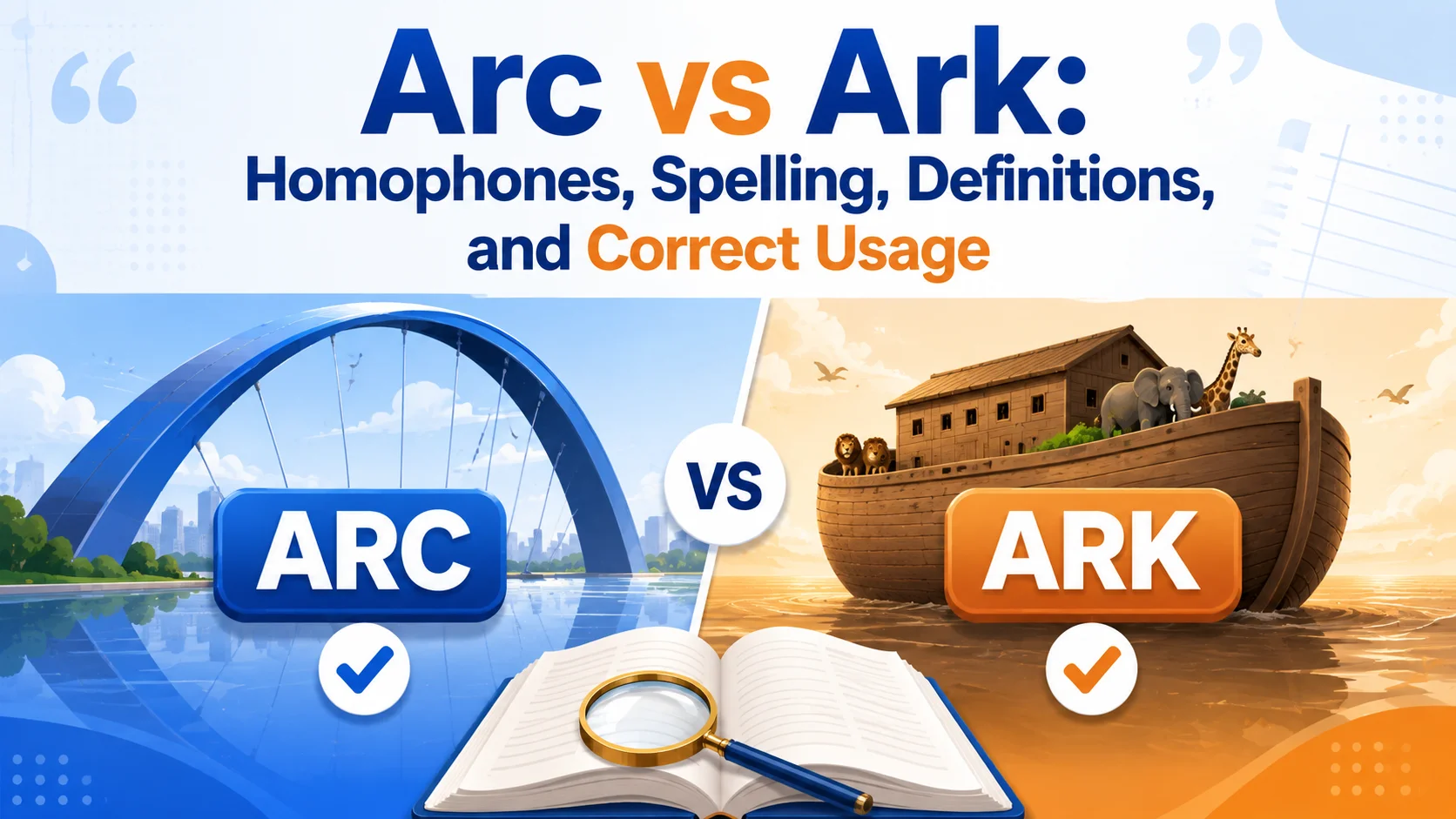
Arc vs ark is a classic English spelling problem because the two words are pronounced alike in standard English, yet they refer to completely different things. Arc can describe a curve, a curved path, a progression in a story, or a discharge of electricity. Ark, on the other hand, usually refers to a vessel such as Noah’s Ark or a sacred chest such as the Ark of the Covenant. The difference looks small on the page, but choosing the wrong word can change the meaning of an otherwise perfectly clear sentence.
The confusion becomes especially common when you encounter these words in phrases you’ve heard many times but rarely seen written down. You might know that a hero has a “character ___” without immediately remembering whether the final letter is c or k. The same problem appears with arc length, electrical arc, Noah’s Ark, and Ark of the Covenant. Because spellcheck recognizes both words as legitimate English, it may not flag a mistake. The solution is to connect the spelling with the meaning and context, not simply with the sound.
In this guide, you’ll learn exactly when to use arc and when to use ark, how their meanings developed, why they sound the same, and how to distinguish them from arch. You’ll also see practical examples from mathematics, storytelling, sports, electricity, religion, and everyday writing. By the end, you should be able to choose the correct spelling almost automatically: arc means a curve or progression; ark means a vessel or sacred chest. That simple distinction solves most cases.
Arc vs Ark: The Quick Answer
The simplest way to remember the difference is:
Arc = a curve, curved path, or progression.
Ark = a vessel, boat, or sacred chest.
Both words are pronounced /ɑːk/ in British English and /ɑːrk/ in American English, although exact pronunciation varies by accent. Cambridge gives the same basic pronunciation for arc and ark, which is why they function as homophones.
| Word | Meaning | Common examples |
| Arc | A curve or curved path | arc length, arc of a ball, electrical arc |
| Arc | A progression or development | character arc, story arc |
| Ark | A vessel associated with Noah | Noah’s Ark |
| Ark | A sacred chest | Ark of the Covenant |
| Arch | A curved structural form | stone arch, doorway arch |
So if you’re describing the path of a basketball, use arc. If you’re discussing Noah’s vessel, use ark. If you’re talking about a curved structure over a doorway, use arch.
That three-way distinction is worth remembering because arc, ark, and arch are frequently mixed up in writing.
Are Arc and Ark Homophones?
Yes. Arc and ark are homophones because they have the same pronunciation but different meanings and spellings.
A homophone is a word that sounds like another word but differs in spelling, meaning, or both. Other familiar examples include:
- right / write
- flower / flour
- sea / see
- brake / break
The same principle applies to arc and ark.
Why Do They Sound the Same?
In modern English, both words contain the same basic vowel and end with the same /k/ sound. The spelling tells you which word you’re looking at; pronunciation usually doesn’t.
Cambridge lists arc as /ɑːk/ in British English and /ɑːrk/ in American English, while ark is likewise pronounced /ɑːk/ in British English and /ɑːrk/ in American English.
That creates a practical problem: you can hear the sentence correctly and still spell the word incorrectly.
For example:
- “The character has a powerful arc.”
- “Noah built an ark.”
If you only hear those sentences, there’s no reliable sound-based clue telling you which spelling to choose. You have to use context.
What Does Arc Mean?
Arc is a noun with several related meanings, all connected in some way to the idea of curvature, movement, or development.
Merriam-Webster defines arc in senses that include something curved, a curved path, an electrical discharge, a portion of a circle or ellipse, and a continuous progression or line of development.
The Core Definition of Arc
At its most basic, an arc is something curved or a curved path.
For example:
- “The rainbow formed a bright arc across the sky.”
- “The ball traveled in a high arc.”
- “The bridge follows a graceful arc.”
The word can describe a physical shape, the path something takes, or a more abstract form of progression.
That last meaning explains why English speakers use arc in storytelling. A story or character can be said to move through a sequence of development, almost as though that development follows a curved path from one point to another.
Arc in Geometry and Mathematics
In geometry, an arc is a continuous portion of a curved line, especially part of the circumference of a circle.
Imagine drawing a circle and selecting only one section of its circumference. That selected portion is an arc.
Some useful terms include:
- Minor arc: the shorter arc between two points on a circle.
- Major arc: the longer arc between two points.
- Semicircular arc: half of a circle.
- Arc length: the distance along the curved portion.
- Central angle: an angle formed at the center of a circle by two radii.
For a circle, arc length can be calculated using the central angle. If the angle is measured in degrees:
Arc length = (θ / 360°) × 2πr
where θ is the central angle and r is the radius.
For example, if a circle has a radius of 10 cm and you need the length of a 90-degree arc:
(90 / 360) × 2π(10) = 5π cm
So the arc is approximately 15.7 cm long.
You don’t need this formula to use arc correctly in ordinary writing, but understanding the mathematical meaning makes the spelling much easier to remember.
Arc as a Curved Path
You’ll also see arc used for the trajectory of moving objects.
Consider a ball thrown into the air. It doesn’t normally travel straight upward and then straight downward. Its path forms a curve, or arc.
Examples:
- “The quarterback threw the ball in a high arc.”
- “The fireworks rose in a brilliant arc.”
- “The rocket followed an upward arc.”
This meaning appears frequently in sports, physics, astronomy, engineering, and everyday descriptions of movement.
Arc in Storytelling and Literature
One of the most common non-mathematical uses of arc is character arc.
A character arc describes how a character changes over the course of a story. The change may involve beliefs, behavior, relationships, goals, values, or emotional maturity.
For example:
“Her character arc takes her from fear of failure to confidence in her own abilities.”
The word arc works because the character moves through a sequence of experiences and ends somewhere meaningfully different from where they began.
A story arc is broader. It refers to the development of a storyline, often involving setup, conflict, escalation, and resolution.
So:
- Character arc = how a character develops.
- Story arc = how a storyline develops.
- Plot arc = the progression of the plot.
This is why character arc is correct, while character ark is not.
Arc in Electricity
In electrical terminology, an arc is a powerful or sustained flow of electricity across a gap.
Cambridge describes an electrical arc as a powerful flow of electricity that crosses a space between two points, while Merriam-Webster similarly defines it as a luminous electrical discharge across a gap in a circuit or between electrodes.
You may encounter terms such as:
- electrical arc
- arc flash
- arc welding
- electric arc
- arc discharge
For example:
“The technician followed safety procedures to prevent an electrical arc.”
Again, the correct spelling is arc, because the word describes an electrical discharge that jumps across a gap.
Arc in Sports and Motion
Sports provide another familiar example.
In basketball, the arc can refer to the curved three-point line around the basket. Merriam-Webster also records arc as a basketball term for the three-point line.
You’ll also hear phrases such as:
- “The shot had a high arc.”
- “He shoots well from beyond the arc.”
- “The ball traveled in a shallow arc.”
The word remains arc because the underlying idea is curvature.
What Does Ark Mean?
Ark is a different word entirely.
Its best-known meaning is a large vessel associated with Noah and the biblical Flood. It can also refer to the Ark of the Covenant, a sacred chest described in the Hebrew Bible.
Merriam-Webster traces ark through Middle English and Old English forms to Latin arca, meaning a chest, box, or coffer.
The Core Definition of Ark
The word ark traditionally refers to a container, chest, or vessel, with its most familiar meanings developing around important biblical objects.
Today, most readers immediately associate it with:
Noah’s Ark
However, that isn’t the only use of ark.
Noah’s Ark
Noah’s Ark is the large vessel described in the biblical account of the Flood.
The correct spelling is:
Noah’s Ark
Not:
- Noah’s Arc
- Noah’s Arch
The confusion is understandable because ark and arc sound alike. But their meanings are completely different.
Cambridge defines the ark in this context as the large wooden ship Noah built to save his family and animals during the Flood narrative.
Example:
“The children learned the story of Noah’s Ark in Sunday school.”
The Ark of the Covenant
There is another important biblical use of ark: the Ark of the Covenant.
Unlike Noah’s Ark, this ark is not a ship. It refers to a sacred chest associated with the ancient Israelites.
Cambridge describes the Ark of the Covenant as a wooden box associated with the writings of Jewish law and the presence and guidance of God.
That distinction is useful because it shows that ark does not simply mean “boat.”
It can refer to a sacred chest or repository as well.
Ark in Historical and Modern Usage
The older history of ark is broader than the modern association with Noah.
Merriam-Webster traces the word through forms meaning chest, box, coffer, or coffin, ultimately connecting it with Latin arca.
The word can also appear metaphorically. Something described as an ark may represent a place of protection, preservation, or safety.
This makes sense historically: a container protects what is inside it, while Noah’s Ark is traditionally understood as a means of preservation during the Flood.
Arc vs Ark: The Key Differences
| Feature | Arc | Ark |
| Pronunciation | Usually /ɑːk/ or /ɑːrk/ | Usually /ɑːk/ or /ɑːrk/ |
| Word type | Noun; also verb | Mainly noun |
| Core idea | Curve, path, or progression | Vessel, chest, or repository |
| Geometry | Yes | No |
| Storytelling | Character arc, story arc | No |
| Electricity | Electrical arc | No |
| Sports | Arc of a shot; beyond the arc | No |
| Noah | No | Noah’s Ark |
| Covenant | No | Ark of the Covenant |
| Common confusion | “character ark” | “Noah’s arc” |
The easiest decision rule is this:
If the meaning involves a curve, trajectory, development, or electrical discharge, choose arc. If it involves Noah, a sacred chest, or a vessel, choose ark.
Arc vs Ark vs Arch: Why These Words Get Confused
The third word in this group, arch, creates another spelling trap.
Arc vs Arch
An arc is a curve or curved path.
An arch is commonly a curved structural form, especially one spanning an opening.
Compare:
- “The ball traveled in an arc.”
- “The old stone bridge has a large arch.”
Merriam-Webster defines an arch as a usually curved structural part positioned over an opening and serving as support. Its etymology is related to Latin arcus, the same broader historical family associated with a bow or curved form.
The words are related historically, but modern English uses them differently.
Is It Character Arc or Character Arch?
The correct expression is character arc.
“The protagonist has a compelling character arc.”
Here, arc means the character’s development or progression.
Arch would suggest a physical curved structure, which makes no sense in this context.
Arc, Arch, and Ark at a Glance
| Word | Basic meaning | Example |
| Arc | Curve or progression | “The ball followed an arc.” |
| Arch | Curved structure | “The doorway has a stone arch.” |
| Ark | Vessel or sacred chest | “Noah built an ark.” |
A useful memory sentence is:
An arc curves, an arch supports, and an ark carries or contains.
That isn’t a formal dictionary definition, but it’s an effective way to keep the three spellings apart.
Common Arc vs Ark Spelling Mistakes
“Noah’s Arc” vs “Noah’s Ark”
Correct: “The story of Noah’s Ark is familiar to many people.”
Incorrect: “The story of Noah’s Arc is familiar to many people.”
Why? Because Noah’s vessel is an ark, not a mathematical or physical curve.
“Character Ark” vs “Character Arc”
Correct: “The character arc becomes clear near the end of the novel.”
Incorrect: “The character ark becomes clear near the end of the novel.”
A character doesn’t travel inside a vessel. The phrase describes character development, so arc is the correct word.
“Electrical Ark” vs “Electrical Arc”
Correct: “The equipment was designed to reduce the risk of an electrical arc.”
Incorrect: “The equipment was designed to reduce the risk of an electrical ark.”
An electrical discharge is an arc.
“Arc of the Covenant” vs “Ark of the Covenant”
Correct: “The Ark of the Covenant is an important biblical object.”
Incorrect: “The Arc of the Covenant is an important biblical object.”
The biblical object is a sacred ark, meaning a chest or repository.
“Arch Length” vs “Arc Length”
This mistake is particularly common among students.
Arc length is the length of a curved section of a circle or another curve.
Arch length would describe the length of an arch in a context where that measurement is relevant, but it is not the standard mathematical term for the curved portion of a circle.
So in geometry, write:
Calculate the arc length.
Not:
“Calculate the arch length.”
Arc vs Ark Example Sentences
Examples Using Arc
- “The moon appeared through a narrow arc of the clouds.”
- “The gymnast moved through a graceful arc.”
- “The ball traveled in a high arc.”
- “Students learned how to calculate the arc length.”
- “The welding process can produce an electrical arc.”
- “The protagonist’s character arc is the strongest part of the novel.”
- “The second season completes the larger story arc.”
- “He shoots accurately from beyond the arc.”
Examples Using Ark
- “The children read a story about Noah’s Ark.”
- “The animals were taken aboard the ark.”
- “The Ark of the Covenant is described in the Hebrew Bible.”
- “The novel imagines a generation ship as a modern ark.”
- “The ark became a symbol of preservation and safety.”
Correct and Incorrect Examples
| Meaning | Correct | Incorrect |
| Character development | character arc | character ark |
| Biblical vessel | Noah’s Ark | Noah’s Arc |
| Geometry | arc length | arch length |
| Electrical discharge | electrical arc | electrical ark |
| Sacred chest | Ark of the Covenant | Arc of the Covenant |
| Curved trajectory | ball’s arc | ball’s ark |
| Curved structure | stone arch | stone arc/ark |
How to Remember Arc vs Ark
Memory Trick: Arc = A Curve
Think of the c in arc as standing for curve.
That gives you:
Arc → Curve
When you see phrases such as arc length, arc of a circle, or character arc, the connection is easy: each involves some kind of movement or progression from one point to another.
Memory Trick: Ark = A Vessel
Associate ark with Noah’s Ark.
Think:
Ark → Noah → vessel
You can then extend that association to the Ark of the Covenant, which is a sacred chest rather than a ship.
The Three-Word Memory Rule
If you frequently confuse all three words, use:
Arc = curve
Arch = structure
Ark = vessel
This is more useful than memorizing individual phrases because it gives you a rule you can apply to unfamiliar sentences.
A Fast Context Test
When you’re unsure, stop listening to the sound and ask:
“What does this word mean here?”
If the answer is:
- a curve → arc
- a curved path → arc
- a character’s development → arc
- a storyline’s progression → arc
- an electrical discharge → arc
- a curved structure → arch
- Noah’s vessel → ark
- a sacred biblical chest → ark
This method is more reliable than trying to remember how the word sounds.
Why Spellcheck Often Misses Arc vs Ark Errors
Spellcheck is useful, but it can’t always determine what you intended.
Consider this sentence:
“The hero’s character ark was surprisingly moving.”
Every individual word is spelled correctly according to the dictionary. Ark is a real English word. Therefore, a basic spellchecker may have no reason to mark it as a spelling error.
The problem is contextual correctness, not conventional spelling.
The same thing happens with:
“Noah’s arc carried the animals safely.”
Again, arc is spelled correctly as a word. It’s simply the wrong word for the meaning.
A Better Proofreading Strategy
When proofreading homophones:
- Look for words that sound alike.
- Ask what each word means in the sentence.
- Check familiar phrases rather than isolated words.
- Read the sentence for meaning, not just spelling.
- Use a dictionary when the intended word is uncertain.
This approach works for arc/ark as well as there/their/they’re, your/you’re, and other contextual spelling problems.
Expert tip: When spellcheck accepts both options, don’t ask “Is this word spelled correctly?” Ask “Is this the correct word for what I mean?”
That small change in proofreading habits catches errors that ordinary spellcheck cannot.
When the Difference Between Arc and Ark Matters Most
The distinction matters most when the surrounding context is technical, academic, or formal.
Academic and Mathematical Writing
In mathematics, using arc correctly matters because arc is a defined geometric term.
Examples include:
- arc length
- circular arc
- minor arc
- major arc
- arc measure
A spelling error can make an otherwise accurate solution look careless.
Creative Writing
Writers regularly use:
- character arc
- story arc
- narrative arc
- emotional arc
- dramatic arc
Using ark in one of these expressions can distract readers and undermine confidence in the writing.
Technical Writing
Electrical engineering, welding, physics, and related fields use arc as technical vocabulary.
For example:
“The system includes protection against arc faults.”
In this context, substituting ark is more than a casual spelling mistake because it changes a recognized technical term.
Religious and Historical Writing
When discussing biblical subjects, ark is essential:
- Noah’s Ark
- Ark of the Covenant
A writer discussing these subjects should be particularly careful because arc and ark can both pass ordinary spellcheck.
The Linguistic Difference Between Arc and Ark
Although arc and ark sound alike today, their histories are not identical.
Merriam-Webster traces arc through Middle English ark from Anglo-French arc, ultimately from Latin arcus, meaning a bow, arch, or arc.
Ark, meanwhile, comes through Germanic and Middle English forms ultimately connected with Latin arca, meaning a chest, box, or coffer.
That distinction is fascinating because the modern words are almost indistinguishable in speech while having different historical pathways.
It also explains why pronunciation alone is not a good spelling guide.
Why English Has So Many Homophones
English has absorbed vocabulary from many languages over centuries. Words with different origins can gradually develop similar pronunciations because of sound changes, borrowing, and the evolution of English pronunciation.
That means two words don’t have to come from the same original word to sound identical today.
For learners, the practical lesson is simple:
English spelling often requires you to connect sound with meaning and context.
A Practical Decision Guide for Arc, Ark, or Arch
| If you mean… | Use | Example |
| A portion of a circle | arc | “The angle subtends an arc.” |
| A curved trajectory | arc | “The ball followed an arc.” |
| A character’s development | arc | “Her character arc is subtle.” |
| A storyline’s progression | arc | “The story arc reaches its climax.” |
| An electrical discharge | arc | “The fault produced an arc.” |
| A curved structural support | arch | “The arch supports the entrance.” |
| Noah’s vessel | ark | “Noah’s Ark is central to the story.” |
| A sacred biblical chest | ark | “The Ark of the Covenant is mentioned.” |
When in doubt, focus on the concept, not the pronunciation.
Conclusion
The easiest way to master arc vs ark is to stop treating it as a pronunciation problem. The two words sound alike, but their meanings point in completely different directions. Arc belongs to curves, trajectories, electrical discharges, geometry, and development in storytelling. Ark belongs primarily to vessels, sacred chests, Noah’s Ark, and the Ark of the Covenant. When arch enters the picture, remember that it generally describes a curved structure. One final actionable tip: whenever you hesitate between arc and ark, replace the word mentally with its meaning. If you mean curve or progression, choose arc. If you mean vessel or sacred chest, choose ark. A common mistake to avoid is trusting spellcheck alone: both words are correctly spelled, so only context tells you whether you chose the right one. In short, hear the sound, but choose the spelling by meaning.
Frequently Asked Questions
Q1. Is arc and ark the same word?
No. Arc and ark are different words even though they sound alike. Arc refers to a curve, curved path, or progression, while ark refers to a vessel or sacred chest. Their shared pronunciation makes them homophones, but their meanings and spellings remain distinct.
Q2. Are arc and ark pronounced the same?
Yes, in standard English they are generally pronounced the same: /ɑːk/ in British English and /ɑːrk/ in American English. Regional accents can produce minor differences, but those differences usually don’t provide a dependable spelling clue.
Q3. Is it character arc or character ark?
The correct phrase is character arc. It describes the way a character develops or changes during a story. The word arc comes from the idea of a progression or curved course. Character ark is a homophone-based spelling mistake, not an accepted storytelling term.
Q4. Is it Noah’s Arc or Noah’s Ark?
The correct spelling is Noah’s Ark. Here, ark refers to the vessel Noah built in the biblical Flood narrative. Noah’s Arc is incorrect because arc means a curve or curved path and doesn’t have the intended meaning in this expression.
Q5. What is the difference between arc, ark, and arch?
Arc means a curve, curved path, or progression; ark means a vessel or sacred chest; and arch commonly means a curved structural form over an opening. For example, a ball follows an arc, a doorway may have an arch, and Noah built an ark.