
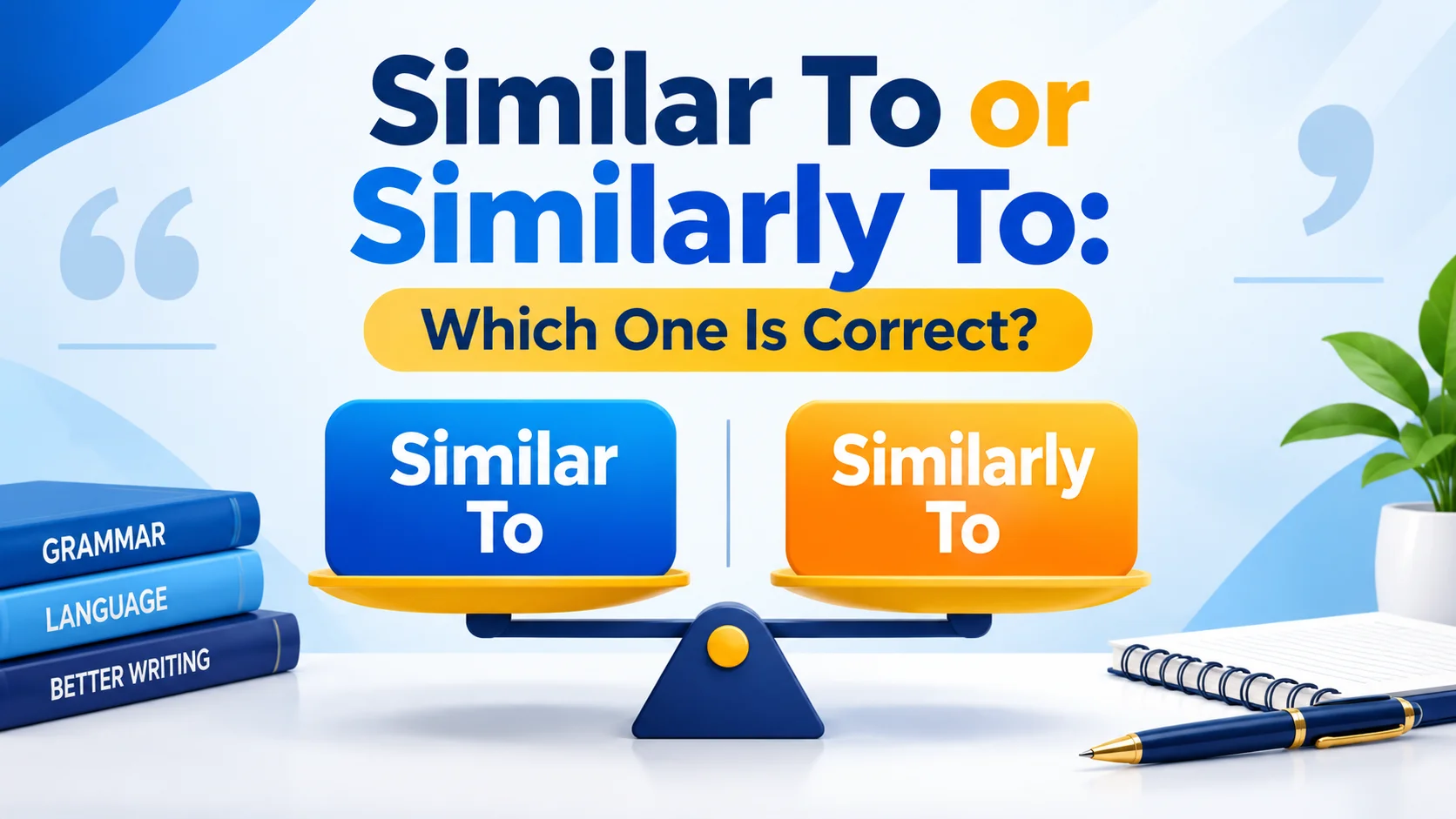
Similar to or similarly to—which one should you use? The answer depends on what you are comparing. Similar to is an adjective phrase used to show that one person, thing, idea, or situation resembles another. Similarly, by contrast, is an adverb meaning “in a similar way” or “likewise.” The two forms look closely related, but they do not normally do the same grammatical job. Once you identify whether your sentence compares things or the way actions happen, the choice becomes much easier.
The confusion usually appears in sentences such as “This device works similar to that one” or “Similarly to the previous model, this version is cheaper.” Some of these sentences can be corrected in more than one way, depending on the intended meaning. The important issue is not simply whether a word “sounds right.” You need to know what the word modifies, what relationship you want to express, and whether the comparison is between nouns, actions, results, or whole ideas.
In this guide, you will learn exactly how similar to, similarly, and similarly to work, with practical examples from everyday, academic, and professional English. You will also see common mistakes, sentence rewrites, comparisons with like, alike, and same, and a quick decision method you can use when writing. By the end, you should be able to choose the natural form without relying on guesswork.
Quick Answer: Similar To vs. Similarly To
If you need a simple rule, start here:
Use “similar to” when you are describing one thing as resembling another. Use “similarly” when you mean “in a similar way.” Use “similarly to” only when the sentence genuinely compares the manner in which an action is performed.
For example:
- The new phone is similar to my old phone.
- The two phones are similarly designed.
- The new phone performs similarly to the older model.
These sentences are related, but their structures are different.
| Expression | Grammatical role | Main meaning | Example |
| similar | Adjective | Almost, but not exactly, the same | The designs are similar. |
| similar to | Adjective + preposition | Resembling another thing | This design is similar to that one. |
| similarly | Adverb | In a similar way | Both machines operate similarly. |
| similarly to | Adverb + preposition | In a similar way to something | The machine operates similarly to the older model. |
The Oxford Advanced Learner’s Dictionary lists similar as an adjective meaning “like somebody/something but not exactly the same” and specifically gives the pattern similar to somebody/something. Cambridge likewise identifies similar as an adjective and gives examples such as “very similar to”.
What Does “Similar To” Mean?
Similar means that two things have characteristics in common, although they are not necessarily identical.
The word similar is an adjective. It describes a noun or pronoun, while introducing the thing being compared.
Basic structure
The most common pattern is:
Subject + linking verb + similar to + comparison
Examples:
- My laptop is similar to yours.
- This painting is similar to the original.
- Her writing style is similar to her teacher’s.
- The two problems are similar to each other.
- This situation is similar to what happened last year.
The phrase does not necessarily mean the two things are exactly alike. Cambridge defines similar as “looking or being almost, but not exactly, the same.”
Similar does not mean identical
This distinction matters.
If two objects are the same, they may be identical or refer to the same thing. If they are similar, they share some characteristics but remain different in some respects.
Compare:
- These two shirts are the same.
- These two shirts are similar to each other.
The first can suggest exact identity or equivalence. The second simply establishes resemblance.
How to Use “Similar To” Correctly
1. Use “similar to” for direct comparisons
When you are comparing a person, object, idea, place, product, or situation with another, similar is usually the natural choice.
Examples:
- This camera is similar to the previous model.
- Your answer is similar to mine.
- The two buildings are similar to each other.
- Her experience was similar to mine.
This is by far the most common situation in which people asking about “similar to or similarly to” actually need help.
2. “Similar to” can be followed by a noun phrase
Examples include:
- similar to my car
- similar to the original design
- similar to his explanation
- similar to the previous version
- similar to what we discussed
The comparison target does not have to be a single noun.
3. “Similar to” can appear with pronouns
Pay attention to pronoun choice:
- The result was similar to mine.
- Her opinion is similar to his.
- Their experience was similar to ours.
A common beginner mistake is writing “similar to my” when a possessive pronoun is needed.
Incorrect: The result is similar to my.
Correct: The result is similar to mine.
4. Use modifiers when you need to express degree
You can make the comparison stronger or weaker:
- very similar to
- quite similar to
- remarkably similar to
- closely similar to
- almost similar to
However, not every combination sounds equally natural. In many cases, very similar to, quite similar to, or remarkably similar to will be cleaner than piling several modifiers into one sentence.
Examples of “Similar To” in Sentences
Everyday examples
- This recipe is similar to the one my grandmother uses.
- Your jacket looks similar to mine.
- The new sofa is similar to our old one.
- Their houses are surprisingly similar to each other.
Academic examples
- The second experiment produced results similar to the first.
- The student’s argument is similar to an earlier theory.
- The two studies used methods similar to those used in previous research.
Workplace examples
- The new procedure is similar to the existing process.
- This proposal is similar to the one we discussed last week.
- The updated software has features similar to those found in competing products.
Technology examples
- This interface is similar to the previous version.
- The new tablet is similar to the older model in appearance.
- The two systems have similar security features.
Notice that similar to is doing one consistent job in all these examples: it identifies a relationship of resemblance between things.
What Does “Similarly” Mean?
Similarly is an adverb. It means “in a similar way” or “likewise.” Cambridge classifies it as an adverb and gives examples where it connects comparable actions or statements.
Examples:
- The children were similarly dressed.
- Both machines operate similarly.
- The first experiment was successful. Similarly, the second produced positive results.
- She handled the problem calmly. Her colleague responded similarly.
The important difference is that “similarly ” does not simply mean “similar.” It tells the reader that something happens or is expressed in a comparable way.
“Similarly” can modify an action
Consider:
The two students answered similarly.
Here, similarly describes how they answered.
Compare that with:
The two students are similar.
Here, similar describes the students themselves.
That small grammatical difference explains much of the confusion.
How “Similarly” Works in a Sentence
At the beginning of a sentence
Similarly can connect one statement with a previous statement:
The first method reduced costs. Similarly, the second method improved efficiency.
The second sentence is being presented as comparable to the first.
In the middle of a sentence
It can also occur within a clause:
The two systems are similarly designed.
Here, similarly modifies the adjective/participial construction designed.
After a semicolon
A common formal pattern is:
The first approach produced strong results; similarly, the second approach performed well.
This structure is particularly useful in academic and professional writing because it makes the relationship between two statements obvious.
Is “Similarly To” Grammatically Correct?
Yes, “similarly to” can be grammatically possible, but it should not be treated as a direct replacement for “similar to.”
The distinction is subtle.
When similarly modifies an action and to introduce the comparison target, the construction can work:
The new system operates similarly to the old system.
Here, similarly describes operations. The sentence means that the new system operates in a way comparable to the old system.
Another example:
The second team performed similarly to the first team.
The comparison concerns how the teams performed, not whether the teams themselves are similar.
That is fundamentally different from:
The second team is similar to the first team.
In this sentence, similar describes the teams.
Why “similarly to” often sounds awkward
Although the construction can be grammatical, writers sometimes use it where a more direct expression would be clearer.
For example:
Similarly to the previous version, the new version includes the same feature.
A reader can understand the sentence, but the wording may feel stiff. Depending on the intended meaning, these alternatives can be clearer:
- Like the previous version, the new version includes the same feature.
- As with the previous version, the new version includes the same feature.
- The new version is similar to the previous version and includes the same feature.
This is an important editing principle: grammatical does not always mean stylistically preferable.
Similar To vs. Similarly: The Key Grammatical Difference
The easiest way to understand the distinction is to ask what the word is describing.
| If you are describing… | Prefer | Example |
| A person | similar to | Sara is similar to her sister. |
| An object | similar to | This phone is similar to mine. |
| An idea | similar to | His argument is similar to yours. |
| An action | similarly | They responded similarly. |
| A result | similarly | Both experiments performed similarly. |
| A previous statement | similarly | Similarly, the second study found an improvement. |
| How an action compares with another | similarly to can work | It operates similarly to the older system. |
A useful test is:
Am I saying that two things resemble each other, or am I saying that two actions happen in a similar way?
If you are comparing things, similar is usually the answer.
If you are comparing actions or ways of doing something, similarly may be appropriate.
Similar To vs. Similarly To: Side-by-Side Examples
Example 1: Comparing objects
Correct:
This laptop is similar to my old one.
Why? The laptop is being described as resembling another laptop.
Not a good replacement:
This laptop is similar to my old one.
The adverb similarly cannot simply replace the adjective similar in this structure.
Example 2: Comparing actions
Correct:
The new laptop performs similarly to the old one.
Here, the comparison concerns performance.
A slightly more explicit version would be:
The new laptop performs in a similar way to the old one.
Example 3: Comparing results
The first study produced encouraging results. Similarly, the second study reported positive findings.
Here, similarly connects the second statement to the first.
Example 4: Comparing people
Ali is similar to Ahmed.
This describes the people.
But:
Ali reacted similarly to Ahmed.
This describes how Ali reacted in comparison with Ahmed’s reaction.
That distinction is one of the most useful rules to remember.
Common Mistakes With Similar and Similarly
Mistake 1: Using “similarly” as an adjective
Incorrect:
The two products are similar.
Correct:
The two products are similar.
Or:
The two products are similarly designed.
The first sentence needs an adjective after are, while the second uses an adverb to modify design.
Mistake 2: Using “similar” to modify an action
You may see:
The two machines operate similarly.
In careful standard writing, similarly is the better choice:
The two machines operate similarly.
The reason is grammatical: operate is a verb, so the manner of operating is expressed with an adverb.
Mistake 3: Assuming “similar to” and “similarly to” are interchangeable
They are not.
Compare:
The two products are similar to each other.
versus:
The two products perform similarly to each other.
The first compares the products. The second compares their performance.
Mistake 4: Assuming “similarly” always needs “to”
It does not.
Both teams performed similarly.
There is no comparison target after similarly, yet the sentence is complete.
You can also write:
Similarly, both teams improved during the second half.
Here, similarly connects the statement to another idea.
How to Rewrite Awkward Sentences
Good editing is often about asking what the writer actually means.
| Awkward or unclear sentence | Better version | Why |
| The two devices work similarly. | The two devices work similarly. | The adverb modifies work. |
| This device is similarly to mine. | This device is similar to mine. | The adjective describes the device. |
| Similarly to the old model, this one is cheaper. | Like the old model, this one is cheaper. | More direct comparison. |
| The new system operates similarly to the old one. | The new system operates similarly to the old one. | Similarly modifies operations. |
| The new system is similar to the old one. | The new system is similar to the old one. | Similar describes the system. |
Expert editing tip
Do not automatically “correct” every instance of similar to to similar to.
First determine what the writer means.
If the sentence describes an object’s characteristics, use similar to.
If it describes the manner of an action, similarly to may be defensible. But if the resulting sentence feels heavy, consider in the same way as, in a similar way to, as with, or another clearer construction.
Similar To vs. Like: Are They the Same?
Similar to and like can overlap in meaning, but they are not identical in every sentence.
Compare:
This material is similar to leather.
and:
This material is like leather.
Both communicate resemblance, but similar to explicitly presents the relationship as similarity, while like is often shorter and more conversational.
For formal writing, similar to is frequently useful when making a precise comparison:
The new procedure is similar to the procedure used in the earlier study.
For everyday speech, like may sound more natural:
This tastes like chocolate.
The best choice depends on the sentence, register, and exact relationship you want to express.
Similar To vs. Alike vs. Same
These words are related but should not be treated as interchangeable.
Similar to
Means having characteristics in common without necessarily being identical.
The two houses are similar to each other.
Alike
Means similar or resembling one another and commonly appears after a linking verb:
The twins look alike.
You would not normally replace similar with alike without changing the sentence structure.
Same
Usually expresses a stronger relationship than similar.
We bought the same model.
This can mean the model is identical.
We bought similar models.
This means the models resemble each other but may not be identical.
Cambridge specifically distinguishes similar from same, noting that similar means almost—but not exactly—the same.
Using Similar To and Similarly in Formal Writing
The choice becomes particularly important in academic and professional writing because unclear comparisons can make an argument harder to follow.
Academic writing
Use similar to when comparing studies, theories, findings, methods, or concepts:
The results were similar to those reported in the earlier study.
Use similarly when connecting comparable findings:
The first study identified a significant improvement. Similarly, the second study reported better outcomes.
This creates a useful distinction:
- similar to → identifies the comparison.
- similarly → connects comparable statements.
Workplace writing
Suppose a manager is comparing two procedures:
The new approval process is similar to the existing process.
But if the manager is describing what employees do:
Employees in both departments respond similarly to customer complaints.
The first sentence compares processes. The second compares behavior.
Avoid unnecessary complexity
Professional writing benefits from direct wording. If “similarly to” makes a sentence harder to read, rewrite it.
Instead of:
Similarly to the previous quarter, sales increased in March.
Consider:
As in the previous quarter, sales increased in March.
Or, if the meaning is about the figures themselves:
Sales in March were similar to those in the previous quarter.
The best revision depends on what is actually being compared.
Alternatives to “Similarly”
Sometimes repeating similarly makes a paragraph feel mechanical. Several alternatives are available, but each has its own nuance.
Likewise
Usually means in the same way or introduces a comparable point.
The first approach reduced costs. Likewise, the second improved efficiency.
In the same way
A straightforward alternative:
The second system works in the same way.
In a similar way
Useful when you want to emphasize manner:
The second process operates in a similar way.
Just as
Useful for parallel structures:
Just as the first method improved accuracy, the second reduced processing time.
Correspondingly
More formal and particularly useful when two changes or results correspond to each other:
Demand increased, and production rose correspondingly.
Comparably
Useful when discussing degree or measurable characteristics:
The two products are comparably priced.
These alternatives are not perfect substitutes in every context. Likewise can connect whole statements, while in the same way emphasizes manner, and correspondingly often suggests a relationship between changes or results.
A Practical Decision Guide
When you are unsure which expression to choose, use this three-step test.
Step 1: Identify what you are comparing
Are you comparing:
- people?
- objects?
- products?
- ideas?
- places?
- characteristics?
Use similar to.
The two products are similar to each other.
Step 2: Ask whether you are describing an action
If you are explaining how something happens or is done, consider similarly.
Both machines operate similarly.
If you have a specific comparison target:
Both machines operate similarly to the older model.
Step 3: Check whether a simpler construction works
Even when similarly to is grammatically possible, another construction may communicate the idea more naturally.
Try:
- similar to
- similarly
- like
- as with
- in the same way as
- in a similar way to
Choose the one that expresses your intended relationship most directly.
Quick rule: If you can replace the phrase with “almost the same as,” you probably need something similar to. If you can replace it with “in a similar way,” you probably need it similarly.
Common Misconceptions
“Similarly to” is always wrong
Not necessarily. A construction such as:
The new system operates similarly to the old one.
can make grammatical sense because similarly describes operates.
The problem arises when writers use similarly to simply because they think it is the adverbial version of similar to.
“Similar” and “similarly” are just different forms of the same word
They are related words, but their parts of speech are different.
- similar = adjective
- similarly = adverb
That difference affects where they can appear in a sentence.
“Similar to” means exactly the same
It does not. Similarity implies shared characteristics, not necessarily identity.
If exact identity matters, same or identical may be more appropriate.
“Similarly” always has to appear at the beginning of a sentence
No. It can appear in different positions depending on what it modifies:
The two systems are similarly designed.
Both teams performed similarly.
Similarly, the second study reached a comparable conclusion.
Conclusion
The safest distinction is simple: similar to describes resemblance, while similarly describes a comparable manner, action, or idea. Similar is an adjective; similarly is an adverb. That grammatical difference explains why “The two products are similar to each other” works, while “The two products are similar to each other” does not. Similarly to has legitimate uses when an action is being compared—for example, “The new system operates similarly to the old one”—but it should not be used as a mechanical substitute for similar to. One final actionable tip: identify the word or action you are actually comparing before choosing the phrase. A common mistake to avoid is assuming that adding -ly automatically creates a direct grammatical replacement. When the comparison concerns a thing, choose similar to; when it concerns how something happens, consider similarly. Clear grammar starts with clear meaning.
Frequently Asked Questions
Q1. Is “similar to” grammatically correct?
Yes. Similar to is a standard and extremely common construction. Similar is an adjective, and to introduce the person, thing, or idea being compared. For example: “This method is similar to the previous method.” Major dictionaries list it as a normal usage pattern.
Q2. Is “similarly to” grammatically correct?
Similarly to can be correct, particularly when similarly modifies an action and to introduce the comparison target: “The new system operates similarly to the old system.” However, it can sound less natural in some contexts, so alternatives such as in the same way as may be clearer.
Q3. What is the main difference between “similar” and “similarly”?
Similar is an adjective, so it describes a person, thing, idea, or situation. Similarly is an adverb, meaning “in a similar way.” Compare “The designs are similar” with “The machines operate similarly.” Their related meanings do not make them grammatically interchangeable.
Q4. Can I say “similarly” without “to”?
Absolutely. In fact, this is extremely common. For example: “The first team performed well. Similarly, the second team improved.” You can also say “Both machines operate similarly.” The comparison can be understood from the surrounding context without explicitly naming a comparison target.
Q5. Which is better: “similar to” or “similarly to”?
Neither is universally “better”; they serve different purposes. Use similar to for resemblance between things. Use similarly to when comparing how an action is performed, provided the construction sounds natural. When in doubt, rewrite the sentence rather than forcing either phrase.