

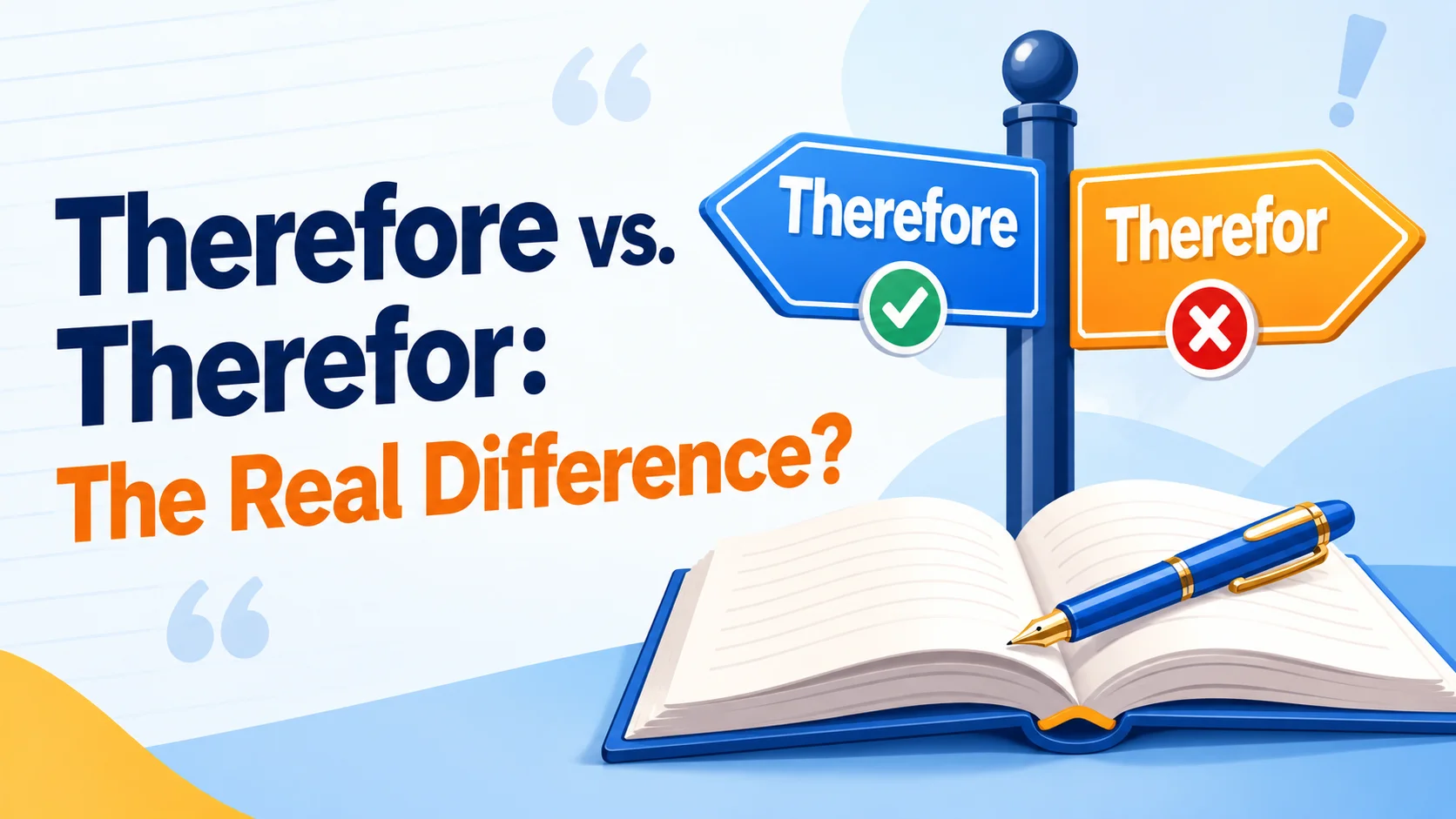
Therefore vs. therefor can be confusing because the two words differ by only one letter, yet they perform completely different jobs in a sentence. If you are writing an essay, email, report, contract, or academic paper, choosing the wrong one can change the meaning rather than merely create a spelling error. Therefore normally means “for that reason” or “as a result,” while therefore means “for that” or “for it.” The first is common modern English; the second is a specialized and relatively uncommon word.
The important point is that therefore is not simply a misspelling of therefore. Both are legitimate English words with different histories and functions. Therefore commonly introduces a logical consequence: a fact is presented, and therefore connects it to the result that follows. Therefore, by contrast, refers back to something already mentioned and means roughly “for that thing.” This distinction becomes particularly useful when reading legal, contractual, historical, or highly formal language, where therefore can still appear.
In this guide, you will learn when to use therefore, when therefore is actually correct, how to punctuate therefore, and how to distinguish both from “there for.” You will also see practical examples, side-by-side comparisons, common mistakes, and a simple substitution test that makes the choice almost automatic. By the end, you should be able to recognize the intended meaning rather than relying on how the word looks.
Quick Answer: Therefore vs. Therefor
The simplest distinction is:
- Therefore = for that reason; as a result; consequently
- Therefor = for that; for it; in exchange for that
- There for = present in a place or available for a particular purpose
Compare:
The roads were flooded; therefore, the school closed.
Here, therefore, introduces a result.
The company requested payment therefore.
Here, therefore, means roughly “for that”—in this case, payment for the thing previously mentioned.
A useful rule is:
If you can replace the word with “as a result,” choose “therefore.” If you can replace it with “for that,” “therefore” may be appropriate.
For most everyday, academic, business, and general-purpose writing, therefore is the word you are looking for. Cambridge defines therefore as “for that reason,” while Merriam-Webster defines therefore as “for or in return for that.”
What Does “Therefore” Mean?
Therefore is an adverb used to show that one statement follows logically from another. It can introduce a consequence, conclusion, or result.
For example:
The store was closed; therefore, we went home.
The first fact explains the second. The store was closed, so going home followed that situation.
Oxford describes therefore as introducing the logical result of something just mentioned. Cambridge similarly defines it as “for that reason.”
Common meanings of “therefore”
Depending on the sentence, therefore can be understood as:
- for that reason
- because of that
- as a result
- consequently
- thus
For example:
The evidence was incomplete. Therefore, the committee delayed its decision.
This does not merely connect two unrelated statements. It tells the reader that the second statement is a consequence of the first.
Examples of “therefore” in sentences
- The weather was severe; therefore, the flight was delayed.
- She had already completed the assignment and therefore did not need extra time.
- The product failed the safety test. Therefore, it could not be released.
- He missed the last bus and therefore had to walk home.
- The figures were inaccurate; therefore, the report needed revision.
The word works especially well when the writer wants to make the relationship between evidence and conclusion explicit.
How “Therefore” Functions in a Sentence
Unlike a conjunction such as and or but, therefore is commonly treated as a conjunctive adverb or transitional adverb. Its job is to show the logical relationship between ideas rather than simply join them grammatically.
Consider:
The deadline was moved. Therefore, we had more time.
The second sentence is a conclusion based on the first.
It can also appear within a sentence:
The deadline was moved, and we therefore had more time.
Here, therefore sits inside the second clause and emphasizes the consequence.
Therefore at the beginning
A sentence can begin with therefore:
Therefore, we decided to postpone the meeting.
The comma is commonly used when therefore functions as an introductory transition.
Therefore in the middle
Therefore can appear after the subject or auxiliary verb:
The team therefore decided to postpone the meeting.
Or:
The team has therefore decided to postpone the meeting.
This position often sounds natural in formal or academic prose.
Therefore after a semicolon
When two independent clauses are closely connected, a semicolon can be followed by therefore and a comma:
The evidence was incomplete; therefore, the investigation continued.
The semicolon separates the two independent clauses, while therefore signals the logical connection.
A semicolon is useful because punctuation helps readers understand how closely ideas are related. Purdue’s writing guidance notes that semicolons can signal a close relationship between independent clauses.
What Does “Therefore” Mean?
Therefore is a real English word, but it is much less common than that.
Merriam-Webster defines therefore as meaning “for or in return for that.” Dictionary.com similarly gives meanings such as “for or in exchange for that” and “for it.”
For example:
The supplier provided replacement equipment and received payment therefor.
Here, therefor means approximately:
payment for that equipment
It does not mean “as a result.”
That is the crucial distinction.
Why “therefor” looks like a mistake
Most modern readers encounter therefore frequently but encounter therefore rarely. As a result, it can look like someone accidentally deleted the final e.
But it is not automatically an error.
Its history is also much older than many readers might expect. Merriam-Webster records its first known use in the 12th century, and Dictionary.com traces the word to Middle English therfor.
The problem is therefore not whether therefor is a word. It is. The real question is whether its meaning fits the sentence.
Therefore vs. Therefor: The Key Difference
The easiest way to understand the distinction is to focus on what each word points to.
| Word | Meaning | Main function | Typical context | Example |
| therefore | for that reason; as a result | Shows a consequence or conclusion | Everyday, academic, business, formal writing | It was raining; therefore, we stayed inside. |
| therefor | for that; for it; in exchange for that | Refers back to something previously mentioned | Legal, contractual, formal, historical writing | Payment therefore was received. |
| there for | in that place for a purpose/reason | Ordinary phrase with separate words | Everyday English | I was there for the meeting. |
The most important contrast is:
Therefore connects a reason to a result.
Therefore connects an action, payment, or other reference back to a previously mentioned thing.
A quick substitution test
Ask what you could replace the word with.
Sentence:
The roads were dangerous; ___, the event was canceled.
Try “as a result.”
The roads were dangerous; as a result, the event was canceled.
That works. So therefore is correct.
Now:
The buyer made payment ___.
Try “for that.”
The buyer made payment for that.
If the surrounding context identifies what the payment is for, therefore may fit.
This test is more reliable than simply asking which spelling “looks right.”
Therefore vs. Therefor vs. There for
These three forms deserve separate attention because they are visually similar but grammatically different.
| Form | Meaning | Example |
| therefore | for that reason; as a result | The shop was closed; therefore, we left. |
| therefor | for that; for it | Compensation therefore was agreed upon. |
| there for | there + for; present for a reason or purpose | I was there for the interview. |
Notice how dramatically the meaning changes.
She was there for the meeting.
This tells us why she was at that place.
She was late; therefore, she missed the meeting.
This tells us the consequence of her lateness.
Payment therefore was required.
This refers back to something for which payment was required.
The spacing matters
Therefore is one word.
Therefore there are two words.
If you mean physical presence, purpose, or availability, you will usually need the two-word phrase:
I will be there for you during the presentation.
You would not write:
I will be there for you during the presentation.
That changes the grammatical construction completely.
When Should You Use “Therefore”?
For most writers, the answer is simple: use therefore when you want to express a conclusion or consequence.
In academic writing
The sample size was too small; therefore, the findings should be interpreted cautiously.
This is useful when moving from evidence to interpretation.
In business writing
The supplier missed the deadline and therefore incurred additional costs.
It provides a concise connection between an event and its consequence.
In everyday writing
I forgot my umbrella; therefore, I got wet.
Although therefore is somewhat more formal than so, it is perfectly understandable in ordinary English.
In logical reasoning
Therefore is particularly useful when one proposition leads to a conclusion:
All registered participants received an identification number. Sara is a registered participant. Therefore, Sara received an identification number.
The conclusion follows from the preceding information.
When Is “Therefore” Correct?
Therefore it is appropriate when it means “for that” or “for it.”
It is most likely to appear in formal constructions where a previously mentioned object, service, right, or action is being referred to.
Legal and contractual language
For example:
The purchaser shall pay the agreed fee, and the seller shall issue a receipt therefor.
Here, therefore refers to the agreed fee or transaction.
Another example:
The parties shall execute the agreement and provide consideration therefor.
The meaning is essentially “consideration for that.”
Legal writing contains many words built around there + preposition, including thereof, thereto, and therefrom. Oxford labels several of these forms as legal, formal, or specialized—for example, thereto means “to the thing mentioned,” while thereof means “of the thing mentioned.”
That context helps explain why it can still appear even though most general readers rarely use it.
Historical writing
Therefore may also occur in older documents or historical quotations. In such cases, changing the original wording may be inappropriate if the goal is to preserve the historical text accurately.
Common Mistakes With Therefore and Therefor
Mistake 1: Treating “therefor” as a shorter spelling of “therefore”
Incorrect:
The road was closed; therefore, we took another route.
If the intended meaning is “as a result,” therefore is wrong.
Correct:
The road was closed; therefore, we took another route.
Mistake 2: Assuming “therefor” is always wrong
This goes too far in the opposite direction.
Consider:
The contractor submitted the invoice and requested payment therefore.
If therefor means “for that”, the word can be legitimate.
The better editing principle is not “always change therefore to therefore.” Instead, ask what the writer means.
Mistake 3: Confusing “therefor” with “there for”
Compare:
I was there for the interview.
with:
Payment was made therefore.
The first is an ordinary phrase. The second is a single formal word.
Mistake 4: Using a comma incorrectly
A common structure is:
The information was incomplete; therefore, the report was revised.
Another is:
Therefore, the report was revised.
But punctuation depends on the sentence structure. Therefore is not a magic comma word that automatically requires commas wherever it appears.
Compare:
The report was therefore revised.
There is no reason to insert commas around therefore simply because the word is transitional.
How to Punctuate “Therefore”
Punctuation should follow the grammatical structure, not the presence of the word itself.
Pattern 1: Introductory therefore
Therefore, we rejected the proposal.
The comma separates the introductory transition from the main clause.
Pattern 2: Two independent clauses
The proposal was incomplete; therefore, we rejected it.
The semicolon separates the independent clauses, while the comma after therefore is conventional in this construction.
Pattern 3: Therefore inside a clause
We therefore rejected the proposal.
No surrounding commas are necessary.
Pattern 4: Therefore interrupting a sentence
The proposal was, therefore, rejected.
This is grammatically possible when therefore functions as an interrupting element, although the smoother version may be:
The proposal was therefore rejected.
Expert editing tip: Don’t add commas merely because a word feels formal. First identify what grammatical role the word is playing.
Therefore vs. Thus vs. Hence vs. Consequently
These words overlap, but they are not interchangeable in every sentence.
| Word | Basic meaning | Tone | Best use |
| therefore | for that reason | Neutral to formal | Conclusions and consequences |
| thus | in this way; as a result | Formal/concise | Academic, technical, analytical writing |
| hence | for this reason; from this fact | Formal | Conclusions and explanations |
| consequently | as a consequence | Formal | Clear cause-and-effect relationships |
| so | for that reason | Conversational | Everyday speech and informal writing |
For example:
The evidence was insufficient; therefore, the claim was rejected.
You could use consequently, but it may sound slightly more formal. So would sound more conversational:
The evidence was insufficient, so the claim was rejected.
The best choice depends on your audience and tone rather than on grammar alone.
Is “Therefore” Too Formal?
Not necessarily.
Therefore is more formal than so, but it is widely understood and useful in professional, academic, and explanatory writing. Cambridge lists it as a common adverb meaning “for that reason,” and its dictionary examples include academic and everyday contexts.
Compare:
It was raining, so we stayed inside.
with:
It was raining; therefore, we stayed inside.
Both are grammatical. The second simply makes the logical relationship more explicit and sounds more formal.
Choose based on audience
Casual message:
I was tired, so I went home.
School essay:
The evidence was limited; therefore, further research is necessary.
Business report:
Demand has declined; therefore, production will be reduced.
You do not need to avoid it. Just avoid using it repeatedly when a simpler so would sound more natural.
Is “Therefore” Still a Correct Word?
Yes. Therefore is a legitimate word, not merely an obsolete spelling mistake.
Merriam-Webster gives its meaning as “for or in return for that” and records its first known use in the 12th century.
However, legitimacy does not mean frequency.
Modern general readers encounter therefore far more often. Dictionary.com explicitly describes therefore as rarely used in its comparison with therefore.
That difference explains why it can feel strange to contemporary readers.
The practical lesson is:
Rare does not mean incorrect. Context determines correctness.
If you are writing ordinary modern prose and mean “as a result,” use therefore.
If you encounter it in a contract or historical document, don’t automatically assume it is a typo.
British English vs. American English
The fundamental distinction between therefore and therefore is not a British-versus-American spelling difference.
Both varieties use therefore to express a result or conclusion.
The less common therefore can occur in formal or specialized language, particularly legal or historical contexts, but it is not simply the British version of therefore.
In other words:
- American English: therefore for “as a result”
- British English: therefore for “as a result”
- Specialized/legal usage: therefor may mean “for that”
So if you are wondering whether changing from one English variety to another makes it correct, the answer is generally no.
A Practical Editing Test
When proofreading, use this three-step test.
Step 1: Identify the intended relationship
Ask:
Is this word introducing a result or conclusion?
If yes, think therefore.
Step 2: Try “as a result”
Replace the word:
The machine failed; as a result, production stopped.
If the replacement works naturally, therefore is likely correct.
Step 3: Try “for that”
Now consider:
The buyer requested compensation for that.
If the sentence genuinely means “for that thing” or “for that action,” therefore may be correct.
| Question | If the answer is yes | Choice |
| Does it mean “as a result”? | It introduces a consequence | therefore |
| Does it mean “for that” or “for it”? | It refers back to something | therefor |
| Does it mean “present for a purpose”? | It describes being there | there for |
This is much safer than relying on the spelling.
Real-World Sentence Comparisons
Scenario 1: A school essay
The experiment produced inconsistent results; therefore, the hypothesis could not be confirmed.
Why? Therefore introduces the conclusion.
Scenario 2: A business report
Sales declined during the quarter; therefore, management reduced its forecast.
Why? The second event follows from the first.
Scenario 3: A contract
The purchaser shall pay the stated fee and provide evidence of payment therefor.
Why? Therefore refers back to the fee/payment arrangement and carries the sense of “for that.”
Scenario 4: An everyday sentence
I wasn’t feeling well, so I stayed home.
Here, it is more natural than therefore because the setting is casual.
Scenario 5: “There for”
I was there for the entire presentation.
This is completely different from both one-word forms.
A Quick Decision Chart
If you’re stuck between the three forms, use this:
Do you mean “as a result”?
→ Therefore
Do you mean “for that/for it”?
→ Therefor
Do you mean “in that place for a purpose”?
→ There for
Mini practice
- The roads were icy; ___, the school closed.
- The company requested payment ___ the services provided.
- I was ___ the interview yesterday.
- The evidence was incomplete; ___, the conclusion remained uncertain.
- The agreement required compensation ___.
Answers:
- therefore
- therefor
- there for
- therefore
- therefor
The trick is to identify the meaning before thinking about spelling.
Common Misconceptions
“Therefore is just a typo.”
Not always. It is a legitimate word meaning roughly “for that” or “for it.” It is simply uncommon in general modern writing.
“Therefore always needs a comma.”
Not true. Compare:
Therefore, we left.
with:
We therefore left.
The second sentence does not need commas around therefore.
“Therefore is the British spelling of therefore.”
No. The two words have different meanings, not merely different regional spellings.
“Therefore and so always mean exactly the same thing.”
They overlap, but their tone and placement differ. So is much more conversational, while therefore is often preferred when a writer wants to make a logical relationship explicit.
Best Practices for Writers
When editing your own work, keep these habits in mind:
- Check meaning before spelling.
- Use therefore for results and conclusions.
- Reserve therefore for contexts where “for that” genuinely makes sense.
- Don’t replace every unusual word automatically; investigate its function.
- Use so when a casual tone is more appropriate.
- Avoid repeatedly using therefore in consecutive sentences.
- Pay attention to punctuation when connecting independent clauses.
- Preserve therefore when accurately quoting historical or specialized language.
- If a sentence sounds unnecessarily formal, consider whether so, as a result, or because of this would be clearer.
Writer’s tip: A precise word is useful only when its meaning is clear. In ordinary prose, clarity usually matters more than sounding formal.
Conclusion
The real difference between therefore and therefore is meaning, not merely spelling. Therefore expresses a consequence: it means “for that reason,” “as a result,” or “consequently.” Therefore is a separate, legitimate word meaning “for that” or “for it,” although it is much less common in modern general writing. One final actionable tip: whenever you hesitate, replace the word mentally with “as a result” or “for that.” The sentence’s intended meaning will usually reveal the correct choice immediately. A common mistake to avoid is treating every unfamiliar therefore as an error—or, conversely, using it simply because it looks like a shorter version of therefore. Good editing starts with meaning. Once you understand what the sentence is trying to say, the spelling becomes the easy part. For most everyday writing, remember the simple rule: result = therefore; for that = therefore; purpose or presence = there for.
Frequently Asked Questions
Q1. Is “therefore” a misspelling of “therefore”?
No. Therefore is a legitimate English word meaning “for that,” “for it,” or “in exchange for that.” It is uncommon in ordinary modern writing, which is why it often looks like a typo. Therefore is the correct choice when you mean “as a result.”
Q2. Can I use “therefore” in everyday writing?
You can if you genuinely mean “for that”, but it will often sound unusually formal. In ordinary communication, a clearer phrase such as “for that,” “for it,” or a more specific expression may be easier for readers to understand. Therefore is most noticeable in specialized or formal language.
Q3. Does “therefore” always need a comma?
No. Therefore I can take different positions in a sentence. An introductory therefore is commonly followed by a comma, while a sentence such as “We therefore agreed” does not require commas. When therefore follows a semicolon between independent clauses, a comma commonly follows it.
Q4. Is “therefore” common in legal writing?
It can be found in legal and contractual language, especially in constructions referring back to something previously mentioned. However, its presence does not mean every legal sentence should use it. If “as a result” is intended, therefore remains the appropriate word.
Q5. What is the easiest way to remember therefore and therefore?
Use the substitution test. If you can replace the word with “as a result” or “for that reason,” choose therefore. If the intended meaning is “for that” or “for it,” therefore may be correct. For “present for a purpose,” use the two-word phrase there for.