

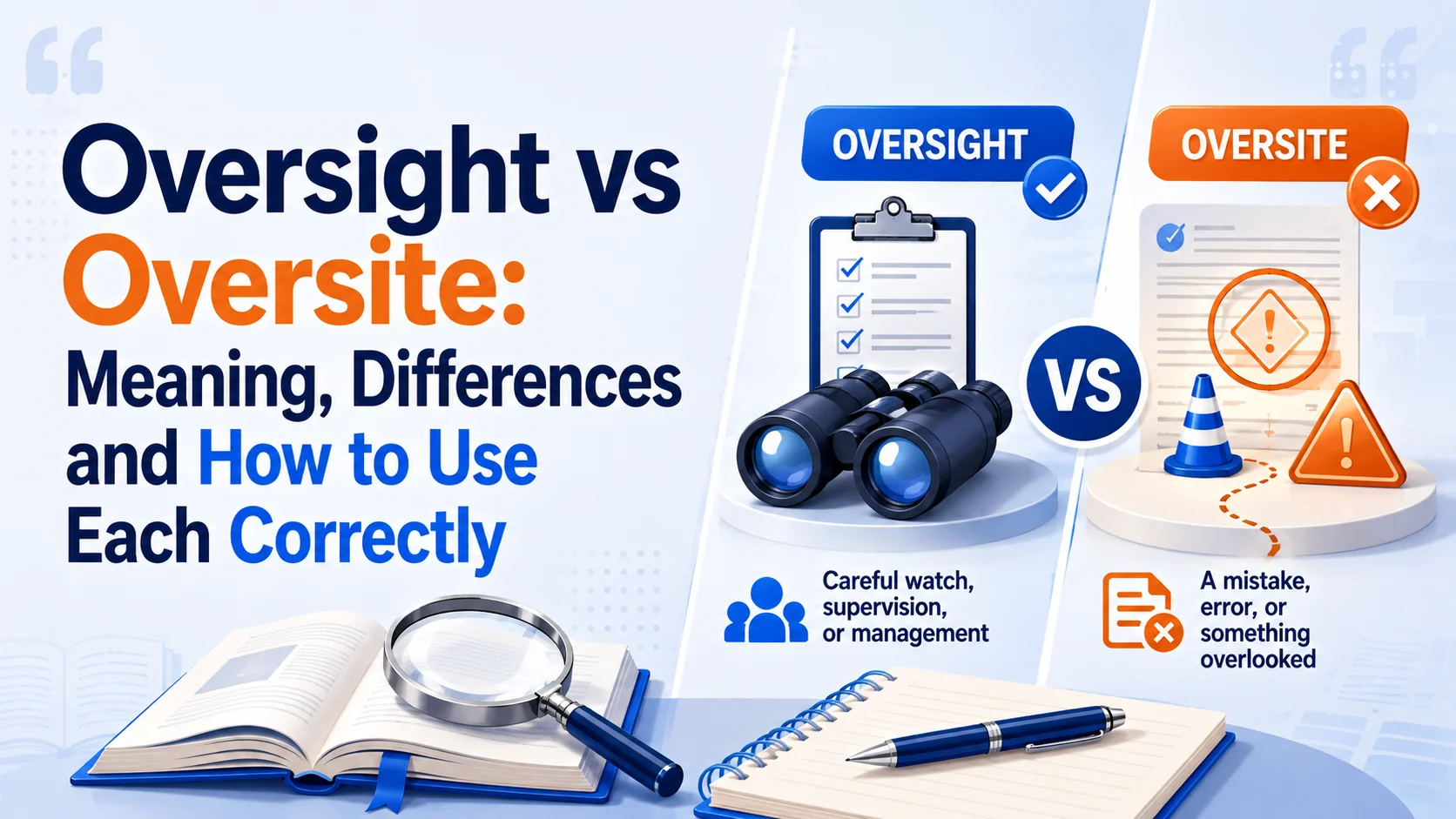
If you’re comparing oversight vs oversite, the one-letter difference can make the two words look interchangeable when they actually belong to very different contexts. Oversight is a common English noun with two established meanings: supervision and an accidental omission or mistake. Oversite, by contrast, is a specialized construction term referring to material or a concrete layer laid over prepared ground, particularly beneath a building floor.
That distinction matters because oversight appears regularly in business, government, education, law, project management, and everyday writing. Oversite is much narrower and is most likely to appear in construction documents, building specifications, or discussions of ground-floor preparation. Using oversite when you mean oversight can make an otherwise polished sentence look like a spelling mistake, while changing oversite to oversight in a construction document can change the technical meaning entirely.
In this guide, you’ll learn what oversight means, what oversite means, why the spellings are confused, how their pronunciations differ or overlap, and when each word belongs in a sentence. You’ll also see practical examples, a comparison table, common mistakes, and a simple decision rule you can use whenever you hesitate between the two.
Oversight vs Oversite at a Glance
The fastest way to separate these words is to focus on context rather than spelling.
| Word | Main meaning | Typical context | Example |
| Oversight | Supervision or responsible monitoring | Business, government, projects, organizations | “The committee provides oversight of the program.” |
| Oversight | An accidental omission or error | Everyday, professional, academic writing | “Leaving her name off the list was an oversight.” |
| Oversite | A construction layer or area over prepared ground | Building and construction | “The workers prepared the oversite before laying the floor.” |
The important point is that oversight is not merely the “correct spelling” of oversite in every situation. Oversite is a legitimate but uncommon technical term. In ordinary English, however, oversight is overwhelmingly the word you’re looking for.
What Does “Oversight” Mean?
Oversight is a noun with two seemingly opposite meanings.
First, it can mean supervision, monitoring, or responsible control. A manager may have oversight of a project, a government body may provide oversight of an agency, or a committee may exercise oversight of an organization.
Second, an oversight can mean an unintentional omission or error—something that was accidentally forgotten, missed, or left undone. Merriam-Webster recognizes both meanings and dates the noun’s first known use to the 15th century.
Oversight meaning “supervision”
In this sense, oversight describes the responsibility to watch, review, direct, or monitor something.
Examples include:
- The board provides oversight of the company’s finances.
- The manager has oversight of the entire project.
- The committee is responsible for regulatory oversight.
- The agency operates under congressional oversight.
- The supervisor maintains oversight of daily operations.
Notice that this meaning often appears with phrases such as:
- provide oversight
- maintain oversight
- regulatory oversight
- government oversight
- financial oversight
- independent oversight
- managerial oversight
- oversight of a project
These combinations strongly signal the supervision meaning.
Oversight meaning “mistake”
The second meaning refers to something that was missed unintentionally.
For example:
- Forgetting to attach the file was an oversight.
- The missing signature was a simple oversight.
- I apologize for the oversight in the report.
- The error appears to have resulted from an oversight.
- Leaving one employee off the schedule was an oversight.
Here, oversight is usually close in meaning to omission, error, mistake, lapse, or something accidentally overlooked.
This creates one of English’s more interesting semantic quirks: the same noun can describe careful supervision and a failure to notice something.
Why Can “Oversight” Mean Both Supervision and a Mistake?
This is one of the most confusing features of the word.
The connection becomes clearer when you consider the verb oversee. To oversee something means to watch over it, inspect it, or supervise it. Merriam-Webster defines oversee in terms including examining and directing an undertaking or group of workers.
From that idea of watching over something, oversight developed its supervisory sense.
But there’s a natural irony in supervision: if you are responsible for watching something and fail to notice it, that failure can also be called an oversight.
Compare:
“The committee provides oversight of the project.”
Here, the committee is monitoring the project.
“The missing safety check was an oversight.”
Here, something was missed.
Context tells you which meaning is intended.
A useful grammatical clue
The phrase surrounding oversight can often help.
Supervision meaning:
- oversight of the project
- government oversight
- regulatory oversight
- independent oversight
Mistake meaning:
- an oversight
- a simple oversight
- an accidental oversight
- due to an oversight
This isn’t an absolute rule, but it’s a useful reading and writing clue.
What Does “Oversite” Mean?
Oversite is a rare English technical term used primarily in construction.
In construction terminology, an oversite can refer to a layer of concrete beneath a building’s ground floor or an oversite slab laid over prepared ground. It may form part of the ground-floor construction and can be associated with sealing or protecting the ground beneath the floor.
The word can also function as an adjective in construction-related usage, referring to something laid over the ground or built above an existing site.
Oversite in construction
You may encounter expressions such as:
- oversite concrete
- oversite slab
- concrete oversite
- oversite preparation
- oversite development
The exact construction method varies according to the building design, local standards, materials, and floor system, so oversite should not be treated as a universal synonym for every type of concrete floor slab.
A simple example
Imagine a building site where the ground has been prepared and compacted before the floor system is completed. A construction document might refer to a concrete layer laid over the prepared ground as an oversite or oversite concrete.
For someone outside construction, the term may look like a misspelling of oversight. Within the appropriate technical context, however, oversite can be intentional and correct.
Oversite vs Oversight: The Core Difference
The easiest distinction is:
Oversight = supervision or an accidental omission.
Oversite = a specialized construction term.
That gives you a practical decision rule.
| If you mean… | Use |
| Supervision | oversight |
| Monitoring | oversight |
| Regulatory control | oversight |
| Management responsibility | oversight |
| An accidental mistake | oversight |
| Something forgotten or missed | oversight |
| A construction layer over prepared ground | oversite |
| An oversite slab | oversite |
| A technical construction context | Potentially oversite |
The one-question test
Ask yourself:
“Am I talking about supervision, a mistake, or construction?”
- Supervision → oversight
- Mistake → oversight
- Construction layer/site terminology → oversite
If you’re writing an ordinary email, essay, report, article, or business document and you aren’t discussing construction, oversight is almost certainly the word you need.
Why Do People Confuse Oversight and Oversite?
The confusion is understandable. The words differ by only one letter, and both are built from familiar English elements.
1. They look almost identical
Visually:
oversight
oversite
The only difference is gh versus e at the end.
That makes proofreading particularly easy to skip over. Your brain can recognize the overall shape of a familiar word without carefully checking every letter.
2. They sound similar
In ordinary pronunciation, oversight is pronounced approximately OH-ver-site. The final sound is essentially the same as the word site.
Oversite can therefore look like a plausible spelling if someone has only heard oversight spoken aloud.
The spelling distinction is especially important because sight and site are themselves commonly confused words.
3. “Site” feels logical
People often associate site with a place:
- construction site
- building site
- website
- work site
That makes oversite look intuitively reasonable when someone is trying to express an idea involving a location or area.
In fact, that intuition happens to overlap with the specialized construction meaning of oversite.
4. Spellcheck may not solve the problem
A spelling checker is primarily concerned with whether a sequence of letters is recognized as a word. If oversite is accepted in a particular dictionary or language database, the software may not flag it.
More importantly, spellcheck usually can’t determine what you intended to mean.
A sentence containing the wrong but recognized word can still be grammatically valid.
“The committee provided oversite of the project.”
The problem isn’t simply spelling. The problem is word choice. In ordinary professional English, oversight is the intended term.
Oversight and Oversite Pronunciation
Pronunciation can contribute to the confusion because oversight ends with the sound of site.
Oversight: approximately OH-ver-site
Oversite: approximately OH-ver-site
In contexts where oversite is used as a technical construction term, the words can therefore be pronounced the same or nearly the same, depending on the speaker and variety of English.
That makes this a case where hearing the word alone may not be enough. You need the context.
For example:
“The contractor discussed the oversite.”
If you’re reading a construction specification, oversite may make sense.
But:
“The manager discussed the oversite of the project.”
In ordinary business English, that is almost certainly a misspelling of oversight.
Examples of “Oversight” in Everyday and Professional Writing
Supervision and management
The director has oversight of the department.
The committee provides oversight of public spending.
The project requires independent oversight.
The supervisor was responsible for oversight of the installation process.
Mistakes and omissions
Leaving the attachment out of the email was an oversight.
The missing figure was an oversight, not an intentional omission.
I apologize for the oversight.
The scheduling error was caused by an administrative oversight.
Legal and government contexts
Oversight is particularly common when institutions monitor other institutions.
Examples include:
- legislative oversight
- regulatory oversight
- judicial oversight
- government oversight
- independent oversight
Merriam-Webster’s examples include uses involving regulatory and congressional oversight, demonstrating how established this sense is in institutional language.
Examples of “Oversite” in Construction
Because oversite is specialized, examples should stay within its technical context.
The contractor prepared the oversite before the floor construction began.
The specification calls for an oversite concrete layer.
The workers completed the oversite slab before proceeding with the floor installation.
The engineer reviewed the proposed oversite construction.
The terminology surrounding an oversite may include ground preparation, hardcore, blinding, concrete, floor construction, damp protection, and floor slabs, depending on the particular building system.
Construction references describe oversite concrete as a layer placed over prepared ground and beneath the floor construction.
Important: Don’t assume every concrete layer beneath a floor should automatically be called an oversite. Construction terminology varies by region, building system, specification, and technical context.
Common Mistakes With Oversight vs Oversite
Mistake 1: Using “oversite” for a general mistake
❌ Leaving the attachment out was an oversite.
✅ Leaving the attachment out was an oversight.
The mistake meaning belongs to oversight.
Mistake 2: Using “oversite” for supervision
❌ The committee provides oversite of the department.
✅ The committee provides oversight of the department.
Again, oversight is the standard word for supervision.
Mistake 3: Assuming “oversite” is always wrong
❌ “Oversite isn’t a real English word.”
That is too broad.
Oversite does exist, but it is an uncommon, specialized construction term.
Mistake 4: Treating “site” as the clue for every situation
It’s tempting to think:
site = place → oversite = something over a place
But word meanings aren’t always predictable from their parts.
For ordinary writing, don’t invent a meaning from the spelling. Choose the established word that matches the context.
Oversight in Different Professional Contexts
The word oversight is especially useful because its supervision meaning fits many fields.
| Field | Example |
| Business | “The board provides oversight of company operations.” |
| Government | “The agency is subject to legislative oversight.” |
| Finance | “Independent oversight helps monitor financial controls.” |
| Education | “The committee provides oversight of the program.” |
| Healthcare | “The project requires appropriate regulatory oversight.” |
| Technology | “Human oversight remains part of the review process.” |
| Construction | “The project manager provides oversight of the work.” |
Notice that oversight does not mean the same thing as hands-on management in every sentence. It often implies monitoring, accountability, review, or supervisory responsibility rather than personally performing the work.
That’s an important distinction in professional writing.
Oversite in Construction: What It Does and What It Doesn’t Mean
When oversite appears in construction, readers may assume it refers to a general building foundation. That’s too broad.
An oversite can be associated with the prepared ground beneath a ground floor, often involving a concrete layer. Its precise role depends on the construction design.
Historical and technical construction references describe oversite concrete as being used over prepared ground, including as part of systems addressing level surfaces and moisture-related concerns.
However, an oversite should not automatically be treated as:
- the entire foundation,
- every type of floor slab,
- a structural foundation footing,
- a damp-proof membrane itself,
- or a complete floor system.
Those are distinct components or concepts.
Why technical context matters
Construction terminology is particularly sensitive to regional usage and specifications. A term that is familiar to one construction audience may be less common elsewhere.
So if you’re writing technical documentation, follow the terminology used by the project specification, relevant standards, drawings, and local professional practice rather than replacing a specialized term simply because it looks unusual.
A Practical Decision Guide
When you’re editing a sentence, use this checklist:
Use oversight if:
- You’re talking about supervision.
- Someone is monitoring a project.
- An organization has regulatory responsibility.
- Something was accidentally missed.
- A document contains an accidental omission.
- You’re writing ordinary business, academic, or general English.
Use oversite if:
- You’re discussing construction terminology.
- The sentence refers to an oversite slab.
- You’re discussing oversite concrete.
- The word appears in a building specification or technical construction discussion.
- The context clearly concerns material or construction over prepared ground.
A Simple Memory Trick for Oversight vs Oversite
The safest memory trick isn’t based solely on spelling. Use meaning.
Think “watch” → oversight
Oversight contains sight, which can remind you of seeing or watching.
So:
Oversight → watch over → supervision
It also works for the second meaning because something that becomes an oversight is something that wasn’t properly noticed.
Think “site” → oversite
Oversite → site → construction site
This works because the specialized term is associated with construction and prepared ground.
So remember:
Oversight = watching or missing something.
Oversite = construction/site terminology.
Oversight vs Oversite: Quick Comparison
| Feature | Oversight | Oversite |
| Common in everyday English? | Yes | No |
| Standard noun? | Yes | Yes, but specialized |
| Means supervision? | Yes | No |
| Means accidental mistake? | Yes | No |
| Construction term? | Sometimes in its general supervision sense | Yes |
| Refers to concrete/floor preparation? | No | Yes, in technical usage |
| Common in business writing? | Yes | Rare |
| Common in government writing? | Yes | Rare |
| Common in construction documents? | Yes, for supervision | Yes, for the technical term |
Is “Oversite” a Misspelling?
Sometimes, but not always.
If someone writes:
“The manager has oversite of the team.”
they almost certainly mean oversight, so oversite is a spelling error.
But if a construction professional writes:
“The oversite concrete was completed before the next stage.”
the spelling may be entirely intentional because oversite is an established construction term.
This distinction is important for editors. You shouldn’t automatically “correct” every instance of oversite. First ask:
What does the writer mean?
That’s a much better proofreading habit than relying on visual similarity alone.
What About “Oversight of” vs “Oversight”?
The phrase oversight of commonly introduces the thing being supervised.
For example:
The board has oversight of financial reporting.
The agency provides oversight of regulated industries.
She was given oversight of the project.
When oversight means a mistake, it often appears in a different structure:
It was an oversight.
The omission was an oversight.
The error occurred through an oversight.
Recognizing these patterns can help you determine the intended meaning quickly.
Why “Oversight” Can Be Ambiguous
Some sentences can theoretically support either meaning.
Consider:
The agency’s oversight caused changes to the policy.
Does oversight mean the agency’s supervision caused the changes?
Or does it mean an error or omission by the agency caused them?
Without additional context, both readings can be possible.
A professional writer should remove that ambiguity when it matters.
Make the meaning explicit
For supervision:
The agency’s close oversight of the program led to several policy changes.
For a mistake:
An oversight by the agency led to several policy changes.
The small additions make the intended meaning obvious.
Why This Distinction Matters in Professional Writing
A one-letter difference isn’t always a minor proofreading issue.
In a business report:
“The board provides oversite of financial controls.”
looks like a spelling mistake and may undermine confidence in the document.
In a construction specification, changing:
“oversite concrete”
to:
“oversight concrete”
would destroy the intended technical term.
The lesson is broader than this particular pair:
Good editing requires context, not just spelling correction.
A word can look unusual and still be correct. Conversely, a familiar-looking word can be wrong for the intended meaning.
Conclusion
Understanding oversight vs oversite becomes much easier once you stop treating them as simple spelling variants. Oversight is the everyday word you need when discussing supervision, monitoring, accountability, or an accidental omission. Oversite has a much narrower role as a construction term associated with material or concrete laid over prepared ground. One final actionable tip: before choosing the spelling, identify what the sentence is actually describing. If someone is watching over something or something was accidentally missed, choose oversight. If you’re discussing a technical construction layer or oversite slab, oversite may be correct. A common mistake to avoid is assuming that an unfamiliar word must be a typo. Good writing isn’t only about recognizing words; it’s about recognizing the right word for the right context.
Frequently Asked Questions
Q1. What is the main difference between oversight and oversite?
Oversight is the standard English word for supervision or an accidental omission. Oversite is a specialized construction term associated with a layer or slab over prepared ground. In ordinary writing, use oversight unless your context specifically concerns construction terminology.
Q2. Is oversite a real word or just a misspelling?
Oversite is a real but uncommon word in English construction terminology. It can refer to an oversite slab or concrete layer beneath a building floor. Outside technical construction contexts, however, oversite is often an accidental spelling of oversight.
Q3. Why does oversight have two opposite meanings?
The two meanings developed around the idea of watching over something. Oversight can describe responsible supervision, but it can also describe an accidental failure to notice something. Context distinguishes the meanings, such as “regulatory oversight” versus “an unfortunate oversight.
Q4. Should I use oversite in a business email?
Usually, no. If you’re discussing supervision, management responsibility, or monitoring, use oversight. Use oversite only when your business communication specifically concerns its technical construction meaning, such as an oversite slab or oversite concrete.
Q5. Are oversight and oversite pronounced the same?
They can be pronounced the same or very similarly, which helps explain the spelling confusion. In particular, oversight ends with the same basic sound as site. When the distinction matters, rely on context and spelling, not pronunciation alone.