

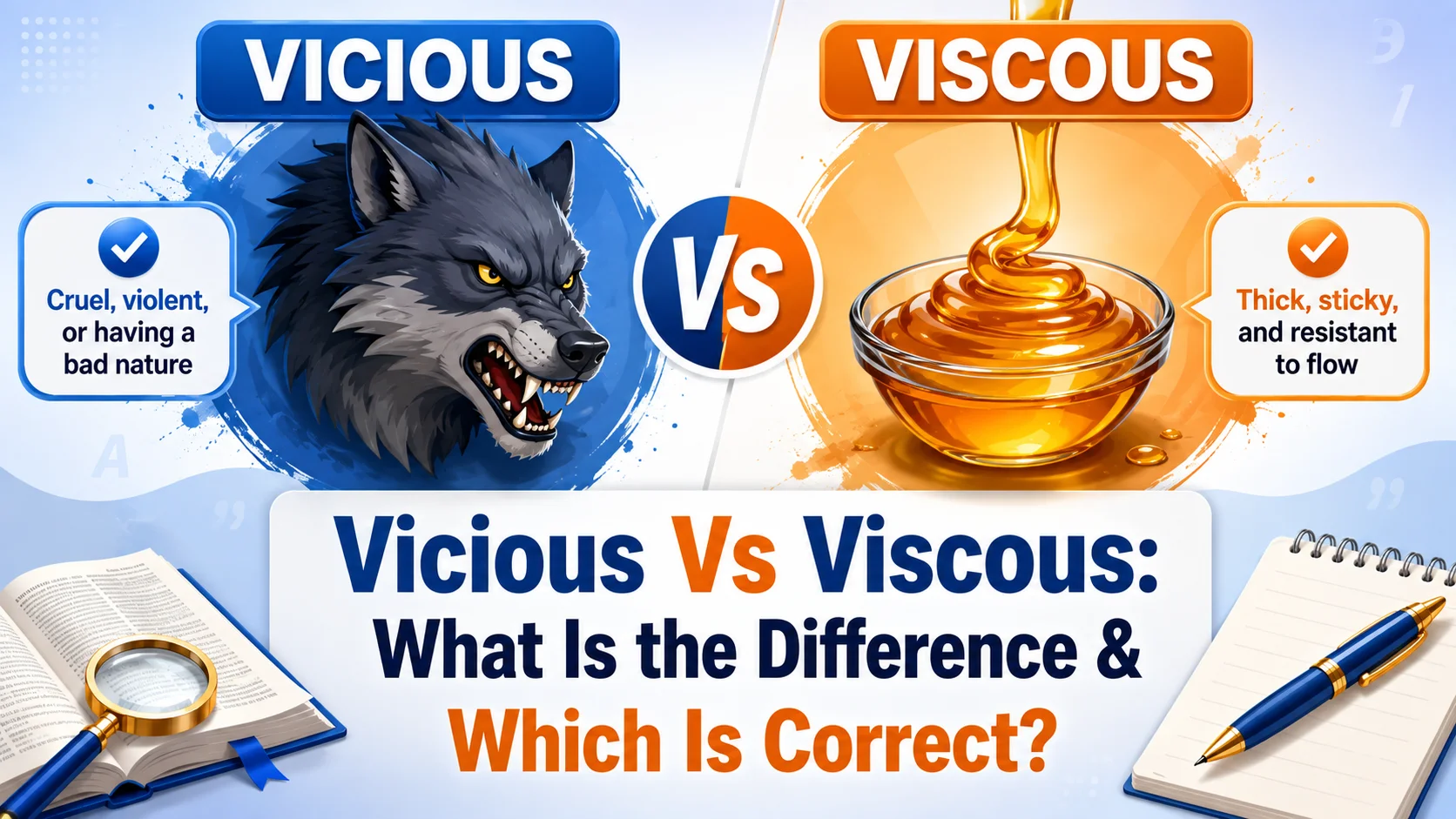
Vicious vs viscous is a classic English word pair that can cause trouble because the two adjectives look almost identical but describe completely different things. Vicious usually relates to cruelty, aggression, violence, or something seriously harmful, while viscous describes a substance that is thick, sticky, or resistant to flowing. One letter—and a different middle sound—changes the meaning entirely. If you’ve ever hesitated over whether to write a vicious attack or a viscous liquid, you’re dealing with a genuine vocabulary distinction, not two spellings of the same word.
The confusion becomes easier to solve once you stop looking at the spelling alone and connect each word to its meaning. Vicious can describe a person, animal, attack, criticism, rumor, or harmful cycle. Viscous, on the other hand, belongs mainly to the world of fluids, viscosity, science, engineering, and physical properties. A vicious dog may be dangerous; a viscous substance may simply take a long time to pour. Neither word can replace the other without changing the sentence completely.
This guide explains the difference between vicious and viscous from several angles, including pronunciation, grammar, word origins, scientific meaning, common expressions, and everyday usage. You’ll also see practical examples, comparison tables, common mistakes, and a quick decision test you can use whenever the words get mixed up. By the end, choosing between them should feel much more like recognizing the meaning than memorizing a spelling rule.
Vicious vs Viscous: The Difference at a Glance
Both vicious and viscous are adjectives, but they operate in entirely different semantic fields.
| Feature | Vicious | Viscous |
| Basic meaning | Cruel, aggressive, violent, malicious, or harmful | Thick, sticky, or resistant to flow |
| Usually describes | People, animals, actions, remarks, situations | Liquids and fluid behavior |
| Common contexts | Conflict, criticism, attacks, behavior | Cooking, chemistry, physics, engineering |
| Pronunciation | VISH-us | VIS-kus |
| IPA | /ˈvɪʃəs/ | /ˈvɪskəs/ |
| Related noun | viciousness | viscosity |
| Example | a vicious attack | viscous honey |
The easiest distinction is conceptual:
Vicious = harmful behavior or severity.
Viscous = resistance to flow.
For example:
- The dog became vicious when threatened.
- The honey was too viscous to pour easily.
The first sentence describes behavior. The second describes a physical property.
Memory shortcut: If you’re talking about cruelty or aggression, choose vicious. If you’re talking about fluid flow, choose viscous.
What Does “Vicious” Mean?
Vicious is an adjective used for something cruel, aggressive, violent, malicious, or seriously harmful. It can describe both literal physical behavior and figurative forms of harm.
Cambridge defines vicious in terms of people or actions showing an intention or wish to hurt someone badly. It also uses the word for things such as accusations, rumors, headaches, and cycles that cause serious physical or emotional harm.
Merriam-Webster gives several related senses, including dangerously aggressive, violent or fierce, malicious or spiteful, and a figurative sense involving conditions that worsen one another.
Vicious When Describing a Person or Animal
When vicious describes a person or animal, it generally suggests dangerous aggression or a willingness to cause harm.
Examples:
- The shelter warned visitors about the vicious dog.
- He was known for his vicious temper.
- The animal became vicious when cornered.
- The attacker was described as vicious.
Notice that vicious is stronger than simply saying angry or unfriendly.
An angry dog may bark or growl. A vicious dog suggests a more serious tendency toward violent or harmful behavior.
Vicious When Describing an Attack or Action
The word is particularly common with words connected to physical conflict:
- vicious attack
- vicious assault
- vicious fight
- vicious bite
- vicious beating
- vicious response
For example:
The boxer delivered a vicious punch.
Here, vicious emphasizes the severity and force of the action.
Vicious in Figurative Contexts
You don’t need physical violence for vicious to be correct.
The word can describe something emotionally or socially damaging:
- vicious criticism
- vicious rumor
- vicious accusation
- vicious argument
- vicious competition
Consider:
The article contained a vicious personal attack on the writer.
The attack may be verbal rather than physical. The important idea is deliberate or extreme harm.
Cambridge specifically includes examples such as vicious lies, vicious accusations, and vicious rumors, demonstrating that the word extends well beyond physical violence.
What Does “Vicious Cycle” Mean?
A vicious cycle is a repeating situation in which one negative condition causes another, which then makes the original condition worse.
For example:
Lack of sleep can reduce productivity, which creates stress, which makes it harder to sleep. That can become a vicious cycle.
This use is figurative. Nothing necessarily involves violence.
Merriam-Webster includes this sense of vicious for situations that become worse because their causes reinforce one another.
That distinction matters because a common beginner mistake is to assume vicious always means violent. It doesn’t.
What Does “Viscous” Mean?
Viscous describes a substance that is thick, sticky, or resistant to flowing easily.
Cambridge gives examples such as viscous oil and defines a viscous liquid as one that does not flow easily. Merriam-Webster likewise defines viscous as having a thick or sticky consistency and, technically, as having a high resistance to flow.
Common examples include:
- honey
- molasses
- syrup
- some oils
- certain sauces
- some industrial fluids
For example:
The syrup became so viscous that it barely moved through the tube.
Here, viscous has nothing to do with cruelty or violence. It describes how the substance behaves as it flows.
Viscous in Everyday Life
You’ve probably encountered viscous substances without using the word.
Imagine pouring water from a glass. It flows quickly and easily.
Now imagine pouring cold honey. It moves slowly and may cling to the container.
Honey is commonly described as more viscous than water.
That makes viscous a useful technical alternative to simply saying something is “thick.”
Viscous in Science
In scientific contexts, viscous has a more precise meaning.
Viscosity measures a fluid’s resistance to flow. NIST describes viscosity as a measure of resistance to flow, using honey as an example of a high-viscosity substance and water as an example of a low-viscosity substance.
So:
- viscous = adjective
- viscosity = noun
Compare:
The liquid is viscous.
The liquid has a high viscosity.
The second sentence names the property itself.
Viscous Liquids vs Less Viscous Liquids
A simple comparison makes the concept easier:
| Substance | Relative viscosity in everyday terms | What you notice |
| Water | Low | Flows easily |
| Milk | Relatively low | Pours readily |
| Cooking oil | Moderate, depending on type and temperature | Flows smoothly |
| Syrup | High | Pours slowly |
| Honey | High | Flows slowly and clings to surfaces |
| Molasses | Very high in ordinary conditions | Moves particularly slowly |
These descriptions are intentionally general because viscosity depends on factors such as temperature and the substance itself.
Is “Viscous” the Same as “Sticky”?
Not exactly.
In everyday English, viscous, thick, and sticky often overlap. Scientifically, however, viscosity refers more specifically to a fluid’s resistance to flow or deformation.
NIST describes viscosity as a measure of resistance to flow and, more precisely, resistance to shear.
That means saying “viscous means sticky” is useful for a beginner, but it isn’t a complete technical definition.
A better mental model is:
Viscous describes how strongly a fluid resists flowing.
Vicious vs Viscous: The Main Difference
The two words are not interchangeable.
Vicious belongs to the vocabulary of behavior, harm, aggression, cruelty, and severity.
Viscous belongs to the vocabulary of fluids, flow, physical properties, and viscosity.
Compare these sentences:
The journalist received a vicious response.
The scientist studied a viscous fluid.
In the first sentence, the response is harsh or malicious.
In the second, the fluid resists flowing.
The spelling difference reflects a pronunciation difference, too:
- vicious → “VISH-us”
- viscous → “VIS-kus”
That middle sound is a useful clue when speaking, although meaning should remain your strongest guide.
Vicious vs Viscous Pronunciation
Pronunciation is one reason these words can become confused. Their beginnings sound similar, but the middle consonant differs.
How to Pronounce “Vicious”
Vicious is pronounced approximately:
VISH-us
IPA:
/ˈvɪʃəs/
The middle sound is the “sh” sound, as in ship.
Cambridge lists the same basic pronunciation in both British and American English.
Examples:
- vicious dog
- vicious attack
- vicious criticism
How to Pronounce “Viscous”
Viscous is pronounced approximately:
VIS-kus
IPA:
/ˈvɪskəs/
The middle sound contains a “sk” sound.
Cambridge gives /ˈvɪskəs/ for the word in both major varieties of English.
Examples:
- viscous oil
- viscous syrup
- viscous fluid
Why Do They Sound Confusing?
The first syllables are almost identical:
vi-
Both words are also relatively short adjectives with an unstressed second syllable.
The useful distinction is in the middle:
vi-sh-us
versus
vis-kus
If you’re speaking and hear the “sh” sound, think vicious. If you hear the “sk” sound, think viscous.
How to Use “Vicious” Correctly in a Sentence
The safest way to use vicious is to ask what kind of quality you are describing.
Vicious for Cruel or Aggressive Behavior
The dog had a reputation for being vicious.
The attacker launched a vicious assault.
The animal became vicious when it felt threatened.
In each example, the word communicates danger or aggression.
Vicious for Harsh Criticism
The review was unusually vicious.
She faced vicious criticism after the announcement.
This is not necessarily physical. The criticism can be verbally or emotionally damaging.
Vicious for Rumors and Accusations
A vicious rumor spread throughout the office.
The politician rejected the vicious accusation.
The adjective emphasizes that the statement is malicious, harmful, or unfairly hostile.
Vicious for Harmful Cycles
Debt and unemployment can form a vicious cycle.
Poor communication created a vicious cycle of mistrust.
Here, vicious means that the situation feeds negatively on itself.
How to Use “Viscous” Correctly in a Sentence
Use viscous when the subject involves a fluid or a physical property associated with fluid flow.
Viscous for Thick or Slow-Flowing Substances
The honey was too viscous to pour quickly.
The sauce becomes more viscous as it cools.
The laboratory sample was unusually viscous.
These sentences describe physical behavior.
Viscous in Scientific Writing
The word becomes especially useful in technical contexts:
- viscous fluid
- viscous flow
- viscous force
- viscous resistance
- viscous effects
- viscous layer
For example:
Engineers must account for viscous effects when modeling fluid flow.
Here, replacing viscous with sticky would make the sentence less precise.
Viscous Does Not Mean “Very Thick” in Every Context
A common shortcut is to define viscous as “very thick.” That works reasonably well in everyday explanations, but it can become misleading in technical writing.
Viscosity is a measurable physical property. NIST notes that viscosity is related to resistance to flow and that its measurement is important in areas ranging from fluid research to industrial applications.
So when writing scientifically, think flow resistance, not merely appearance.
Viscosity: The Science Behind “Viscous”
If you understand viscosity, you almost automatically understand viscous.
What Is Viscosity?
Viscosity is a property that describes a fluid’s resistance to flow.
A fluid with relatively high viscosity tends to resist flowing more strongly than a fluid with lower viscosity under comparable conditions.
NIST identifies viscosity as one of the important physical properties used in studying fluid flow.
The relationship is straightforward:
viscous → characterized by viscosity
viscosity → the property itself
High Viscosity vs Low Viscosity
Consider water and honey.
Water generally flows quickly when poured.
Honey moves more slowly and resists flowing.
That makes honey a familiar example of a high-viscosity liquid, while water is a familiar example of a lower-viscosity liquid. NIST uses essentially this contrast when explaining viscosity.
Why Temperature Matters
Viscosity isn’t fixed for many substances.
For many ordinary liquids, increasing temperature makes them flow more easily and therefore reduces their viscosity. NIST notes that viscosity depends on factors including temperature and density.
That is why cold honey can seem dramatically harder to pour than warm honey.
The exact behavior depends on the substance, so avoid turning this into an absolute rule for every material.
Where Viscosity Matters
Viscosity has practical importance in many fields, including:
- lubrication
- automotive engineering
- petroleum processing
- manufacturing
- food production
- chemical engineering
- biomedical research
- fluid mechanics
NIST’s rheology research, for example, examines viscosity and other flow properties in materials such as cement, mortar, concrete, and complex fluids.
Vicious vs Viscous in Real-World Contexts
Context often provides the answer before you even finish reading the sentence.
| Situation | Correct word | Example |
| Aggressive animal | Vicious | The dog was vicious. |
| Violent attack | Vicious | It was a vicious attack. |
| Harsh criticism | Vicious | She received vicious criticism. |
| Harmful repeating pattern | Vicious | They were trapped in a vicious cycle. |
| Thick honey | Viscous | Honey is highly viscous. |
| Slow-flowing syrup | Viscous | The syrup was viscous. |
| Fluid mechanics | Viscous | The model accounts for viscous flow. |
| Industrial oil | Viscous | The machine uses a viscous lubricant. |
Workplace Examples
Imagine an employee receives an unusually hostile personal response after making a proposal:
The employee faced vicious criticism.
But if engineers are discussing a manufacturing process:
The team measured the viscosity of the fluid.
The subject matter tells you which vocabulary family belongs there.
Academic Examples
In literature, history, or social sciences:
The novel portrays a vicious struggle for power.
In physics:
The experiment examined the behavior of a viscous fluid.
Both are perfectly correct, but they belong to different academic contexts.
Everyday Conversation
A person might naturally say:
“That was a vicious comment.”
A cook might say:
“This sauce is really viscous.”
The first describes a harmful quality of speech. The second describes physical flow.
Social Media and Informal Writing
Social media frequently uses vicious in expressions such as:
- vicious comments
- vicious replies
- vicious criticism
- vicious rumors
If someone writes:
“The comments were viscous.”
the reader may assume they are talking about a physical substance rather than hostile comments.
Common Mistakes With Vicious and Viscous
Mistake 1: “A Viscous Attack”
Incorrect:
The newspaper reported a viscous attack.
If you mean a cruel, violent, or aggressive attack, use vicious.
Correct:
The newspaper reported a vicious attack.
Mistake 2: “Vicious Honey”
Incorrect:
The recipe calls for vicious honey.
Correct:
The recipe calls for viscous honey.
Honey isn’t cruel. It can be thick and resistant to flow.
Mistake 3: Thinking “Viscous” Just Means “Sticky”
This isn’t completely wrong in casual English, but it is incomplete.
A substance may be sticky because it adheres strongly to surfaces, while viscosity concerns resistance to flow. The properties can overlap, but they are not identical concepts.
For technical writing, use the more precise idea of flow resistance.
Mistake 4: Assuming “Vicious” Always Means Violent
Consider:
She gave him a vicious look.
The newspaper published a vicious accusation.
They were caught in a vicious cycle.
None necessarily describes physical violence.
The broader idea is harmfulness, hostility, cruelty, or destructive severity.
Mistake 5: Choosing the Word Only by Spelling
Trying to memorize the extra c in viscous isn’t enough.
Instead, connect the word to its related noun:
viscous → viscosity
If you’re talking about fluid behavior, that connection makes the choice much easier.
Vicious vs Viscous Word Forms and Related Vocabulary
Understanding the word families helps prevent future mistakes.
Forms Related to Vicious
The main forms include:
- vicious — adjective
- viciously — adverb
- viciousness — noun
Examples:
The animal behaved viciously.
The article was criticized for its viciousness.
Merriam-Webster lists viciously and viciousness as established derivatives.
Related vocabulary includes:
- cruel
- brutal
- aggressive
- malicious
- hostile
- savage
- fierce
- harmful
These words overlap in meaning but are not always interchangeable.
Forms Related to Viscous
The key family is:
- viscous — adjective
- viscosity — noun
Examples:
The liquid is viscous.
The liquid has a high viscosity.
The plural noun is viscosities. Merriam-Webster identifies viscosity as the property or state of being viscous and, technically, as resistance to flow in fluid materials.
Related terms include:
- fluid
- flow
- resistance
- viscosity
- syrupy
- thick
- viscid
Again, these aren’t perfect synonyms. Viscosity is the technical property; thick is often a broader everyday description.
Vicious vs Viscous Word Origins
The words look related because their spellings overlap, but their histories are quite different.
Origin of Vicious
Merriam-Webster traces vicious through Middle English and Anglo-French to Latin vitiosus, meaning full of faults or corrupt, from vitium, meaning vice. Its first known English use is recorded in the 14th century.
That history fits the word’s older moral sense. Over time, vicious developed and broadened into meanings involving cruelty, aggression, maliciousness, and destructive behavior.
Origin of Viscous
Viscous has a completely different history. Merriam-Webster traces it through Middle English and Anglo-French to Late Latin viscosus, associated with viscum, meaning mistletoe or birdlime—a sticky substance. Its first known English use is recorded in the 14th century.
That sticky association makes sense of its modern physical meaning.
Why Their Origins Matter
The etymologies explain why the words developed such different meanings:
- vicious → fault, vice, moral corruption → harmful or cruel behavior
- viscous → sticky substance → resistance to flow
So their similarity today is largely a spelling trap, not evidence that they are variants of the same word.
Vicious vs Viscous: Which Word Should You Choose?
Use this decision guide when you’re writing quickly.
Choose “Vicious” If You Mean:
- cruel
- aggressive
- violent
- malicious
- hostile
- brutally severe
- emotionally harmful
- destructive in a figurative sense
Examples:
a vicious attack
vicious criticism
a vicious rumor
a vicious cycle
Choose “Viscous” If You Mean:
- thick
- sticky
- slow-flowing
- resistant to flow
- related to viscosity
- associated with fluid mechanics
Examples:
viscous honey
viscous oil
a viscous liquid
viscous flow
The Fastest Decision Test
Ask yourself:
Am I describing behavior or harm?
→ Choose vicious.
Am I describing how a fluid flows?
→ Choose viscous.
That single question will solve most everyday cases.
How to Remember the Difference Between Vicious and Viscous
Use the “SH vs SK” Trick
Think of the middle sounds:
vicious = VISH-us
viscous = VIS-kus
The SH sound points toward aggression or hostility.
The SK sound points toward viscosity.
Connect Viscous to Viscosity
This is probably the most useful long-term memory trick.
viscous → viscosity → fluid flow
Once you recognize viscosity, viscous becomes much harder to confuse with vicious.
Use the Honey Test
Imagine the thing you’re describing is honey.
If the word would make sense for honey’s slow flow, choose viscous.
If you’re describing a cruel person, aggressive animal, harmful attack, or malicious comment, choose vicious.
Honey can be viscous. A hostile attack can be vicious.
Quick Practice Quiz: Vicious or Viscous?
Choose vicious or viscous in each sentence.
- The dog became extremely ______ when threatened.
- The laboratory tested the ______ liquid.
- She received ______ criticism after the interview.
- The honey was too ______ to pour quickly.
- The company became trapped in a ______ cycle of falling sales and layoffs.
- The engineer measured the fluid’s ______.
- The newspaper condemned the ______ attack.
- The sauce became more ______ as it cooled.
Answers
- vicious — describes aggressive behavior.
- viscous — describes a fluid property.
- vicious — describes harsh or malicious criticism.
- viscous — describes slow flow.
- vicious — describes a self-reinforcing harmful situation.
- viscosity — this is the noun for the property of resisting flow.
- vicious — the attack is violent or severe.
- viscous — the sauce has become thicker and more resistant to flow.
The key isn’t memorizing eight individual answers. It’s recognizing the category: harmful behavior = vicious; fluid behavior = viscous.
Conclusion
Vicious and viscous are both correct English words, but they belong to completely different areas of meaning. Use vicious when you mean cruel, aggressive, malicious, violent, or seriously harmful. Use viscous when you’re describing a fluid that is thick or resistant to flowing. Their pronunciation gives you another useful clue: vicious sounds like VISH-us, while viscous sounds like VIS-kus. The related noun viscosity provides an especially reliable connection for the scientific sense. One final actionable tip: when you’re unsure, identify what you’re describing before thinking about spelling. A common mistake to avoid is treating viscous as merely a fancy spelling of vicious. Once you connect each word with its meaning, the distinction becomes straightforward—and much easier to remember.
Frequently Asked Questions
Q1. What is the difference between vicious and viscous?
Vicious describes cruelty, aggression, violence, maliciousness, or harmful severity. Viscous describes a substance that is thick or resistant to flow. For example, you can have a vicious attack but a viscous liquid. They are different words with different meanings.
Q2. Is honey vicious or viscous?
Honey is viscous, because it flows relatively slowly and has resistance to flow. Its viscosity can also change with conditions such as temperature. Calling honey vicious would incorrectly suggest that it is cruel, aggressive, or harmful in the sense associated with that adjective.
Q3. Is a vicious cycle the same as a violent cycle?
No. A vicious cycle is usually a figurative expression for a self-reinforcing negative situation. One problem contributes to another, which makes the original problem worse. It doesn’t necessarily involve physical violence or aggressive behavior.
Q4. How do you pronounce vicious and viscous?
Vicious is pronounced approximately “VISH-us,” /ˈvɪʃəs/. Viscous is pronounced approximately “VIS-kus,” /ˈvɪskəs/. The middle sh versus sk sound provides a useful pronunciation clue when distinguishing the two words.
Q5. Does viscous mean sticky?
In everyday language, viscous can describe something thick or sticky, but scientifically the term is more precise. Viscosity refers to a fluid’s resistance to flow. A sticky substance may adhere strongly to surfaces, whereas viscosity concerns how the material responds when it flows or is forced to deform.