

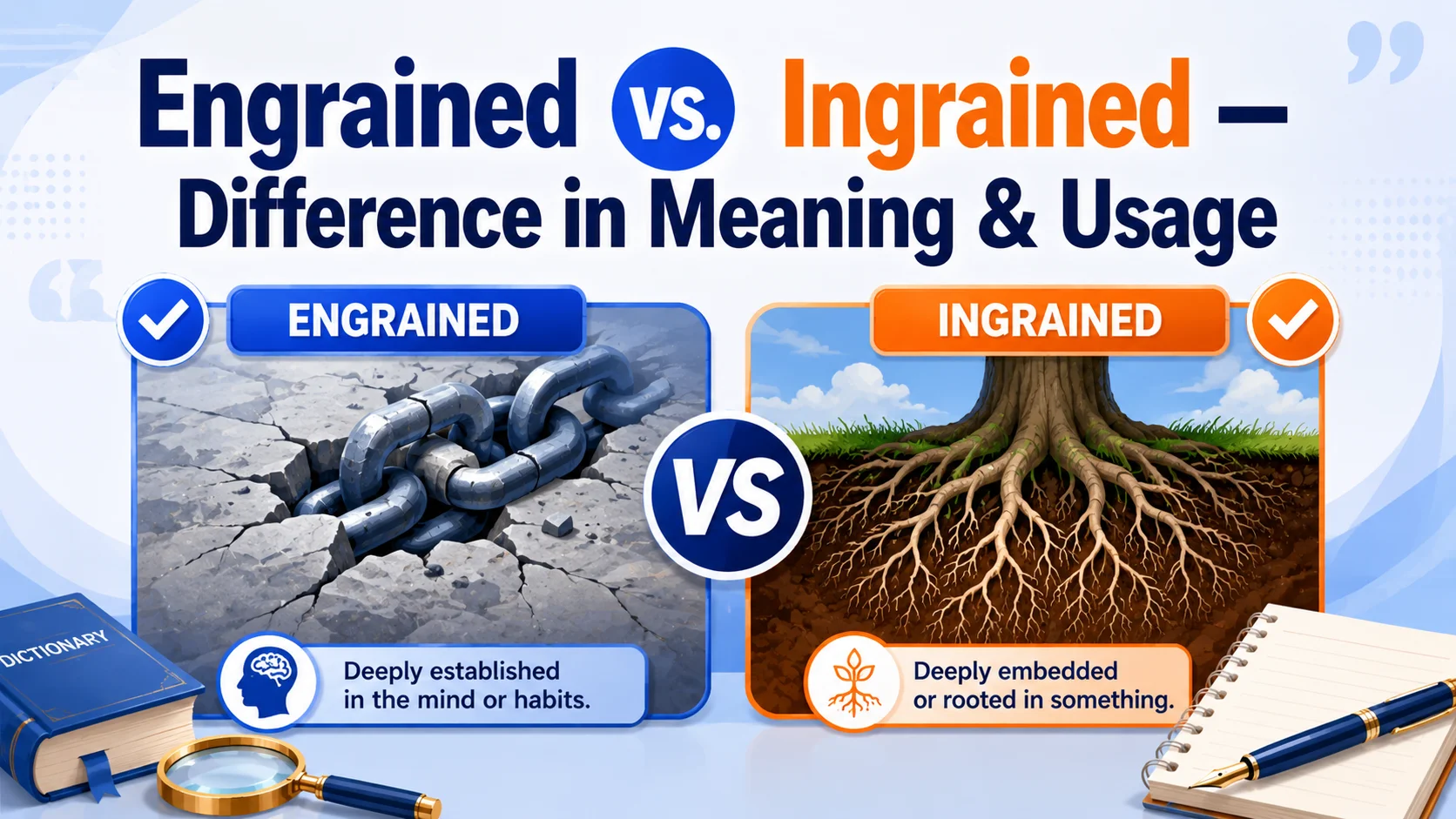
Engrained vs. ingrained can be confusing because both spellings appear in English, and both can refer to something that has become deeply fixed or embedded. If you’re wondering which one you should use, the short answer is ingrained is the standard and much more common choice in modern English. Engrained is also a recognized variant, but it appears far less often.
The distinction matters most when you’re writing for an audience that expects conventional English. You’ll commonly see ingrained used with words such as habits, beliefs, attitudes, behaviors, traditions, and prejudices. It can also describe physical things such as dirt or stains that have become difficult to remove. Knowing these patterns makes the correct spelling much easier to choose.
In this guide, you’ll learn exactly what ingrained and engrained mean, whether they have different meanings, where the two forms came from, how ingrain and engrain relate to them, and which form works best in formal writing. You’ll also see practical examples, common mistakes, and a simple way to remember the difference.
Engrained vs. Ingrained: The Quick Answer
Ingrained is the preferred spelling in contemporary English.
Engrained is a legitimate but less common variant with essentially the same meaning.
Both can describe something that is:
- Deeply established
- Firmly fixed
- Difficult to change
- Embedded in something
- Worked into a material
For most writing situations, choose ingrained.
| Word | Meaning | Frequency | Recommended use |
| Ingrained | Deeply established or embedded | Common | Preferred |
| Engrained | Same basic meaning | Less common | Acceptable variant |
| Ingrain | To establish or embed deeply | Common | Preferred verb |
| Engrain | Variant of ingrain | Less common | Usually unnecessary |
Quick rule: If you’re unsure, use ingrained. It’s the familiar standard form and will work naturally in almost every modern context.
What Does “Ingrained” Mean?
Ingrained is an adjective that describes something deeply established, firmly fixed, or difficult to change.
It is particularly common when talking about habits, beliefs, attitudes, behaviors, traditions, and ways of thinking.
For example:
- She has an ingrained habit of checking her phone before bed.
- His fear of failure was deeply ingrained.
- The company has an ingrained culture of punctuality.
- Hospitality is ingrained in the local culture.
- The belief became ingrained in his thinking.
The central idea is depth. An ingrained habit isn’t something you picked up yesterday. It has become established through repetition, experience, teaching, or long exposure.
Ingrained Can Also Describe Physical Things
The word isn’t restricted to thoughts and behavior.
You can use ingrained for physical substances that have become embedded in a material and are difficult to remove.
For example:
- The carpet was covered with ingrained dirt.
- Years of smoke left an ingrained smell in the curtains.
- The grease became ingrained in the fabric.
- Mud was ingrained in the fibers of the carpet.
This physical sense is useful because it reveals the broader idea behind ingrained: something has gone deep into something else rather than merely sitting on the surface.
What Does “Engrained” Mean?
Engrained has essentially the same meaning as ingrained.
It can describe something that has become:
- deeply established,
- firmly fixed,
- embedded in a material, or
- difficult to remove or change.
Examples include:
- The tradition was engrained in the community.
- His approach to work was engrained in his personality.
- The stain was engrained in the fabric.
The important point is that engrained is not normally a completely different word with a separate definition. It is a less common variant of ingrained.
That means you shouldn’t rely on a rule such as:
“Ingrained is for mental things, while engrained is for physical things.”
That distinction is too rigid and doesn’t accurately represent actual English usage.
Is “Engrained” Correct?
Yes. Engrained is a recognized English word.
However, there is an important difference between being valid and being the best choice for ordinary writing.
Engrained is much less common than ingrained. As a result, readers are more accustomed to seeing:
- deeply ingrained beliefs
- ingrained habits
- ingrained attitudes
- ingrained traditions
- ingrained behavior
rather than the corresponding engrained forms.
So if someone tells you that engrained is always a spelling error, that’s too strong. But if you’re asking which form you should normally write, ingrained is the better answer.
Expert tip: When two forms have essentially the same meaning but one is overwhelmingly more familiar, the more established form is usually the safer choice in professional and formal writing.
Is “Ingrained” the Standard Form?
Yes. Ingrained is the form you should normally choose.
It works naturally in almost every context where you might be tempted to use engrained.
Consider these examples:
- Ingrained habits can be difficult to change.
- The company has an ingrained preference for traditional methods.
- The belief is deeply ingrained in society.
- Years of use left ingrained dirt on the floor.
None of these sentences requires engrained.
The advantage of ingrained isn’t that it has a different meaning. Its advantage is familiarity, conventionality, and frequency.
Engrained vs. Ingrained: The Main Difference
The easiest way to understand the pair is to separate meaning from usage frequency.
| Aspect | Ingrained | Engrained |
| Core meaning | Deeply fixed or embedded | Deeply fixed or embedded |
| Used for habits | Yes | Yes |
| Used for beliefs | Yes | Yes |
| Used for traditions | Yes | Yes |
| Used for physical substances | Yes | Yes |
| Common in modern English | Yes | Less common |
| Safe default for formal writing | Yes | Usually not necessary |
| Considered a valid form | Yes | Yes |
So the question isn’t really:
“Which word means this?”
It’s more accurately:
“Which spelling should I prefer?”
For most modern readers, the answer is ingrained.
Why Do People Confuse Engrained and Ingrained?
There are several reasons these forms cause uncertainty.
The Spellings Are Nearly Identical
The only obvious difference is the vowel after the first consonant:
- ingrained
- engrained
When words look this similar, writers naturally wonder whether the spelling difference signals a difference in meaning.
“Engrained” Looks Like “Engraved”
The beginning of engrained resembles words such as engrave and engraved.
That can lead writers to assume engrained must refer to something physically carved into a surface.
It doesn’t.
Compare:
- The name was engraved on the watch.
- The habit was ingrained in her behavior.
Engraved describes a marking or design cut into a surface. Ingrained describes something deeply embedded or firmly established.
People Learn Conflicting Rules
One writer may have been taught that engrained is incorrect. Another may have encountered it in published writing.
Both experiences can be explained by the same fact: ingrained is the dominant form, while engrained survives as a less common variant.
Ingrain vs. Engrain
The same spelling difference appears in the verbs ingrain and engrain.
What Does “Ingrain” Mean?
Ingrain means to establish something deeply or firmly, especially a habit, belief, attitude, or characteristic.
It can also mean to work something into a material.
Examples:
- Parents can ingrain good habits from an early age.
- Years of training ingrained discipline in the athletes.
- The experience ingrained a strong sense of responsibility in her.
- Dirt had become ingrained in the carpet fibers.
The verb is less common in everyday conversation than the adjective ingrained, but it is completely standard.
What Does “Engrain” Mean?
Engrain is a less common variant of ingrain.
Its meaning is essentially the same.
For example:
The experience engrained a sense of caution in him.
The sentence can be understood, but ingrained and ingrain are generally the more natural choices for contemporary writing.
A Simple Verb-to-Adjective Pattern
Think of the relationship like this:
ingrain → ingrained
and, as the less common variant:
engrain → engrained
This helps explain why the spelling difference isn’t merely an isolated adjective issue.
How to Use “Ingrained” Correctly
The adjective frequently appears with words describing something that has become deeply established.
Common combinations include:
- deeply ingrained
- firmly ingrained
- strongly ingrained
- ingrained habit
- ingrained belief
- ingrained attitude
- ingrained behavior
- ingrained tradition
- ingrained culture
- ingrained prejudice
- ingrained tendency
One of the most natural structures is:
be + ingrained + in + something/someone
Examples:
- The habit is ingrained in him.
- The tradition is ingrained in the community.
- The belief is deeply ingrained in society.
- Safety awareness is ingrained in the company’s employees.
“Ingrained In” vs. “Ingrained Into”
Both constructions can appear, but they often emphasize slightly different ideas.
Ingrained in
Ingrained in is particularly natural when describing an established state.
Respect for elders is deeply ingrained in the culture.
The habit is ingrained in her daily routine.
Ingrained into
Ingrained into can emphasize the process of establishing something within a person or system.
The importance of safety was ingrained into the workers from the beginning.
However, don’t force into simply because you’re describing a process. In many sentences, ingrained in will sound smoother.
Examples of “Ingrained” in Real-Life Writing
Habits
- Waking up early became an ingrained habit.
- Checking emails first thing in the morning was ingrained in his routine.
- Her habit of taking notes was deeply ingrained.
Beliefs
- The idea was ingrained in his thinking.
- Some beliefs become so deeply ingrained that people rarely question them.
- The assumption was ingrained in the organization’s culture.
Attitudes
- The manager had an ingrained preference for traditional methods.
- Years of experience created an ingrained skepticism toward quick solutions.
- The attitude was too deeply ingrained to disappear overnight.
Traditions
- The custom is ingrained in local culture.
- Family traditions can become ingrained over generations.
- The practice is deeply ingrained in community life.
Physical Materials
- The carpet contained ingrained dirt.
- The grease was ingrained in the fabric.
- The old shirt had an ingrained odor that washing couldn’t remove.
Examples of “Engrained” in Sentences
Although ingrained is preferable, engrained can still be encountered.
Here are examples that show its range:
- The tradition was engrained in the community.
- His work habits were engrained from childhood.
- The stain had become engrained in the fabric.
- The belief was engrained in the organization’s culture.
- Her response seemed engrained through years of experience.
These examples also demonstrate why trying to give the two spellings completely separate meanings doesn’t work. Engrained can occur in both figurative and physical contexts.
Ingrained vs. Engraved: Don’t Mix Them Up
This is one of the most useful distinctions to remember.
| Word | Meaning | Example |
| Ingrained | Deeply established or embedded | The habit was deeply ingrained. |
| Engrained | Less common variant of ingrained | The belief was engrained in him. |
| Engraved | Cut, carved, or marked into a surface | Her name was engraved on the ring. |
If you’re talking about a design carved into wood, use engraved.
If you’re talking about a habit that is difficult to change, use ingrained.
For example:
The initials were engraved on the metal.
The habit was ingrained after years of practice.
The visual similarity between engrained and engraved is probably responsible for some of the confusion.
Does “Ingrained” Only Describe Mental Things?
No.
This is a common misconception.
Ingrained can describe both abstract concepts and physical substances.
Abstract
- an ingrained belief
- an ingrained habit
- an ingrained attitude
- an ingrained tradition
Physical
- ingrained dirt
- ingrained grease
- an ingrained stain
- an ingrained odor
The shared idea is that something has become deeply embedded.
That underlying concept is more useful than memorizing separate lists.
Does “Engrained” Have a Different Meaning From “Ingrained”?
Generally, no meaningful modern distinction needs to be made.
Both can refer to something that has become deeply fixed or embedded.
If you’re editing a sentence such as:
His fear was engrained in his mind.
you would normally change it to:
His fear was ingrained in his mind.
You aren’t changing the meaning. You’re choosing the more conventional spelling.
Likewise, if you encounter engrained in a published text, it doesn’t automatically mean the writer misunderstood the word. It may simply reflect the less common variant.
Common Mistakes With Ingrained and Engrained
Mistake 1: Calling “Engrained” a Misspelling Every Time
It’s better to say that engrained is uncommon, rather than claiming that it is never legitimate.
Fix: Prefer ingrained, but recognize engrained as an established variant.
Mistake 2: Creating a Mental-vs.-Physical Rule
It’s tempting to say:
Ingrained = mental
Engrained = physical
That’s not reliable.
Both forms can be used in figurative and physical contexts.
Fix: Choose based primarily on standard usage, not the type of thing being described.
Mistake 3: Confusing “Ingrained” With “Engraved”
These words have different meanings.
Fix: Use engraved for carving or marking a surface and ingrained for something deeply established or embedded.
Mistake 4: Thinking the Less Common Form Must Be More Precise
Writers sometimes choose engrained because it seems to provide a special distinction.
There usually isn’t any advantage in doing so.
Fix: If your intended meaning is covered by ingrained, use the familiar form.
Mistake 5: Assuming Frequency Determines Whether a Word Is Real
A rare word isn’t necessarily incorrect.
English contains many words and variants that occur infrequently but remain legitimate.
Fix: Separate “uncommon” from “wrong.”
When Should You Use “Ingrained”?
Choose ingrained when you’re describing something that has become deeply established or embedded.
It’s particularly suitable for:
- Academic writing
- Business writing
- News writing
- Essays
- Educational content
- Professional communication
- Everyday writing
For example:
The organization has an ingrained culture of accountability.
This behavior is deeply ingrained in society.
She developed an ingrained habit of planning ahead.
These forms sound natural and familiar to modern readers.
When Might You Encounter “Engrained”?
You may see engrained in:
- Older writing
- Less common published usage
- Individual writing styles
- Historical texts
- General prose
If you’re reading rather than writing, there usually isn’t a need to stop and question the word.
If you’re writing, however, ingrained is the safer default.
Editorial recommendation: Don’t change engrained automatically in every quotation or historical text. But when choosing your own wording, use ingrained unless a particular style or source requires otherwise.
A Practical Decision Guide
| If you are… | Best choice |
| Writing an academic paper | Ingrained |
| Writing a business report | Ingrained |
| Writing an email | Ingrained |
| Writing website content | Ingrained |
| Writing an essay | Ingrained |
| Speaking casually | Ingrained |
| Reading an older text containing engrained | Understand it as a variant |
| Quoting someone directly | Preserve the original if appropriate |
| Trying to describe carved lettering | Engraved, not ingrained/engrained |
How to Remember Ingrained vs. Engrained
The easiest memory trick is:
When in doubt, go with “in.”
Think:
IN + GRAINED = deeply IN something
For example:
The belief is ingrained in her thinking.
Dirt is ingrained in the carpet.
This isn’t a complete explanation of the word’s history, but it’s an effective writing shortcut.
Another useful trick is to remember the common collocation:
deeply ingrained
If you’ve seen that phrase repeatedly, use it as your default.
A Second Memory Trick: Avoid the “Engrave” Trap
If you’re thinking about engraving, stop.
- Engraved = carved or marked
- Ingrained = deeply fixed or embedded
That distinction prevents one of the most common spelling-related mistakes.
Synonyms for “Ingrained”
Depending on context, useful alternatives include:
- Deep-rooted
- Deep-seated
- Established
- Fixed
- Embedded
- Entrenched
- Firmly established
- Habitual
- Persistent
- Internalized
However, these words aren’t perfect substitutes in every sentence.
For example, deep-rooted works well with beliefs and traditions, while embedded may be better for something physically located within another material.
Example
She has an ingrained habit of arriving early.
Possible alternatives:
She has a deep-rooted habit of arriving early.
She has an established habit of arriving early.
The original is often the most natural because ingrained specifically conveys something that has become difficult to change.
Related Word: “Entrenched”
Entrenched is another useful word when discussing established beliefs, attitudes, systems, or practices.
For example:
The company has an entrenched hierarchy.
The political disagreement has become deeply entrenched.
There is overlap with ingrained, but entrenched often emphasizes resistance to change or a position that has become firmly established.
Related Word: “Deep-Seated”
Deep-seated is especially common for feelings, beliefs, fears, and attitudes.
Examples:
- a deep-seated fear
- a deep-seated belief
- a deep-seated resentment
Compare:
His fear was ingrained from childhood.
He had a deep-seated fear of failure.
Both work, but they emphasize slightly different aspects. Ingrained often highlights how something became established; deep-seated highlights how deeply it exists.
Why “Ingrained” Is Usually Better for Modern Writing
When you’re choosing between two accepted variants, the reader’s experience matters.
Ingrained has several practical advantages:
- Readers recognize it immediately.
- It appears frequently in standard prose.
- It works in both formal and informal contexts.
- It fits established phrases naturally.
- It avoids unnecessary questions about spelling.
There’s no prize for choosing the rarer spelling when the common one communicates exactly what you mean.
Good editing often means making the choice that removes friction for the reader.
A Quick Editing Checklist
Before publishing your sentence, ask:
- Am I describing something deeply established or embedded?
- If yes, would ingrained fit naturally?
- Am I actually talking about something carved or marked?
- If so, should I use engraved instead?
- Am I writing formal or professional content?
- If yes, have I chosen the more familiar form?
- Am I treating engrained as automatically wrong without checking context?
- Have I accidentally invented a mental-versus-physical distinction?
If the answer points toward the common form, write ingrained.
Conclusion
When choosing between engrained vs. ingrained, the safest answer is straightforward: use ingrained in most modern writing. It is the standard, familiar form for describing deeply established habits, beliefs, attitudes, traditions, behaviors, and even physical substances embedded in a material. Engrained isn’t simply a spelling error, though; it is a recognized, less common variant with essentially the same core meaning. One final actionable tip: when editing your own work, replace engrained with ingrained unless you have a specific reason to retain the less common form. A common mistake to avoid is confusing ingrained with engraved. If something is deeply established, choose ingrained. If something is carved into a surface, choose engraved. In English, the most useful distinction isn’t always between right and wrong—it can be between a possible form and the best form for your reader.
Frequently Asked Questions
Q1. Is “engrained” a real word?
Yes. Engrained is a recognized variant of ingrained, although it is much less common. It can describe something deeply established or embedded. For general modern writing, ingrained is the safer and more familiar choice, especially in professional, academic, and educational contexts.
Q2. Is “ingrained” only used for habits and beliefs?
No. Ingrained can describe both abstract and physical things. You can have an ingrained habit or an ingrained belief, but you can also have ingrained dirt, grease, stains, or odors. The common idea is that something has become deeply embedded or difficult to remove or change.
Q3. Is “engrained” the same as “engraved”?
No. Engrained is a variant of ingrained, while engraved means carved, cut, or marked into a surface. For example, a name can be engraved on a ring, while a habit can become ingrained over time. The similar spelling doesn’t mean the words are interchangeable.
Q4. Should I use “ingrained” in academic writing?
Yes. Ingrained is generally the better choice for academic writing because it is the standard, familiar form. It works naturally in discussions of beliefs, social attitudes, cultural practices, institutional behavior, and established assumptions. If you encounter engrained in a source, don’t automatically assume the source is incorrect.
Q5. What is the easiest way to remember “ingrained” vs. “engrained”?
Use ingrained as your default. A useful memory cue is the common phrase “deeply ingrained.” Also remember that ingrained can mean something is deeply “in” a material, habit, belief, or culture. Reserve engraved for something physically carved or marked.