

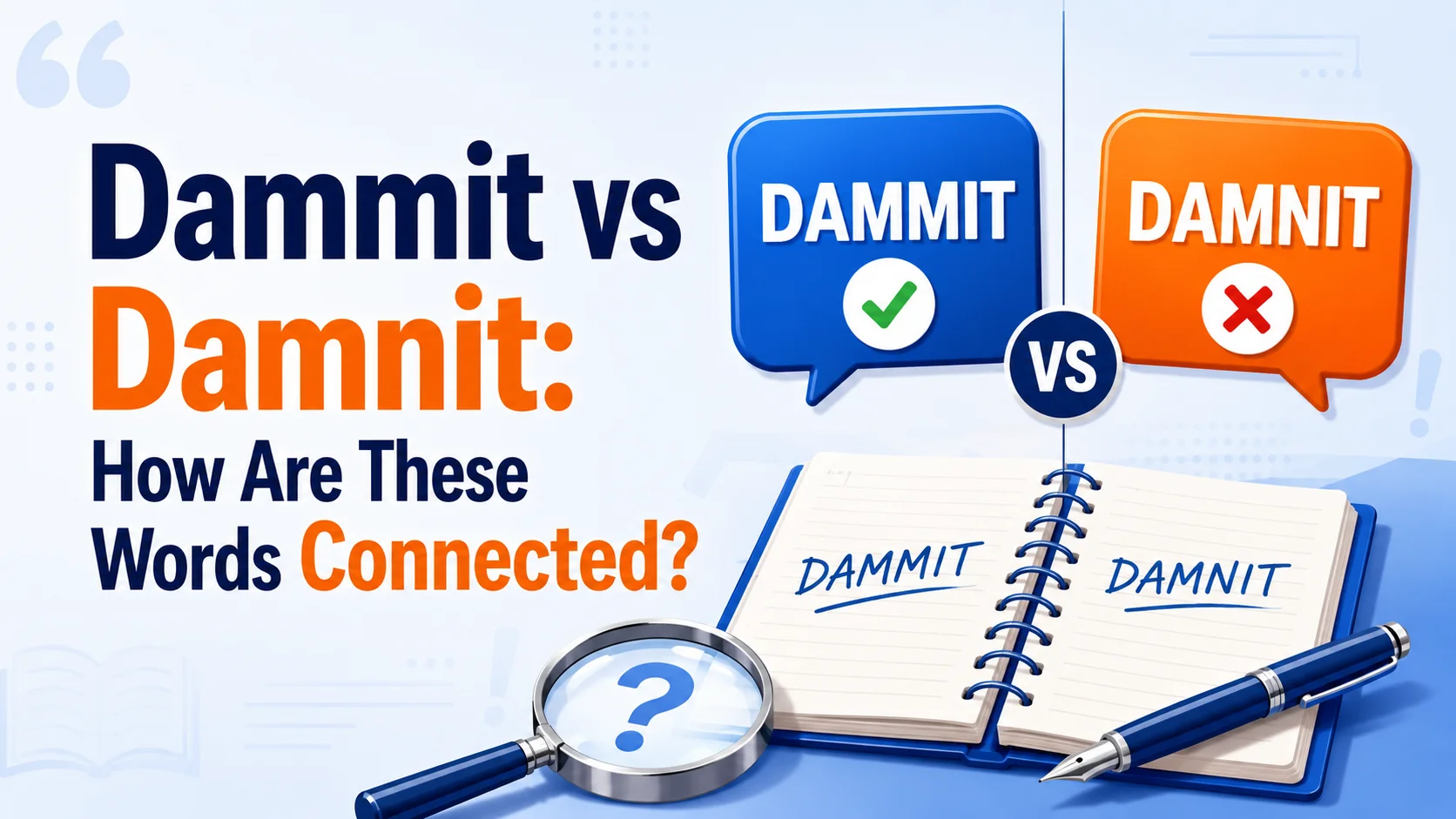
Dammit vs Damnit is a surprisingly common spelling question because the two forms look almost identical, sound essentially the same in ordinary speech, and are used to express the same basic emotion. If you’ve ever typed one and then stopped to wonder whether the other spelling was correct, the confusion is understandable.
The short answer is that dammit is the more established dictionary spelling, while damnit is also recognized by some dictionaries as a very informal variant. Both forms are connected to the expression “damn it,” but they don’t have different meanings. Merriam-Webster defines dammit as an interjection and traces it to an alteration of damn it. Cambridge likewise lists damnit as a variant of dammit.
That distinction matters because spelling and register are separate questions. Even though you may see damnit in texts, social media, dialogue, or casual online writing, that doesn’t automatically make either form appropriate everywhere. In a professional email or academic paper, the bigger issue usually isn’t choosing between the two spellings—it’s whether you should use the emotionally charged expression at all.
Dammit vs Damnit: The Quick Answer
If you need a simple rule, remember this:
Use “dammit” when you want the safest established one-word spelling. Recognize “damnit” as a very informal variant, but avoid both forms in formal writing unless you have a specific reason to reproduce informal speech.
The two forms generally function as interjections. They can express frustration, anger, annoyance, disappointment, or strong emphasis.
| Question | Answer |
| Dammit or damnit? | Dammit is the safer standard spelling. |
| Do they mean different things? | No. They generally express the same emotion. |
| Are they pronounced differently? | Usually no. |
| Where does dammit come from? | It developed from “damn it.” |
| Is damnit used? | Yes. Some dictionaries recognize it as a very informal variant. |
| Can you use either in formal writing? | Generally, neither is a good choice for formal prose. |
The important nuance is that calling damnit simply “not a word” is too absolute. Cambridge explicitly lists damnit as a variant, while other references describe it as nonstandard.
What Does “Dammit” Mean?
Dammit is an informal exclamation used to express a strong reaction, particularly anger, frustration, irritation, or disappointment. It can stand alone or appear inside a sentence.
For example:
- “Dammit!” I forgot my wallet.
- Dammit, we’re going to be late.
- I tried to fix it, but dammit, the thing still won’t work.
- Dammit, that was my last chance.
Merriam-Webster classifies dammit as an interjection and describes it as a mild imprecation. Collins similarly associates it with anger, irritation, contempt, and disappointment.
How “Dammit” Expresses Emotion
The word itself doesn’t identify exactly why someone is upset. Its emotional meaning comes from context, punctuation, surrounding words, and delivery.
Compare:
“Dammit! I locked my keys in the car.”
This clearly communicates frustration.
Now consider:
“Oh, dammit, I forgot the tickets.”
The second version can sound less explosive because oh and the surrounding sentence soften the delivery.
In dialogue, repetition can intensify the reaction:
“Dammit, dammit, dammit. Where did I put that file?”
The spelling remains the same, but the context changes the emotional force.
What Feelings Can “Dammit” Convey?
Depending on the situation, dammit can signal:
- Frustration — something isn’t working.
- Annoyance — an unwanted problem has appeared.
- Disappointment — an expected outcome failed.
- Anger — someone feels strongly upset.
- Surprise — an unexpected problem occurs.
- Emphasis — the speaker wants to add emotional force.
That’s why translating dammit into one fixed phrase can be misleading. In one situation it may be close to “Oh no,” while in another it may communicate genuine anger.
What Does “Damnit” Mean?
Damnit generally has the same meaning as dammit. It is an informal spelling associated with the same expression and is sometimes treated as a variant or nonstandard form.
Cambridge lists damnit alongside dammit and damn it, giving examples in which the form expresses anger or emphasis.
So:
Dammit, I missed the train.
and
Damnit, I missed the train.
normally communicate the same thing.
The difference is primarily spelling and usage preference, not meaning.
Why “Damnit” Exists as a Spelling
The answer becomes easier when you think about pronunciation.
When people say “damn it” quickly, the two words can run together. English speakers often represent spoken expressions in writing by creating contracted or fused forms. Dammit is one result of that process.
Damnit is another spelling that attempts to preserve a visual connection with damn + it.
The form is familiar enough that major dictionaries document it, even though its status differs from that of dammit. Cambridge marks the expression as very informal and includes damnit as a variant.
Dammit vs Damnit: What Is the Actual Difference?
There is no meaningful difference in the basic emotion or communicative function of the two forms.
The practical distinction is their status in edited English.
| Feature | Dammit | Damnit |
| Basic meaning | Frustration, anger, annoyance, emphasis | Same |
| Part of speech | Interjection | Interjection |
| Pronunciation | Usually /ˈdæmɪt/ | Usually similar |
| Origin | From damn it | From damn it |
| Dictionary recognition | Well established | Recognized as a variant by some dictionaries |
| Formality | Very informal | Very informal |
| Best choice when unsure | Yes | No |
| Professional writing | Usually avoid | Usually avoid |
Merriam-Webster gives dammit as the established entry and identifies its etymology as an alteration of damn it. Cambridge goes further by explicitly recording damnit as a variant.
So the safest editorial advice is not “damnit has a completely different meaning.” It doesn’t. Instead:
Dammit is the safer established spelling; damnit is a documented but highly informal variant.
Why Do People Spell “Damnit” Instead of “Dammit”?
The spelling becomes less mysterious when you separate sound from spelling.
Pronunciation Influences Spelling
In ordinary speech, the final consonant of damn isn’t pronounced in isolation the way many learners might expect. When damn and it occur together, the resulting pronunciation sounds much closer to “dam-it” than the spelling damnit might suggest.
That makes dammit visually intuitive to many writers.
Fast Speech and Informal Writing
Informal expressions often develop spellings that imitate how people actually hear or say them.
This happens throughout English. Spoken language is messy, fast, and context-dependent; spelling is comparatively conservative.
When people repeatedly hear an expression as one unit, they may naturally begin writing it as one unit too.
Internet and Texting Culture
Online communication encourages speed and informality. A person writing a quick message usually isn’t thinking about the historical relationship between damn and it.
For example:
“Damnit I left my charger at home.”
The writer’s goal is to communicate frustration, not demonstrate formal spelling.
That doesn’t make the spelling meaningless. It shows how informal digital writing can preserve variant forms.
Is “Damnit” a Misspelling of “Dammit”?
The answer depends on what you mean by “misspelling.”
If you’re asking, “Which spelling should I choose when I want the most widely established form?”, choose dammit.
If you’re asking, “Is damnit ever used and recognized in English?”, yes. Cambridge lists it as a variant, while other references label it nonstandard.
This is an important distinction because dictionary labels don’t always divide English into a simple correct/wrong system.
A form can be:
- established,
- informal,
- regional,
- nonstandard,
- archaic,
- dialectal,
- or recognized only in particular contexts.
Damnit belongs to the informal end of that spectrum.
When Should You Correct “Damnit”?
Correction depends on the situation.
If you’re editing:
“Damnit, I forgot the attachment.”
for a professional publication, changing it to “Dammit” would be reasonable if the expression itself is appropriate.
But if you’re editing a novel in which a character consistently writes or speaks in a particular informal style, preserving “damnit” may make sense if the author’s chosen voice supports it.
The editor’s job isn’t simply to eliminate every unusual spelling. It’s to determine whether the form is intentional, appropriate, and consistent.
Where Did “Dammit” Come From?
The history of dammit is closely tied to “damn it.”
Merriam-Webster identifies dammit as an alteration of damn it, while Etymonline dates the recorded form to the early 20th century and describes it as a written representation of how the oath was commonly sounded.
Dictionary.com gives a first-recorded period of 1905–10, which broadly agrees with the early-20th-century history reported by other references.
The Connection to “Damn It”
Historically, the expression began as two words:
damn + it → damn it
As the phrase became familiar and was spoken rapidly, the words could function as a single emotional unit.
That produced the one-word form:
dammit
This process is sometimes described as univerbation—two words becoming a single lexical unit.
Why the One-Word Form Matters
Compare:
Damn it!
with:
Dammit!
They are closely related, but modern English treats dammit as an established interjection in its own right. Merriam-Webster specifically lists it as an interjection rather than merely presenting it as an ordinary two-word phrase.
How to Use “Dammit” Correctly in a Sentence
Because dammit is an interjection, it doesn’t behave like a normal noun or verb.
You can use it independently:
Dammit!
You can also place it before or inside a statement:
Dammit, I forgot the appointment.
I was ready to leave when, dammit, the phone rang.
You don’t normally write:
❌ I dammited the situation.
That doesn’t work because dammit isn’t a verb in ordinary modern English.
Dammit at the Beginning of a Sentence
This is one of the most natural positions:
Dammit, I missed the bus.
It immediately establishes the speaker’s emotional reaction.
Dammit at the End
You can also use it after the main statement:
I missed the bus again, dammit.
Here, the word acts almost like an emotional afterthought.
Dammit With Punctuation
Because it is an interjection, punctuation can strongly influence how it reads.
Dammit! — strong reaction
Dammit, I forgot again. — emotional opening
I forgot again—dammit. — emphatic ending
In fiction, punctuation can help distinguish irritation from explosive anger without changing the word itself.
How to Use “Damnit” in a Sentence
If you’re intentionally using the variant spelling, its grammatical function is essentially the same.
Examples include:
Damnit! I left my phone upstairs.
Damnit, why does this always happen?
I knew I had forgotten something. Damnit.
However, if you’re writing something that will be graded, professionally edited, published, or submitted formally, dammit is generally the safer one-word choice.
The key point isn’t that damnit changes the sentence’s grammar. It doesn’t. The choice mainly affects the spelling convention and perceived informality.
Dammit vs Damnit in Real-Life Contexts
Different environments call for different levels of language control.
| Context | Dammit | Damnit | Recommended approach |
| Private text to a friend | Fine if appropriate | Possible | Either may appear |
| Social media | Common | Possible | Match your audience |
| Fictional dialogue | Useful | Possible | Preserve character voice |
| Casual personal writing | Possible | Possible | Choose deliberately |
| Workplace email | Usually inappropriate | Usually inappropriate | Prefer neutral wording |
| Academic essay | Avoid | Avoid | Use neutral language |
| Formal report | Avoid | Avoid | Use professional wording |
| Quoted speech | Depends | Depends | Preserve the original if necessary |
Notice that spelling correctness isn’t the only issue.
A perfectly spelled informal expression can still be inappropriate for the audience.
That is a broader writing lesson worth remembering: correct grammar doesn’t automatically mean appropriate communication.
What Tone Does “Dammit” Communicate?
One of the easiest mistakes is assuming that dammit always means “I am furious.”
Not necessarily.
Mild Frustration
Dammit, I forgot my umbrella.
The speaker may simply be annoyed.
Strong Anger
Dammit! Get out of here!
Now the expression accompanies a much stronger emotional reaction.
Disappointment
Dammit. We were so close.
The dominant feeling may be disappointment rather than anger.
Playful Frustration
Friends may even use it jokingly:
Dammit, you beat me again!
The relationship and surrounding context can make the statement playful rather than hostile.
This is why tone cannot be determined from the spelling alone.
Common Mistakes With Dammit and Damnit
Mistake 1: Assuming They Have Different Definitions
They generally don’t.
If someone writes damnit instead of dammit, they’re not usually trying to communicate a different emotion.
Mistake 2: Treating “Damnit” as Completely Invalid
That conclusion ignores actual dictionary evidence. Cambridge explicitly records damnit as a variant.
It’s more accurate to call it very informal, variant, or nonstandard depending on the reference and context.
Mistake 3: Using Either Form in Formal Writing
This is the bigger practical mistake.
Even if the spelling is accepted, dammit remains an informal exclamation. Merriam-Webster and Cambridge both identify it as informal or an interjection associated with anger.
Mistake 4: Assuming Pronunciation Determines Spelling
English spelling rarely works that neatly.
A word can be pronounced in a way that doesn’t transparently reveal its spelling. Don’t decide the written form solely from what you hear.
Mistake 5: Ignoring the Audience
A text to your best friend and an email to your manager don’t require the same language choices.
Always ask:
Who is reading this, and what impression should the wording create?
Dammit, Damn It, and Other Related Forms
“Dammit” vs “Damn It”
Damn it preserves the original two-word structure:
Damn it! I forgot my keys.
Dammit is the established one-word interjection:
Dammit! I forgot my keys.
Both express frustration, although dammit is more visibly lexicalized as one word.
“Dammit” vs “Damnit”
The central distinction is spelling status rather than meaning:
- dammit — established one-word spelling
- damnit — very informal variant
- damn it — two-word form from which the expression developed
“Damn” vs “Dammit”
These aren’t interchangeable in every sentence.
Damn has several functions and can modify or intensify another word:
That was a damn good performance.
Dammit is an emotional interjection:
Dammit! I forgot the tickets.
Related Expressions
English also has softened or alternative expressions such as:
- darn it
- dang it
- damn it all
- for goodness’ sake
- oh no
These can be useful when you want to express frustration without using the same level of profanity.
Is “Dammit” Appropriate in Formal Writing?
Usually, no.
The problem isn’t primarily spelling. It’s register.
Academic writing, business communication, formal reports, and professional correspondence generally favor language that is precise and emotionally restrained.
Instead of:
Dammit, the shipment arrived late again.
a professional email might say:
Unfortunately, the shipment has arrived late again.
Or:
The shipment was delayed again, which has affected our schedule.
The second versions communicate the problem without adding an emotional outburst.
When Quoting Someone
There is an important exception.
If you’re reporting someone’s exact words, you may need to preserve their language:
The manager reportedly said, “Dammit, we need to fix this today.”
Here, the informal expression belongs to the quotation rather than the writer’s own voice.
In creative writing, the same principle applies. A character’s dialogue can be informal even when the surrounding narration is polished.
Dammit vs Damnit: Common Misconceptions
“Damnit Is a Completely Different Word”
No. The two forms are connected to the same expression and generally communicate the same emotion.
“Damnit Is Always a Typo”
Not necessarily. Some writers intentionally use it, and Cambridge records it as a variant.
“Dammit Is Appropriate Anywhere”
Definitely not.
It’s an informal emotional expression, so the audience and setting matter.
“The Two Spellings Sound Different”
For most speakers, they are pronounced essentially the same. Cambridge gives the pronunciation of dammit as /ˈdæm.ɪt/.
A Simple Memory Trick for Dammit vs Damnit
If you need one spelling to remember, choose:
DAMMIT = the safer one-word choice.
A useful way to remember it is to connect it to the spoken form rather than trying to preserve every letter of damn.
Think:
damn it → dammit
The n from damn isn’t retained in the established one-word spelling.
If you see damnit, recognize what the writer means. You don’t need to assume they’ve invented a new word.
Quick Decision Guide: Which Form Should You Use?
Choose “Dammit” When…
- You need the established one-word form.
- You’re writing informal dialogue.
- You’re writing a casual message.
- You’re intentionally using an emotional interjection.
- You want the safest spelling when choosing between the two.
Recognize “Damnit” as an Informal Variant When…
- You encounter it in texting.
- You see it in social media.
- A character uses it in dialogue.
- Someone writes in a deliberately informal style.
- You’re reading a source that recognizes the variant.
Avoid Both Forms When…
- You’re writing an academic paper.
- You’re preparing a formal business email.
- You’re writing a professional report.
- Your audience expects neutral language.
- The emotional expression doesn’t add anything useful.
Practice: Dammit vs Damnit
Try these quick examples.
Choose the More Established One-Word Spelling
1. “_____! I forgot the deadline.”
Answer: Dammit
2. “She whispered, ‘_____.’”
Answer: Dammit is the safer edited spelling, although damnit can occur as an informal variant.
Identify the Register
Which sentence is most appropriate for a professional email?
A. Dammit, the invoice is wrong again.
B. The invoice appears to contain an error again.
Answer: B.
The point isn’t that dammit cannot be understood. It clearly can. The problem is that professional writing usually requires a neutral and controlled tone.
Conclusion
The Dammit vs Damnit question looks like a simple spelling dispute, but it actually illustrates how English evolves through speech, informal writing, and repeated usage. Dammit is the safest established one-word spelling, while damnit is a documented but very informal variant. Both are connected to “damn it” and generally express the same emotions—frustration, anger, annoyance, disappointment, or emphasis. One final actionable tip: when you’re unsure, choose dammit for the one-word form, or write damn it as two words. If you’re preparing formal or professional writing, consider replacing either expression with neutral wording instead. A common mistake to avoid: don’t confuse spelling choice with language appropriateness. A form can be understandable or even dictionary-listed and still be unsuitable for your audience. Good writing isn’t only about choosing the right letters; it’s about choosing the right language for the situation.
Frequently Asked Questions
Q1. Is “Dammit” or “Damnit” the correct spelling?
Dammit is the safer established spelling when you want the one-word form. However, damnit is not simply meaningless: Cambridge lists it as a very informal variant. Both generally express frustration, anger, annoyance, or emphasis and trace their connection to “damn it.”
Q2. Is “Damnit” considered a real word?
Damnit is documented as a variant, although its status is less standard than dammit. Cambridge includes it alongside dammit, while other references describe it as nonstandard. In edited writing, dammit is the safer choice when the expression is appropriate.
Q3. Do “Dammit” and “Damnit” mean the same thing?
Yes. In ordinary use, dammit and damnit communicate essentially the same meaning. They can express frustration, anger, disappointment, annoyance, or emphasis. The difference is primarily spelling and usage status, not the emotion being communicated.
Q4. Is “Dammit” considered profanity?
Dammit is an informal expletive derived from “damn it.” Its strength depends on the speaker, audience, and situation. It may sound relatively mild in casual conversation but remains inappropriate in some professional, academic, family, or formal settings.
Q5. Can I use “Dammit” in professional or academic writing?
You generally shouldn’t use it in your own formal prose because it’s an emotional, informal expression. If you’re quoting someone or reproducing dialogue, however, it can be appropriate when the original wording matters. Otherwise, use a neutral expression that communicates the underlying problem.