
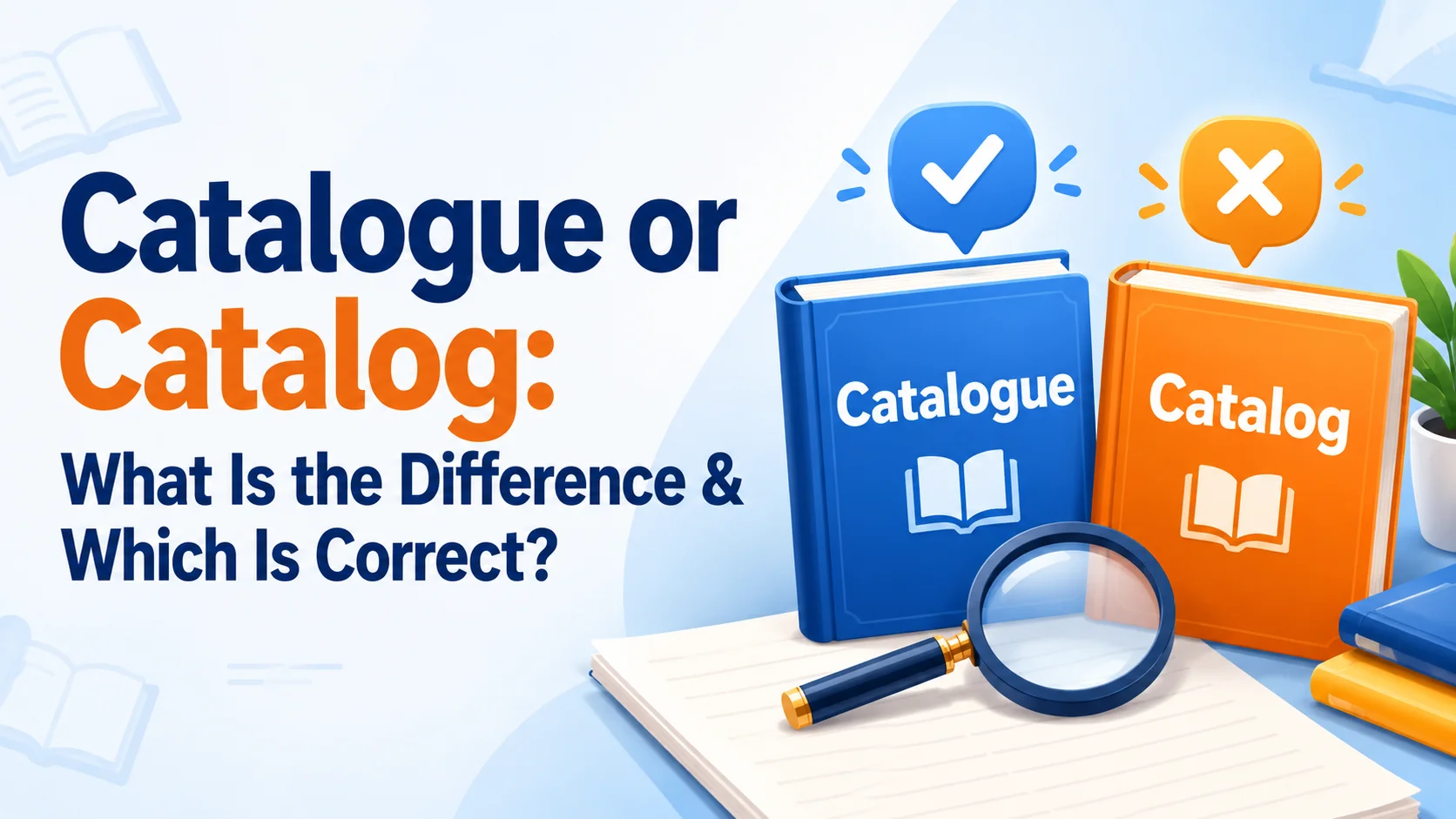
Catalogue or catalog can look like two different words, but in most situations they have the same meaning. The main difference is spelling: catalogue is generally preferred in British English, while catalog is the standard American English form. Both can function as a noun for an organized list of items and as a verb meaning to record or arrange things in a list.
That small spelling difference becomes important when you are writing for a particular audience. A British publisher, university, retailer, or library may naturally use catalogue, whereas an American company or website is more likely to use catalog. The choice is therefore less about one spelling being “right” and the other being “wrong” and more about regional English, house style, and consistency.
In this guide, you will learn exactly when to use catalogue or catalog, how the words work as nouns and verbs, what happens to related forms such as cataloguing and cataloging, and how the choice changes across common contexts such as retail, libraries, education, museums, and technology. You will also get practical examples and a simple decision guide so you can choose confidently without second-guessing every sentence.
Catalogue vs Catalog: The Short Answer
Catalogue and catalog are generally two regional spellings of the same word.
| Question | Catalogue | Catalog |
| Meaning | An organized list or record | An organized list or record |
| British English | Preferred | Less common |
| American English | Less common | Preferred |
| Noun | Yes | Yes |
| Verb | Yes | Yes |
| Product listings | Yes | Yes |
| Library collections | Yes | Yes |
| Main difference | Spelling | Spelling |
Cambridge lists catalogue as the UK form and catalog as the US form. It also recognizes both noun and verb forms.
So, if you are writing:
The university published its new course catalogue.
That is perfectly natural in British English.
For an American audience, you would normally write:
The university published its new course catalog.
The underlying meaning has not changed.
Quick rule: Use catalogue for British English and catalog for American English, unless a particular organization or style guide specifies otherwise.
What Does “Catalogue” Mean?
Catalogue is a noun and a verb.
As a noun, it commonly means an organized list of things, often with information about each item. It may be a physical publication, a digital database, or another structured record.
Examples include:
- a product catalogue
- a library catalogue
- a university course catalogue
- an art catalogue
- a seed catalogue
- a catalogue of historical records
Cambridge defines catalogue as a book containing a list of goods and also as a list of things such as books or paintings. As a verb, it means to record something, particularly in a list.
Catalogue as a noun
The furniture company released its new catalogue in September.
Here, catalogue refers to a publication showing products.
It can also describe a collection or record:
The museum maintains a catalogue of its paintings.
Catalogue as a verb
The verb means to systematically record or list things.
Researchers catalogued hundreds of plant specimens.
This use is particularly common in academic, scientific, library, museum, and archival contexts.
There is also a figurative use:
The report contained a catalogue of errors.
Here, the word means a series or collection of things rather than a literal product list. Cambridge also recognizes this sense.
What Does “Catalog” Mean?
Catalog has the same core meanings as catalogue. It is the spelling most strongly associated with American English.
As a noun, it can refer to:
- a list of products
- a library record
- a collection of works
- a database of resources
- a scientific list
- a publication containing item descriptions
As a verb, it means to systematically record or classify something.
For example:
The store published its winter catalog online.
Or:
Scientists cataloged the newly identified specimens.
Cambridge identifies catalog as the US spelling of catalogue and gives both noun and verb uses.
Catalogue vs Catalog: What Is the Main Difference?
The most important point is simple: the difference is primarily regional spelling, not meaning.
The meaning is essentially the same
A catalogue and a catalog can both be:
- a list of products
- a record of books
- a collection of artworks
- a database of resources
- a scientific inventory
- a list arranged for reference
The surrounding context tells you what kind of catalog or catalogue is being discussed.
British English generally uses “catalogue”
If your writing follows British English conventions, catalogue is normally the natural choice.
For example:
- product catalogue
- library catalogue
- university catalogue
- exhibition catalogue
- mail-order catalogue
American English generally uses “catalog”
American English normally removes the final -ue:
- product catalog
- library catalog
- university catalog
- exhibition catalog
- mail-order catalog
This is not a difference in grammatical correctness. It is a difference in spelling convention.
The pronunciation is not the important distinction
The two spellings are normally pronounced essentially the same way within their respective varieties of English. Therefore, learners should concentrate on which spelling fits their variety of English, rather than trying to treat them as two differently pronounced words.
Catalogue vs Catalog Comparison Table
| Feature | Catalogue | Catalog |
| Primary regional association | British English | American English |
| Basic meaning | Organized list or record | Organized list or record |
| Noun | Yes | Yes |
| Verb | Yes | Yes |
| Product example | Product catalogue | Product catalog |
| Library example | Library catalogue | Library catalog |
| Course example | Course catalogue | Course catalog |
| Past tense | Catalogued | Cataloged |
| -ing form | Cataloguing | Cataloging |
| Best approach | Use consistently in British-style writing | Use consistently in American-style writing |
The important takeaway is that regional preference extends beyond the base word. If you choose a catalogue, related forms normally follow the same British spelling pattern. If you choose a catalog, related forms normally follow the American pattern.
When Should You Use “Catalogue”?
Use catalogue when your document follows British English conventions.
In British English writing
A UK-focused website might write:
Browse our latest furniture catalogue.
A British university might use:
Please consult the course catalogue for module information.
A museum could write:
The exhibition catalogue contains detailed information about every artwork.
In formal British writing
The longer spelling is particularly natural when the surrounding text already follows British conventions.
For example, if your document uses:
- colour
- organisation
- centre
- programme
- travelling
then catalogue will normally fit that spelling system better than catalog.
The broader principle is consistency. A single American spelling inside an otherwise British document may not make the sentence grammatically wrong, but it can make the copy look inconsistent.
In retail and publishing
Traditional British retail terminology commonly uses expressions such as:
- mail-order catalogue
- product catalogue
- fashion catalogue
- furniture catalogue
- Christmas catalogue
The word does not have to describe a physical booklet, however. A digital product collection can also be called a catalogue.
When Should You Use “Catalog”?
Use a catalog when your writing follows American English conventions.
In American English
For an American audience, these forms are standard:
Browse our online catalog.
The library’s catalog contains thousands of records.
Download the latest product catalog.
In American business writing
Businesses often use catalogs for product collections and sales materials.
For example:
The sales team sent the customer a digital product catalog.
The spelling is especially natural when the rest of the company’s copy follows American English.
In technology
The shorter spelling is also common in American-oriented technical terminology:
- data catalog
- software catalog
- product catalog
- service catalog
- application catalog
- digital catalog
In technical writing, the correct choice may depend on the product’s official terminology. If a software platform officially calls something a Service Catalog, changing it to Service Catalogue merely because you prefer British spelling could create an inaccurate product name.
Expert tip: Proper names, branded features, product names, and official interface labels should normally be written exactly as the organization presents them.
Catalogue or Catalog in Different Contexts
The best spelling becomes easier to understand when you see how the word behaves in real situations.
Product catalogue vs product catalog
Both are correct.
British English:
Our new product catalogue includes furniture, lighting, and accessories.
American English:
Our new product catalog includes furniture, lighting, and accessories.
The product information itself does not change.
Library catalogue vs library catalog
Libraries use the word for an organized record of their holdings.
British English:
Search the library catalogue to find the book.
American English:
Search the library catalog to find the book.
A library’s official system name may determine the exact wording used in its interface.
Course catalogue vs course catalog
Educational institutions may use the word for a collection of courses, programs, policies, or academic information.
British English:
The course catalogue explains the requirements for each programme.
American English:
The course catalog explains the requirements for each program.
Notice that other regional spellings may change too. This is why it is better to think in terms of an English variety rather than changing individual words independently.
Museum and exhibition catalogues
Museums and galleries frequently use the term for publications documenting exhibitions or collections.
For example:
The exhibition catalogue includes essays about the featured artists.
An American museum may instead write:
The exhibition catalog includes essays about the featured artists.
Online catalogue vs online catalog
The move from printed publications to websites has not eliminated the word.
An online catalogue can be:
- a searchable collection
- an e-commerce product listing
- a library database
- a museum collection
- a university resource
- a supplier’s inventory
The digital format does not determine the spelling. Regional English does.
Catalogue vs Catalog as a Verb
One area that causes more confusion is the verb.
Both versions can mean to record, classify, or list systematically.
British English:
The archivist catalogued the documents.
American English:
The archivist cataloged the documents.
The same distinction appears in the present participle.
| Form | British English | American English |
| Base verb | catalogue | catalog |
| Third-person singular | catalogues | catalogs |
| Past tense | catalogued | cataloged |
| Present participle | cataloguing | cataloging |
| Noun plural | catalogues | catalogs |
This pattern is useful because it prevents a common mistake: changing only the base word while leaving related forms in another regional spelling.
For example, if your document consistently uses American English, this combination looks inconsistent:
The researcher catalogued the specimens in the online catalog.
It would normally be better to write:
The researcher cataloged the specimens in the online catalog.
For British English:
The researcher catalogued the specimens in the online catalogue.
Common Catalogue vs Catalog Mistakes
Mistake 1: Thinking one spelling is universally correct
Neither spelling should automatically be labeled “wrong.”
Catalogue is appropriate for British English, while catalog is appropriate for American English. The intended audience matters.
Mistake 2: Mixing regional spellings
A document that uses colour, organisation, and centre throughout but suddenly switches to catalog may look poorly edited.
Likewise, an American document using color and organization would normally use catalog, not catalogue.
Mistake 3: Assuming “catalogue” is more formal
The extra letters do not make the word more formal.
Catalogue is not inherently more professional, sophisticated, or correct. It is simply the spelling associated particularly strongly with British English.
Mistake 4: Changing an official product name
If a company calls its feature Product Catalog, do not automatically change the official name to Product Catalogue.
Official terminology is a separate issue from ordinary regional spelling.
Mistake 5: Treating SEO as a reason to mix spellings
Writers sometimes try to include both forms repeatedly because users search for both.
That usually makes the article awkward.
A better approach is to write naturally, identify the regional distinction clearly, and use the spelling appropriate for the intended audience.
How to Choose Between Catalogue and Catalog
Use this decision table when you are unsure:
| Your situation | Recommended choice | Why |
| Writing primarily for the UK | Catalogue | Matches common British spelling |
| Writing primarily for the US | Catalog | Matches common American spelling |
| Following a UK organization’s style guide | Catalogue | House style takes priority |
| Following a US organization’s style guide | Catalog | House style takes priority |
| Writing for an international audience | Choose one consistent variety | Consistency improves clarity |
| Referring to an official product name | Use the official spelling | Proper terminology should not be altered |
| Editing someone else’s copy | Preserve their established style unless asked otherwise | Avoid unnecessary style changes |
| Academic writing | Follow the institution/style guide | Formal requirements vary |
A simple three-step rule
Step 1: Identify your audience.
Is the primary audience British, American, or international?
Step 2: Check the style guide.
If a school, publisher, employer, client, or organization specifies a spelling, follow it.
Step 3: Stay consistent.
Once you choose catalogue or catalog, use the corresponding forms throughout the document.
Does the Choice Matter for SEO?
For SEO, the most important thing is clear, useful content that matches the reader’s intent. The existence of two regional spellings does not mean you should repeatedly insert both terms.
For a British audience, a page can naturally use catalogue. For an American audience, catalogs will usually feel more natural.
If the article specifically answers a spelling question, however, it makes sense to mention both forms because the distinction is the subject itself.
For example, an article targeting readers searching for catalogue or catalog should naturally explain:
- which spelling is British
- which spelling is American
- whether the meanings differ
- which form to use
- how the verb forms change
That is useful keyword coverage because it directly answers the user’s question rather than forcing variations into unrelated sentences.
Best practice: Optimize for the reader’s language variety and search intent, not for the highest possible number of spelling variants.
Is “Catalog” Correct in British English?
Catalog is understandable in British English, but catalogue is generally the traditional and preferred British spelling.
The important distinction is between acceptable to understand and normally preferred in standard usage.
A British reader will generally understand:
Search the online catalog.
But a British organization may naturally write:
Search the online catalogue.
Specialized terminology, company names, software interfaces, and individual house styles can create exceptions.
So, do not treat catalog as a spelling error every time you see it in a British context.
Is “Catalogue” Correct in American English?
Catalogue is recognizable in American English, but catalog is the normal American spelling.
An American reader will understand catalogue, but an American publication would generally use:
product catalog
rather than:
product catalogue
Again, an official name or quotation can preserve another spelling.
Does Google Prefer Catalog or Catalogue?
There is no universal rule that says Google simply prefers catalog or catalogue.
Search engines can understand that the two forms are closely related, but writers should still use the spelling that fits the target audience and language variety.
For example, a UK-focused retail website should not replace catalogue everywhere simply because catalog is shorter.
Likewise, an American site does not need to sprinkle catalogue into its pages to demonstrate keyword variety.
The better strategy is straightforward:
- Identify the audience.
- Use the appropriate regional spelling.
- Keep related forms consistent.
- Write naturally.
- Mention the alternative spelling where it genuinely helps readers.
A Practical Editing Checklist
Before publishing content containing catalogue/catalog, check these points:
| Check | What to ask |
| Audience | Is the content mainly British or American? |
| Base spelling | Did I choose catalogue or catalog appropriately? |
| Verb forms | Do catalogued/cataloged and related forms match? |
| Style guide | Does the client or organization have a preferred style? |
| Official names | Have I preserved branded terminology? |
| Consistency | Am I mixing regional spellings unnecessarily? |
| SEO | Am I mentioning both forms only where useful? |
| Readability | Does the wording sound natural to the intended reader? |
This small check catches most catalogue/catalog errors before publication.
Catalogue vs Catalog: Real-World Examples
British English examples
- The company has published its new product catalogue.
- Please search the university catalogue for available courses.
- The museum’s exhibition catalogue contains photographs of the collection.
- The librarian catalogued the new books.
- Researchers are cataloguing the historical documents.
American English examples
- The company has published its new product catalog.
- Please search the university catalog for available courses.
- The museum’s exhibition catalog contains photographs of the collection.
- The librarian cataloged the new books.
- Researchers are cataloging the historical documents.
Side-by-side comparison
| British English | American English |
| product catalogue | product catalog |
| online catalogue | online catalog |
| library catalogue | library catalog |
| course catalogue | course catalog |
| exhibition catalogue | exhibition catalog |
| catalogue entry | catalog entry |
| catalogued the books | cataloged the books |
| cataloguing records | cataloging records |
The sentences communicate the same ideas. The spelling follows the regional convention.
Catalogue or Catalog: Which One Should You Use?
The answer depends on where your English is coming from and who will read it.
Choose catalogue when:
- You are writing in British English.
- Your institution uses British spelling.
- Your publication follows British style.
- Your audience is primarily British.
- You are maintaining an established British spelling system.
Choose catalog when:
- You are writing in American English.
- Your institution uses American spelling.
- Your publication follows the American style.
- Your audience is primarily American.
- An official product or feature is named Catalog.
For international content, there is no need to panic over the choice. Pick the variety that best fits the main audience and apply it consistently.
Conclusion
Catalogue and catalog are both correct, but they belong to different spelling traditions. Catalogue is generally the better choice for British English, while catalog is normally preferred in American English. The same distinction carries into related forms such as catalogued/cataloged and cataloguing/cataloging. The smartest choice is therefore not to memorize one spelling as “correct” and reject the other. Instead, match the spelling to your audience, follow the relevant style guide, and keep the entire document consistent. Official product names and established terminology deserve special attention because they may follow their own conventions. One final actionable tip: decide which variety of English your document uses before editing individual spelling choices. A common mistake to avoid is mixing British and American forms simply because both are technically understandable. Good editing is not about choosing the longest or shortest spelling; it is about choosing the form that fits the reader.
Frequently Asked Questions
Q1. Is “catalogue” or “catalog” correct?
Both are correct English spellings. Catalogue is generally preferred in British English, while catalog is standard in American English. The two words normally have the same meaning, so the right choice depends on your audience, regional spelling convention, and any applicable style guide.
Q2. Is the catalog British or American English?
Catalog is primarily associated with American English. British English traditionally uses catalogue. However, catalogs can appear in British contexts, particularly in technical terminology, product names, or organizations that have adopted American-style spelling. Always consider the established terminology of the organization you are writing for.
Q3. What is the difference between cataloging and cataloguing?
The difference is mainly regional spelling. Cataloging is the American English form, while cataloguing is the British English form. Both mean systematically recording or organizing information. The same regional distinction applies to cataloged and catalogued.
Q4. Should I use catalogue or catalog in academic writing?
Follow the style requirements of your institution, publisher, or course first. If no specific guide applies, identify the English variety used by the publication and remain consistent. Academic writing benefits more from consistent terminology than from choosing one spelling because it appears more formal.
Q5. Does catalogue have a different meaning from catalog?
Usually, no. They can both refer to an organized list, record, collection, or publication, and both can be used as verbs meaning to record systematically. Some specialized contexts may establish their own terminology, but the ordinary distinction between these spellings is regional rather than semantic.