

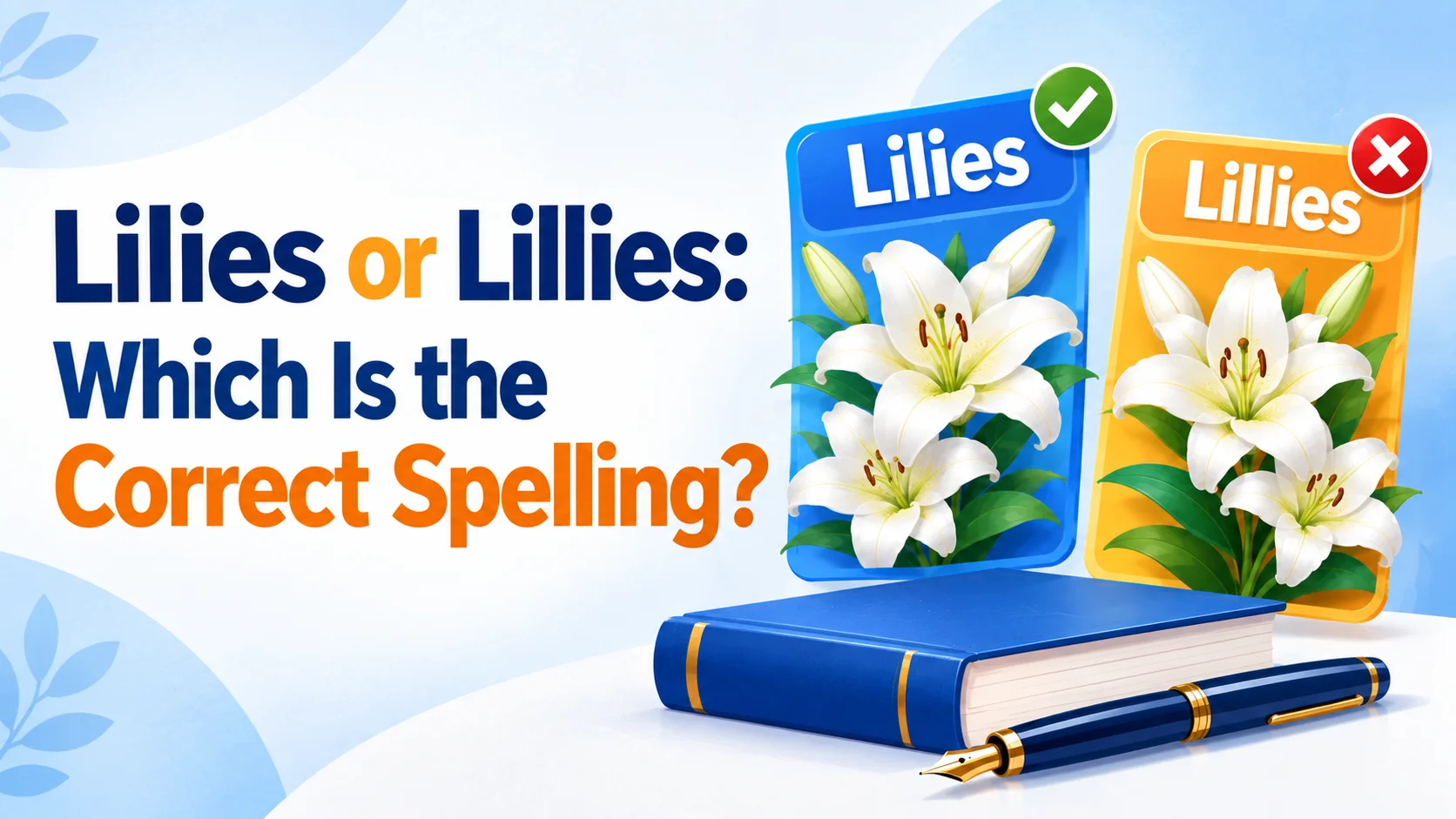
Lilies is the correct spelling when you mean the plural of lily. The spelling lillies is a common mistake, but it is not the standard plural form in English. If you are writing a school assignment, email, article, flower description, or social media post, use lilies. Major dictionaries, including Merriam-Webster, Cambridge, and Oxford, list lilies as the plural of lily.
The reason is not arbitrary. Lily ends in a consonant followed by y, and English commonly changes that final y to i and adds -es when forming the plural. The same pattern appears in words such as baby → babies, city → cities, and story → stories. Understanding this small spelling rule makes it much easier to remember why lilies, rather than lillies or lilys, is correct.
There is also more to the question than simply memorizing one spelling. Writers sometimes confuse lilies, lily’s, and lilies’, while others wonder whether British and American English use different spellings. This guide explains those differences, shows the word in natural sentences, covers pronunciation and the flower itself, and clears up related questions such as whether water lilies and calla lilies are true lilies.
Lilies or Lillies: Quick Answer
The correct spelling is:
lily → lilies
Lillies is incorrect when it is intended as the plural of lily.
| Form | Correct? | Meaning |
| lily | ✓ | One lily |
| lilies | ✓ | More than one lily |
| lilys | ✗ | Incorrect plural |
| lillies | ✗ | Incorrect plural |
| lily’s | ✓ | Usually singular possessive or a contraction |
| lilies’ | ✓ | Plural possessive |
Merriam-Webster specifically gives the plural of lily as lilies, while Cambridge and Oxford do the same.
The easiest answer to remember
If you are unsure, think:
one lily → two lilies
You do not add another l.
How Do You Spell the Plural of Lily?
The plural of lily is lilies.
For example:
- There is one lily in the vase.
- There are six lilies in the vase.
- The garden is full of colorful lilies.
- She bought a bouquet of white lilies.
The spelling is confirmed by several major English dictionaries. Oxford lists lilies with the plural lilies, and Merriam-Webster likewise gives lilies as the plural form.
Lily → Lilies
The transformation looks like this:
l i l y
↓
Remove the final y
↓
Add i e s
↓
l i l i e s
The important point is that the original two l letters remain exactly where they belong. You are changing the final y, not adding an extra l.
Why “Lillies” Is Incorrect
A common mistake is to write:
lily → lillies
This adds an unnecessary l. English spelling does not require that extra consonant when pluralizing lily.
The correct process is:
lily → lilies
not:
lily → lillies
The pronunciation can make the spelling feel less obvious, especially for someone learning English, but the dictionary form is unambiguous.
Why Does Lily Become Lilies Instead of Lilies?
The answer is a common English pluralization pattern.
The Consonant + Y Rule
When a noun ends in a consonant + y, English generally changes the y to i and adds -es.
For example:
- baby → babies
- city → cities
- family → families
- country → countries
- story → stories
- party → parties
- lily → lilies
The British Council describes the same general rule: nouns ending in a consonant and -y form their plural with -ies.
So:
lil + y → lil + ies
This is why lilies look different from the singular lily.
When the Y Does Not Change
The rule has an important distinction.
When a word ends in a vowel + y, the y normally stays in place and the plural is formed with -s.
Examples:
- boy → boys
- toy → toys
- key → keys
- day → days
- monkey → monkeys
Compare:
| Singular | Ending | Plural |
| lily | consonant + y | lilies |
| baby | consonant + y | babies |
| city | consonant + y | cities |
| boy | vowel + y | boys |
| toy | vowel + y | toys |
| key | vowel + y | keys |
This distinction is more useful than simply memorizing lily → lilies, because it lets you apply the spelling pattern to unfamiliar words.
Lilies vs. Lillies: Side-by-Side Comparison
| Question | Lilies | Lillies |
| Is it standard English? | Yes | No |
| Is it the plural of lily? | Yes | No |
| Used in dictionaries? | Yes | No as the standard plural |
| Used in British English? | Yes | No |
| Used in American English? | Yes | No |
| Suitable for formal writing? | Yes | No |
| Example | “The lilies are blooming.” | “The lillies are blooming.” ✗ |
Which Spelling Should You Use?
Use lilies whenever you mean more than one lily.
This applies regardless of the type of writing:
- School: “The garden contains several lilies.”
- Business: “Our flower shop sells fresh lilies.”
- Gardening: “Plant the lilies in well-drained soil.”
- Social media: “These lilies look beautiful.”
- Academic writing: “Several lily species were observed.”
There is no need to change the spelling based on whether the writing is formal or informal.
Is “Lilies” Correct in British and American English?
Yes. Lilies is the standard plural in both major varieties of English.
Cambridge provides both UK and US pronunciation information for lily and gives the same word as a standard English noun.
British English
British English uses:
lily → lilies
It does not normally change the plural to lillies.
American English
American English also uses:
lily → lilies
There is no American-versus-British spelling difference here.
Is “Lillies” a British Spelling?
No.
If you have seen lilies somewhere, it should not be assumed that it is the British version. It is generally a misspelling of lilies, rather than a regional spelling.
Quick rule: If you mean more than one lily, write lilies whether your audience uses British or American English.
How to Use “Lilies” Correctly in a Sentence
Seeing the word in context makes the spelling easier to remember.
Simple Examples
- The garden is filled with lilies.
- She received a bouquet of lilies.
- The white lilies opened in the morning.
- Several lilies were growing near the path.
- These lilies have a strong fragrance.
Incorrect vs. Correct
| Incorrect | Correct |
| The vase contains three lilies. | The vase contains three lilies. |
| I planted five lilies. | I planted five lilies. |
| The lilies are blooming. | The lilies are blooming. |
| She bought pink lilies. | She bought pink lilies. |
In School Writing
Suppose a student writes:
“There were many beautiful lilies in the garden.”
The corrected version is:
“There were many beautiful lilies in the garden.”
The correction is small, but spelling matters in schoolwork because repeated errors can affect the overall quality of written communication.
Lily, Lilies, Lily’s, and Lilies’: What Is the Difference?
This is one of the most useful distinctions to learn because these forms can look similar.
Lily
Lily is singular.
“A lily is growing in the pot.”
It refers to one flower or plant.
Lilies
Lilies is plural.
“Several lilies are growing in the pot.”
It refers to more than one.
Lily’s
Lily commonly indicates possession by one lily or can be a contraction of lily is in an appropriate context.
For possession:
“The lily’s petals are white.”
Here, the petals belong to one lily.
Lilies’
Lilies’ is the plural possessive form.
“The lilies’ petals were covered with dew.”
The petals belong to multiple lilies.
A Quick Reference
| Form | Function | Example |
| lily | Singular | “The lily is beautiful.” |
| lilies | Plural | “The lilies are beautiful.” |
| lily’s | Singular possessive | “The lily’s petals are soft.” |
| lilies’ | Plural possessive | “The lilies’ petals are soft.” |
This distinction is particularly useful in formal writing because an apostrophe does not normally make a noun plural.
Why Do People Spell Lilies as Lillies?
The mistake is understandable, especially for learners who rely heavily on how words look or sound.
Double-L Confusion
The word lily already contains two l sounds/letters at different positions, and changing the ending can make the plural visually unfamiliar.
A writer may incorrectly assume that another l is needed before -ies. It is not.
Pronunciation Can Mislead Writers
Cambridge gives the pronunciation of lily as /ˈlɪl.i/ in both UK and US English.
Because the spoken word does not clearly announce its written letters, someone spelling the plural from memory may produce lilies.
This is a useful general lesson: English spelling cannot always be reconstructed perfectly from pronunciation.
Memory Errors
People also tend to remember familiar-looking patterns rather than the exact spelling of an individual word.
Once you remember the transformation lily → lilies, however, the problem becomes much easier.
How Do You Pronounce “Lilies”?
The word lilies is pronounced approximately like:
LIL-eez
The singular lily is approximately:
LIL-ee
Cambridge lists the pronunciation of lily as /ˈlɪl.i/ in both UK and US English.
The plural ending changes the final sound, but it does not create a spelling with an additional l.
So:
- lily → roughly “LIL-ee”
- lilies → roughly “LIL-eez”
If you are learning English, it can help to memorize the written and spoken forms together rather than trying to spell the plural only from its sound.
What Does “Lilies” Mean?
Lilies is simply the plural of lily.
A lily is a flowering plant or, in broader everyday usage, one of several plants commonly given a name containing lily. Cambridge defines lily as a plant with a large flower on a long stem, while Merriam-Webster gives a more botanical definition centered on the genus Lilium but also notes broader uses of the word.
For example:
“The florist arranged white lilies in a vase.”
The word lilies tells us there is more than one flower.
A Small Botanical Detail
The everyday word lily can be broader than the strictly botanical term Lilium. This matters because plants such as water lilies and calla lilies contain lilies in their common names even though they are not all members of the genus Lilium. Merriam-Webster also recognizes broader everyday uses of lily.
Lily Flower Meaning and Symbolism
Once the spelling question is settled, another common reason people search for lilies is to understand what the flowers represent.
Lily symbolism varies by culture, color, religion, historical period, and occasion, so it is better to describe meanings as common associations rather than universal rules.
Common Associations
Lilies are often associated with ideas such as:
- purity
- beauty
- innocence
- renewal
- remembrance
- affection
The exact meaning depends on the situation. A lily in a garden does not automatically carry the same symbolic message as lilies selected for a wedding, memorial, or gift.
White Lilies
White lilies are commonly associated with purity, peace, innocence, and remembrance.
Their clean appearance has made them popular in ceremonial arrangements and other formal settings.
However, flower symbolism is cultural rather than a strict dictionary definition. If you are writing about symbolism, phrases such as “often associated with” are more accurate than claiming that a flower always has one fixed meaning.
Common Types of Lilies
The word lilies can refer to many different flowers, and common names can sometimes be confusing.
Asiatic Lilies
Asiatic lilies are popular garden flowers known for their wide range of colors. Many varieties are relatively compact and are valued for their bright flowers.
Oriental Lilies
Oriental lilies are well known for their large, showy flowers and often strong fragrance. They are frequently used in ornamental gardens and floral arrangements.
Easter Lilies
The Easter lily is commonly associated with spring and religious Easter celebrations. Its white flowers contribute to its strong cultural association with purity and renewal.
Tiger Lilies
Tiger lilies are recognizable for their orange flowers and dark markings. Their distinctive appearance makes them popular ornamental plants.
Stargazer Lilies
Stargazer lilies are a well-known type of Oriental lily, recognized for their prominent pink-and-white flowers and strong fragrance.
Writing tip: When discussing a specific plant, use its established common name rather than assuming every flower called a “lily” belongs to the same botanical group.
Are Water Lilies and Calla Lilies True Lilies?
Not necessarily. This is where common names and botanical classification can diverge.
True Lilies
True lilies belong to the genus Lilium, within the family Liliaceae. Merriam-Webster defines the lily in its primary botanical sense as a member of this genus.
Water Lilies
Water lilies are aquatic flowering plants commonly known by the name water lily, but they are not true Lilium lilies.
The familiar name comes from their appearance and traditional naming rather than membership in the genus Lilium.
Calla Lilies
The name calla lily is another example of a common name that can create botanical confusion. It contains the word lily, but the plant is not a true Lilium lily.
This distinction is useful when reading gardening references: a shared common name does not necessarily mean two plants belong to the same botanical genus.
Common Spelling Mistakes With “Lilies”
Mistake 1: Writing “Lillies”
Wrong: lillies
Right: lilies
The extra l is unnecessary.
Mistake 2: Writing “Lilys”
Wrong: lilys
Right: lilies
Because lily ends in consonant + y, the plural follows the -ies pattern.
Mistake 3: Using “Lily’s” as a Plural
This is another frequent punctuation mistake.
Wrong: “There are three lilies in the garden.”
Right: “There are three lilies in the garden.”
An apostrophe generally does not create an ordinary plural.
Mistake 4: Assuming British English Uses “Lillies”
It does not. Lilies is the standard plural in British English as well as American English. Cambridge, Oxford, and other major dictionaries list the plural as lilies.
A Simple Trick to Remember the Correct Spelling
Use this three-step memory rule:
1. Find the final letter:
lily
2. Notice what comes before it:
The y follows a consonant.
3. Change y → i and add -es:
lilies
So:
lily → lilies
You can reinforce the pattern with a few familiar words:
- baby → babies
- city → cities
- family → families
- story → stories
- lily → lilies
Once you recognize the pattern, there is no reason to insert an additional l.
When Should You Use “Lily” Instead of “Lilies”?
The choice depends on the number.
Use lily when discussing one:
“A red lily was growing beside the path.”
Use lilies when discussing two or more:
“Red lilies were growing beside the path.”
You can also use a singular noun after expressions such as each and every:
“Each lily was carefully planted.”
But after many, several, numerous, or a number greater than one, use the plural:
“Several lilies were blooming.”
This is a useful grammar distinction because the correct spelling is not only about letters; it also depends on how the noun functions in the sentence.
Quick Reference: Lily Forms
| What you mean | Correct form | Example |
| One flower | lily | “The lily is pink.” |
| More than one | lilies | “The lilies are pink.” |
| Possession by one | lily’s | “The lily’s stem is tall.” |
| Possession by several | lilies’ | “The lilies’ stems are tall.” |
| Incorrect plural | lilys | ✗ |
| Incorrect plural | lillies | ✗ |
Conclusion
If you are deciding between lilies and lillies, the answer is straightforward: lilies is the correct standard spelling. It is the plural of lily in both British and American English, and major dictionaries consistently record it that way. The spelling becomes easier to remember once you understand the rule behind it. Because lily ends in consonant + y, the y changes to i and -es is added: lily → lilies. The same pattern appears in baby → babies and city → cities. One final actionable tip: when proofreading, compare the word directly with the singular lily rather than relying on how it sounds. A common mistake to avoid is adding an unnecessary second l or using an apostrophe to form the plural. Once you remember lily → lilies, this spelling question becomes one you rarely need to think about again.
Frequently Asked Questions
Q1. Is “lillies” ever the correct spelling?
No, not as the standard plural of lily. The accepted plural is lilies. If you encounter lilies in informal writing, it is normally a spelling error rather than an alternative English form. Dictionaries such as Merriam-Webster and Oxford explicitly list lilies as the plural.
Q2. Why is the plural of lily “lilies” instead of “lilys”?
Because lily ends in a consonant followed by y. English normally changes that y to i and adds -es in this situation. The same pattern appears in baby → babies and city → cities. This is a spelling rule, not a special exception created for the word lily.
Q3. Is “lilies” used in both British and American English?
Yes. Lilies are standard in both varieties. There is no British-versus-American spelling distinction that changes lilies into lillies. Cambridge provides UK and US information for lily, while Oxford also lists lilies as the plural.
Q4. What is the difference between “lilies” and “lily’s”?
Lilies is the ordinary plural, meaning more than one lily. Lily’s usually shows possession by one lily, as in “the lily’s petals.” The apostrophe and s therefore serve a grammatical purpose; they do not simply create another spelling of the plural.
Q5. Are water lilies and calla lilies actually lilies?
Not in the strict botanical sense of belonging to the genus Lilium. Lily is used more broadly in common plant names. True lilies belong to Lilium, while names such as water lily and calla lily refer to plants outside that genus.