

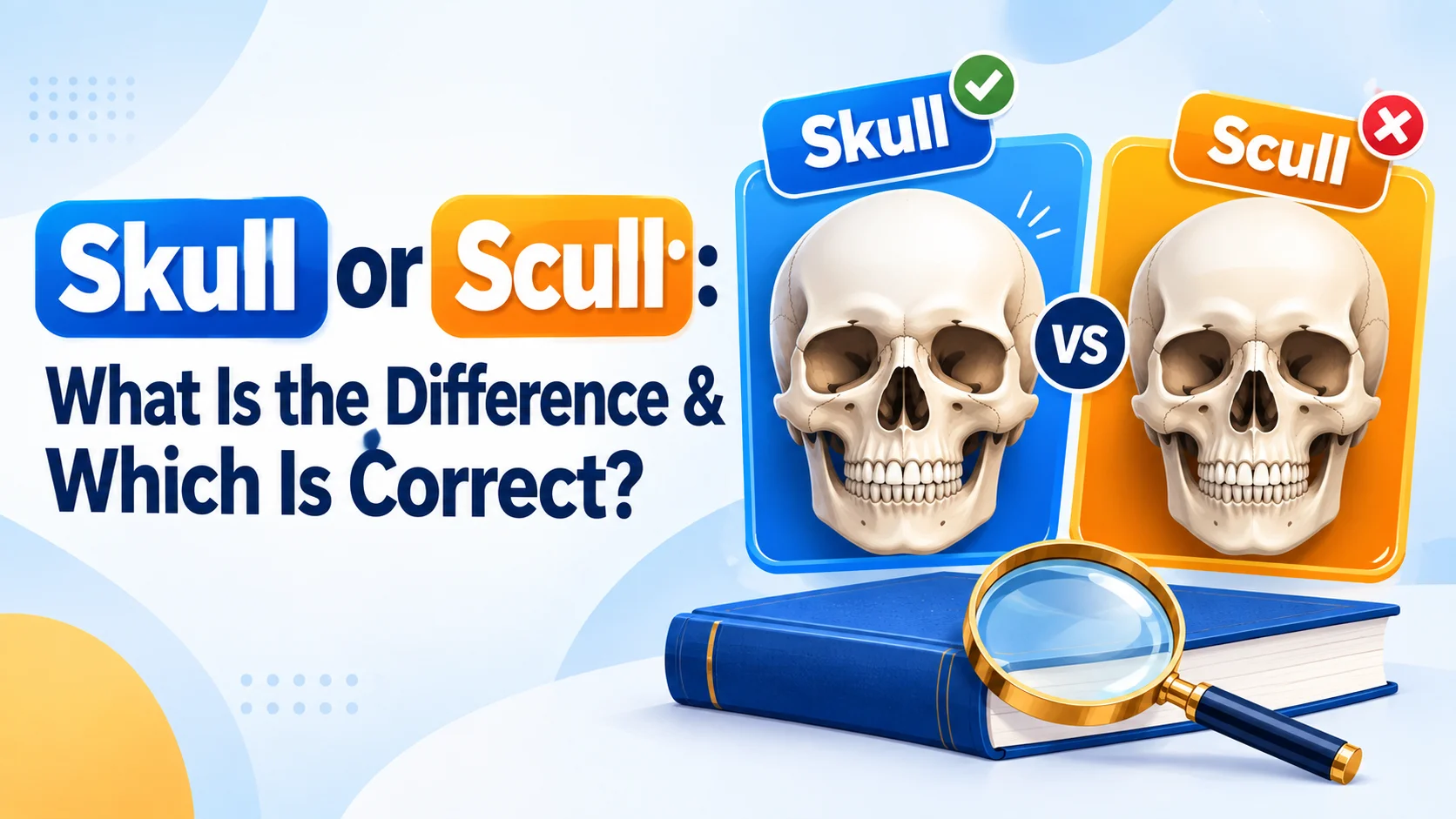
Skull or scull is a classic English word-choice problem because the two words are pronounced the same but refer to completely different things. Skull is the bony structure of the head that surrounds and protects the brain, while skull is mainly associated with rowing, where it can refer to an oar, a rowing boat, or the act of rowing with two oars. Cambridge gives both words the same pronunciation, /skʌl/, which explains why hearing them is not enough to determine the spelling.
The confusion becomes especially noticeable when English learners encounter the words in writing. Someone discussing an injury might need a skull, whereas a rowing article may require scull or sculling. Both spellings are legitimate English words, so a standard spellchecker may not identify the mistake if you choose the wrong one for the sentence. The important distinction is therefore not pronunciation but meaning and context. Once you connect the skull with anatomy and the skull with rowing, the difference becomes much easier to remember.
This guide explains what skull means, what skull means, how the words differ grammatically, why they sound identical, and when each spelling is correct. You will also see side-by-side comparisons, realistic sentence examples, common mistakes, memory techniques, and a quick decision test you can use while writing. Whether you are a student, English learner, writer, or simply checking a sentence, the goal is simple: by the end, you should be able to choose the correct word without hesitation.
Skull vs. Skull at a Glance
The fastest way to understand the difference is to separate the two meanings completely.
| Word | Main meaning | Typical context | Part of speech | Example |
| Skull | The bones of the head surrounding the brain | Anatomy, medicine, biology | Noun | “The scan showed a fracture in his skull.” |
| Scull | An oar used for rowing, a rowing boat, or the act of rowing | Rowing, boating, sports | Noun and verb | “She learned to scull on the river.” |
So, if you are talking about bones, the head, the brain, anatomy, or an injury, the correct word is skull.
If you are talking about rowing, oars, boats, or sculling, the correct word is scull.
Quick rule: Skull = head. Scull = rowing.
There is no general situation in which you can freely substitute one for the other. They are different words with different meanings.
What Does “Skull” Mean?
Skull Definition in Simple English
A skull is the bony structure of the head that surrounds the brain and gives the head much of its shape. Cambridge defines it as the bones of the head that surround the brain.
In everyday English, skull can refer to the skull of a person or an animal:
- “The doctor examined the patient’s skull.”
- “The museum displayed an ancient animal skull.”
- “The fossil included part of a skull.”
The word is usually a countable noun, so you can talk about a skull or several skulls.
What Does the Skull Do?
The skull is more than a hard structure surrounding the brain. Anatomically, the bones of the skull form an important part of the head and provide structural support for the face.
Its major roles include:
- Protecting the brain from external impact.
- Supporting the structure of the face and head.
- Providing attachment points for muscles.
- Forming cavities and openings associated with structures such as the eyes, nose, ears, and mouth.
For ordinary English usage, however, you do not need to memorize the anatomy to use the word correctly. If the sentence concerns the bones of the head, skull is the appropriate spelling.
Skull in Medical and Scientific Contexts
Skull is particularly common in medical, biological, archaeological, and anthropological writing.
You may encounter phrases such as:
- skull fracture
- human skull
- skull bone
- skull injury
- skull anatomy
- animal skull
- skull structure
- skull fossil
For example:
“The X-ray revealed a fracture of the skull.”
Here, scull would be completely wrong because the sentence concerns anatomy rather than rowing.
Common Expressions With “Skull”
Outside scientific writing, the skull can also appear in informal or figurative language. English speakers sometimes use it to refer informally to someone’s head or mind.
For example:
- “Use your skull” can be an informal way of telling someone to think.
- “I can’t get that idea out of my skull” uses skull informally to mean the head or mind.
These expressions are context-dependent and often informal. The basic meaning remains connected to the head.
What Does “Scull” Mean?
Unlike skull, skull belongs primarily to the vocabulary of rowing and boating.
Cambridge lists scull as a noun for a small oar used as one of a pair to move a small, light boat. It also uses scull for a small boat used in sculling and for certain rowing races. As a verb, to scull means to row a boat using a pair of oars.
Scull as a Rowing Oar
A scull can be one of the oars used in sculling. Unlike sweep rowing, where a rower generally handles one oar, sculling involves a rower using two oars.
This distinction is important in rowing terminology.
World Rowing explains that, in its primary rowing sense, scull refers to moving a boat with two oars per rower. A person who grows this way can be called a sculler, and the activity is sculling.
For example:
“The rower adjusted the length of the scull before practice.”
Here, the skull is connected to rowing equipment.
Scull as a Type of Boat
Scull can also refer to a small rowing boat, particularly one designed for sculling.
That is why you may see terms such as:
- single scull
- double scull
- quadruple scull
In competitive rowing, these terms describe boats and events involving different numbers of rowers.
Cambridge also recognizes sculls as a term for races involving small boats in which participants use a pair of oars.
Sculling as an Activity
The verb scull means to propel a boat by using sculls.
Examples include:
- “They sculled across the lake.”
- “She learned to scull during the summer.”
- “The crew practiced sculling before the competition.”
The related forms are useful to know:
| Word | Meaning |
| scull | An oar, a boat, or to row using sculls |
| sculling | The activity or technique of rowing with sculls |
| sculler | A person who sculls |
| sculls | Can refer to multiple oars or certain rowing events |
World Rowing also notes that scull has been used for a single oar mounted at the stern of a small boat, showing that the rowing word has more than one specialized use.
Skull vs. Scull: The Key Differences
The spelling differs by only one letter, but the meanings are far apart.
| Difference | Skull | Scull |
| Core idea | Head and bones | Rowing and oars |
| Main field | Anatomy and medicine | Rowing and boating |
| Pronunciation | /skʌl/ | /skʌl/ |
| Common grammatical role | Noun | Noun and verb |
| Related vocabulary | Brain, bone, head, anatomy | Oar, boat, rowing, sculling |
| Example | “He injured his skull.” | “They learned to scull.” |
| Can they replace each other? | No | No |
Meaning Difference
The biggest difference is semantic: the words describe unrelated concepts.
Skull belongs to the vocabulary of the human or animal body.
Scull belongs mainly to the vocabulary of rowing and boating.
This makes context the strongest clue.
Spelling Difference
The easiest visual distinction is the middle consonant:
Skull → K
Scull → C
The spelling does not reflect a pronunciation difference. Instead, it reflects the fact that these are separate words with different histories and meanings.
Grammar Difference
Skull is primarily used as a noun:
“The skull protects the brain.”
Scull can be a noun:
“He picked up a skull.”
But it can also be a verb:
“They scull across the lake.”
That grammatical flexibility gives scull another clue that can help you identify it.
Why Do Skull and Scull Get Confused?
They Are Homophones
Skull and scull are homophones: they have the same pronunciation but different spellings and meanings.
Both are pronounced /skʌl/ in the standard pronunciations listed by Cambridge.
This is why the confusion usually happens in speech.
If someone says:
“I saw a scull.”
you cannot determine from the sound alone whether the speaker means a rowing object or, in another sentence, something connected to a skull. You need the surrounding context.
Similar Spelling Makes the Mistake Easy
The words share three letters:
S-K-U-L-L
S-C-U-L-L
Only the second consonant changes. That small visual difference makes typing errors particularly easy, especially for someone who has heard the word more often than they have seen it written.
Typing and Autocorrect Errors
There is an important difference between a spelling error and a word-choice error.
If you type skul, a spellchecker can usually recognize that something is wrong.
But if you type scull when you actually mean the bones of the head, the word itself is correctly spelled. The problem is that it is the wrong word for the context.
That is why proofreading should include a meaning check, not just a spelling check.
Limited Exposure to Rowing Vocabulary
Many English learners encounter skull frequently but rarely encounter scull. Medical, school, news, and everyday conversations commonly use skull, while scull appears more often in rowing and boating contexts.
As a result, learners may assume skull is always the intended spelling.
That assumption fails when the subject is rowing.
How to Remember the Difference Between Skull and Scull
A Simple Memory Trick for “Skull”
Connect skull with skeleton.
Both words contain the letter K:
sKull → sKeletal structure
It is not an official linguistic rule; it is simply a useful memory association.
A Memory Trick for “Scull”
Think of sculling on water.
If the sentence contains words such as:
- boat
- oar
- rowing
- river
- race
- sculler
- sculling
then scull is probably the word you need.
Use the Context Test
Ask one question:
What is the sentence talking about?
If the answer is the head or bones, choose the skull.
If the answer is rowing, an oar, or a boat, choose scull.
This method is more reliable than trying to remember the spelling in isolation.
Memory shortcut: K = skull and bones; C = sculling and boats.
A One-Line Rule to Remember
Skull protects the brain; scull moves a boat.
That simple contrast captures the most common meanings without requiring you to memorize complicated definitions.
Skull or Scull? Examples in Real Sentences
Correct Examples With “Skull”
- “The doctor examined the patient’s skull.”
- “The fossil contained part of a skull.”
- “The helmet was designed to protect the skull.”
- “Researchers studied the animal’s skull.”
- “The museum displayed an ancient human skull.”
In every example, the subject involves the head, bones, anatomy, or a related scientific context.
Correct Examples With “Scull”
- “The athlete learned to scull on the lake.”
- “She bought a new skull for training.”
- “The rower carried two sculls to the dock.”
- “He competed in the single sculls.”
- “They practiced sculling before the race.”
Here, the context clearly belongs to rowing or boating.
Incorrect vs. Correct Examples
| Incorrect choice | Correct choice | Why? |
| “The doctor examined his skull.” | “The doctor examined his skull.” | The sentence concerns anatomy. |
| “She lifted the skull before rowing.” | “She lifted the skull before rowing.” | The object is a rowing oar. |
| “He fractured his skull.” | “He fractured his skull.” | A head injury involves the skull. |
| “They practiced skulling.” | “They practiced sculling.” | The rowing activity is sculling. |
| “The athlete entered the single skulls.” | “The athlete entered the single sculls.” | The rowing event uses sculls. |
The important lesson is that the wrong word can still look like a legitimate English word. Context determines correctness.
Compare Both Words in Similar Sentences
Consider these two sentences:
“The athlete injured his skull.”
“The athlete practiced sculling.”
The subject is the same person, but the meanings are completely different. In the first sentence, the person has an anatomical reference. In the second, the person is participating in a rowing activity.
The surrounding vocabulary provides the clue.
Common Mistakes With Skull and Scull
Using “Scull” for the Human Head
This is the most important mistake to avoid.
Incorrect:
“The helmet protects the skull.”
Correct:
“The helmet protects the skull.”
The word scull is not the standard spelling for the bones of the head.
Using “Skull” for Rowing
The opposite mistake is also common when someone has only encountered a skull before.
Incorrect:
“She learned how to skull.”
Correct, when referring to the rowing technique:
“She learned how to scull.”
World Rowing specifically distinguishes scull from skull and explains that the rowing term relates to using two oars per rower.
Assuming Similar Sound Means Similar Meaning
English contains many homophones, and pronunciation cannot always tell you which spelling is correct.
For example, hearing /skʌl/ gives you the sound, not the spelling.
When writing, ask:
- What does the word mean?
- What subject is being discussed?
- Which spelling belongs to that subject?
Trusting Spellcheck Too Much
A grammar or spelling program may not flag scull if you intended skull, because scull is a real English word.
That is why contextual proofreading matters.
Expert tip: When two correctly spelled words sound alike, spellcheck alone cannot guarantee that you selected the right one.
Is “Skull” Ever Interchangeable With “Scull”?
No. In their ordinary meanings, skull and scull are not interchangeable.
If you replace one with the other, you can change the meaning of the sentence completely.
Compare:
- “He injured his skull.” → a bodily structure
- “He lifted the skull.” → a rowing oar
The spelling is therefore not a stylistic preference. It identifies a different word.
There is one useful nuance: scull has several related rowing meanings. It can refer to an oar, a boat, an event, or the act of rowing, depending on context. Merriam-Webster also records scull as both a noun and verb, including an oar used at the stern of a boat and a pair of short oars.
That variety does not, however, make skull a variant spelling of skull.
Skull or Scull? How to Choose the Right Word
Choose “Skull” When You Mean:
- The bones of the head
- The structure surrounding the brain
- Human or animal anatomy
- A skull injury
- A fossilized skull
- A skull shown in archaeology or biology
Example:
“The scientist examined the animal’s skull.”
Choose “Scull” When You Mean:
- A rowing oar
- A small rowing boat
- The act of rowing with sculls
- A sculling race
- A person who sculls
Example:
“The rower placed the sculls beside the boat.”
A 5-Second Decision Test
Use this mini checklist before choosing the spelling:
| If the sentence mentions… | Use… |
| Brain | skull |
| Head | skull |
| Bone | skull |
| Injury | skull |
| Anatomy | skull |
| Oar | scull |
| Boat | scull |
| Rowing | scull |
| River race | scull |
| Sculling | scull |
If neither category seems to fit, look at the broader sentence rather than deciding from pronunciation alone.
Skull and Scull in Writing, Exams, and Everyday English
Which Spelling Should Students Use?
Students should focus on meaning first and spelling second.
If an exam sentence describes the bones protecting the brain, the answer should be skull.
If a question describes rowing with a pair of oars, the appropriate word is scull or a related form such as sculling, depending on the grammar of the sentence.
A useful exam strategy is to underline the contextual clues before choosing the word.
How to Avoid Losing Marks for Word Choice
When faced with a confusing pair:
- Read the entire sentence.
- Identify the subject.
- Look for related vocabulary.
- Decide what the word means.
- Select the spelling that matches that meaning.
- Read the sentence again after inserting the answer.
This works better than relying on how the word sounds.
Tips for Writers and English Learners
Build vocabulary in word families and contexts, not as isolated spellings.
For example:
Skull:
skull → skull fracture → skull anatomy → human skull
Scull:
scull → sculling → sculler → sculls → rowing
Learning these associations creates a mental network. When you encounter one member of the group, the surrounding vocabulary helps you recall the correct spelling.
A Practical Mini Case Study
Imagine a student writing this sentence:
“The rower carried his skull toward the boat.”
The sentence is grammatically possible but semantically strange. A reader familiar with rowing will probably infer that the student meant scull, because an oar is being carried toward a boat.
Now consider:
“The helmet protected his skull.”
Again, the spelling is wrong if the writer means the bones of the head.
The student did not necessarily misunderstand English grammar. The problem is lexical selection—choosing the wrong correctly spelled word.
That distinction is useful because it changes how you correct the mistake. The goal is not simply to memorize spelling. It is to connect word → meaning → context → spelling.
Common Misconceptions
Myth: “Scull” Is Just a Misspelling of “Skull”
False. Scull is a genuine English word with established meanings in rowing and boating. Dictionaries list it as a noun and verb.
Myth: The Two Words Have Different Pronunciations
False in standard English. Cambridge lists both skull and scull as /skʌl/.
Myth: Spellcheck Will Always Catch the Error
Not necessarily. Both words are correctly spelled, so a spellchecker may accept either one. The issue is whether the meaning matches the sentence.
Myth: Sculling and Rowing Are Completely Unrelated
No. Sculling is a form of rowing distinguished by the use of two oars per rower, whereas sweep rowing uses one oar per rower. World Rowing makes this distinction in its rowing terminology guidance.
Quick Reference: Skull or Scull?
| Question | Answer |
| Which word means the bones of the head? | Skull |
| Which word relates to rowing? | Scull |
| Do they sound the same? | Yes, in standard pronunciation |
| Can they be used interchangeably? | No |
| Can scull be a verb? | Yes |
| Is skull normally a noun? | Yes |
| What is sculling? | Rowing using two oars per rower |
| What is a sculler? | A person who sculls |
| Does spellcheck always distinguish them? | No |
| Best way to choose? | Check the meaning and context |
Conclusion
The choice between skull and scull becomes straightforward once you stop relying on pronunciation. Skull belongs to anatomy and refers to the bones of the head, while skull belongs mainly to rowing and can describe an oar, a boat, or the act of rowing with two oars. Because both are pronounced /skʌl/, hearing the word cannot tell you which spelling is intended. The surrounding meaning has to do that work. One final actionable tip: when proofreading, replace the word mentally with its definition—“bones of the head” or “rowing/oar.” A common mistake to avoid is assuming that spellcheck will catch a wrong choice simply because the word looks suspicious. Both spellings are correct; only one may be correct for your sentence.
Frequently Asked Questions
Q1. Is “skull” and “scull” the same word?
No. Skull refers to the bones of the head, while skull is mainly associated with rowing. The words are pronounced alike in standard English but have different spellings, meanings, and grammatical uses. They are therefore homophones, not interchangeable forms of one word.
Q2. What is the difference between skull and skull?
The central difference is meaning. A skull is the bony structure surrounding the brain. A scull can be a rowing oar, a rowing boat, or the act of rowing with sculls. Context makes the intended word clear, even though both words sound the same.
Q3. How do you remember skull vs. scull?
Use the association “skull = skeleton” to remember the K spelling. For scull, think about sculling on water with oars. The quickest test is to ask whether your sentence concerns the head and bones or rowing and boats.
Q4. Is sculling the same as rowing?
Sculling is a type of rowing, not a completely separate activity. In rowing terminology, sculling involves a rower using two oars, one in each hand. Sweep rowing differs because each rower generally uses one oar. This distinction is especially important in competitive rowing vocabulary.
Q5. Why doesn’t spellcheck always correct skull and scull mistakes?
Because both skull and skull are valid English words. A spelling checker can recognize that the word is correctly spelled without knowing whether its meaning fits your sentence. For these homophones, contextual proofreading is more reliable than spellcheck alone.