

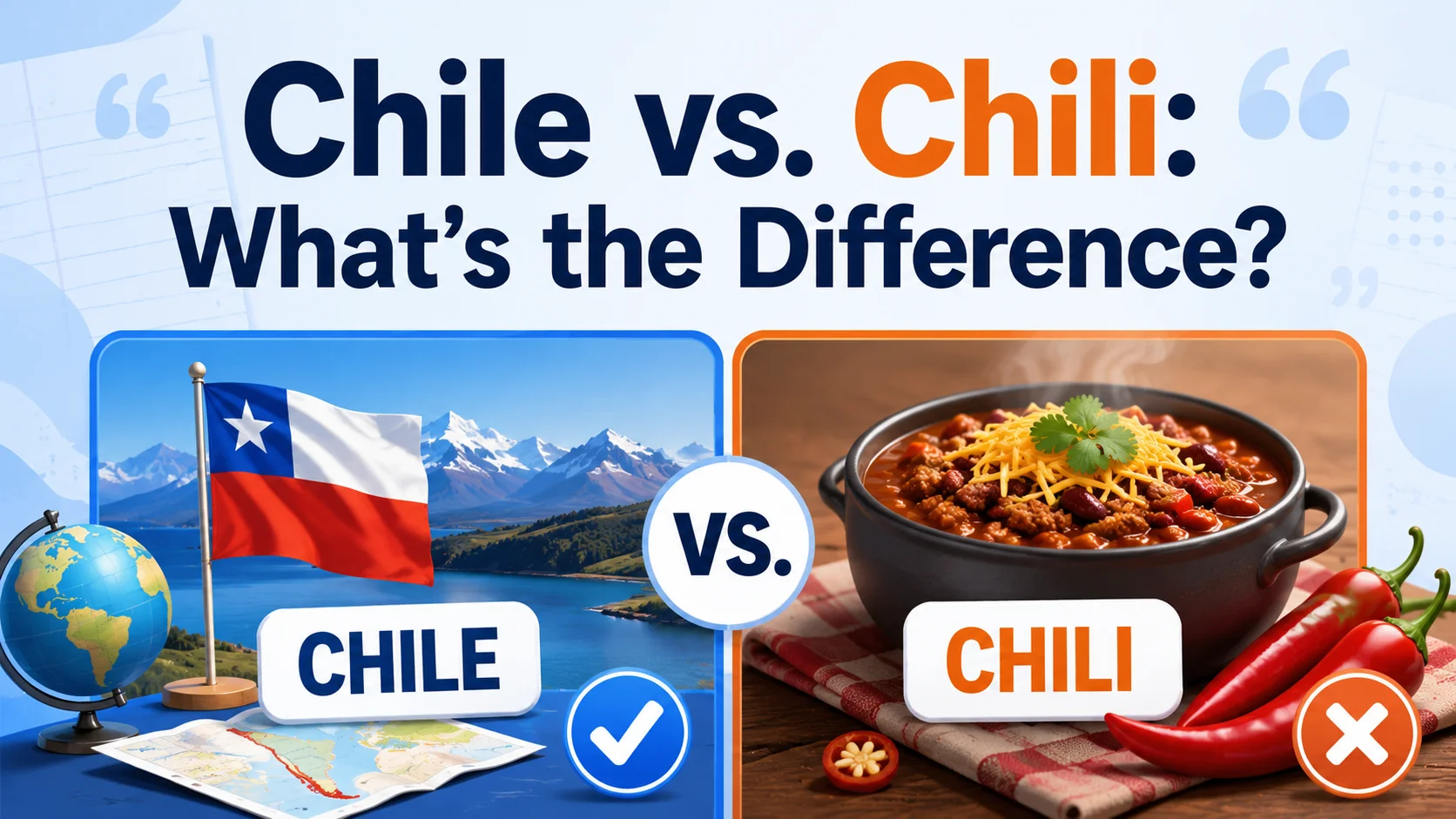
Chile vs. chili can be confusing because the two spellings can refer to a hot pepper, while Chile with a capital C is also the name of a South American country. Add chilli, the spelling commonly used in British English, and the situation gets even messier. The good news is that the difference becomes straightforward once you separate the country, the pepper, and the dish. In American English, chili is widely used for both the pepper and the familiar spicy dish, while chile has an important place in Southwestern and Mexican-influenced culinary language.
The spelling also carries cultural and regional information that a simple “right or wrong” rule misses. In New Mexico, for example, chile is an established culinary term with deep regional roots. A restaurant serving “green chile” isn’t making a spelling mistake; it’s using the terminology associated with a distinctive food tradition. Meanwhile, an American recipe for a pot of chili will almost always use the spelling chili for the dish itself. Context matters more than memorizing a single spelling.
This guide breaks down Chile vs. chili from every angle that matters: definitions, capitalization, pronunciation, American and British usage, culinary terminology, etymology, regional preferences, common mistakes, and practical examples. You’ll also see why chile pepper, chili pepper, chili powder, red chile, and green chile aren’t always interchangeable. By the end, you’ll know exactly which spelling to choose—and when preserving a regional spelling is actually the more accurate choice.
Chile vs. Chili: The Quick Answer
The simplest distinction is this:
Chile with a capital C is the South American country. chile and chili can both refer to hot peppers, depending on regional and culinary usage. Chili is also the standard American spelling for the spicy dish.
Here’s the practical breakdown:
| Word | Main meaning | Example |
| Chile | The South American country | “They visited Chile last summer.” |
| chile | A hot pepper; common in some regional culinary usage | “Add two roasted chiles.” |
| chili | A hot pepper; also a spicy dish | “The chili made the salsa hotter.” / “We’re having chili tonight.” |
| chilli | A hot pepper, especially in British English | “Add a chopped chilli.” |
So if you’re writing:
- “I moved to Chile.” → the country
- “I chopped a chile.” → a pepper
- “I made chili for dinner.” → the dish
- “The recipe calls for one chili pepper.” → a pepper
- “The British recipe uses fresh chilli.” → the pepper in British English
Is “Chile” or “Chili” Correct for a Pepper?
Both are established spellings for the pepper. The choice depends largely on regional and culinary convention.
In broad U.S. English, chili is widely recognizable. In Southwestern U.S. culinary contexts—especially New Mexico—chile is deeply established and can be the preferred spelling.
That means it’s misleading to say that one spelling is universally correct and the other is wrong.
What Does “Chile” Mean?
The word Chile has two important English uses, and capitalization is the key to telling them apart.
“Chile” as the Name of a Country
Chile is the name of the long, narrow country on the western edge of South America.
Because it is a proper noun, it is capitalized:
- “Chile has a long Pacific coastline.”
- “She studied abroad in Chile.”
- “Santiago is the capital of Chile.”
- “The Chilean economy has strong ties to international trade.”
In this context, Chile has nothing to do with a hot pepper.
That’s an important point because the two words have different historical origins. The English name of the South American country and the word for the pepper are not simply the same word transferred from food to geography. Their histories are more complicated.
“chile” as a Hot Pepper
Lowercase chile is also used as a noun for a hot pepper.
Examples include:
- “The recipe calls for three dried chiles.”
- “Roast the green chiles until the skin blisters.”
- “Add a chopped chile to the sauce.”
- “These red chiles have a smoky flavor.”
This spelling is particularly visible in Mexican-influenced and Southwestern U.S. culinary writing.
You may also see the more explicit expression chile pepper, which makes it impossible to confuse the ingredient with the country.
Why Capitalization Matters
Compare these sentences:
“Maria moved to Chile.”
“Maria added a chile to the stew.”
The capitalization isn’t decorative. It helps distinguish a geographic proper noun from a common noun.
That said, context can usually resolve the meaning even when capitalization is inconsistent. A sentence such as “The recipe calls for Chile” is obviously likely to concern a pepper, but standard English capitalization still calls for chile when the country isn’t intended.
What Does “Chili” Mean?
Chili has two major meanings in American English: the pepper and the dish.
“Chili” as a Pepper
In American English, chili can refer to a hot or pungent pepper.
For example:
- “Slice the chili into thin rings.”
- “This chili is much hotter than the last one.”
- “The sauce contains dried chili peppers.”
- “Use a mild chili if you don’t like much heat.”
You’ll also encounter compounds such as:
- chili pepper
- chili flakes
- chili oil
- chili paste
- chili powder
The spelling is especially convenient for general American readers because chili is immediately recognizable as a food term.
“Chili” as a Dish
In the United States, chili can also mean a savory dish typically made with some combination of meat, beans, tomatoes, spices, and chili peppers.
For example:
- “We’re making chili tonight.”
- “She served chili with cornbread.”
- “His vegetarian chili contains three kinds of beans.”
- “The restaurant’s chili is surprisingly spicy.”
This meaning is distinct from the pepper.
You can therefore have:
“I added a chili pepper to the chili.”
The first chili identifies the ingredient; the second identifies the dish.
The history of the dish explains why the word acquired this additional meaning. Etymological records trace chili as a pepper term to the 1640s and record its use as a shortened form connected with chile con carne and similar dishes by the mid-19th century.
Chile vs. Chili: The Difference in One Table
The fastest way to see the distinction is to compare the words by meaning and context.
| Form | Capitalized? | Meaning | Common context | Example |
| Chile | Yes | South American country | Geography, travel, politics | “Chile borders Peru and Argentina.” |
| chile | No | Hot pepper | Southwestern/Mexican-influenced cuisine | “Add roasted green chile.” |
| chili | No | Hot pepper | General American English | “Chop the chili finely.” |
| chili | No | Spicy dish | American food | “We’re serving chili tonight.” |
| chilli | No | Hot pepper | British English and some other varieties | “Add one red chilli.” |
The biggest trap is assuming that Chile and chili are simply two spellings of the same word. They overlap in culinary usage, but Chile the country is a separate proper name.
Why Are There Different Spellings for the Pepper?
The story begins long before English.
The Nahuatl Connection
The English pepper word ultimately comes from Nahuatl, the language associated with Indigenous peoples of central Mexico, including the Aztecs. Etymological sources trace chili, chile, and chilli to Nahuatl chilli, the native term for the pepper.
That origin matters because it explains why English has several spellings. The word traveled through other languages and regional varieties before becoming established in English.
Spanish Helped Spread the Word
Spanish played an important role in carrying Indigenous American food vocabulary into wider European usage.
The Spanish form chile became associated with hot peppers, particularly in Mexican Spanish. English subsequently developed several forms, including:
- chile
- chili
- chilli
These aren’t random inventions. They’re historical variants that became established in different English-speaking communities.
The Pepper Word Is Not Named After Chile
This is one of the most interesting misconceptions.
You might reasonably assume that chili is called chili because of the country Chile. That’s not the established etymological explanation.
Etymological evidence instead traces the pepper term to Nahuatl chilli, while the country name Chile has a separate and uncertain local origin. The two forms later became visually and phonetically similar in English.
So:
The pepper wasn’t named after the South American country.
That distinction is worth remembering.
Chile vs. Chili vs. Chilli
If you’re dealing with English varieties beyond the United States, there’s a third spelling to know.
Chile
Chile can mean:
- the South American country when capitalized; or
- a hot pepper when lowercase in certain culinary contexts.
Chili
Chili is particularly familiar in American English.
It can mean:
- a hot pepper; or
- the American dish.
Chilli
Chilli is a common spelling for the pepper in British English and several other varieties of English.
For example:
“Add two fresh chillies to the curry.”
An American writer would be more likely to write:
“Add two fresh chilies to the curry.”
Neither writer is necessarily making a spelling error. They’re following different regional conventions.
A Three-Way Comparison
| Spelling | Pepper | American dish | Country | Typical association |
| Chile | Yes | No | Yes, when capitalized | Country; Southwestern/Mexican culinary usage |
| chili | Yes | Yes | No | American English |
| chilli | Yes | Usually not this spelling | No | British English and other varieties |
Chile vs. Chili in American English
For an American audience, the choice becomes easier once you distinguish general usage from regional culinary terminology.
Why “Chili” Is So Common in the United States
If you walk into an American supermarket and see products labeled:
- chili powder
- chili flakes
- chili sauce
- chili peppers
- chili oil
the spelling chili is immediately understandable.
It’s also the normal spelling for the dish:
“We’re having chili for dinner.”
That dual use gives chili a particularly strong presence in everyday American English.
Why “Chile” Is Important in the Southwest
The story changes in the American Southwest.
New Mexico has a particularly strong cultural and culinary association with the spelling chile. The state’s tourism authority describes chile as an essential New Mexico crop and notes that chiles have been grown there for centuries. It also emphasizes the region’s distinctive growing conditions and the importance of chile to local food culture.
So if you see:
Green chile
on a New Mexican menu, don’t “fix” it to green chili simply because chili is familiar elsewhere.
The spelling can be part of the regional culinary identity.
Is One Spelling More Correct?
Not universally.
A better question is:
Which spelling is appropriate for this audience and culinary tradition?
For broad U.S. writing, chili is a safe, widely understood choice for the pepper.
For Southwestern or New Mexican food writing, chile may be the more culturally and regionally appropriate choice.
Why New Mexico Uses “Chile”
The New Mexican preference isn’t merely a quirky spelling habit.
Chile Has a Long Regional History
New Mexico’s official tourism information notes that chiles were introduced to the region in 1598, after which Pueblo communities adopted them and incorporated them into local diets.
That history helps explain why chile is so deeply embedded in New Mexican food terminology.
Red Chile and Green Chile
Two phrases you’ll encounter frequently are:
- red chile
- green chile
These refer to different stages and preparations of chile peppers and have become central to New Mexican cuisine.
You’ll see them in dishes and products such as:
- green chile stew
- red chile sauce
- green chile cheeseburgers
- enchiladas with red or green chile
- breakfast dishes topped with chile
The spelling chile communicates more than “pepper.” In this context, it connects the ingredient to a regional food tradition.
Why You Shouldn’t “Correct” a Regional Menu
Imagine a restaurant’s official name is:
“New Mexico Green Chile Kitchen”
Changing it to:
“New Mexico Green Chili Kitchen”
might make it look more familiar to a general American reader, but it would also erase part of the restaurant’s intended regional terminology.
Proper names and established culinary labels should be preserved.
Chile vs. Chili in Mexican Cuisine
Mexican cuisine contains an enormous range of chile peppers, and the word chile is deeply established in Mexican Spanish.
Some familiar varieties include:
- jalapeño
- poblano
- serrano
- ancho
- chipotle
These names don’t all describe the same kind of pepper or preparation.
Why “Chile” Makes Sense in Mexican Culinary Writing
When writing specifically about Mexican food, preserving the culinary vocabulary of the cuisine can be more informative than translating everything into generalized American English.
For example:
“The sauce is made with dried ancho chiles.”
This terminology is perfectly natural in food writing that follows Mexican culinary conventions.
Chipotle Has the Same Linguistic History
The word chipotle is itself connected to Nahuatl through Mexican Spanish. Etymological sources trace it to a combination involving chilli and a word associated with smoke, reflecting the traditional smoked-jalapeño preparation.
That provides a useful reminder: food vocabulary often preserves linguistic history that isn’t obvious from modern English spelling.
Chile vs. Chili: Examples in Real Sentences
The easiest way to master these words is to see them in context.
Examples With “Chile” as the Country
- “Chile stretches along the western edge of South America.”
- “She spent two weeks traveling through Chile.”
- “The Andes form part of Chile’s eastern landscape.”
- “Chile has a distinctive wine-growing tradition.”
- “They flew to Santiago, Chile.”
In every example, Chile is a proper noun, so the first letter is capitalized.
1. Examples With “chile” as a Pepper
- “Roast the green chiles before peeling them.”
- “The recipe uses three dried red chiles.”
- “Add a chopped chile to the salsa.”
- “The sauce gets its heat from roasted chile.”
- “Fresh chile adds a sharp, smoky flavor.”
2. Examples With “chili” as a Pepper
- “Remove the seeds if you want a milder chili.”
- “The recipe calls for one fresh chili pepper.”
- “She sliced the chili into thin strips.”
- “Dried chili adds heat without much moisture.”
3. Examples With “chili” as a Dish
- “I made a large pot of chili.”
- “The chili tastes better the next day.”
- “They served vegetarian chili with cornbread.”
- “His recipe uses beans, tomatoes, and ground beef.”
Notice how context makes the meaning clear even though chili can refer to either the ingredient or the finished dish.
Chile Pepper vs. Chili Pepper: Which Is Better?
Both phrases are established.
Chile Pepper
Chile pepper is especially useful when writing in a Southwestern, Mexican, or culinary context where chile is the preferred spelling.
Example:
“The recipe calls for two roasted chile peppers.”
Chili Pepper
Chili pepper is highly familiar in American English.
Example:
“The chili pepper adds a strong kick to the sauce.”
For a general U.S. audience, chili pepper is often the easiest expression to understand immediately.
Why Adding “Pepper” Can Help
If there’s any possibility of confusion, use the full phrase:
chile pepper
or
chili pepper
It makes clear that you’re discussing the plant or fruit, not the country or the prepared dish.
Chili Powder vs. Ground Chile
This is where spelling can affect cooking, not just writing.
Chili Powder
In many American grocery stores, chili powder is a seasoning product that may contain ground dried chili peppers along with other ingredients, depending on the product.
It may include combinations of:
- ground peppers
- cumin
- garlic
- oregano
- salt
- other spices
The exact formulation varies.
Ground Chile
Ground chile can refer more specifically to dried chile peppers that have been ground into a powder.
For example, a recipe may call for:
“ground ancho chile”
That doesn’t necessarily mean the same thing as a commercial chili powder blend.
Why This Matters When Cooking
If a recipe calls for:
chili powder
and you substitute pure ground chile, the final dish may taste very different.
The reverse is also true.
Expert cooking tip: Read the ingredient label instead of assuming that every product labeled “chili powder” contains only ground peppers.
Chile Sauce vs. Chili Sauce
These terms deserve caution because spelling alone doesn’t identify one universal recipe.
Chile Sauce
The term chile sauce is common in Mexican and Southwestern culinary contexts and can refer to sauces made from specific chile peppers.
For example:
- red chile sauce
- green chile sauce
- roasted chile sauce
Chili Sauce
Chili sauce can describe a range of condiment-style products in American and international cooking.
Depending on the product, it may be:
- sweet
- spicy
- tomato-based
- fermented
- chunky
- smooth
Therefore, don’t assume that chile sauce and chili sauce are merely different spellings for an identical product.
Always check the recipe or product description.
Common Mistakes With Chile and Chili
Mistake 1: Thinking “Chile” Always Means the Country
It doesn’t.
Lowercase chile can refer to a hot pepper.
“The recipe needs two chiles.”
That’s a culinary sentence, not a geographical one.
Mistake 2: Writing “Chile” When You Mean the Dish
If you’re talking about the American food, the standard spelling is:
chili
For example:
“We’re making chili tonight.”
Writing “We’re making Chile tonight” makes it look as though you’re talking about the country.
Mistake 3: Assuming “Chili” Is Always Wrong for a Pepper
It’s not.
Chili is a well-established American spelling for the pepper.
Mistake 4: Treating “Chile” as a Misspelling of “Chili”
This is particularly problematic in Southwestern food writing.
Chile is an established culinary spelling, not a typo.
Mistake 5: Assuming “Chili” and “Chile” Always Describe Identical Ingredients
In everyday use, they can refer to the same general category of pepper. But specialized culinary terminology may use chile for particular varieties, preparations, or regional traditions.
Mistake 6: Confusing the Pepper With the Country
A simple capitalization check solves most cases:
- Chile → country
- chile → pepper in relevant culinary contexts
A Practical Decision Guide: Which Word Should You Use?
Use this table when you’re writing and don’t want to stop and think about the distinction.
| If you mean… | Use… | Example |
| The South American country | Chile | “She moved to Chile.” |
| A pepper in general U.S. usage | chili | “Add one chili pepper.” |
| A pepper in Southwestern/New Mexican usage | chile | “Top it with green chile.” |
| The American spicy dish | chili | “We had chili for lunch.” |
| A pepper in British English | chilli | “Add two red chillies.” |
| A named restaurant or product | Official spelling | Preserve the original |
| A Mexican culinary term | Follow the culinary convention | “dried ancho chiles” |
A Five-Second Rule
If you need a quick memory aid:
Country = Chile
American dish = chili
Pepper = chili or chile, depending on region and context
British pepper = chilli
That rule handles most everyday situations without forcing you to memorize complicated exceptions.
Are Chile and Chili Pronounced the Same?
They can be pronounced similarly enough to create confusion, especially when chile refers to the pepper and chili refers to the pepper.
The country name Chile has its own established English pronunciation, while the culinary word chile can vary according to speaker, region, and whether the speaker is following English or Spanish-influenced pronunciation.
This is one reason spelling matters so much in writing.
Don’t Rely on Sound Alone
If someone says:
“I bought some chile.”
you may need the surrounding conversation to know whether they mean a particular pepper.
But when you’re writing, you can make the meaning explicit:
“I bought several chile peppers.”
That small addition removes ambiguity.
Is “Chili” or “Chile” Better for SEO and Online Writing?
If you’re writing online, the best spelling depends on what your audience is searching for and what you actually mean.
For general American readers:
- chili is highly recognizable.
- chile is important for regional and culinary subjects.
- Chile is essential when discussing the country.
Don’t cram all three spellings into every paragraph just to target variations. That makes writing awkward and can actually make the page less useful.
Instead, use the naturally correct term for each context.
For example, an article about New Mexican cuisine should comfortably use:
“green chile”
while an article explaining an American dinner recipe might naturally use:
“beef chili”
That’s better writing and better semantic coverage at the same time.
Chile vs. Chili: A Few Useful Mini-Scenarios
Scenario 1: You’re Talking About Travel
Write:
“We visited Chile in December.”
Not chili.
Scenario 2: You’re Writing an American Recipe
Write:
“Add one chopped chili pepper.”
or:
“Add one chopped chile pepper.”
Both can work, depending on the recipe’s style.
Scenario 3: You’re Writing About New Mexican Food
Write:
“Serve the enchiladas with green chile.”
Using chile respects the established regional terminology.
Scenario 4: You’re Writing About a Bowl of Food
Write:
“The chili needs another 20 minutes to simmer.”
Here, chili means the dish.
Scenario 5: You’re Writing for a British Audience
Write:
“Slice the red chilli.”
The spelling chilli fits British English.
Conclusion
Chile vs. chili isn’t really a battle between a correct spelling and an incorrect one. The words overlap when they refer to hot peppers, but their uses become clear once you consider capitalization, regional English, and culinary context. Chile with a capital C is the South American country. Lowercase chile is an established pepper term, especially in Southwestern and Mexican-influenced food writing. Chili is the familiar American spelling for the pepper and the standard spelling for the popular American dish, while chilli is common in British English. One final actionable tip: when you’re unsure, identify what you’re naming first—the country, pepper, or dish—then choose the spelling that fits the audience. A common mistake to avoid is treating regional culinary vocabulary as an error. In food writing, spelling can carry history and cultural identity, not just dictionary meaning.
Frequently Asked Questions
Q1. Is “Chile” or “chili” the correct spelling for a pepper?
Both chile and chili are established spellings for a hot pepper. Chili is especially familiar in American English, while chile is strongly associated with Southwestern and Mexican-influenced culinary usage. The correct choice depends on regional convention and context, not a simple right-or-wrong rule.
Q2. Does “Chile” always refer to the country?
No. Chile with a capital C normally refers to the South American country, but lowercase chile can refer to a hot pepper. Capitalization is therefore useful: Chile is the proper noun, while chile is a common culinary noun when used for the pepper.
Q3. Why does New Mexico spell it “chile”?
Chile is deeply established in New Mexican food culture. The state’s chile-growing tradition goes back centuries, and the spelling appears in familiar regional expressions such as green chile and red chile. Using chile in this context reflects a regional culinary tradition rather than a spelling mistake.
Q4. Is “chilli” wrong in American English?
No. Chilli is a recognized spelling of the pepper, but it is much more strongly associated with British English and several other English varieties. American English generally prefers chili. If you’re writing for a U.S. audience, chili will usually look more natural.
Q5. Is the pepper named after the country Chile?
No. Despite the similar spelling, the pepper word and the country name have different historical origins. The pepper term traces back to Nahuatl chilli, while the origin of the South American country’s name is uncertain and appears to come from a separate local term.