
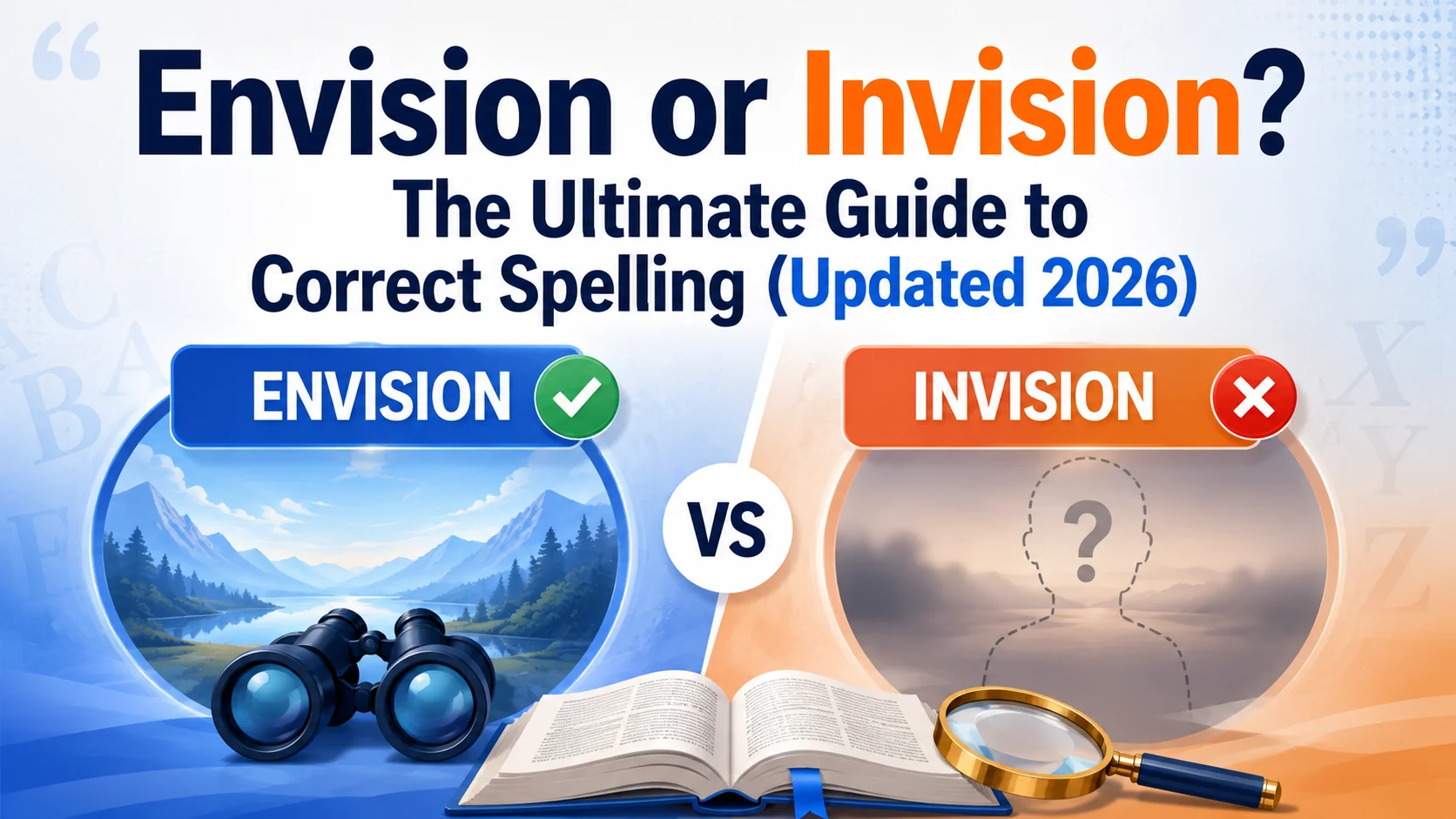
Envision or invision is a common spelling question because the two forms look almost identical, and both can seem plausible when you hear them aloud. However, in standard English, there’s a clear answer: envision is the correct spelling when you mean “to imagine,” “to picture,” or “to expect something in the future.” The word is commonly used to describe a mental picture of a possibility, plan, goal, or future situation.
The confusion is understandable. English contains many words beginning with in-, while envision contains the familiar word vision. The pronunciation can also make the first part sound like “in.” There’s another wrinkle: InVision has been used as a proper name, which can make the spelling invision look legitimate when encountered online.
In this guide, you’ll learn what envision means, why invision is usually incorrect, how to use envision naturally, and when “InVision” may be appropriate as a proper name. We’ll also compare envision with imagine, visualize, foresee, and envisage, so you can choose the right word for the situation instead of relying on spelling alone.
Envision or Invision: Which Spelling Is Correct?
If you’re using the word as an ordinary English verb meaning “to imagine,” “to picture,” or “to anticipate a possible future,” the correct spelling is envision.
The quick answer
| Spelling | Standard English word? | Meaning |
| Envision | Yes | To imagine or anticipate something |
| Invision | Generally no | Usually a misspelling of envision |
| InVision | Can be correct as a proper name | A specific name rather than the ordinary verb |
Consider these examples:
- Correct: I envision myself working abroad someday.
- Correct: The architect envisions a more sustainable city.
- Incorrect: I invision myself working abroad someday.
So, if you’re writing an essay, email, article, report, or ordinary sentence, choose envision.
What “envision” means in modern English
Envision is a verb meaning to form an idea or mental picture of something, particularly something that might happen in the future.
For example:
She envisions a career in medicine.
This means she imagines or sees herself having that career in the future.
The word often appears when someone is discussing:
- future plans
- ambitions
- goals
- possible outcomes
- business strategies
- creative ideas
- personal aspirations
- long-term changes
Why “invision” is usually incorrect
In standard English, invision isn’t the normal spelling of the verb meaning “imagine.”
If you mean:
- imagine
- picture
- conceive
- foresee
- anticipate
- see as a possibility
then envision is normally the word you want.
What Does “Envision” Mean?
At its simplest, envision means to imagine something, especially a future possibility, situation, or result.
The word can describe a mental picture, but it doesn’t always involve a literal visual image.
For example:
The researchers envision a future in which clean energy is widely available.
The researchers aren’t necessarily picturing a photograph-like scene in their minds. They’re imagining a possible future state.
The core definition of envision
To envision something is to form a mental idea of what it could be like.
Examples:
- He envisions owning his own company.
- They envision a city with better public transportation.
- I can’t envision living without access to the internet.
- The team envisions expanding the program next year.
Notice that each example points toward a possibility, plan, or imagined situation.
Envision as a verb
Envision is a transitive verb, which means it normally takes an object.
You can envision:
- a future
- a solution
- a career
- a project
- a change
- an outcome
- a different approach
- yourself in a particular situation
Examples:
I envision a better solution.
She envisions herself becoming a doctor.
They envisioned a much larger project.
We are envisioning several possible outcomes.
What it means to imagine a future situation
One of the most useful ways to understand envision is to associate it with future-oriented imagination.
Compare these two sentences:
I imagined a strange creature.
This could simply be an act of creative imagination.
Now:
I envision myself leading the company one day.
This involves a possible future identity or outcome.
That’s why envision works especially well in discussions about careers, ambitions, organizations, projects, and long-term plans.
Does envision mean something will definitely happen?
No.
This distinction is important.
If someone says:
The company envisions opening 20 new locations.
The sentence doesn’t guarantee that those locations will open.
It tells you what the company currently imagines, plans, or expects as a possible future.
So envision can communicate ambition without making a definite promise.
Why Do People Write “Invision” Instead of “Envision”?
The spelling mistake is easy to understand once you look at how English works.
The spelling looks familiar
English has many common words beginning with in-:
- include
- inspect
- inform
- invent
- involve
- invisible
Because in- is so familiar, invision can look perfectly reasonable at first glance.
But English spelling doesn’t always work by simply combining familiar prefixes and roots.
Confusion caused by “vision”
The word vision is clearly visible inside envision:
en + vision
A writer who remembers the pronunciation but not the spelling may reconstruct the first part incorrectly.
Pronunciation makes the mistake understandable
Envision is commonly pronounced approximately:
in-VIZH-uhn
The first sound resembles the word in, which can encourage the incorrect spelling invision.
This is a useful reminder:
English pronunciation can help you recognize a word, but it can’t always tell you how to spell it.
Confusion with other “in-” words
Learners often build spelling habits from patterns they’ve already encountered.
For example:
- in + visible → invisible
- in + complete → incomplete
- in + direct → indirect
It may therefore seem logical to assume:
in + vision → invision
But that’s not how the standard word developed.
The correct spelling is envision.
The influence of “InVision”
There’s another reason the incorrect-looking spelling can seem familiar.
InVision has been used as a proper name for a technology and design-related company and product. Proper names don’t have to follow ordinary dictionary-word spelling patterns.
That means someone who has seen InVision written with a capital I may later remember the spelling without remembering that it was a name.
This creates an important distinction:
envision = ordinary English verb
InVision = proper name when referring to the specific entity
Envision vs. Invision: The Key Difference
The easiest way to settle the question is to focus on function and meaning.
| Feature | Envision | Invision |
| Standard English verb | Yes | Generally no |
| Means “imagine” | Yes | No |
| Used for future possibilities | Yes | No |
| Used in ordinary writing | Yes | Not normally |
| Can appear as a proper name | No | InVision can |
| Example | I envision a better future. | I invision a better future. ❌ |
Correct spelling, meaning, and function at a glance
Use envision when you’re describing the mental act of imagining something.
We envision a more efficient system.
Don’t use invision merely because the first syllable sounds like “in.”
Why the two aren’t interchangeable
The two forms aren’t simply British and American spellings.
This is important.
Envision is the standard spelling of the ordinary English verb. Writing invision doesn’t normally represent an alternative regional spelling.
If you see invision in ordinary prose, it’s most likely a spelling error.
When capitalization changes the situation
Capitalization can signal that you’re dealing with a proper name.
For example:
The team uses InVision.
Here, the writer may be referring to a specific brand or product rather than using the ordinary English verb.
By contrast:
The team envisions a new design.
Here, envisions is simply the third-person singular form of the verb envision.
Where Does the Word “Envision” Come From?
Understanding the word’s structure can make its spelling easier to remember.
The connection between “envision” and “vision”
The word vision relates to seeing. Envision developed around the idea of mentally seeing or imagining something.
That connection is still useful today.
When you envision something, you’re not necessarily looking at it with your eyes. You’re forming an internal idea or picture of it.
For example:
Can you envision the finished building?
The speaker is asking whether you can mentally picture the completed result.
How the word developed in English
Envision is historically connected with the idea of forming a mental image or seeing something in the mind.
Modern English has extended that meaning beyond literal mental pictures. Today, people commonly use envision for abstract future possibilities:
She envisions a different approach to education.
The “seeing” idea remains underneath the modern meaning, but the word is now frequently conceptual rather than literally visual.
Why etymology doesn’t always solve spelling questions
Word history can help explain why a word looks the way it does, but it isn’t always a practical spelling rule.
You don’t need to memorize the entire history of envision to spell it correctly.
For everyday writing, the most useful rule is simpler:
If you mean “imagine or picture,” spell it envision.
How to Use “Envision” Correctly in a Sentence
Once the spelling is clear, the next question is how the verb behaves grammatically.
Envision + noun
A common structure is:
envision + noun
Examples:
- We envision a stronger economy.
- She envisions a new career.
- The designers envision a completely different layout.
- They envision a future without paper records.
Envision + yourself
Another common pattern is:
envision + yourself + -ing
Examples:
- Can you envision yourself working here?
- I can’t envision myself living in such a busy city.
- She envisions herself running her own business.
This construction is particularly natural when discussing future identity or personal goals.
Envision + -ing
You can also use envision with an activity ending in -ing.
Examples:
- I can’t envision moving again so soon.
- They envision expanding the company overseas.
- We envision creating a simpler system.
Envision + a clause
You can describe a more complete future situation:
The researchers envision that the technology will become more affordable.
However, depending on the sentence, writers often produce smoother prose by using a noun phrase or participial construction:
The researchers envision the technology becoming more affordable.
Both structures can communicate the intended idea, but the second can sound more direct.
Envision vs. Imagine, Visualize, Foresee, and Anticipate
These words overlap, but they aren’t identical.
| Word | Main idea | Typical use |
| Envision | Imagine a possible future or outcome | Plans, goals, possibilities |
| Imagine | Form an idea or mental picture | Broad range of situations |
| Visualize | Create a mental image | Strong visual or performance context |
| Foresee | Expect something before it happens | Predictions |
| Anticipate | Expect or prepare for something | Planning and expectations |
| Picture | Form a mental image | Conversational situations |
Envision vs. imagine
Imagine is broader.
You can imagine almost anything:
Imagine living on Mars.
Envision often sounds more purposeful or future-focused:
Scientists envision humans eventually living on Mars.
Envision vs. visualize
Visualize places greater emphasis on creating a mental image.
For example:
The coach asked the athletes to visualize winning the race.
Envision can be visual, but it doesn’t have to be:
The organization envisions a fairer system.
The second sentence describes a conceptual future, not necessarily a visual picture.
Envision vs. foresee
Foresee is more closely connected with prediction.
Experts foresee higher demand next year.
This suggests that the speaker expects something to happen.
Compare:
Experts envision a completely different market.
Here, the focus is on an imagined or proposed future rather than necessarily a prediction.
Envision vs. anticipate
Anticipate can mean expect something or prepare for it.
We anticipate delays.
That means we expect delays.
We envision a faster process.
That means we imagine or plan for a better future process.
Envision vs. picture
Picture is more conversational:
I can picture myself living there.
A more formal version might be:
I can envision myself living there.
Neither is inherently better. The appropriate choice depends on tone and context.
Is “Invision” Ever Correct?
This is where the answer needs a little nuance.
“Invision” as a misspelling
When someone writes:
I invision a better future.
they almost certainly intend:
I envision a better future.
In ordinary English, invision should not replace envision.
“InVision” as a proper name
A proper name is different.
InVision has been used as the name of a technology company and design platform. If you’re referring specifically to that entity, its name can be written InVision.
That’s not evidence that invision is an alternative spelling of envision.
It’s simply a case where a proper name has its own spelling.
Why proper names follow different rules
Companies, products, organizations, websites, and other entities can choose distinctive spellings.
Consider how brands often use:
- unusual capitalization
- shortened forms
- invented words
- unconventional spellings
You wouldn’t change a brand’s spelling simply because it doesn’t match a dictionary word.
How to handle “InVision” in professional writing
If you’re referring to the specific product or company, retain its established name.
If you’re simply describing the act of imagining something, use envision.
Compare:
The designers used InVision for the project.
with:
The designers envision a simpler interface.
The words may look related, but they perform completely different jobs.
Envision in Different Types of Writing
Envision in everyday conversation
- Envision is perfectly acceptable in conversation, although imagine may sound more casual.
Can you envision yourself living there?
This is natural English.
Envision in emails and workplace communication
The word is especially useful in professional settings when discussing strategy, goals, plans, or future outcomes.
For example:
We envision the new process reducing unnecessary delays.
This sounds more precise than simply saying:
We think the new process might help.
Envision in academic writing
Academic writers can use envision when discussing proposed models, future developments, or theoretical possibilities.
For example:
Researchers envision several applications for the technology.
However, academic writing still benefits from precision. Don’t use envision merely because it sounds formal.
Envision in business and marketing
Business writing frequently uses envision to describe a company’s intended direction:
The company envisions expanding into international markets.
It works particularly well when describing a long-term objective rather than a guaranteed outcome.
Envision in formal writing
Envision has a moderately formal tone but isn’t excessively technical.
It can work in:
- reports
- presentations
- essays
- proposals
- speeches
- professional emails
- articles
Is “envision” too formal for casual English?
Not at all.
It’s simply somewhat more deliberate than imagine.
In casual conversation:
I can’t imagine doing that.
In a more formal context:
I can’t envision pursuing that option.
Both are grammatically sound.
Common Mistakes With Envision
Mistake 1: Writing “invision”
Incorrect:
We invision a better future.
Correct:
We envision a better future.
This is the most common spelling issue.
Mistake 2: Confusing envision with envisage
Both envision and envisage are legitimate English words.
They have closely related meanings.
She envisions a different future.
She envisages a different future.
Neither sentence is inherently wrong.
The choice can depend partly on regional preference and style.
Mistake 3: Using envision when foresee is more precise
Suppose you mean that you expect something to happen:
I foresee problems with the plan.
That’s more precise than:
I envision problems with the plan.
Foresee emphasizes prediction. Envision emphasizes forming an idea of a possible situation.
Mistake 4: Assuming envision always means seeing an image
It doesn’t.
You can envision:
a fairer system
a better policy
a stronger economy
a more efficient process
These aren’t necessarily visual images. They’re conceptual possibilities.
Mistake 5: Incorrect sentence construction
A common awkward structure is:
I envision to become a writer.
A more natural construction is:
I envision becoming a writer.
Or:
I envision myself becoming a writer.
Mistake 6: Treating a brand name as an ordinary word
Seeing InVision somewhere doesn’t make invision an acceptable alternative spelling of envision.
Always ask:
Am I using an ordinary English verb, or am I naming a specific entity?
That simple distinction prevents a lot of confusion.
Envision vs. Envisage: Are They the Same?
This comparison deserves special attention because envisage is another legitimate word that looks and sounds similar.
What “envisage” means
Envisage means to imagine, contemplate, or conceive something, particularly a future situation.
For example:
The government envisages major changes to the system.
Why British English readers may encounter “envisage” more often
Envisage is especially familiar in British English, while envision is very common in American English.
This doesn’t mean that one is grammatically correct and the other is wrong.
Both are established English words.
Envision and envisage in American and British English
A simplified distinction is:
- American English: envision is very common.
- British English: envisage is also particularly common, although envision is understood and used.
Regional frequency is different from correctness.
Are they interchangeable in every sentence?
Often, yes, but not always perfectly.
Envisage can sometimes carry a slightly more formal or contemplative tone.
For example:
The committee envisages significant changes.
sounds somewhat formal.
The committee envisions significant changes.
is also correct and natural.
Your choice should depend on your audience, regional style, and desired tone.
Envision: Related Word Forms You Should Know
Knowing the related forms makes the word easier to use correctly.
| Word form | Grammatical function | Example |
| Envision | Base verb | We envision a better system. |
| Envisions | Third-person singular | She envisions a new approach. |
| Envisioned | Past tense/past participle | They envisioned a larger project. |
| Envisioning | Present participle/gerund | He is envisioning several possibilities. |
Envisioned
Use envisioned when referring to an imagined or planned situation in the past.
The original designers envisioned a much smaller building.
Envisioning
Use envisioning when the mental process is ongoing or when the word functions as a gerund.
The team is envisioning new ways to improve the service.
Envisions
Use envisions with a singular third-person subject:
She envisions a different future.
Not:
She envision a different future.
Practical Examples: Envision vs. Invision
The quickest way to make the distinction stick is to see the words in context.
Correct examples with “envision”
- I envision a future where transportation is more affordable.
- She envisions herself working in environmental science.
- The company envisions expanding its services.
- Can you envision what the finished building will look like?
- They envisioned a completely different approach.
- He can’t envision living in such a crowded city.
Incorrect examples using “invision”
These sentences contain the common spelling error:
- I invision a better future.
- She invisions herself becoming a lawyer.
- They invisioned a larger project.
- We are invisioning a new strategy.
The corrected versions are:
- I envision a better future.
- She envisions herself becoming a lawyer.
- They envisioned a larger project.
- We are envisioning a new strategy.
Examples where “InVision” may be correct
If you’re referring to the specific proper name:
The design team previously used InVision.
Here, InVision is not functioning as the ordinary verb envision.
How to Remember the Correct Spelling
You don’t need a complicated mnemonic.
Memory trick: connect “envision” directly to “vision”
Think:
EN + VISION = ENVISION
The word contains vision, and its meaning involves mentally seeing or imagining something.
The “imagine a future” test
Whenever you’re uncertain, replace the word mentally with imagine.
If the sentence still makes sense, you’re probably looking for envision.
For example:
I ___ myself living in Canada.
Replace the blank:
I imagine myself living in Canada.
Therefore:
I envision myself living in Canada.
Don’t let InVision confuse you
If you’ve seen InVision online, remember that a proper name can have its own spelling.
That doesn’t create a second ordinary spelling of envision.
A one-second proofreading check
Before publishing an article, sending an email, or submitting an assignment, search your document for:
invision
If you intended the ordinary verb, change it to:
envision
This is especially useful because spelling mistakes can survive ordinary spell-checking when the incorrect form resembles a name.
When Should You Use “Envision” Instead of a Simpler Word?
Good writing isn’t just about using the correct word. It’s about using the most appropriate word.
Use “envision” when discussing possibilities or future outcomes
The organization envisions a more flexible workplace.
The focus is on a desired or imagined future.
Use “imagine” for broader hypothetical ideas
Imagine waking up on another planet.
This is more conversational and open-ended.
Use “visualize” when mental imagery matters
Visualize the final design before you begin.
The emphasis is on forming a mental picture.
Use “foresee” when predicting what is likely to happen
We foresee several challenges.
This emphasizes expectation or prediction.
Use “anticipate” when expectation or preparation matters
We anticipate increased demand during the summer.
This can suggest both expectation and preparation.
Quick Decision Guide: Envision or Invision?
When you’re stuck, use this simple decision table.
| What are you trying to say? | Best choice |
| Imagine a possible future | Envision |
| Picture yourself somewhere in the future | Envision |
| Imagine a desired outcome | Envision |
| Form a mental picture | Visualize |
| Make a broad hypothetical suggestion | Imagine |
| Predict something likely to happen | Foresee |
| Expect or prepare for something | Anticipate |
| Refer to a specific brand or proper name | InVision |
The three-question test
Ask yourself:
1. Am I using this as an ordinary English verb?
If yes, don’t use invision.
2. Do I mean “imagine” or “picture”?
If yes, use envision.
3. Am I referring to a specific name?
If yes, check the official spelling of that name. In some contexts, InVision may be correct.
Envision in Professional and Digital Communication
Word choice matters more in professional writing than many people realize.
Why spelling accuracy matters
A single spelling error rarely destroys an otherwise strong document. But repeated errors can affect how readers perceive your attention to detail.
Consider:
Our team invisions a more efficient process.
The meaning is understandable, but the spelling makes the sentence look less polished.
Compare:
Our team envisions a more efficient process.
The second version is immediately standard.
Choosing precise verbs in business communication
Professional writing benefits from distinguishing among related verbs.
For example:
- Envision a future strategy.
- Forecast expected results.
- Anticipate likely challenges.
- Plan specific actions.
- Implement the chosen solution.
These verbs aren’t interchangeable. Using the right one tells readers exactly what kind of claim you’re making.
Avoiding confusion between ordinary words and brand names
Digital communication creates an unusual spelling problem because brand names appear constantly in written text.
A reader might see:
InVision
and later remember:
invision
When proofreading, don’t assume every familiar-looking spelling is a standard dictionary word.
Conclusion
The difference between envision and invision is easier to remember once you separate ordinary English from proper names. Envision is the standard verb when you mean to imagine, picture, or consider a possible future situation. Invision, when written as an ordinary lowercase verb, is generally a spelling mistake. The capitalized InVision is a separate matter because it can function as a specific name. Your choice should also reflect meaning. Use envision for future possibilities, imagine for broad mental ideas, visualize when a mental image is central, and foresee when you’re talking about prediction. One final actionable tip: remember envision as connected directly to vision. A common mistake to avoid is treating a familiar brand name as evidence that its spelling is a standard English word. Once you make that distinction, this spelling problem becomes remarkably simple.
Frequently Asked Questions
Q1. Is “invision” a correct English word?
Invision is generally not the standard spelling when you mean “to imagine” or “to picture.” The correct ordinary English verb is envision. If you encounter InVision with capital letters, it may refer to a specific proper name or brand rather than the ordinary verb.
Q2. Is it “envision” or “invision”?
The correct spelling is envision when you’re talking about imagining or anticipating something. For example, I envision a better future is correct. I invision a better future is a spelling error. The pronunciation may contribute to the confusion, but the standard spelling remains envision.
Q3. What is the difference between envision and envisioning?
Envision is the base form of the verb, while envisioning is its present participle or gerund form. You might say, I envision a new career, but I am envisioning a new career. Both are correct; the surrounding grammar determines which form you need.
Q4. Is “InVision” a real word or a brand name?
InVision can be a proper name associated with a technology and design company or product. Proper names can use distinctive capitalization and spelling. Therefore, InVision may be correct in a specific naming context, while invision is not an alternative spelling of the ordinary verb envision.
Q5. Is “envision” the same as “imagine”?
They are closely related but not identical in every context. Imagine has a broader meaning and can describe almost any act of forming an idea mentally. Envision often emphasizes a possible, intended, or anticipated future situation, making it especially useful for plans, goals, strategies, and long-term possibilities.