

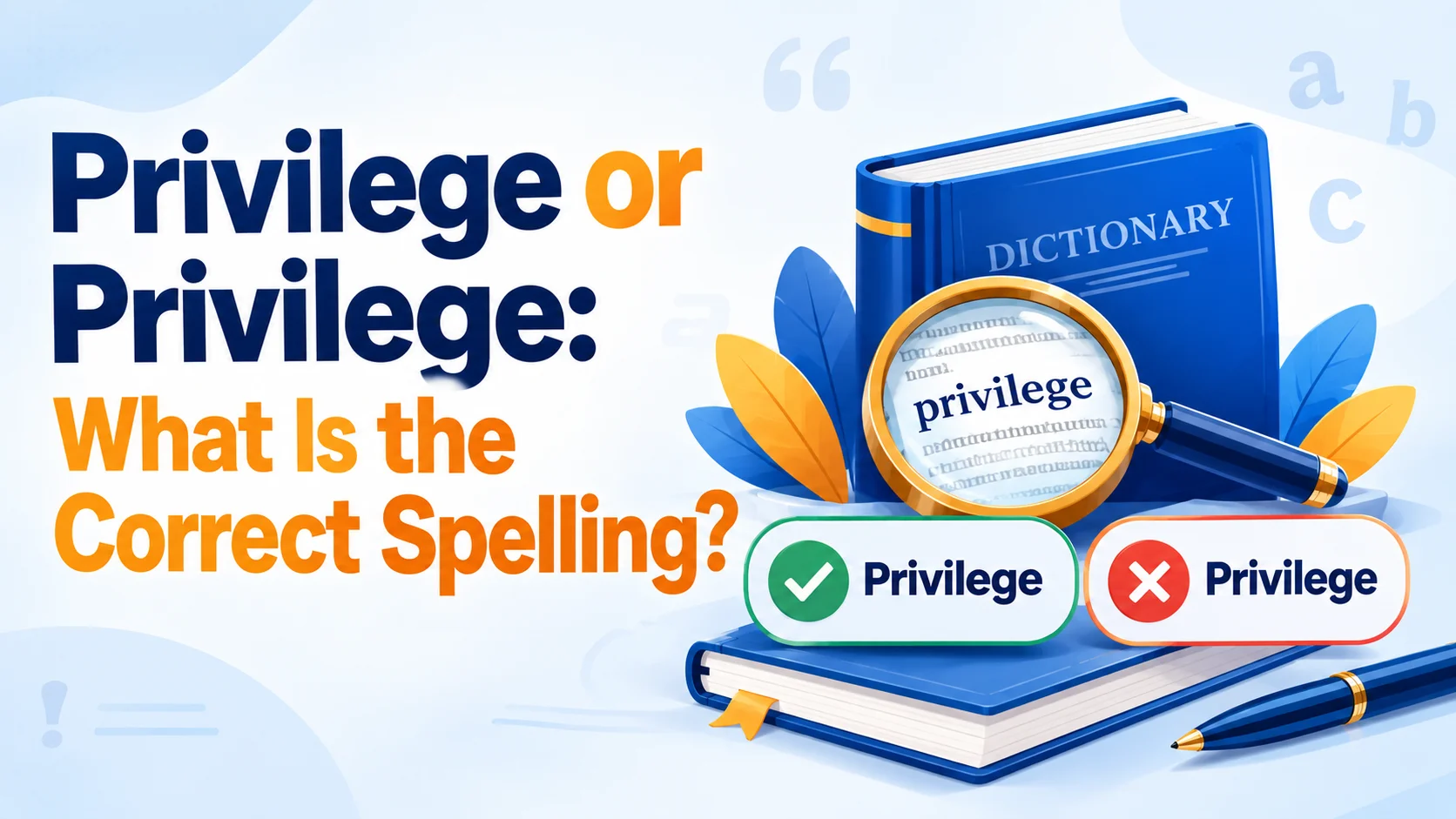
Privilege is the correct spelling; privilege is a misspelling. The confusion is understandable because the word is not pronounced exactly as its letters might suggest, and its related form privileged really does contain a d. That small difference is enough to make even careful writers hesitate. If you have ever stopped while typing and wondered whether the word needs a “d” before the final “ge,” you are dealing with a very common spelling problem. This guide settles the question, explains what privilege means, and shows how to use its related forms correctly.
The word itself has several meanings, so knowing its spelling is only part of the job. Privilege can refer to a special right or advantage, an opportunity that feels like an honor, or a social advantage enjoyed by certain people or groups. In formal contexts, it can also describe specific legal protections or rights. Dictionaries including Merriam-Webster, Cambridge, and Oxford all recognize privilege as the standard English form.
The most useful distinction is simple: privilege is the base word, privileged is a related adjective, and privilege is not a standard spelling. Once you understand why the extra “d” appears in privileged but not privilege, the spelling becomes much easier to remember. Below, we will look at the meaning, pronunciation, history, grammar, common mistakes, examples, and a few practical tricks that can help you write the word confidently.
Privilege or Priviledge: Which Spelling Is Correct?
The correct spelling is privilege.
The spelling privilege is incorrect in standard English. It is not a British alternative, an American alternative, or a separate word with a different meaning.
| Spelling | Correct? | Meaning | Example |
| privilege | Yes | A special right, advantage, benefit, or opportunity | “It was a privilege to meet her.” |
| privilege | No | No standard English meaning | “Priviledge” should be corrected to “privilege.” |
| privileged | Yes | Having a special right, advantage, or opportunity | “He grew up in a privileged family.” |
| privileges | Yes | More than one privilege | “The position comes with several privileges.” |
Why “Priviledge” Looks Plausible
The incorrect spelling often results from a visual or phonetic mix-up. Writers may hear the ending and mentally insert d before g, particularly because the related word privileged contains that letter.
Compare the forms:
- privilege → correct base word
- privileged → correct adjective/past-tense form
- privileges → correct plural
- privilege → incorrect
The important point is that the d belongs to the ending added to the base word in privileged. It is not part of the spelling of privilege itself.
What Does “Privilege” Mean?
At its broadest, privilege means a special advantage, right, benefit, or opportunity that is not necessarily available to everyone.
The exact meaning depends on context. Cambridge defines it as an advantage available to a particular person or group and also recognizes the meaning of an opportunity to do something special or enjoyable. Merriam-Webster similarly includes special rights, benefits, advantages, and opportunities among its meanings.
Privilege as a Special Right or Advantage
A privilege can be something granted to a person because of their position, membership, status, or circumstances.
For example:
Members of the club have the privilege of using the private library.
Here, privilege means a benefit or special right available to members.
Other examples include:
- Employees may receive certain parking privileges.
- The position comes with several privileges.
- Students were given the privilege of using the laboratory after hours.
Privilege as an Opportunity or Honor
The word can also describe an opportunity that someone considers special or meaningful.
For example:
It was a privilege to work with such an experienced teacher.
In this sentence, the speaker is not necessarily describing a legal right. Instead, privilege means a valued or honored opportunity.
This use is especially common in polite or formal expressions such as:
- “It is a privilege to be here.”
- “I had the privilege of meeting her.”
- “We are privileged to welcome our guests.”
Privilege as a Social Advantage
In discussions of society, education, economics, or culture, privilege can describe advantages that some groups have over others.
For example:
The study examined how social privilege can affect access to education.
This meaning is broader than receiving a particular permission. It concerns patterns of advantage or opportunity.
Cambridge specifically includes social privilege among its meanings, while Merriam-Webster also recognizes privilege as an advantage held by wealthy or powerful people in society.
Is “Privilege” a Noun or a Verb?
Most people encounter privilege as a noun, but it can also function as a verb.
“Privilege” as a Noun
As a noun, it refers to a right, advantage, benefit, or special opportunity.
Examples:
- Having access to the facility is a privilege.
- She considered it a privilege to teach young students.
- The position carries certain privileges.
This is the most familiar use.
“Privilege” as a Verb
As a verb, to privilege means to give someone or something a special advantage or to treat one thing as more important than another.
For example:
The policy privileges experienced applicants over newcomers.
In this sentence, privileges means that the policy gives greater advantage or importance to experienced applicants.
Oxford identifies this as a formal verb meaning to give someone or something special rights or advantages.
This usage is more common in academic, professional, political, and analytical writing than in casual conversation.
Why Is “Priviledge” Incorrect?
Privilege is incorrect because the standard English spelling is privilege, with no “d” before the final “ge.”
The mistake becomes particularly understandable when you compare the word with privileged:
- privilege
- privileged
The second word is formed from the first, and the additional d is part of the grammatical ending. It does not mean that the base noun should also contain a “d.”
Think of it this way:
privilege + -d → privileged
The base remains privileged.
Writing priviledge is similar to accidentally moving a letter from a related grammatical form into the base word.
A Quick Test
If you are unsure, remove the ending from privileged.
privileged → privilege
That gives you the correct base spelling.
Do not turn it into:
priviledged → priviledge
Both of those forms are misspelled.
Why Do People Misspell “Privilege” as “Privilege”?
There is no single reason everyone makes this mistake, but several features of the word make it easy to spell incorrectly.
Pronunciation Can Be Misleading
Cambridge gives the pronunciation of privilege as approximately /ˈprɪv.ə.lɪdʒ/ in both British and American English, with some variation in how the unstressed vowels are realized.
The spoken ending can make writers imagine a spelling containing -d- before -ge. However, English spelling does not always map neatly onto individual sounds.
The solution is not to spell the word phonetically. Instead, remember its written form:
privilege
“Privileged” Creates Confusion
This is probably the most useful distinction for learners.
The adjective privileged contains a d:
She comes from a privileged background.
But the noun does not:
She has many privileges.
The two forms are closely related, yet their spellings are not identical.
Similar-Looking Words Can Interfere
English contains many words with endings such as -ledge, including knowledge and college with different spelling patterns. When writing quickly, people may unconsciously create a familiar-looking -ledge ending.
That produces:
privilege
instead of:
privilege
The visual pattern may look reasonable, but English spelling is based on the established form of the word, not simply on what looks familiar.
How to Spell “Privilege” Correctly Every Time
The simplest strategy is to focus on the ending.
Remember the “-lege” Ending
Write the word as:
privi + lege
The final part is lege, not ledge.
A useful visual reminder is:
PRIVI-LEGE
When proofreading, look specifically at the letters before the final g.
Use the Related Word Carefully
You can use privileged as a memory aid, but do not copy its “d” into the base word.
| Word | Correct ending | What it is |
| privilege | -lege | Noun/verb |
| privileges | -leges | Plural noun / third-person verb |
| privileged | -leged | Adjective / past tense |
| privileging | -leging | Present participle |
| privilege | -ledge | Incorrect |
The pattern makes one important fact obvious: the d appears when the grammatical form requires it, not in the basic spelling of privilege.
Privilege, Privileged, and Privileges: What Is the Difference?
These words are related, but they perform different grammatical jobs.
Privilege
Usually a noun:
Access to the archive is a privilege.
It can also be a verb:
The system privileges speed over accuracy.
Privileged
Usually an adjective describing someone or something that has a special advantage, right, or opportunity.
He grew up in a privileged environment.
Oxford also notes another important use: privileged information can refer to information that is legally protected from disclosure.
Privileges
This is generally the plural of privilege.
The position includes several privileges.
It can also be the third-person singular form of the verb:
The system privileges certain users.
A Useful Grammar Comparison
| Form | Part of speech | Meaning/use | Example |
| privilege | Noun | Special right, benefit, or opportunity | “It is a privilege.” |
| privilege | Verb | Give greater advantage or importance | “The policy may privilege one group.” |
| privileged | Adjective | Having special advantages | “They came from a privileged background.” |
| privileged | Verb form | Past tense/past participle of privilege | “The system privileged speed.” |
| privileges | Noun | More than one privilege | “Members enjoy several privileges.” |
| privileges | Verb | Gives an advantage or preference | “The system privileges accuracy.” |
| privileging | Verb form | Giving preference or advantage | “The policy is privileged.” |
Is “Privilege” Spelled Differently in British and American English?
No. Privilege is the standard spelling in both British and American English.
This is worth mentioning because many English words do have spelling differences between the two varieties, such as colour/color and centre/center. Privilege is not one of those words.
So these are not regional alternatives:
- British English: privilege
- American English: privilege
And this remains incorrect:
- British English: priviledge ❌
- American English: priviledge ❌
The pronunciation can vary slightly by speaker or accent, but the standard spelling does not change. Cambridge lists the same written form for its British and American entries.
How to Use “Privilege” Correctly in a Sentence
Understanding the meaning is more useful than memorizing isolated examples. Consider what role the word plays in each situation.
Everyday Examples
Having a quiet place to study is a privilege that not everyone has.
The hotel guests have the privilege of using the private lounge.
She regarded the invitation as a privilege.
Academic Examples
Access to higher education should not depend entirely on privilege.
The researcher examined how economic privilege affects educational opportunities.
Here, privilege refers to an advantage rather than a specific permission.
Professional Examples
Employees with senior positions may receive additional privileges.
It was a privilege to work alongside such an experienced team.
The software privileges security over convenience.
The last example uses privilege as a verb.
Formal and Polite Expressions
One particularly common construction is:
It is a privilege to + verb
Examples:
It is a privilege to speak with you.
It was a privilege to participate in the project.
Another is:
the privilege of + -ing
For example:
She had the privilege of working with an international team.
These expressions are grammatically normal and often carry a respectful or formal tone.
Privilege vs. Right: Are They the Same?
Not always.
A right is generally something a person is entitled to under a recognized legal, moral, or institutional framework. A privilege, depending on context, may be something specially granted, available only to certain people, or capable of being limited or withdrawn.
For example:
Voting is described as a right in many legal systems.
Access to an exclusive members’ lounge may be a privilege.
The distinction becomes more complicated in legal and political contexts because privilege can itself refer to specific legal rights or protections. Merriam-Webster’s legal definition includes rights, licenses, exemptions, and protections connected to particular circumstances.
Expert tip: Do not automatically replace privilege with right simply because the two words are related. Check what the sentence actually means.
Common Mistakes With “Privilege”
Mistake 1: Writing “Privilege”
Incorrect:
It was a great privilege to attend.
Correct:
It was a great privilege to attend.
Mistake 2: Writing “Priviledged”
Incorrect:
She comes from a privileged background.
Correct:
She comes from a privileged background.
The extra d belongs after privilege when forming privileged. It does not replace the spelling of the base word.
Mistake 3: Confusing “Privilege” and “Privileged”
Compare:
Education is a privilege.
Here, privilege is a noun.
He was privileged to receive the scholarship.
Here, privileged is an adjective describing his situation.
Mistake 4: Assuming “Priviledge” Is a Variant
It is not a British spelling or an alternative accepted form. If you see priviledge in informal writing, treat it as a spelling error.
Mistake 5: Using the Word Without Checking Its Meaning
Correct spelling does not automatically make a sentence appropriate.
For example, saying that someone has “the privilege” of doing something can express appreciation, while discussing “social privilege” describes a broader pattern of advantage.
The surrounding context determines which meaning is intended.
Where Does the Word “Privilege” Come From?
The spelling becomes easier to understand when you look at the word’s history.
Privilege entered English through Middle English and Old French from Latin privilegium, referring to a law or provision affecting a particular person. The Latin word combines elements associated with private/individual and law. Merriam-Webster and Oxford both trace the word through this historical path.
Etymonline traces the English noun to the medieval period and records meanings connected with special rights, exemptions, and advantages.
The modern word therefore has a long history; priviledge is not an older version that has simply fallen out of use. The standard spelling developed as a privilege.
Is “Priviledge” Ever Correct?
For standard modern English, no.
If you are writing an essay, email, report, application, article, or school assignment, use privilege.
There may be historical texts, transcriptions, typographical errors, or unusual names where unexpected spellings appear, but that does not make privilege a standard English spelling.
For ordinary writing, the rule is straightforward:
Use privilege. Do not use priviledge.
A Quick Decision Guide
When you are unsure which form to use, identify what you are trying to say.
| What you mean | Correct form | Example |
| A special right or benefit | privilege | “This is a privilege.” |
| A special opportunity or honor | privilege | “It was a privilege to attend.” |
| More than one special right | privileges | “The role includes several privileges.” |
| Having special advantages | privileged | “They had a privileged upbringing.” |
| Giving an advantage to something/someone | privilege | “The policy privileges efficiency.” |
| Incorrect spelling with an extra “d” | not priviledge | Use privilege instead. |
A Practical Proofreading Checklist
Before submitting your writing, check these five points:
- Spelling: Is it privilege, not priviledge?
- Grammar: Are you using the noun, verb, or adjective form correctly?
- Meaning: Does the word mean a right, advantage, opportunity, or social advantage in this context?
- Related form: If you mean “having special advantages,” use privileged.
- Plural: If you mean multiple benefits or rights, use privileges.
Conclusion
When choosing between privilege or priviledge, there is no difficult spelling variation to resolve: privilege is correct, and privilege is incorrect. The word can describe a special right, benefit, advantage, or valued opportunity, and in formal writing it can also work as a verb. Its related forms include privileged, privileges, and privilege, each with its own grammatical function. The easiest way to avoid the common error is to remember the base spelling privilege and not borrow the “d” from privileged. Also remember that privilege and right can overlap in meaning but are not always interchangeable. One final actionable tip: before submitting important writing, search visually for “privilege” and replace it with “privilege.” A common mistake to avoid: assuming that because privileged contains a “d,” the base word does too. When in doubt, keep the simple form in mind: privilege, not privilege.
Frequently Asked Questions
Q1. Is “privilege” the correct spelling?
Yes. Privilege is the standard spelling in modern English. Privilege is a misspelling. The word can function as a noun meaning a special right, advantage, benefit, or opportunity, and it can also function as a formal verb meaning to give an advantage or preference.
Q2. Why do people spell “privilege” as “priviledge”?
The error is often caused by pronunciation, visual confusion, and the related word “privileged.” Because privileged contains a d, writers sometimes incorrectly transfer that letter into the base word. The correct base form is always privileged.
Q3. How do you spell “privileged” correctly?
The correct spelling is privileged, with a d after privilege: p-r-i-v-i-l-e-g-e-d. It is commonly used as an adjective meaning having special rights or advantages. Oxford also recognizes privileged information as legally protected information in certain contexts.
Q4. Is “privilege” the same as “right”?
Not necessarily. A right is generally something a person is entitled to, while a privilege can be a special benefit, permission, advantage, or opportunity. However, legal language sometimes uses privilege for specific protected rights or exemptions, so context matters.
Q5. Is “priviledge” an alternative British spelling?
No. Priviledge is not a standard British spelling. British and American English both use privilege. While the pronunciation may vary slightly among speakers, the spelling remains the same in both varieties.