

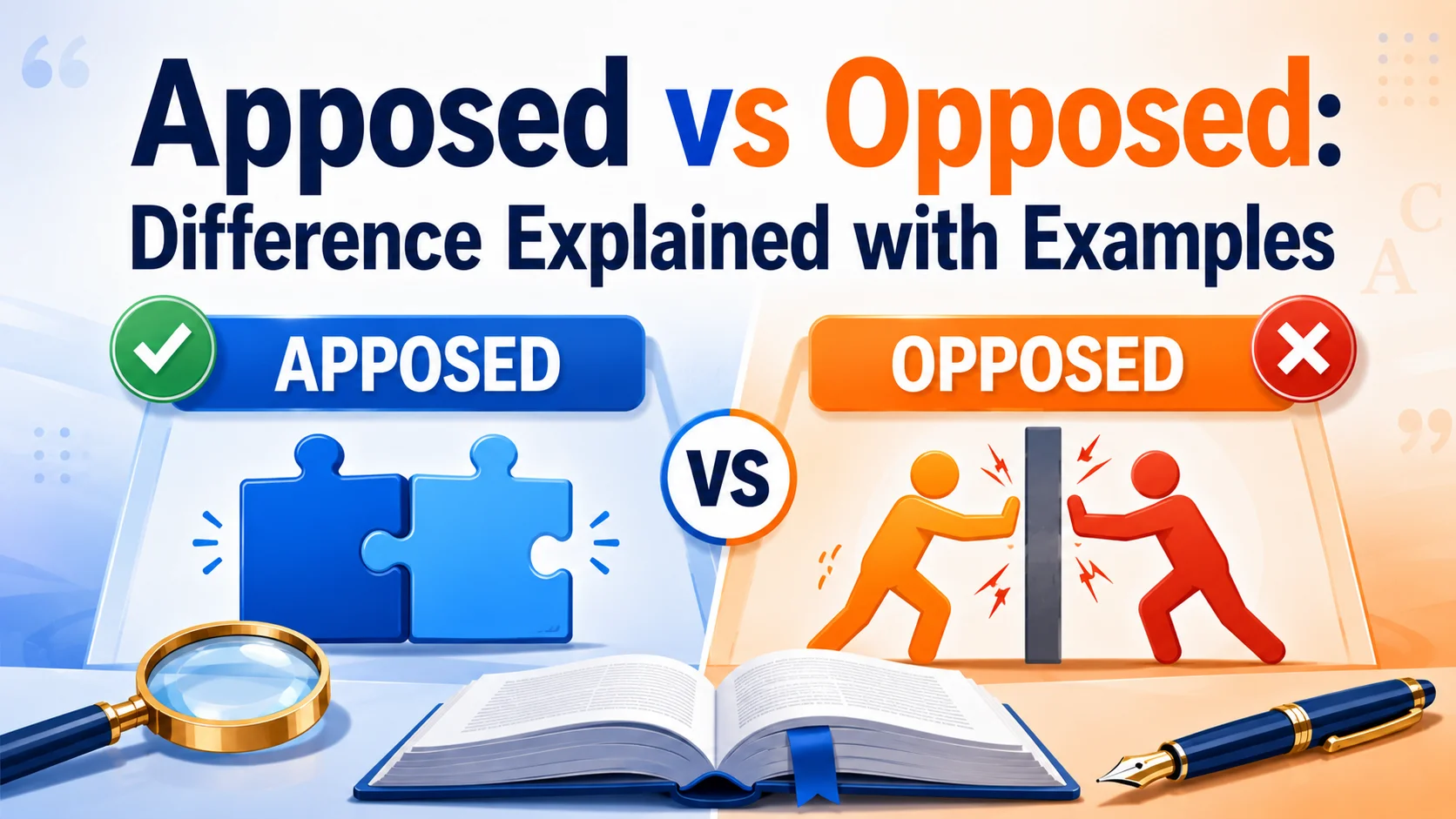
When you’re trying to choose between apposed vs opposed, the difference comes down to two very different ideas: being placed next to something versus being against something. The words look and sound similar, so it’s easy to mix them up, especially when you encounter apposed in technical or grammatical writing. Yet they aren’t interchangeable. Opposed is common in everyday English, while apposed is much more specialized.
The confusion becomes clearer once you focus on the relationship each word describes. If two things are positioned side by side, apposed may be the right term. If someone disagrees with, resists, or stands against an idea, person, action, or proposal, opposed is the natural choice. This distinction matters in academic writing, professional communication, grammar, biology, anatomy, and ordinary conversation.
In this guide, you’ll learn exactly what apposed and opposed mean, how their prefixes influence their meanings, where each word appears naturally, and how to use them correctly in sentences. You’ll also see practical examples, comparison tables, common mistakes, memory tricks, and a few less obvious grammatical details that can help you choose the right word without hesitation.
Quick Answer: Apposed vs Opposed
Opposed means against, in disagreement with, or resisting something. It can describe an opinion, person, policy, proposal, action, or physical force.
The committee was opposed to the proposed changes.
Apposed means placed close to, alongside, or directly next to something else. It’s considerably less common and is most often found in technical, anatomical, grammatical, or formal contexts.
The two structures were apposed to one another.
The easiest way to remember the difference
Think:
- Opposed = against
- Apposed = alongside
If the relationship involves conflict or disagreement, choose opposed.
If it involves position or placement, apposed may be appropriate.
| Word | Core meaning | Typical use | Example |
| Opposed | Against or in disagreement | Everyday, academic, professional | She was opposed to the proposal. |
| Apposed | Placed next to or alongside | Technical, scientific, grammatical | The surfaces were apposed. |
Quick tip: In ordinary writing, opposed is overwhelmingly more likely to be the word you need.
What Does “Opposed” Mean?
Opposed is the past tense and past participle of oppose. It describes a situation in which someone or something is against another person, idea, decision, action, or force.
The word can express disagreement at several levels. Someone might simply have a different opinion, actively resist a proposal, or stand in direct conflict with another side.
Opposed can describe disagreement
This is one of its most common uses.
- I’m opposed to the plan.
- Many residents are opposed to the development.
- The board was opposed to the proposal.
- She strongly opposed the new policy.
The standard construction is often:
opposed to + noun/noun phrase
or
opposed to + -ing form
For example:
They are opposed to the changes.
He is opposed to raising the membership fee.
A frequent mistake is treating to as though it were always an infinitive marker. In opposed to changing, to is a preposition, so it is followed by the -ing form, not change.
Opposed can describe physical conflict
The word isn’t limited to opinions.
Two forces, groups, or sides can be opposed to each other.
The two armies were opposed on opposite sides of the valley.
You might also encounter expressions such as:
- opposing forces
- opposing teams
- opposing sides
- opposed positions
Here, the underlying idea remains being against or in conflict with something else.
Opposed can describe contrasting positions
In academic and professional writing, opposed often introduces competing viewpoints.
The researchers presented two opposed interpretations of the findings.
This doesn’t necessarily mean the researchers were personally hostile toward each other. It simply means their positions conflicted or differed significantly.
What Does “Apposed” Mean?
Apposed is related to the verb appose, which means to place something next to or alongside something else.
It is a legitimate English word, but it is much less common than opposed. That difference in frequency is important: seeing apposed less often doesn’t make it incorrect.
The core meaning of apposed
When two things are apposed, they are positioned closely together, often so that their surfaces, edges, or corresponding parts are adjacent.
For example:
The two surfaces were apposed during the procedure.
The word is especially useful when the writer needs to describe physical arrangement or adjacency precisely.
Where you’re most likely to see “apposed”
Apposed tends to appear in specialized contexts such as:
- Anatomy
- Biology
- Medicine
- Linguistics
- Grammar
- Technical descriptions
- Scientific writing
A technical writer might use apposed because simply saying next to doesn’t always communicate the same degree of precision.
Apposed in grammar and linguistics
In grammatical terminology, apposition refers to a relationship in which one element is placed next to another and provides additional information about it.
For example:
My brother, James, is a doctor.
Here, James is in apposition to my brother because the two noun phrases refer to the same person and are placed together.
The noun apposition and adjective/participle apposed are connected conceptually, although apposed has broader technical applications involving physical or structural adjacency as well.
Apposed vs Opposed: The Core Difference
The simplest distinction is based on the relationship between two things.
Apposed describes proximity. Opposed describes conflict.
That single distinction resolves most cases.
| Feature | Apposed | Opposed |
| Basic idea | Positioned alongside | Against or in conflict |
| Main relationship | Adjacency | Opposition |
| Commonness | Uncommon | Very common |
| Everyday English | Rare | Very common |
| Technical writing | Commoner | Also common |
| Grammar | Related to apposition | Related to opposition |
| Typical phrase | apposed surfaces | opposed to a plan |
| Emotional meaning | Usually neutral | May imply disagreement |
| Physical meaning | Side-by-side placement | Resistance or confrontation |
Consider these two sentences:
The tissues were apposed.
This describes position.
The surgeon was opposed to the proposed procedure.
This describes disagreement.
Changing one word for the other completely changes the meaning.
Why the Words Are So Easy to Confuse
The spelling difference is only one letter, and both words contain the familiar sequence -posed.
That visual similarity can trick you into assuming they’re related in meaning. They aren’t interchangeable simply because they look alike.
The prefixes point in different directions
Both words ultimately contain the Latin root associated with placing or putting, but their prefixes developed into different meanings.
The prefix op- in oppose is historically connected with the idea of being positioned against.
The prefix ap- in appose comes from a form related to ad-, meaning toward or near. The spelling changed as the sounds interacted.
That gives you a useful conceptual contrast:
- appose → place beside
- oppose → place against
The modern meanings are therefore easier to remember when you think about the relationship rather than memorizing spelling alone.
How to Use “Opposed” Correctly
Use “opposed” for disagreement
When someone doesn’t support an idea, decision, policy, or action, opposed is the standard choice.
The employees were opposed to the proposed schedule.
She is opposed to unnecessary restrictions.
Several members opposed the motion.
Notice that oppose can function directly with an object:
They opposed the proposal.
But opposed is also frequently used with to:
They were opposed to the proposal.
Use “opposed” for competing sides
The word can also describe two sides that are in conflict.
The candidates represented opposed political positions.
The two teams were opposed in the final match.
The exact interpretation depends on context, but the central idea remains contrast, resistance, or conflict.
Common sentence patterns
| Pattern | Example |
| be opposed to + noun | She is opposed to the plan. |
| be opposed to + -ing | He is opposed to changing the rules. |
| oppose + noun | They opposed the decision. |
| opposed views | The writers expressed opposed views. |
| opposed forces | The opposed forces moved toward each other. |
How to Use “Apposed” Correctly
Because apposed is specialized, context matters more than frequency.
Use it when you genuinely mean that something is placed next to, alongside, or in close contact with something else.
Physical or scientific example
The two surfaces were carefully apposed.
The sentence focuses on position, not disagreement.
Anatomical example
The structures lie closely apposed to one another.
Here, apposed provides a concise technical description of physical proximity.
Grammatical example
When discussing apposition, you may encounter language describing elements as being apposed.
The descriptive phrase is apposed to the noun it identifies.
The important idea is still being placed alongside another element in a grammatical relationship.
Apposed vs Opposed in Real-World Sentences
The difference becomes much easier when you compare parallel examples.
| Context | Apposed | Opposed |
| Medical | The surfaces were apposed. | The patient was opposed to the treatment. |
| Academic | The two terms were apposed in the structure. | The authors held opposed views. |
| Workplace | Rarely appropriate unless describing physical arrangement. | The employees were opposed to the policy. |
| Everyday speech | Rare | She was opposed to the idea. |
| Grammar | The phrase is apposed to the noun. | The arguments are opposed. |
| Science | Adjacent structures were apposed. | Competing theories were opposed. |
A useful substitution test
Ask yourself:
Could I replace the word with “against”?
If yes, opposed is probably correct.
She was against the proposal.
She was opposed to the proposal.
Now ask:
Could I replace it with “beside,” “alongside,” or “placed next to”?
If yes, apposed may be correct.
The surfaces were placed alongside each other.
The surfaces were apposed.
This isn’t a universal grammar rule, but it’s a highly effective practical test.
Grammar and Sentence Structure
Understanding how each word behaves grammatically can prevent awkward sentences.
“Opposed” with “to”
One of the most important structures is:
be + opposed to + noun/-ing
Examples:
I’m opposed to the proposal.
We’re opposed to increasing the price.
They were opposed to changing the deadline.
Avoid:
I’m opposed to change it.
Better:
I’m opposed to changing it.
Here, to is functioning as a preposition.
“Opposed” as a past participle
Opposed can also appear in passive constructions.
The proposal was opposed by several members.
It can also function adjectivally:
The two sides held opposed views.
The grammar is flexible because opposed comes from a verb but is frequently used as an adjective.
“Apposed” in technical constructions
Apposed is more likely to appear in specialized descriptive constructions.
The structures were apposed to each other.
The membrane surfaces remained closely apposed.
Because the word is uncommon in ordinary conversation, it can sound overly technical when a simpler phrase such as next to or alongside would be clearer.
Common Mistakes With Apposed and Opposed
Mistake 1: Using “apposed” to mean “against”
Incorrect:
I am apposed to the new rule.
Correct:
I am opposed to the new rule.
This is probably the most important mistake to avoid.
Mistake 2: Assuming “apposed” is simply a misspelling
Although apposed is uncommon, it is not merely an incorrect version of opposed.
In technical contexts, it can be exactly the right word.
The two surfaces were apposed.
Calling this sentence incorrect would erase a legitimate technical distinction.
Mistake 3: Using “opposed” for simple physical proximity
Suppose two objects are sitting next to each other without conflict.
The two panels were opposed.
That may suggest that the panels are facing each other or positioned in opposition, rather than simply touching or sitting alongside each other.
If you mean simple adjacency, adjacent, beside, alongside, or apposed may be more accurate depending on the context.
Mistake 4: Overusing “apposed” in ordinary writing
Even when apposed is technically valid, it may not be the clearest option.
For a general audience:
The two surfaces were next to each other.
may be easier to understand than:
The two surfaces were apposed.
Good writing isn’t only about choosing a technically correct word. It’s also about choosing the word that communicates the idea most efficiently.
Apposed vs Opposed vs Adjacent
Another useful comparison involves adjacent, because it overlaps with apposed more closely than opposed does.
| Word | Meaning | Best use |
| Apposed | Placed alongside or in close relation | Technical descriptions |
| Adjacent | Next to or nearby | General and technical writing |
| Opposed | Against or in conflict | Opinions, forces, positions |
| Opposing | Actively against or competing | People, sides, forces, arguments |
For example:
The buildings are adjacent.
This simply tells us they are next to each other.
The surfaces are apposed.
This gives a more specialized description of their positioning or contact.
The residents are opposed to the development.
Now the relationship is one of disagreement.
Synonyms and Better Alternatives
Choosing a synonym depends heavily on the intended meaning.
Alternatives for “opposed”
Depending on context, you might use:
- against
- resistant to
- hostile to
- disagreeing with
- objecting to
- contrary to
- conflicting with
- antithetical to
These aren’t perfect substitutes in every sentence.
For example, resistant to can suggest reluctance or refusal, while hostile to is much stronger emotionally.
Alternatives for “apposed”
Possible alternatives include:
- adjacent
- alongside
- next to
- adjoining
- juxtaposed
- placed beside
- positioned against
Be careful with juxtaposed. It means placing things close together for comparison or contrast and doesn’t necessarily mean they are physically touching.
Which Word Sounds More Natural?
For most readers, opposed is the natural everyday word.
You’ll encounter it in:
- conversations
- news writing
- workplace communication
- essays
- academic arguments
- political discussions
- formal correspondence
Apposed, by contrast, belongs largely to specialized vocabulary.
That doesn’t make it less legitimate. It simply has a narrower audience and purpose.
Expert writing tip: Don’t choose apposed merely because it sounds sophisticated. Choose it when the technical meaning of placement or adjacency actually matters.
When Should You Use “Opposed”?
Choose opposed when:
- You mean against.
- Someone disagrees with an idea.
- A group rejects a proposal.
- Two viewpoints conflict.
- Two forces face one another.
- You’re describing resistance.
- You’re writing ordinary or professional English.
Examples
The residents were opposed to the construction project.
She strongly opposed the recommendation.
The researchers presented two opposed interpretations.
He is opposed to changing the agreement.
When Should You Use “Apposed”?
Choose apposed when:
- You mean placed alongside.
- You’re describing physical proximity.
- You’re writing about anatomy or biology.
- You’re discussing a specialized grammatical relationship.
- A technical context requires precise terminology.
Examples
The two surfaces remained apposed.
The structures are closely apposed.
The phrase is apposed to the noun.
If your audience is unfamiliar with the term, consider whether next to, alongside, or adjacent would communicate the same idea more clearly.
A Simple Decision Guide
When you’re unsure, work through these questions:
| Question | If yes, choose |
| Do you mean “against”? | Opposed |
| Does someone disagree with something? | Opposed |
| Are two sides in conflict? | Opposed |
| Are two things positioned beside each other? | Apposed |
| Are you describing close physical contact? | Apposed |
| Are you discussing a specialized grammatical relationship? | Apposed |
| Would “next to” express your meaning better? | Consider adjacent/alongside |
The key is to identify the relationship, not the spelling.
Common Misconceptions
“Apposed” is just a typo
False. Apposed is a legitimate word. It has a specialized meaning associated with being placed beside or alongside something.
“Opposed” always means hatred
False. Someone can be opposed to an idea without feeling hostility toward the person who proposed it.
I’m opposed to the policy, but I respect the people who support it.
“Apposed” and “adjacent” are always identical
Not necessarily. They can overlap, but apposed can carry a more specific technical sense of being placed in close relation or contact, depending on the field.
“Opposed to” should always be followed by a verb
Not exactly. It can be followed by a noun:
opposed to the proposal
or an -ing form:
opposed to changing the proposal
A Practical Mini-Quiz
Choose apposed or opposed.
- The committee was ___ to the proposed amendment.
- The two surfaces were closely ___.
- She is ___ to raising the fees.
- The structures were ___ to one another.
- Several residents ___ the development.
Answers
- opposed
- apposed
- opposed
- apposed
- opposed
The pattern should now be clear: disagreement → opposed; placement → apposed.
How to Remember Apposed vs Opposed
A simple memory device works well:
Opposed = Opposition
Both begin with oppo-.
Think:
OPPOSED → OPPOSITION → AGAINST
Apposed = Alongside
Think:
APPOSED → APPOSITION → ALONGSIDE
You don’t need to memorize complicated etymology every time you write. The practical contrast is enough:
Opposed = against
Apposed = alongside
If you remember those two words, you’ll get most everyday decisions right.
Why Precision Matters in Professional Writing
The distinction becomes especially important in technical and academic writing.
Consider:
The two membranes were opposed.
A reader might interpret this as the membranes being positioned against one another, perhaps facing each other.
Now compare:
The two membranes were apposed.
The second sentence focuses on close placement or contact.
In ordinary writing, the difference may seem minor. In scientific or technical writing, however, seemingly small distinctions can communicate different physical relationships.
The same principle applies to professional communication more broadly: precise vocabulary reduces ambiguity.
Apposed vs Opposed: Final Comparison
| Category | Apposed | Opposed |
| Meaning | Placed beside or alongside | Against or in disagreement |
| Frequency | Uncommon | Common |
| Register | Mainly technical/formal | General and formal |
| Common contexts | Anatomy, biology, grammar | Everyday, academic, business |
| Emotional component | Usually none | Can imply disagreement |
| Physical relationship | Close placement | Conflict or opposing position |
| Common construction | apposed to | opposed to |
| Everyday substitute | next to, alongside | against |
| Main memory clue | alongside | against |
Conclusion
Understanding apposed vs opposed becomes much easier once you stop focusing on their similar spelling and focus on the relationship each word describes. Opposed is the everyday choice when you mean against, disagreeing with, resisting, or conflicting with something. Apposed is a legitimate but specialized term for things positioned alongside or closely related to one another. One final actionable tip: before choosing the word, replace it mentally with “against” or “alongside.” The intended meaning usually becomes obvious immediately. A common mistake to avoid is assuming that an unfamiliar word must be an error. Apposed has a real technical role; it simply belongs in narrower contexts. When precision matters, choose the word that describes the relationship—not the one that merely looks familiar.
Frequently Asked Questions
Q1. Is “apposed” a real word or a misspelling of “opposed”?
Apposed is a real English word, not simply a misspelling. It means placed alongside or in close relation to something else and appears mainly in technical fields. Opposed, by contrast, means against or in disagreement with something and is far more common in everyday English.
Q2. Should I say “I am apposed to” or “I am opposed to”?
You should say “I am opposed to.” This construction means that you disagree with or do not support something. Apposed to does not mean “against” in ordinary English. For example, “I am opposed to the proposal” is correct.
Q3. What does “apposed” mean in anatomy?
In anatomy and related scientific contexts, apposed generally describes structures that are positioned closely alongside or in contact with one another. It emphasizes spatial relationship rather than disagreement. The precise interpretation can depend on the particular anatomical context.
Q4. Is “opposed to” followed by a noun or a verb?
Opposed to can be followed by either a noun or an -ing form. For example, “She is opposed to the proposal” uses a noun, while “She is opposed to changing the proposal” uses a gerund. The to here functions as a preposition.
Q5. What is the easiest way to remember apposed and opposed?
Use the simplest contrast: opposed means against, while apposed means alongside. If you’re describing disagreement, resistance, or conflict, choose opposed. If you’re describing close placement or adjacency in a technical context, apposed may be the correct word.