

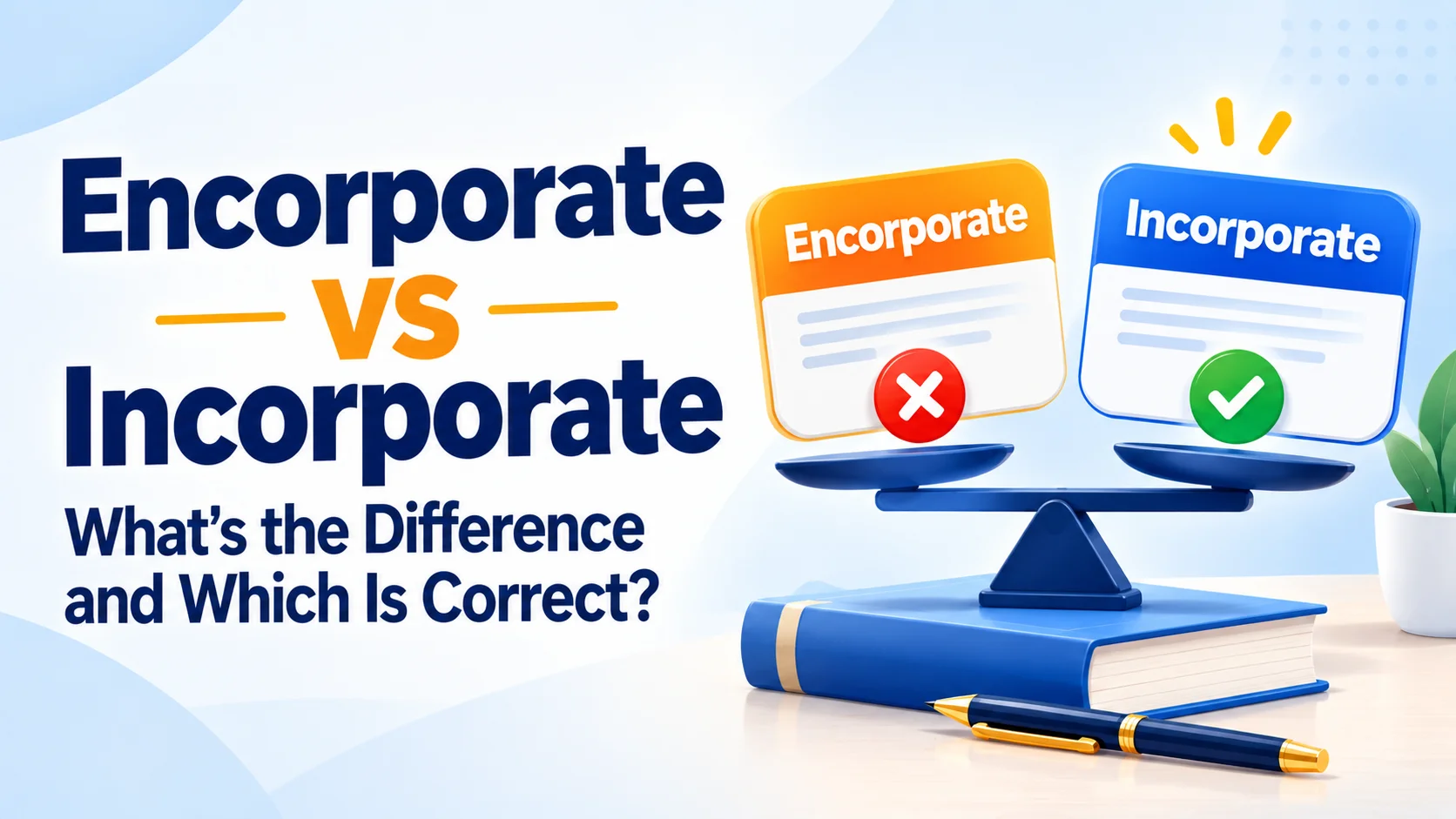
Encorporate vs incorporate is a spelling question with a surprisingly simple answer: incorporate is the correct standard English word, while incorporate is generally a misspelling. The confusion usually comes from pronunciation, familiarity with other en- words, or simply remembering the sound rather than the spelling. Once you know what incorporate means and how its word family works, the distinction becomes much easier to remember.
The important part is that incorporate has more than one useful meaning. In everyday, academic, professional, and technical writing, it can mean to include something as part of a larger whole. In business and law, it can mean to legally form a company as a corporation. These meanings are related, but the context changes what the word communicates.
This guide explains why “incorporate” is correct, why incorporate is so easy to write by mistake, and how to use the correct word naturally. You’ll also see practical examples, grammar patterns, comparisons with include, integrate, and combine, common mistakes, business usage, spelling tips, and answers to frequently searched questions. The goal is not simply to memorize one spelling—it is to understand the word well enough to use it confidently.
Encorporate vs. Incorporate: The Quick Answer
If you are deciding between incorporate and incorporate, choose incorporate.
| Question | Answer |
| Correct spelling | Incorporate |
| Incorrect/common misspelling | Encorporate |
| Part of speech | Primarily a verb |
| General meaning | To include or combine something into a larger whole |
| Business meaning | To legally form a corporation |
| Past tense | Incorporated |
| -ing form | Incorporating |
| Noun | Incorporation |
| Common pattern | Incorporate something into something |
Major English dictionaries, including Cambridge and Merriam-Webster, list incorporate as the standard word. Cambridge gives both the general sense of including something within something larger and the specialized business/legal sense of making a company into a corporation.
Quick rule: If you mean “include,” “combine,” or “make part of a whole,” use incorporate. If you mean the legal creation of a corporation, use incorporate as well.
What Does “Incorporate” Mean?
Incorporate Meaning in Simple English
Incorporate means to take something and make it part of something larger.
For example:
- The designer incorporated blue accents into the room.
- The teacher incorporated games into the lesson.
- The new version incorporates several useful features.
- We should incorporate your suggestion into the plan.
The underlying idea is not merely that something exists alongside something else. It becomes part of the larger thing.
Cambridge defines the general use as including something as part of something larger, while Merriam-Webster emphasizes joining or working something into an existing whole.
The Two Main Meanings of Incorporate
1. General meaning — include or combine
The report incorporates findings from several studies.
Here, the findings have been brought into the report.
2. Business/legal meaning — form a corporation
The company was incorporated in 2024.
Here, incorporated refers to the legal status or formation of a corporation.
These are different applications of the same word, but both involve the basic idea of bringing something into a larger whole or corporate body.
Incorporate as a Word Family
Learning the entire word family is more useful than memorizing incorporate alone:
- incorporate — base verb
- incorporates — third-person singular present
- incorporated — past tense/past participle
- incorporating — present participle
- incorporation — noun
- incorporator — a person involved in forming a corporation
Cambridge and Merriam-Webster both identify incorporated, incorporating, and incorporation as established forms of the word.
Is “Encorporate” a Real Word?
For ordinary modern English writing, do not use “encorporate.” The standard spelling is incorporate.
That matters because people sometimes assume that a word must be acceptable simply because they have seen it online. User-generated content, informal posts, comments, and poorly edited pages can contain spelling errors. A word appearing somewhere on the internet does not automatically make it a standard dictionary form.
If you are writing:
- a school assignment,
- an email,
- a résumé,
- a report,
- an academic paper,
- business documentation, or
- website content,
use incorporate.
There is also an important distinction between incorporate and legitimate words that happen to begin with en-. English contains many such words, but that does not mean incorporate follows the same spelling pattern.
Why Do People Write “Encorporate” Instead of “Incorporate”?
The mistake is understandable. English spelling often cannot be predicted perfectly from pronunciation.
Pronunciation Makes the First Vowel Easy to Mishear
Incorporate begins with an unstressed in- sound. When people hear the word quickly, the first vowel may not feel particularly distinct.
That can make someone write what sounds right rather than what they have actually learned.
Confusion With “En-” Words
English has many common words beginning with en-, including encourage, enable, enrich, and enclose.
Because en- is a familiar beginning, a writer who remembers only the sound may unconsciously produce incorporate.
The “In-” Beginning Is Easy to Overlook
The correct spelling is:
IN + CORPORATE
not:
EN + CORPORATE
A useful strategy is to remember the beginning as a separate chunk: in-corporate.
Typing and Autocomplete Can Reinforce Errors
If you have repeatedly typed a misspelling, your brain may begin to recognize it as familiar. Autocomplete can make this worse if an incorrect form appears in a context where you do not notice it.
That is why deliberately learning the correct word family is more reliable than trusting familiarity.
Pronunciation-Based Spelling Is Especially Risky
English has many words whose pronunciation does not transparently reveal their spelling. Incorporate is one of them.
For spelling questions, the better approach is:
- Learn the dictionary spelling.
- Notice the word family.
- Read the word in context.
- Use it in your own sentences.
Encorporate vs. Incorporate: Side-by-Side Comparison
| Feature | Encorporate | Incorporate |
| Standard spelling | ❌ No | ✅ Yes |
| Used in standard English | Not as the normal form | Yes |
| General meaning | — | Include or combine |
| Business meaning | — | Form a corporation |
| Past form | — | Incorporated |
| Noun form | — | Incorporation |
| Suitable for academic writing | ❌ | ✅ |
| Suitable for professional writing | ❌ | ✅ |
The practical decision is straightforward: replace “encorporate” with “incorporate.”
How to Spell “Incorporate” Correctly
The spelling is:
I-N-C-O-R-P-O-R-A-T-E
A useful visual breakdown is:
IN + CORPORATE
You do not need to treat this as a complicated spelling puzzle. The important part is remembering that the word starts with in-.
A Simple Memory Trick
Think:
“Put it IN the whole” → INcorporate
The memory trick is based on the word’s general meaning rather than an arbitrary spelling rule.
For example:
We need to incorporate the new idea into the plan.
The idea is being brought into the existing plan.
Common Misspellings
Besides encorporate, writers sometimes make other spelling mistakes such as:
- incorporate
- incorporate
- incorporate
- encorporated
When proofreading, pay particular attention to the vowels in the middle as well as the opening in-.
How to Use “Incorporate” in a Sentence
Incorporate Something Into Something
This is one of the most useful patterns:
incorporate + something + into + something
Examples:
- The editor incorporated the suggestions into the final draft.
- The architect incorporated natural light into the design.
- The teacher incorporated practical exercises into the lesson.
- The company incorporated customer feedback into its next update.
This pattern makes the relationship clear: one thing is being added to another existing whole.
Incorporate Something In Something
In can also appear in certain constructions, especially passive ones:
The changes were incorporated in the final report.
Cambridge recognizes both incorporated into and incorporated in in appropriate contexts.
For learners, however, incorporate something into something is an especially useful pattern to remember when describing an active addition.
Incorporate Something With Something
With can occur in appropriate contexts, but it should not automatically replace into.
For example:
The new system was incorporated with the existing platform.
Depending on the intended meaning, integrated with may sound more natural if the emphasis is on two systems working together.
Active and Passive Examples
Active:
The writer incorporated three examples into the article.
Passive:
Three examples were incorporated into the article.
Both are grammatically useful. The active version emphasizes who performed the action; the passive version emphasizes the result.
“Incorporate” Examples in Real-Life Contexts
Everyday Conversation
Let’s incorporate your idea into our plan.
She incorporated some new activities into her routine.
School and Academic Writing
The essay incorporates evidence from several sources.
The researcher incorporated the latest findings into the analysis.
Academic writing often uses incorporate because ideas, evidence, theories, and findings are being brought into a larger argument.
Workplace Communication
We can incorporate your feedback into the next version.
The manager incorporated the team’s recommendations into the proposal.
Business and Marketing
The campaign incorporates customer stories.
The company incorporated sustainability goals into its strategy.
Technology and Product Design
The application incorporates several accessibility features.
Engineers incorporated a new security feature into the system.
Food, Art, and Creative Work
The recipe incorporates fresh herbs and spices.
The artist incorporated geometric shapes into the composition.
The word works across many subjects because its central meaning—making something part of a larger whole—is broadly useful.
What Does “Incorporate” Mean in Business and Law?
The business meaning deserves special attention because incorporate can have a much more specific meaning in this context.
What Does It Mean to Incorporate a Business?
To incorporate a business generally means to legally establish it as a corporation under the applicable law.
For example:
The founders decided to incorporate the business.
This is not simply another way of saying “register a business.” Incorporation can involve creating a distinct legal entity and complying with the rules of the relevant jurisdiction.
Cambridge specifically identifies the business/legal meaning as making a company or organization into a legal corporation.
What Happens When a Business Is Incorporated?
The exact process depends on the country or jurisdiction, but incorporation can involve matters such as:
- creating the corporation under applicable law,
- filing required formation documents,
- establishing the corporation’s legal structure,
- identifying ownership or shares where applicable,
- adopting governing documents, and
- meeting continuing legal and regulatory requirements.
The details vary considerably by jurisdiction, so incorporation should not be treated as one identical procedure worldwide.
Incorporated vs. Registered: Are They the Same?
Not necessarily.
Registration is a broad term that can refer to recording a business, organization, name, tax status, or other information with an authority.
Incorporation specifically concerns forming or recognizing a corporation as a legal entity.
The two processes may overlap in some jurisdictions, but they are not automatically interchangeable.
What Does “Inc.” Mean?
Inc. is commonly used as an abbreviation associated with an incorporated company in jurisdictions where that designation is used.
For example:
Example Technologies, Inc.
The exact naming rules depend on the jurisdiction. If you are dealing with an actual company formation, use the relevant government or legal authority for the applicable rules rather than relying on general English definitions.
Incorporate vs. Include vs. Integrate vs. Combine
These words overlap, but their emphasis differs.
| Word | Main idea | Example | Best when… |
| Include | Make something part of a group or whole | The price includes delivery. | You simply want to say something is part of something else. |
| Incorporate | Add something into an existing whole | The design incorporates local materials. | The added element becomes part of the larger creation. |
| Integrate | Bring parts together so they function as a connected system | The software integrates with the database. | Interaction or coordinated functioning matters. |
| Combine | Join two or more things | Combine the ingredients in a bowl. | The emphasis is simply on joining things together. |
Incorporate vs. Include
Consider these two sentences:
The report includes three charts.
The report incorporates three charts into its overall presentation.
The first simply tells us that the charts are present. The second emphasizes their incorporation into the larger work.
That distinction is subtle, so do not replace include with incorporate merely to sound more formal.
Incorporate vs. Integrate
Integrate often suggests that separate parts are brought together so they operate as a connected whole.
The company integrated the new software with its existing system.
Incorporate can also describe adding a feature to a system:
The company incorporated a new reporting feature into the software.
If the emphasis is on joining systems so they work together, integration may be the sharper choice.
Incorporate vs. Combine
Combine is broader and often simpler:
Combine the flour and water.
Incorporate can suggest a more deliberate process of making something part of an existing structure:
The chef incorporated the new ingredient into the recipe.
Neither is universally “better.” The intended relationship determines the best verb.
Grammar and Usage Rules for “Incorporate”
Is “Incorporate” a Verb?
Yes. Its most common modern uses are verbal.
The designer incorporated the feedback.
We should incorporate these changes.
Transitive Use
In its common “include or combine” sense, incorporate is often transitive, meaning it takes an object.
The plan incorporates new safety measures.
The thing being added—new safety measures—is the object.
Present, Past, and -ing Forms
| Form | Example |
| Incorporate | We will incorporate the changes. |
| Incorporates | The design incorporates new materials. |
| Incorporated | The team incorporated the feedback. |
| Incorporating | We are incorporating new data. |
Incorporation as a Noun
Incorporation can refer to the act of including something or, in business, the legal process of forming a corporation. Cambridge lists both meanings.
The incorporation of new evidence strengthened the report.
The company completed its incorporation last year.
Incorporated as an Adjective
Incorporated can describe a company that has been legally formed as a corporation:
The company is an incorporated business.
It can also function as the past participle in ordinary sentences:
The changes were incorporated into the final version.
Context tells you which sense is intended.
Common Mistakes With “Incorporate”
Mistake 1: Writing “Encorporate”
This is the central spelling error.
Wrong: We need to incorporate these ideas.
Correct: We need to incorporate these ideas.
Mistake 2: Using “Incorporate” When “Include” Is Better
Not every instance of “include” needs to become “incorporate.”
The package includes a charger.
That is perfectly natural. Using incorporate here would sound unnecessarily formal.
Mistake 3: Confusing It With “Integrate”
If two technological systems need to communicate and operate together, integration may be more precise.
Mistake 4: Ignoring the Preposition
Learners sometimes create unnecessarily complicated structures around the verb.
A dependable pattern is:
incorporate X into Y
For example:
Incorporate customer feedback into the next version.
Mistake 5: Assuming “Incorporate” Always Refers to Companies
It does not.
The recipe incorporates garlic.
The film incorporates elements of comedy.
The lesson incorporates practical activities.
The company-related meaning is only one sense of the word.
Formal vs. Everyday Use of “Incorporate”
Incorporate is completely normal in professional and academic writing, but that does not mean it is always the best choice in casual conversation.
Compare:
Formal: We should incorporate your recommendations into the proposal.
Simple: We should add your recommendations to the proposal.
Both can be correct. The second is simply more direct.
A good writer chooses the word that expresses the relationship most accurately—not the word that sounds most sophisticated.
Expert tip: If add or include communicates exactly what you mean, there is no prize for replacing it with a longer word.
How to Remember “Incorporate” Every Time
Use three memory anchors:
1. Remember “IN.”
Think IN-corporate, not EN-corporate.
2. Learn the family.
If you know incorporate, incorporated, and incorporation, the spelling becomes easier to recognize.
3. Connect the spelling with the meaning.
When something is incorporated, it is brought into a larger whole.
A 10-Second Spelling Check
When you hesitate, ask:
“Am I trying to say include or combine?”
If yes, the word you probably need is:
incorporate
If you mean a legal company-formation process, it is still:
incorporate
When Should You Use “Incorporate” Instead of a Simpler Synonym?
- Use incorporate when an element is being deliberately made part of an existing whole.
- Use includes when you only need to indicate that something is present.
- Use integrate when the important idea is that separate parts become connected or work together.
- Use combine when the emphasis is simply on joining things.
- Use add when straightforward everyday language is preferable.
- This distinction improves writing because it makes the relationship between ideas more precise.
Conclusion
When choosing between incorporate vs incorporate, the answer is clear: incorporate is the standard spelling. More importantly, understanding its meaning makes the spelling easier to remember. The verb can describe adding an idea, feature, ingredient, or element to a larger whole, and it also has a specialized business and legal meaning connected with forming a corporation. Major dictionaries recognize both uses. One final actionable tip: remember the opening as IN-corporate, then learn its related forms—incorporated and incorporation—as a family. A common mistake to avoid is assuming that incorporation is acceptable simply because it sounds plausible. When precision matters, use the established form and choose simpler alternatives such as include, add, or integrate when they communicate your meaning more naturally.
Frequently Asked Questions
Q1. Is “encorporate” correct English?
Encorporate is not the standard spelling of the verb used in modern English. The correct form is incorporate. Use incorporated in schoolwork, professional communication, academic writing, and formal documents. If you see incorporated online, treat it as a likely spelling error rather than an accepted alternative.
Q2. What is the correct spelling: incorporate or incorporate?
The correct spelling is incorporate, beginning with in-. Its related forms include incorporated, incorporating, and incorporation. A useful memory aid is to connect the spelling with the meaning: something is incorporated when it is brought into a larger whole.
Q3. What is the past tense of incorporate?
The past tense is incorporated. For example: “The editor incorporated the suggested changes into the article.” The same form, incorporated, also functions as a past participle in passive constructions and can describe a legally formed corporation depending on context.
Q4. Is “incorporate into” grammatically correct?
Yes. Incorporate something into something is a common and useful grammatical pattern. For example: “The designer incorporated new materials into the building.” Cambridge specifically provides examples using incorporate into and also recognizes incorporate in in appropriate contexts.
Q5. What is the difference between incorporate and integrate?
Both can describe bringing things together, but their emphasis differs. Incorporate usually focuses on making something part of a larger whole. Integrate often emphasizes connecting separate parts so they function together. In technology, for example, integration is often especially appropriate when systems need to work together.