
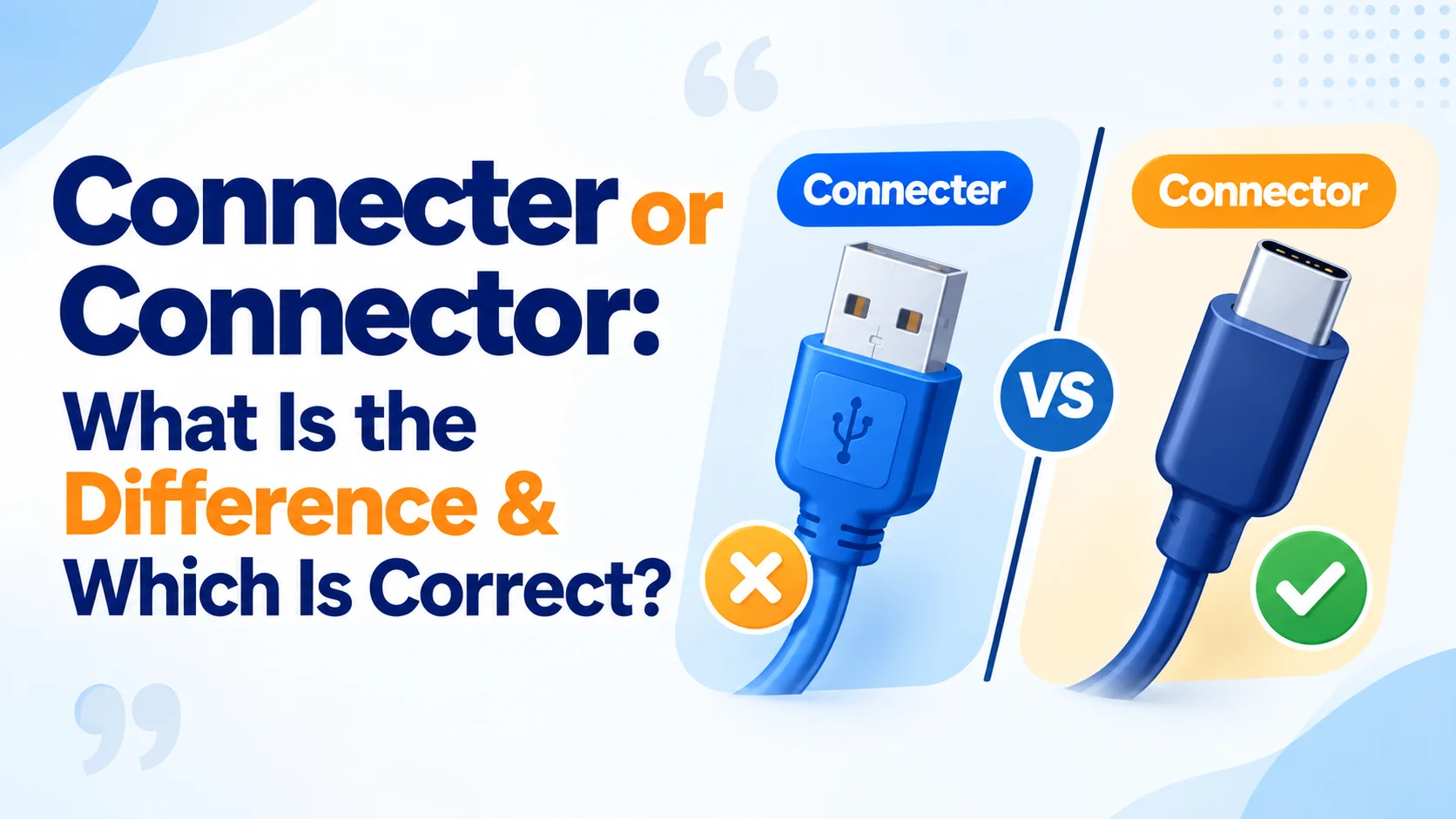
Connector is the spelling you will normally want when referring to a person, thing, device, or component that connects something to something else. The confusing part is that connecter is not simply an invented spelling: major dictionaries recognize it as a variant. Merriam-Webster lists connector as the usual noun and connecter as a less common form, while Collins also gives connecter as an alternative.
That distinction matters because spelling questions are often presented as a simple “right versus wrong” choice when actual English usage is more nuanced. If you are writing an essay, email, technical document, website, or school assignment, connector is the safest and most recognizable choice. Oxford defines connector as a thing that links two or more things together, with “cable connector” as an example.
So why does connecter look so reasonable? The verb is connect, and English frequently forms nouns ending in -er from verbs. Yet English also has established nouns ending in -or, and word formation does not always follow a simple spelling formula. This guide explains the difference, the history behind the two forms, where connector appears in technology and grammar, and when you may encounter connecter.
Connector vs. Connecter at a Glance
| Feature | Connector | Connecter |
| Standard modern choice | Yes | Less common |
| Meaning | A person or thing that connects | Same basic meaning |
| Technical use | Very common | Rare |
| Electronics | Standard term | Uncommon variant |
| Academic/formal writing | Recommended | Usually avoid |
| Dictionaries | Widely defined | Recognized as a variant |
| Best choice for most writers | Connector | Only when a specific source/context requires it |
The key point is not that “connecter” has no existence in English. Rather, connector is the established form you are most likely to see and the one that will sound natural to modern readers.
Quick rule: When you need the noun related to connect, choose connector unless you have a specific reason to preserve the less-common spelling connector.
What Does “Connector” Mean?
A connector is something—or sometimes someone—that connects two or more things.
Oxford gives the general meaning as “a thing that links two or more things together.” Merriam-Webster similarly treats connector as a noun derived from connect, while Cambridge gives especially clear examples involving electrical equipment and pipes.
Connector as a Person or Thing That Connects
The word can describe a person who brings people or ideas together:
- She is an excellent connector who introduces people with similar interests.
- The conference became a connector between researchers and industry.
- The bridge serves as an important connector between the two communities.
It can also refer to an object:
- The cable needs a new connector.
- Check whether the connector fits the socket.
- The pipe connector is damaged.
Connector in Technology and Electronics
This is one of the most familiar uses today.
A connector is a physical component that allows electrical or electronic equipment to be joined. Cambridge specifically defines it as a device or part of a device that allows electrical equipment to connect through contact between wires or components.
Examples include:
- USB connector
- audio connector
- power connector
- cable connector
- optical connector
- network connector
For example:
The new monitor uses a different connector from the older model.
In technical writing, connector is the established terminology. Collins also lists electrical engineering as a specific field in which the word is used.
Connector in Language and Communication
The word can also describe something that links ideas or people.
However, there is an important terminology distinction here. In grammar, connective is often the more precise term for a word that connects parts of a sentence. Oxford, for example, defines connective as a word that connects two parts of a sentence.
So a learner might encounter:
- connector — a general term for something that connects
- connective — a grammatical term for a linguistic element that connects parts of a sentence
This is one reason context matters.
What Does “Connecter” Mean?
Connecter has essentially the same basic meaning as connector. It is formed transparently from connect + -er, and dictionaries recognize it as a variant.
Merriam-Webster gives:
connector noun, or less commonly connecter
Collins likewise lists connecter as an alternative spelling under connector.
That means calling the connector an outright “wrong word” is too strong. A better description is an uncommon variant of connector.
Why “Connecter” Looks So Natural
English has many nouns formed with -er:
- teach → teacher
- write → writer
- drive → driver
- run → runner
- work → worker
Therefore, someone who knows the verb connect may naturally reason:
connect + er = connecter
The logic is understandable. The problem is that English vocabulary is full of historical forms that cannot always be predicted from a single productive rule.
Why “Connecter” Is Less Common
The established noun connector uses -or, and that form has become conventional in modern English.
Dictionary.com identifies connector as the main entry and gives connecter as a variant. It traces connector to connect + -or and dates the word to the late 18th century.
In other words, the spelling is not determined simply by asking which suffix seems logically possible. Established usage wins.
Why Is “Connector” the Preferred Spelling?
The strongest reason is simple: it is the conventional modern form.
Oxford has a dedicated entry for connector; Cambridge defines it extensively; Merriam-Webster lists it as the primary noun form; and Collins treats connecter as an alternative.
The Word Formation Behind “Connector”
The word is related directly to connect:
connect → connector
A connector is therefore something that performs the function expressed by the verb: it connects.
But the suffix cannot be predicted solely from the modern English verb. English has inherited and developed vocabulary through several historical layers, including Latin, French, and Germanic influences.
Why English Uses Both “-er” and “-or”
There is no universal modern rule saying:
“Every noun made from a verb must end in -er.”
Consider:
| Verb | Noun |
| teach | teacher |
| drive | driver |
| act | actor |
| inspect | inspector |
| operate | operator |
| connect | connector |
The -er/-or choice is partly historical and lexical. Once a particular form becomes established, speakers learn that word as part of the vocabulary.
That is why trying to invent a spelling from a formula can lead to mistakes.
The Historical Story Is More Interesting Than It Looks
The verb connect itself ultimately comes through Middle English from Latin conectere/connectere, associated with the idea of binding or joining. Merriam-Webster gives this Latin origin, while Etymonline dates the noun connector to around 1795.
This does not mean that English speakers consciously chose -or because they were thinking about Latin every time they wrote connector. Rather, historical word formation helped establish the vocabulary, and usage eventually standardized the familiar form.
Connector vs. Connecter: The Real Difference
The two spellings have a very small visual difference but a meaningful difference in frequency and conventionality.
Difference in Spelling
The only spelling change is the final vowel:
- connect + or → connector
- connect + er → connecter
Both are pronounced essentially the same in ordinary English.
Difference in Meaning
There is generally no important modern meaning distinction between the two.
Connecter is not normally used to describe one particular kind of connector while connector describes another. Instead, dictionaries treat connecter as a variant of connector.
Difference in Usage
This is where the practical distinction lies.
Connector is the normal choice in:
- technical documentation
- electronics
- engineering
- education
- business writing
- websites
- general English
- formal writing
Connecter may appear in dictionaries, older material, or individual publications, but it is much less likely to be the form a modern writer should choose spontaneously.
When Should You Use “Connector”?
In almost every ordinary situation, connector is the better choice.
In Everyday English
Use connector for objects or people that join things:
- The cable connector is loose.
- We need a connector for this pipe.
- Maria is a natural connector who knows everyone.
In Academic and Formal Writing
If you are writing an assignment, report, article, or presentation, use connector when the noun is appropriate.
For example:
The researchers used a specialized cable connector to link the instruments.
This is clearer and more consistent with established terminology.
In Technical and Engineering Writing
Technical terminology benefits from consistency. If a manufacturer’s documentation, engineering specification, or product manual calls a component a connector, changing it to connecter can make the terminology look unusual.
Oxford explicitly gives cable connector as an example, while Cambridge and Collins provide electrical and equipment-related definitions.
In Software and Digital Technology
The modern technology world also uses connector broadly for components or services that link systems.
Examples include:
- database connector
- API connector
- cloud connector
- network connector
- integration connector
Here again, connector is the natural form.
When Might You Encounter “Connecter”?
Finding connecter in a text does not automatically mean the author made a spelling mistake.
Older or Historical Texts
Less-common word forms can survive in historical writing. A dictionary may preserve them because English vocabulary is not limited to the forms most frequently used today.
Dictionaries and Variant Entries
This is the clearest evidence that connecter deserves a more nuanced treatment.
Merriam-Webster calls it a less common form. Dictionary.com calls it a variation of connector. Collins sends readers from connector to connector.
So:
“Connector is never a word” → too absolute.
“Connector is the normal spelling to use” → accurate.
Why You Should Usually Choose “Connector”
Even when a variant is technically recognized, recognition and recommendation are not the same thing.
If your goal is to write naturally for a modern audience, connector has several advantages:
- It is immediately recognizable.
- It matches major dictionary headwords.
- It is standard in technical terminology.
- It avoids distracting readers.
- It is the form most likely expected in educational or professional contexts.
Connector vs. Connection vs. Connect
These words belong to the same family, but they perform different grammatical jobs.
| Word | Part of speech | Basic meaning | Example |
| connect | Verb | To join or link | Connect the cable. |
| connection | Noun | A link or act/state of being connected | The connection is weak. |
| connector | Noun | Something or someone that connects | Replace the connector. |
| connective | Noun/adjective | Something that connects, especially in language | “Because” can function as a connective. |
Oxford defines connection as a link or the act/state of being connected, while its grammar entry uses connective for a word joining parts of a sentence.
A Simple Word-Family Example
Connect the two devices.
The connection is stable.
The cable connector is damaged.
The conjunction acts as a connective.
Understanding these distinctions prevents a spelling problem from turning into a vocabulary problem.
Connector in Different Fields
The word becomes particularly useful when you look at how specialists use it.
Electronics and Electrical Engineering
A connector physically joins components, wires, cables, or equipment.
Examples:
- USB connector
- power connector
- cable connector
- optical connector
The exact design can vary according to the application, but the spelling remains connector.
Computer Networking
Network equipment can use different physical connectors and connection standards.
A writer might discuss:
The network cable uses a compatible connector.
The technical context makes precision especially important because a connector is a physical or defined component, not simply the abstract idea of a connection.
Software and APIs
In software, connector can describe a component that allows two systems or services to exchange information.
For example:
The platform uses a database connector to communicate with the external system.
This is a natural extension of the core meaning: something that makes a connection possible.
Writing and Language
In language-related discussions, you may see connector used broadly for words or expressions that link ideas. However, connective is also an established grammatical term, so always follow the terminology used by the particular textbook, course, or linguistic framework.
Common Mistakes With Connector and Connecter
Mistake 1: Assuming Every Agent Noun Ends in “-er”
The fact that teacher and writer end in -er does not mean connecter must be the preferred form.
English contains many established -or nouns, and their spellings need to be learned as vocabulary.
Mistake 2: Saying “Connecter” Is Completely Incorrect
This is an oversimplification.
Major dictionaries recognize connecter as a variant or less-common form.
For a modern writing guide, the useful advice is not “this word does not exist.” It is:
Use connector as your default spelling.
Mistake 3: Using “Connecter” in Technical Documentation
Even if a variant is dictionary-listed, technical communication generally benefits from using the terminology readers already expect.
If an equipment manual says connector, changing the term to connecter serves no useful purpose.
Mistake 4: Confusing “Connector” With “Connection”
A connector is the thing that connects.
A connection is the link, relationship, or state of being connected.
Compare:
The connector is damaged.
with:
The connection is unstable.
The first refers to a component; the second refers to the link or state.
How to Remember the Correct Spelling
A simple memory trick is:
Connect + OR = CONNECTOR
When you picture a physical connector, imagine the “or” as the final two letters.
You can also remember the word through familiar compounds:
- USB connector
- cable connector
- electrical connector
- network connector
- pipe connector
Seeing the word in real technical contexts reinforces the standard spelling naturally.
Connector or Connecter? A Practical Decision Guide
| If you are… | Best choice | Why |
| Writing an essay | Connector | Standard modern form |
| Writing an email | Connector | Natural and familiar |
| Describing a USB component | Connector | Established technical term |
| Writing a manual | Connector | Consistent technical terminology |
| Discussing a person who brings people together | Connector | Common modern usage |
| Discussing grammar | Connector or connective, depending on terminology | Context determines the preferred term |
| Quoting an older source | Preserve the original | Historical wording may matter |
| Encountering “connecter” in a dictionary | Recognize it as a variant | It is not necessarily a typo |
Conclusion
When choosing between connector and connecter, the practical answer is straightforward: connector is the standard spelling you should normally use. It is the established form in modern English and is especially common in technical, academic, professional, and everyday writing.
However, connecter is not simply a misspelling. Major dictionaries recognize it as a less-common or variant form, so encountering it does not automatically mean that the writer has made an error. The important distinction is between a word being recognized and being the usual choice for modern readers.
Frequently Asked Questions
Q1. Is “connector” the correct spelling?
Yes. Connector is the standard modern spelling and the form you should normally use in everyday, academic, professional, and technical writing. Major dictionaries such as Oxford, Merriam-Webster, Cambridge, and Collins recognize connector as an established English noun.
Q2. Is “connecter” a real English word?
Yes, but it is much less common. Merriam-Webster lists connecter as a less common form of connector, while Collins and Dictionary.com also recognize it as a variant. Therefore, it is better described as an uncommon variant rather than simply a nonexistent or impossible word.
Q3. Why does “connecter” seem like the logical spelling?
Because English frequently forms agent nouns with -er: teach → teacher and write → writer. That pattern makes the connector look perfectly logical. However, English spelling reflects historical development and established usage, so not every verb takes the suffix a learner might predict.
Q4. Should I use “connecter” in formal writing?
Generally, no—choose connector unless you are reproducing a historical quotation, following a source’s exact terminology, or have another specific contextual reason. Although dictionaries recognize connecter, connector is the more familiar and conventional form for modern readers.
Q5. What is the difference between a connector and a connective?
A connector generally means a person or thing that connects. Connective has a specialized linguistic use: Oxford defines it as a word that connects two parts of a sentence. Thus, in grammar discussions, connective may be more precise than the broader word connector.