

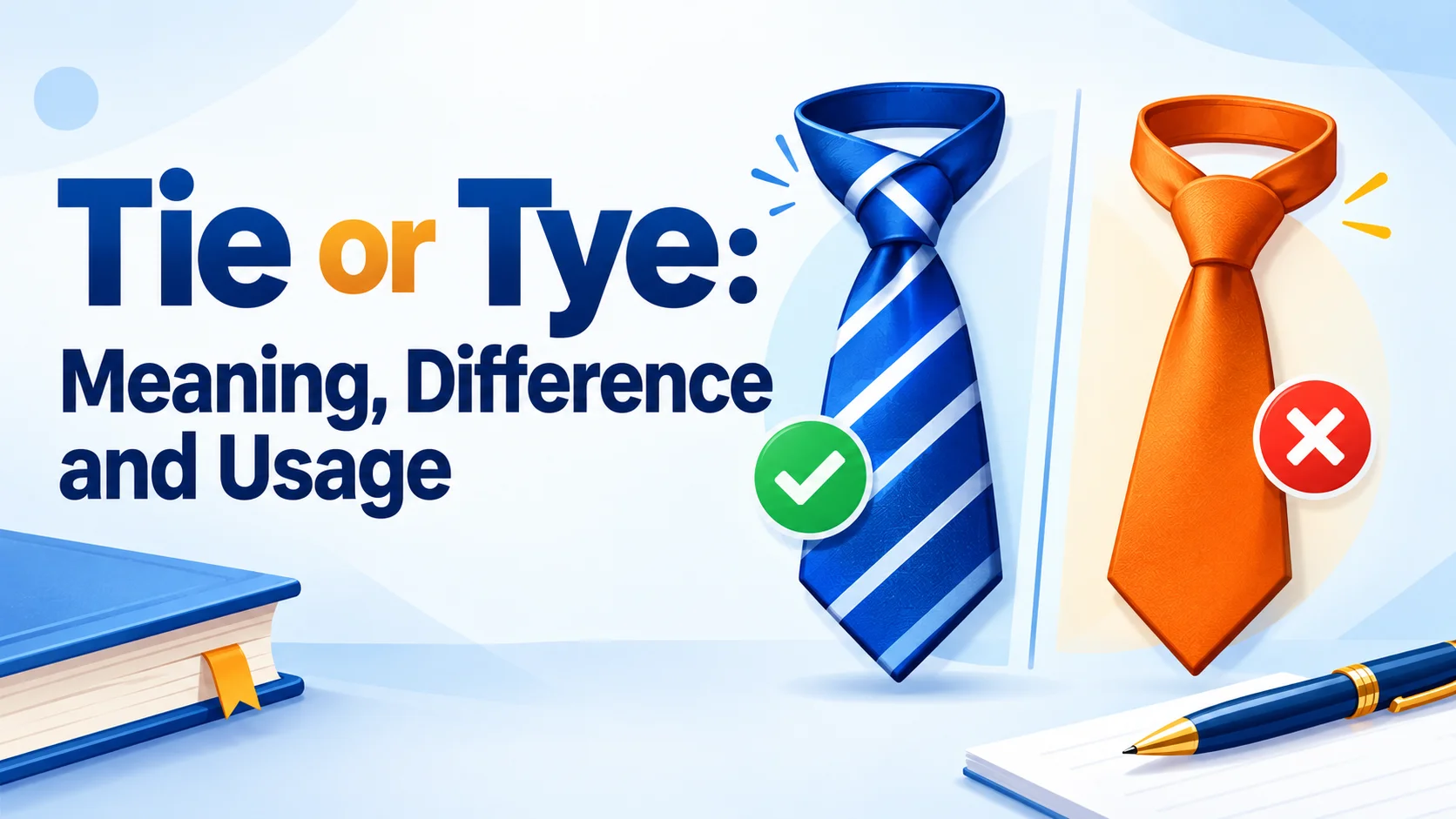
Tie or Tye can be confusing because both spellings are pronounced the same, but they do not have the same role in modern English. If you mean fastening your shoes, wearing something around your neck, connecting two things, or describing an equal score, tie is the spelling you want. Tye, meanwhile, survives in a handful of specialized, historical, dialectal, and proper-name contexts. Dictionaries still record tye as a real word in certain technical senses, so calling it “always wrong” is too simplistic.
The distinction matters most when you are writing something that other people will read—an email, school assignment, article, report, or professional document. A sentence such as “Please tye your shoes” is incorrect in standard modern English, while a technical text about ore washing or nautical equipment may legitimately contain tye. The pronunciation does not help you choose because both forms are pronounced /taɪ/, like buy or my. The spelling and context provide the answer.
This guide explains what tie means, what tye means, why the spellings are confused, when each form is appropriate, and which mistakes to avoid. You will also see practical examples involving clothing, sports, relationships, knots, technical terminology, names, and historical writing. By the end, you will have a simple rule for everyday English—and a clear understanding of the exceptions that make tye more than just a typo.
Tie or Tye: Which Spelling Is Correct?
For almost every ordinary modern-English situation, tie is correct.
Use tie when you mean:
- To fasten something with a knot, cord, string, or similar method
- To connect or attach things
- A piece of clothing worn around the neck
- An equal score or result in a competition
- A relationship or connection, such as family ties
- A physical fastening or connecting device
Examples:
- Please tie your shoelaces.
- He wore a blue tie.
- The match ended in a tie.
- They have strong family ties.
- Tie the package with string.
Tye is much less common. It is documented in dictionaries with specialized meanings, including a British term connected with mining, a nautical term for a rope or chain used in hoisting a yard, and some obsolete or dialectal meanings.
Simple rule: If you are writing ordinary modern English and mean “fasten,” “connect,” “necktie,” or “equal score,” choose tie.
That rule handles the overwhelming majority of situations without requiring you to memorize obscure vocabulary.
Tie vs Tye at a Glance
| Feature | Tie | Tye |
| Standard everyday English | Yes | No |
| Pronunciation | /taɪ/ | /taɪ/ |
| Used for shoelaces and knots | Yes | No |
| Used for neckwear | Yes | No |
| Used for equal scores | Yes | No |
| Used for relationships/connections | Yes | No |
| Historical usage | Yes | Yes |
| Nautical technical term | General word has many uses | Yes, specialized |
| Mining terminology | No special need | Yes, specialized British use |
| Dialectal usage | Common word | Yes, limited |
| Personal/place names | Possible | Possible |
| Safe choice for ordinary writing | Yes | Usually no |
The important point is that tie and tye are not interchangeable spellings of the same everyday word. Although historical sources show a connection between the forms, modern writers should not substitute tye for tie simply because the pronunciation is identical. Merriam-Webster, for example, gives tie a broad range of modern meanings while separately listing specialized definitions for tye.
What Does “Tie” Mean?
Tie is a highly versatile English word. It can function as both a verb and a noun, and its meanings extend far beyond shoelaces.
Tie as a Verb
As a verb, tie commonly means to fasten, attach, connect, or secure something.
Examples:
- Tie the ribbon around the box.
- She tied her hair back.
- He tied the rope to the post.
- Tie the two pieces together.
It can also describe creating a knot or bow:
- Tie a knot in the string.
- She tied a bow on the gift.
Another important meaning appears in sports and competitions. To tie means to reach the same score as another competitor or team.
For example:
The home team tied the score in the final minute.
The verb can also describe a connection in a broader sense:
- The agreement ties the two companies together.
- The evidence ties the events together.
- Family traditions tie generations together.
Merriam-Webster lists these meanings alongside the core sense of fastening or forming a knot.
Tie as a Noun
As a noun, tie can refer to several different things.
A Piece of Clothing
A tie can mean a necktie worn with formal or business clothing.
Example:
He wore a dark blue tie to the interview.
This is one of the most familiar uses of the word.
An Equal Result
In sports and competitions, a tie occurs when competing sides finish with equal scores.
Example:
The game ended in a 2–2 tie.
The exact rules vary by sport, of course. Some competitions use overtime or another method to produce a winner rather than allowing the result to remain tied.
A Connection or Relationship
A tie can also mean a relationship, bond, or connection.
Examples:
- Family ties can remain strong across generations.
- The two countries have close economic ties.
- She has strong ties to her hometown.
Here, the word has nothing to do with clothing or knots. The underlying idea is connection.
A Fastening or Connecting Object
In technical or practical contexts, tie can refer to something that holds parts together.
Examples include terms such as:
- cable tie
- tie-down
- structural tie
- railroad tie
The precise meaning depends on the field.
Common Uses of “Tie” in Everyday English
The easiest way to understand tie is to see how naturally it appears across different situations.
Clothing
His tie matched his shirt.
Shoelaces
Remember to tie your shoes before running.
Knots
Tie the rope securely.
Packaging
She tied the parcel with string.
Sports
The teams finished in a tie.
Relationships
They maintain close family ties.
Business
The companies have strong commercial ties.
Ideas and information
The final paragraph ties the main points together.
These examples show why replacing tie with tye creates problems. The ordinary word is deeply established across many areas of modern English.
What Does “Tye” Mean?
Here is where the simple “tye is just wrong” explanation falls short.
Tye is a real dictionary word in certain contexts, but it is uncommon and specialized. Merriam-Webster records multiple meanings, including a British term associated with washing ores, a nautical term for a rope or chain used in hoisting a yard, and obsolete or dialectal meanings.
Collins similarly records tye as a British dialect noun referring to a trough used in mining to separate valuable material from waste, as well as a related verb.
So the correct distinction is:
“Tye” is not the normal spelling of the everyday word “tie,” but “tye” does exist in specialized vocabulary.
Tye in Mining
One documented use of tye is related to historical British mining.
In this context, a tye refers to equipment or a trough used in the processing or washing of ore. The associated verb describes washing or separating ore using such a device.
This is not the vocabulary most people need in ordinary conversation. It is relevant mainly when reading historical, regional, mining, or technical material.
Tye in Nautical Terminology
Tye also has a specialized nautical meaning.
Merriam-Webster defines this tye as a chain or rope associated with a mast and yard, used with tackle to raise or lower a yard.
That means a sailor, maritime historian, or specialist studying older sailing terminology could encounter tye legitimately.
The crucial lesson is context. A technical document saying tye is not necessarily making a spelling mistake.
Tye as a Historical or Dialectal Word
Historical dictionaries also record tye in older or regional senses. One documented meaning concerns a piece of enclosed land, while another British dialectal meaning refers to a large pasture or common.
These meanings help explain why the spelling appears in historical texts and some geographical names.
Modern writers should not automatically replace every historical tye with tie. If you are quoting or discussing a historical source, the original spelling may be important evidence.
Is “Tye” a Misspelling of “Tie”?
Sometimes yes—but not always.
Consider these two sentences:
I need to tye my shoes.
Here, tye is almost certainly a spelling error. The writer means the ordinary verb tie.
Now consider a historical document discussing a nautical tye. In that context, changing the word to tie could remove the technical meaning.
This creates a useful three-part test:
- Everyday action? Use a tie.
- Ordinary object or concept? Use a tie.
- Historical, dialectal, technical, or proper-name context? Check whether tye is intentional.
That approach is more accurate than memorizing “tye is wrong.”
Why Do People Confuse Tie and Tye?
The biggest reason is simple: they sound the same.
Both are pronounced /taɪ/. This makes them homophones—or, more precisely in ordinary comparison, words with the same pronunciation but different spellings and uses.
When speaking, there is no audible difference between:
tie
and
tye
The listener has to infer the intended word from context.
Writing is different. Spelling provides information that pronunciation does not.
Names Add Another Layer of Confusion
Tye can also appear as a personal name or part of a proper name. If someone is named Tye, that spelling should be preserved.
For example:
Tye joined the team after lunch.
Changing the person’s name to Tie would obviously be incorrect.
The same principle applies to official place names, business names, historical names, and titles. Proper nouns follow their established spelling rather than the spelling rules you would apply to an ordinary vocabulary word.
Tie vs Tye: British and American English
A common misconception is that tye is the British version of tie.
It is not.
For ordinary modern English, both British and American English use tie.
Examples:
- British English: Please tie your shoes.
- American English: Please tie your shoes.
Likewise:
- British English: He wore a tie.
- American English: He wore a tie.
The existence of specialized British or dialectal meanings for tye does not turn it into a general British spelling of tie. Collins specifically labels one of its modern dictionary meanings as British dialect.
Important: Regional English differences do exist, but “tye” is not a standard British-American spelling difference for the everyday word “tie.”
The History Behind Tie and Tye
The relationship between these spellings is older than modern spelling rules.
Merriam-Webster traces tie back through Middle English forms including teg and tye, ultimately connecting it with Old English tēag. Its dictionary records the first known use of tie as a verb and noun as being before the 12th century.
This historical background explains why encountering tye in an old text does not necessarily mean the writer made a random typo.
English spelling was not always as standardized as it is today. Historical forms could vary, and some older spellings survived in specialized vocabulary, regional language, names, or technical terminology.
Over time, tie became the standard modern spelling for the common word.
That distinction is important: the historical relationship between tie and tye does not mean modern writers can use them interchangeably.
Tie vs Tye Examples in Sentences
Examples with “Tie”
Fastening:
Please tie the package securely.
Shoelaces:
I forgot to tie my shoelaces.
Clothing:
His black tie completed the formal outfit.
Sports:
The match ended in a tie.
Relationships:
The families have strong ties.
Connection:
The final chapter ties the story together.
Examples with “Tye”
Because tye is specialized, its examples depend on context.
Mining:
The historical text describes a tye used for washing ore.
Nautical terminology:
The sailor used the tye associated with the yard and tackle.
Proper name:
Tye submitted the form before the deadline.
Notice how different these examples are. The ordinary word tie appears naturally in daily life; tye generally requires a specific historical, technical, dialectal, or naming context.
Common Mistakes With Tie and Tye
Mistake 1: Writing “tye your shoes”
Incorrect:
I need to tye my shoes.
Correct:
I need to tie my shoes.
Mistake 2: Writing “tye” for a necktie
Incorrect:
He bought a new tye.
Correct:
He bought a new tie.
Mistake 3: Using “tye” for a sports result
Incorrect:
The teams finished in a tye.
Correct:
The teams finished in a tie.
Mistake 4: Assuming “tye” is simply a fancy spelling
It is not a stylistic alternative to tie. Using tye merely to make ordinary writing look unusual can make the sentence appear misspelled.
Mistake 5: Correcting a legitimate “Tye”
Not every occurrence of Tye should be changed.
If Tye is someone’s name, preserve it.
If it appears in a historical or technical source, investigate the context before editing it.
This is especially important for editors, students working with historical texts, and researchers who need to preserve source terminology accurately.
A Practical Decision Guide: Should You Write Tie or Tye?
Use this quick decision table when you are unsure:
| What do you mean? | Correct choice | Example |
| Fasten something | tie | Tie the rope. |
| Fasten shoelaces | tie | Tie your shoes. |
| Neckwear | tie | He wore a red tie. |
| Equal score | tie | The game was a tie. |
| Relationship | tie | Family ties matter. |
| Connect ideas | tie | The evidence ties the events together. |
| Historical technical term | tye, if the source uses it | A nautical tye |
| Historical mining term | tye, in the documented sense | A mining tye |
| Person’s name | Tye, if that is the person’s spelling | Tye arrived early. |
| Official place name | Tye, if officially spelled that way | Use the established name. |
Tie, Tied, Tying, and Ties: Related Forms
Once you know the base word, its common forms are straightforward.
Tie
I will tie the ribbon.
Tied
She tied the package yesterday.
Tying
He is tying his shoelaces.
Ties
Their family ties are strong.
One spelling detail deserves attention: tying is spelled with tying, not tyeing.
The final e of tie is removed before the -ing ending:
- tie → tying
- untie → untying
This is a common English spelling pattern and is unrelated to the existence of tye.
Merriam-Webster lists tied and tying as forms of the verb tie.
What About “Tie-Dye” and “Tye-Dye”?
The standard spelling of the craft and pattern is tie-dye.
The term uses tie because the process involves tying or binding portions of fabric before dyeing them, creating areas that resist or receive the dye differently.
So write:
She made a tie-dye shirt.
Not:
She made a tye-dye shirt.
The spelling tye-dye may occasionally appear because of the same spelling confusion discussed throughout this article, but it is not the standard spelling of the common English term.
Tie vs Tye in Formal and Professional Writing
For schoolwork, business communication, reports, applications, articles, and general professional writing, the safest approach is simple:
Use “tie” for the ordinary meaning.
For example:
The agreement will tie the two departments more closely together.
The candidate wore a conservative tie during the interview.
The final score was a tie.
Using tye in any of those sentences would distract the reader and may be marked as a spelling error.
There is, however, one professional exception: specialized terminology should be preserved when it is genuinely the correct term.
An editor working on a historical maritime document should not automatically replace every occurrence of tye. The same applies to technical historical material involving mining terminology.
Expert Editing Tip
When proofreading, don’t correct a word solely because it looks unfamiliar.
Instead, ask:
- Is this an ordinary English sentence?
- Is the word a person’s or place’s name?
- Is the document historical?
- Is the subject highly technical?
- Does a reliable dictionary support the unusual form?
That approach prevents both under-editing and over-editing.
A Simple Memory Trick for Tie or Tye
For everyday English, remember:
If you can tie it, wear it, or score it, spell it “tie.”
You can tie your shoes.
You can wear a tie.
A sports match can be a tie.
A family can have strong ties.
Tye should trigger a second thought:
“Is this a name, historical term, dialect word, or technical term?”
If the answer is no, tie is almost certainly what you need.
When Should You Check a Dictionary?
Most people will never need to look up tye. But there are situations where checking is worthwhile.
Use a dictionary or authoritative reference when:
- You are editing a historical document.
- You encounter tye in an old book.
- You are reading nautical terminology.
- You are researching historical mining.
- Tye appears as part of an unfamiliar place name.
- You are unsure whether it is a person’s name.
- A specialized field uses unusual terminology.
The reason to check is not that tye is common. It is that rare words can have precise meanings that ordinary spelling rules cannot resolve.
Conclusion
The difference between tie and tie becomes much easier once you separate ordinary English from specialized vocabulary. For everyday writing, tie is the standard spelling: you tie your shoes, wear a tie, tie objects together, describe family ties, and call an equal result a tie. Tye has a narrower life in historical, dialectal, nautical, mining, and proper-name contexts, so dismissing it as nothing more than a typo is not completely accurate. One final actionable tip: whenever you mean the familiar everyday word, choose tie without hesitation. A common mistake to avoid is assuming that because two words sound identical, their spellings can be exchanged. They cannot. Let the meaning and context guide your choice, and reserve tye for cases where the unusual spelling is genuinely established. In ordinary modern English, tie is the spelling you can trust.
FAQs
Q1. Is “tie” or “tye” the correct spelling?
For ordinary modern English, tie is the correct spelling. Use it for fastening objects, shoelaces, neckwear, equal scores, and connections. Tye has limited historical, dialectal, technical, and proper-name uses, so it should not be treated as a general replacement for tie.
Q2. Is “tye” a real English word?
Yes. Tye is a real but uncommon word. Dictionaries record specialized meanings, including a British mining term and a nautical term involving a rope or chain used for hoisting. It also occurs in historical and dialectal vocabulary. Therefore, it is more accurate to call tye rare or specialized than simply nonexistent.
Q3. Are “tie” and “tye” pronounced the same?
Yes. In the relevant English uses, both are pronounced /taɪ/. This is why they are easy to confuse when heard aloud. The difference becomes visible in writing, where context determines whether the standard word tie or a specialized/proper form tye is intended.
Q4. Is “tye” the British spelling of “tie”?
No. Tie is the normal spelling in both British and American English. Some dictionaries record tye as a British dialect word with specialized meanings, particularly in mining, but that does not make it the British spelling of the everyday word tie.
Q5. Should I write “tie-dye” or “tye-dye”?
Write tie-dye. It is the standard form of the name for the fabric-dyeing technique and resulting patterns. The word uses tie because sections of fabric are tied or bound before dyeing. If you are writing ordinary modern English, tie-dye is the form to choose.