

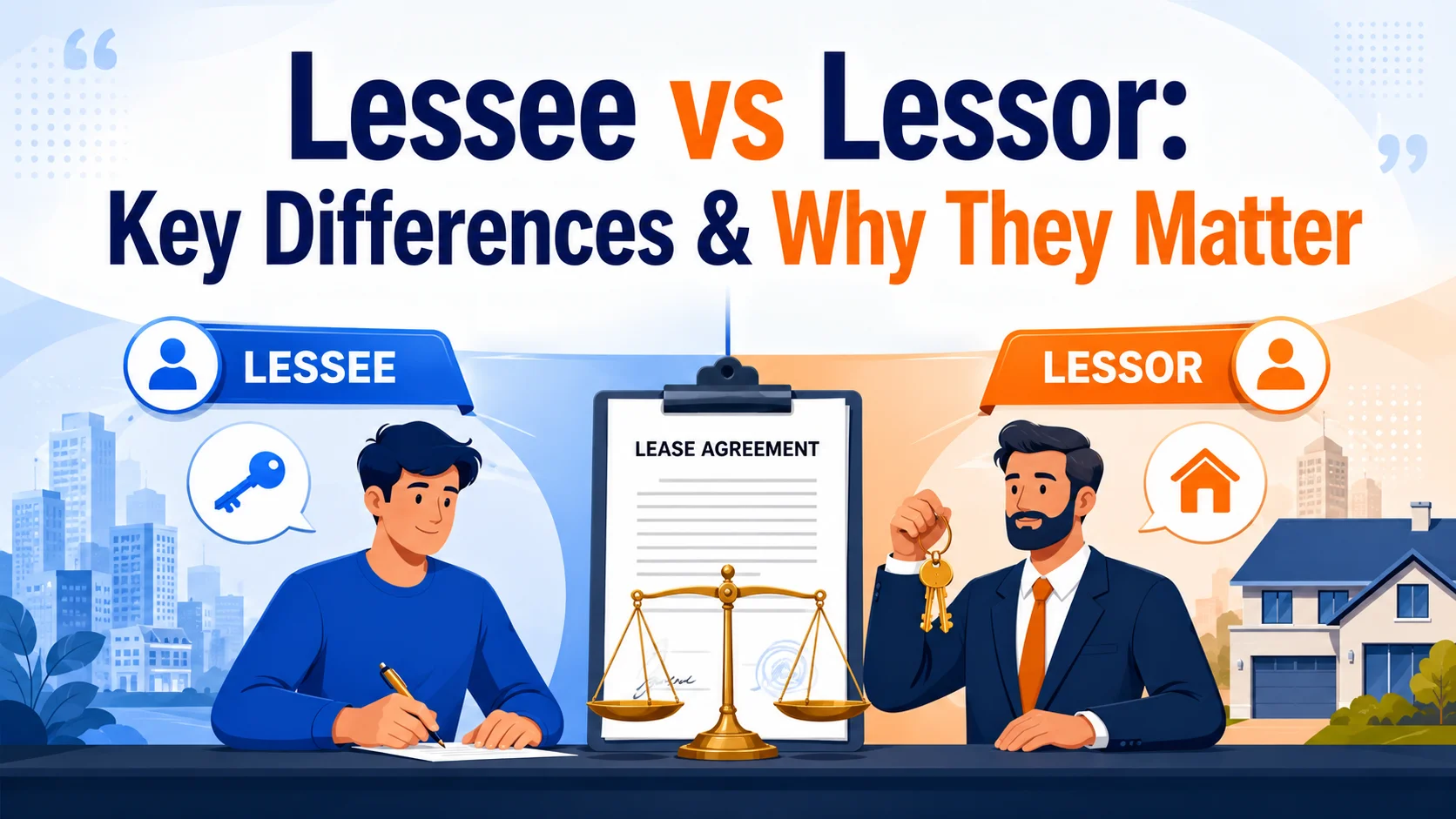
Lessee vs lessor can be confusing because the two words describe opposite sides of the same lease agreement. A lessee is generally the party that receives the right to use an asset, while a lessor is the party that provides that right in exchange for payments. Once you understand who uses the asset, who provides it, and who makes or receives the payments, the distinction becomes much easier.
These terms appear in rental agreements, commercial leases, vehicle contracts, equipment financing, property documents, and accounting records. They also appear in professional standards such as ASC 842, IFRS 16, and GASB 87, where identifying the lessee and lessor correctly is essential. A simple mistake can lead to confusion about ownership, payment obligations, accounting treatment, or contractual responsibilities.
This guide breaks the difference down in plain English. You’ll learn what each term means, how the roles work in real situations, how lessee vs lessor differs from tenant vs landlord, what happens in subleases, and why the distinction matters for accounting and legal documents. By the end, you should be able to identify either party quickly—even when the lease involves complicated business arrangements.
Lessee vs Lessor at a Glance
Before getting into the details, remember this simple rule:
The lessee uses the asset. The lessor provides the asset for use.
For example, imagine that a company rents an office building from a property owner. The company using the office is the lessee. The owner leasing the building to the company is the lessor.
The same relationship exists outside real estate. If a business leases a delivery van, the business is usually the lessee and the company providing the van is the lessor.
Quick Answer: Who Rents and Who Owns?
In the most common lease arrangement:
- Lessee: The party that obtains the right to use an asset.
- Lessor: The party that provides the asset for use under the lease.
- Lessee: Usually makes lease payments.
- Lessor: Usually receives lease payments.
- Lessor: Usually retains legal ownership, although ownership can depend on the specific arrangement.
- Lessee: Receives contractual rights to use the asset for an agreed period.
The key distinction is therefore right of use versus providing that right.
Simple Definition of Lessee
A lessee is a person or organization that enters into a lease to obtain the right to use an identified asset for a specified period.
In everyday language, the lessee is usually the renter.
For example:
Maria rents an apartment from a property owner. Maria is the lessee.
Or:
ABC Company leases a printer from an equipment provider. ABC Company is the lessee.
The lessee doesn’t necessarily own the asset. Instead, the lease gives the lessee certain rights to possess, access, or use it according to the contract.
Simple Definition of Lessor
A lessor is the person or organization that grants another party the right to use an asset under a lease.
In everyday language, the lessor is often the landlord or leasing provider.
For example:
A property owner rents an apartment to Maria. The property owner is the lessor.
A lessor may be an individual, company, financial institution, equipment leasing company, vehicle provider, or another organization.
One-Minute Memory Trick
If you keep mixing up the two words, use this shortcut:
Lessor = lets someone use something.
Lessee = uses something that has been leased.
Another useful question is:
“Who is receiving the right to use the asset?”
The answer is usually the lessee.
Ask:
“Who is granting that right?”
That party is the lessor.
What Is a Lessee?
The term lessee is especially common in legal, financial, and accounting documents because it precisely identifies the party receiving the right to use an asset.
Lessee Definition in Plain English
A lessee agrees to use an asset according to specific lease terms, typically in exchange for periodic payments.
The leased asset could be:
- An apartment
- A house
- An office
- Retail space
- A vehicle
- Construction equipment
- Manufacturing machinery
- Computers or other equipment
- Specialized business assets
The lease determines exactly what the lessee can do with the asset and what obligations come with using it.
What Rights Does a Lessee Have?
A lessee’s rights depend on the contract, but may include the right to:
- Use the asset during the lease term
- Occupy leased property
- Operate equipment
- Use a vehicle
- Access specified facilities
- Receive agreed services connected to the lease
- Renew the lease if a renewal option exists
- End the agreement if permitted by its terms
The lessee’s rights aren’t unlimited. A residential tenant, for example, may not be allowed to make major structural changes to a property.
Similarly, a company leasing specialized machinery may be required to operate it only for approved purposes.
What Responsibilities Does a Lessee Have?
Common lessee responsibilities include:
- Making lease payments on time
- Following the lease agreement
- Maintaining the asset when required
- Avoiding unauthorized use
- Complying with applicable rules
- Reporting damage when required
- Returning the asset when the lease ends, if applicable
The exact obligations depend on the contract.
Does a Lessee Own the Leased Asset?
Usually, no.
A lessee normally receives a right to use an asset rather than immediate legal ownership.
However, some arrangements contain purchase options or ownership-transfer provisions. For example, a lease may eventually allow the lessee to purchase the asset.
That is why it is risky to treat every lease as identical.
Common Examples of Lessees
A lessee could be:
- A person renting an apartment
- A company renting office space
- A restaurant leasing a storefront
- A business leasing vehicles
- A manufacturer leasing machinery
- A government agency using leased property
- A retailer leasing commercial equipment
The common factor is that the party receives the right to use an asset under a lease.
What Is a Lessor?
The lessor occupies the opposite side of the lease relationship.
Lessor Definition in Plain English
A lessor is the party that provides an asset or grants another party the right to use an asset for an agreed period.
The lessor typically receives payments from the lessee.
For example:
A company owns a fleet of vehicles and leases one to another business. The vehicle leasing company is the lessor.
What Rights Does a Lessor Have?
Depending on the contract and applicable law, the lessor may have rights involving:
- Receiving lease payments
- Enforcing lease conditions
- Inspecting the asset under permitted circumstances
- Recovering an asset after lease termination
- Taking action when the lessee defaults
- Receiving compensation for certain damages
- Enforcing renewal or termination provisions
A lessor’s rights aren’t unlimited either. Lease agreements operate within applicable laws and regulations.
What Responsibilities Does a Lessor Have?
Depending on the lease, a lessor may be responsible for:
- Providing access to the leased asset
- Maintaining certain aspects of the property or equipment
- Meeting contractual obligations
- Handling specified repairs
- Maintaining ownership records
- Providing required notices
- Complying with applicable legal requirements
A commercial lease might assign maintenance differently from a residential lease, so the contract matters.
Does the Lessor Always Own the Asset?
Not necessarily in every legal or financial structure.
The lessor is generally the party granting the right to use an asset, and often owns the underlying asset. However, more complex arrangements can involve intermediaries, financing structures, or subleases.
For ordinary rental situations, though, thinking of the lessor as the owner or leasing provider is a useful starting point.
Common Examples of Lessors
A lessor may be:
- A homeowner
- A commercial property owner
- A vehicle leasing company
- An equipment financing company
- A manufacturer
- A financial institution
- A government entity
- A business that owns assets and leases them to others
Lessee vs Lessor: What Is the Difference?
The easiest way to understand lessee vs lessor is to focus on the direction of the lease relationship.
The lessee receives the right to use the asset.
The lessor grants the right to use the asset.
The Core Difference in One Sentence
The lessee rents or uses the asset; the lessor leases or provides the asset.
Ownership vs Right of Use
Ownership and use are not automatically the same thing.
Someone can legally own a building while another party has a contractual right to occupy it.
For instance, a property owner may retain ownership of an office building while a business has the right to operate there for five years.
That distinction becomes particularly important in accounting because modern lease accounting focuses heavily on the right to use an identified asset rather than simply asking who owns it.
Payments: Who Pays and Who Receives?
In a standard lease:
- The lessee pays.
- The lessor receives.
The payments may be monthly, quarterly, annually, or structured differently.
Additional charges can also exist, such as maintenance costs, taxes, insurance, service fees, or variable payments.
Possession, Control, and Use of the Asset
The lessee generally receives contractual rights associated with using the asset during the lease period.
The lessor retains rights that the contract and applicable law reserve for the asset owner or provider.
This is why the phrase “right to use” is so important. It helps distinguish leasing from an outright purchase.
What Happens When the Lease Ends?
Depending on the agreement, the asset may:
- Return to the lessor
- Be renewed for another term
- Be purchased by the lessee
- Be replaced
- Continue under a modified agreement
Never assume that every lease ends the same way. Check the termination and renewal provisions.
Lessee vs Lessor Comparison Table
| Feature | Lessee | Lessor |
| Basic role | Receives the right to use an asset | Grants the right to use an asset |
| Everyday equivalent | Renter | Landlord or leasing provider |
| Lease payments | Usually makes payments | Usually receives payments |
| Uses the asset | Yes | Usually does not use it under the lease |
| Legal ownership | Usually does not receive immediate ownership | Often retains ownership |
| Main concern | Access, use, and lease obligations | Asset, income, and lease obligations |
| Contract position | User of leased asset | Provider of leased asset |
| End of lease | May return, renew, or purchase | May recover, renew, or sell the asset |
How a Lease Relationship Works From Start to Finish
A lease isn’t simply a payment arrangement. It creates a set of rights and responsibilities that operate throughout the contract.
1: The Lessor Provides Access to the Asset
The lessor makes the identified asset available according to the lease.
For real estate, that could mean providing possession of an apartment or office.
For equipment, it could mean delivering machinery that the lessee is permitted to operate.
2: The Lessee Accepts the Lease Terms
The lessee agrees to the conditions, which may cover:
- Lease term
- Payment amount
- Security requirements
- Permitted use
- Maintenance
- Insurance
- Renewal options
- Termination provisions
3: Lease Payments Are Made
The lessee makes payments according to the agreed schedule.
The lessor records or receives those payments according to the applicable contractual and accounting requirements.
4: Both Parties Follow Their Contractual Duties
This is where many real-world disputes arise.
A lease might assign responsibility for repairs to one party while assigning insurance or operating expenses to the other.
The signed agreement controls those responsibilities, subject to applicable law.
5: The Lease Is Renewed, Modified, or Terminated
At the end of the original term, the parties may:
- Renew the lease
- Negotiate new terms
- Modify the agreement
- Return the asset
- Exercise a purchase option
- End the relationship
Lessee vs Lessor in Different Types of Leases
The same basic roles appear across many types of leases, but the practical details can differ considerably.
Residential Real Estate Leases
A person renting a home or apartment is generally the lessee, while the property owner or leasing party is the lessor.
The agreement may address rent, security deposits, repairs, utilities, occupancy, pets, renewal, and termination.
Commercial Property Leases
A business leasing an office, warehouse, restaurant, or retail space is generally the lessee.
The property owner or leasing entity is the lessor.
Commercial agreements can be more complex because they may include operating expenses, insurance requirements, maintenance provisions, property taxes, and other charges.
Vehicle Leases
A person or company obtaining the use of a vehicle through a lease is the lessee.
The vehicle provider is the lessor.
The contract may establish mileage limits, maintenance responsibilities, damage standards, payment terms, and end-of-lease options.
Equipment Leases
Businesses frequently lease machinery, computers, medical equipment, construction equipment, or other specialized assets.
The business using the equipment is the lessee. The company providing it is the lessor.
Finance and Capital Leases
Some leases are structured so that the economic characteristics resemble ownership more closely than a straightforward rental.
Accounting treatment depends on the applicable standard and the facts of the arrangement.
This is one reason you shouldn’t assume that the everyday meaning of “renter” completely describes the accounting position of a lessee.
Operating Leases
Operating leases are another important category in accounting.
The classification and accounting requirements depend on the applicable accounting framework, so businesses should evaluate the actual arrangement rather than relying on the label used in a contract.
Subleases and Sublessor/Sublessee Relationships
A sublease introduces another layer.
Suppose Company A leases an office from Company B but later leases part of that office to Company C.
Company A may become a sublessor in relation to Company C while remaining the lessee in relation to Company B.
This means one organization can hold different lease roles at the same time.
A Practical Example of Lessee and Lessor
Example: Renting an Apartment
Suppose James signs a two-year apartment lease with a property owner.
James:
- Receives the right to live in the apartment.
- Makes monthly rent payments.
- Must follow the lease conditions.
- Is the lessee.
The property owner:
- Provides the apartment for James’s use.
- Receives rent.
- Retains ownership of the property.
- Is the lessor.
The distinction remains straightforward even though both parties have rights and responsibilities.
Example: Leasing a Company Vehicle
Imagine a delivery company leases ten vans from a vehicle leasing provider.
The delivery company is the lessee because it receives the right to use the vans.
The leasing provider is the lessor because it provides those vehicles under the lease.
The agreement might also determine who pays for routine maintenance, insurance, registration, repairs, and excess mileage.
Example: Leasing Office Equipment
A company leases high-end printers for its corporate office.
The company using the printers is the lessee.
The equipment provider is the lessor.
The arrangement could include service and maintenance obligations, making the contract more than a simple monthly payment for equipment.
What Each Party Records and Receives
The economic effect differs by role.
The lessee generally has an obligation to make lease payments and, under applicable accounting standards, may recognize lease-related assets and liabilities.
The lessor generally recognizes lease income or other accounting effects based on the nature and classification of the lease.
Lessee and Lessor Responsibilities: Who Handles What?
There isn’t one universal responsibility list because lease agreements vary.
| Responsibility | Often Associated With | Depends on Contract? |
| Regular lease payments | Lessee | Yes |
| Receiving lease payments | Lessor | Yes |
| Basic use of asset | Lessee | Yes |
| Structural property repairs | Lessor | Often |
| Routine maintenance | Either party | Yes |
| Insurance | Either party | Yes |
| Property taxes | Either party | Yes |
| Returning leased asset | Lessee | Usually |
| Enforcing lease terms | Lessor | Subject to law and contract |
Rent or Lease Payments
The lessee is normally responsible for making the required payments.
A missed payment can trigger contractual consequences, depending on the agreement and applicable law.
Repairs and Maintenance
This is one of the most frequently misunderstood areas.
A residential landlord might handle major structural repairs while the tenant handles minor upkeep.
A commercial lease can allocate responsibilities very differently.
Always read the maintenance clause instead of assuming.
Insurance
Insurance obligations can fall on either party or both.
A business leasing commercial property may be required to maintain liability insurance, while the property owner maintains coverage related to the building.
Taxes and Operating Costs
Commercial leases can include provisions concerning property taxes, utilities, common-area expenses, or other operating costs.
These terms can substantially affect the actual cost of leasing.
Damage, Default, and Contract Violations
Both parties may have obligations when something goes wrong.
The lessee may be responsible for damage caused by improper use, while the lessor may have responsibilities related to the condition of the underlying property.
The contract and applicable law determine the consequences.
Returning the Asset at the End of the Lease
Many leases require the lessee to return the asset in an agreed condition.
Vehicle leases, for example, may establish standards for excessive wear and damage.
Lessee vs Lessor in Lease Accounting
The difference becomes especially important when you’re dealing with business financial statements.
Why Accounting Treatment Differs by Role
A lessee and lessor experience the same lease from opposite financial perspectives.
The lessee obtains a right to use an asset and typically has payment obligations.
The lessor provides the asset and earns income or otherwise accounts for the lease based on the applicable framework.
Lessee Accounting Under ASC 842
Under ASC 842, the U.S. GAAP lease standard, lessees generally recognize a right-of-use asset and a lease liability for leases, subject to the standard’s requirements and exceptions.
This is important because a lease is no longer simply treated as a series of rent payments for many accounting purposes.
The classification and measurement requirements depend on the facts and circumstances.
Lessor Accounting Under ASC 842
Lessor accounting follows a different framework because the lessor is providing the right to use the underlying asset.
The accounting depends on the lease classification and other relevant factors.
The lessor therefore doesn’t simply mirror the lessee’s accounting.
Lessee Accounting Under IFRS 16
IFRS 16 generally uses a lessee model in which lessees recognize a right-of-use asset and lease liability for most leases, subject to specified exemptions.
This can significantly affect a company’s balance sheet compared with older approaches to lease accounting.
Lessor Accounting Under IFRS 16
Lessor accounting under IFRS 16 retains distinctions between different types of leases.
The lessor’s accounting depends on whether the arrangement is classified as an operating lease or finance lease.
Government Lease Accounting Under GASB 87
Government entities may apply GASB 87, which establishes lease accounting requirements for state and local governments within its scope.
The terminology remains useful here: identifying the party obtaining the right to use the asset and the party providing that right is foundational to understanding the accounting relationship.
Right-of-Use Assets and Lease Liabilities
One of the most important concepts for beginners is the right-of-use asset.
It doesn’t necessarily mean the lessee owns the underlying asset.
Instead, it represents the lessee’s accounting recognition of its right to use the asset during the lease term.
That distinction is critical:
A right-of-use asset is not the same thing as legal ownership of the underlying asset.
When Accounting Treatment Depends on the Lease
Don’t determine accounting treatment solely by asking, “Who owns the property?”
You may also need to consider:
- Lease classification
- Lease term
- Payment structure
- Purchase options
- Transfer provisions
- Underlying asset
- Discount rate
- Modifications
- Exemptions
- Applicable accounting framework
For complex arrangements, professional accounting guidance should be applied to the specific facts.
Legal and Contractual Differences Between a Lessee and Lessor
A lease is a contractual relationship, so the exact rights of each party depend on the agreement and applicable law.
Lease Agreement Rights and Obligations
A well-drafted lease typically identifies:
- The parties
- The asset
- Lease term
- Payment requirements
- Permitted use
- Maintenance obligations
- Insurance requirements
- Default provisions
- Termination conditions
- Renewal options
Default and Breach of Contract
If a lessee fails to make required payments, the lessor may have contractual remedies.
Likewise, if a lessor fails to satisfy important obligations, the lessee may have remedies under the contract or applicable law.
The consequences vary by jurisdiction and agreement.
Renewal and Termination Rights
A renewal option can significantly affect both parties.
A lessee may want continuity, while a lessor may want flexibility to regain control of the asset.
Don’t overlook renewal clauses when evaluating the real cost or benefit of a lease.
Security Deposits and Guarantees
Some leases require security deposits or guarantees to protect the lessor against certain losses.
These provisions are especially common in property leasing but can appear in other arrangements.
Restrictions on Assignment and Subleasing
A lessee may not automatically have the right to transfer the lease to another party.
The agreement may require the lessor’s consent before an assignment or sublease occurs.
Common Lessee vs Lessor Misconceptions
“The Lessee Owns the Property”
Usually false.
The lessee generally receives a right to use the asset rather than immediate legal ownership.
“The Lessor Is Always the Person Who Uses the Asset”
No.
The lessor generally grants another party the right to use the asset.
“Lessee and Tenant Always Mean Exactly the Same Thing”
They are closely related in ordinary property rentals, but lessee is a broader and more formal term.
A lessee can lease equipment, vehicles, machinery, or other assets—not just real estate.
“Every Lease Has the Same Accounting Treatment”
Definitely not.
Accounting treatment can depend on the applicable framework and the specific characteristics of the lease.
“The Lessor Is Always an Individual Owner”
No.
A lessor can be a corporation, financial institution, equipment company, government entity, or other organization.
“A Lease Automatically Transfers Ownership”
A lease and a purchase are different transactions.
Some leases may contain purchase options or ownership-transfer provisions, but the existence of a lease does not by itself mean ownership has transferred.
Lessee vs Lessor vs Tenant vs Landlord
These terms overlap, but they’re not interchangeable in every situation.
Is a Lessee the Same as a Tenant?
For many residential and commercial property arrangements, yes in practical terms.
A tenant is commonly a person or business renting property, while lessee is the more formal legal or contractual term.
Is a Lessor the Same as a Landlord?
Often, but not always.
A landlord is generally someone who rents property to a tenant.
A lessor can provide non-real-estate assets, such as vehicles or machinery.
When Are These Terms Used Outside Real Estate?
“Lessee” and “lessor” are particularly useful when discussing:
- Equipment
- Vehicles
- Aircraft
- Machinery
- Technology
- Commercial assets
- Property
- Specialized business assets
Why Legal and Accounting Documents Prefer “Lessee” and “Lessor”
These terms clearly identify each side of the contractual relationship.
“Renter” and “owner” can be too informal or incomplete when an agreement involves complex rights and obligations.
Lessee, Lessor, Sublessee, and Sublessor Explained
A sublease can make the terminology seem complicated.
What Is a Sublease?
A sublease occurs when a lessee grants another party a right to use all or part of the leased asset, subject to the original lease and applicable requirements.
Who Is the Sublessor?
The original lessee becomes the sublessor when it leases the asset or part of it to another party.
Who Is the Sublessee?
The new party receiving the right to use the asset is the sublessee.
How the Roles Change in a Sublease
Consider this structure:
Original owner → Lessee → Sublessee
The original owner is the lessor to the first party.
The first party remains the lessee under the original agreement but may become the sublessor under the new arrangement.
The new user becomes the sublessee.
This is why a single business can simultaneously be a lessee and sublessor.
Common Mistakes When Reading Lease Documents
Confusing Ownership With the Right to Use
A lease gives a party contractual rights to use an asset, but that doesn’t automatically make the party its owner.
Ignoring Additional Lease Costs
Don’t look only at the headline rent.
Review provisions involving:
- Maintenance
- Utilities
- Taxes
- Insurance
- Service charges
- Fees
- Repairs
The total economic cost may be very different from the base payment.
Overlooking Renewal or Termination Clauses
A low initial payment may become less attractive if renewal terms, escalation clauses, or termination costs are significant.
Misunderstanding Maintenance Responsibilities
Never assume that “the owner handles repairs” or “the renter handles everything.”
The agreement should tell you who is responsible.
Failing to Identify the Actual Contracting Parties
A property owner, management company, leasing company, and payment processor may all appear in the same arrangement.
The party receiving payments isn’t necessarily the only relevant party.
How to Quickly Identify the Lessee and Lessor in a Contract
When you’re reading a lease and the terminology isn’t obvious, use this checklist.
Look for the Party Providing the Asset
Who is making the property, vehicle, equipment, or other asset available?
That party is generally the lessor.
Look for the Party Making Payments
Who has the obligation to make lease payments?
That party is generally the lessee.
Check the Defined Terms Section
Many professional contracts explicitly define terms such as:
- “Lessor”
- “Lessee”
- “Landlord”
- “Tenant”
- “Sublessor”
- “Sublessee”
The definitions section should take priority over assumptions based on everyday language.
Confirm the Names on the Signature Page
The signature page can help verify who actually entered into the agreement.
However, don’t rely on the signature page alone. Read the defined terms and operative clauses as well.
Choosing the Right Term in Your Writing
When to Use “Lessee”
Use lessee when you’re discussing the party receiving the right to use a leased asset, especially in:
- Contracts
- Accounting documents
- Legal writing
- Financial reports
- Business discussions
When to Use “Lessor”
Use lessor for the party granting the right to use the asset.
When “Tenant” and “Landlord” Are More Natural
For ordinary housing conversations, tenant and landlord usually sound more natural.
For example:
“The tenant paid the rent.”
is more conversational than:
“The lessee paid the lease consideration.”
Both may be understandable, but context determines which sounds appropriate.
Why Precision Matters in Legal and Financial Writing
In professional documents, a small terminology error can create unnecessary ambiguity.
If you’re describing a contract, make sure you’re identifying the correct party based on the actual rights and obligations—not simply based on who appears to own the asset.
A Simple Decision Guide: Which Term Should You Use?
| If the party… | Use this term |
| Receives the right to use an asset | Lessee |
| Grants the right to use an asset | Lessor |
| Rents residential property | Tenant or lessee |
| Owns and rents out residential property | Landlord or lessor |
| Leases equipment from a provider | Lessee |
| Provides equipment under a lease | Lessor |
| Leases an asset to another party under a sublease | Sublessor |
| Receives rights under a sublease | Sublessee |
Conclusion
Understanding lessee vs lessor becomes much easier when you focus on the direction of the lease relationship. The lessee receives the right to use an asset, while the lessor grants that right. In a typical arrangement, the lessee makes payments and the lessor receives them, while ownership usually remains with the lessor unless the agreement provides otherwise. The distinction matters far beyond vocabulary. It affects contracts, property relationships, business decisions, subleases, and lease accounting under frameworks such as ASC 842 and IFRS 16. If you’re reading a lease, don’t rely on assumptions. Identify who receives the right of use, who provides it, and what each party has agreed to do. One final actionable tip: when you’re unsure, find the defined terms in the lease and trace each party’s rights and obligations. A common mistake to avoid: never assume that the person using an asset is automatically its owner. In leasing, use and ownership are two different concepts.
Frequently Asked Questions
Q1. Is the lessee the owner of the leased property?
No. A lessee generally receives the right to use an asset rather than legal ownership of it. The lessor often retains ownership throughout the lease. However, some agreements contain purchase or ownership-transfer provisions, so the contract should always be checked before drawing a final conclusion.
Q2. Is the lessee the renter or tenant?
Yes, in many everyday property situations. A lessee is essentially the party renting or using an asset under a lease. “Tenant” is more common in ordinary conversations about property, while “lessee” is frequently used in formal legal, financial, and accounting contexts.
Q3. Is the lessor the landlord?
Usually, when discussing real estate. A landlord is generally a type of lessor because the landlord grants a tenant the right to use property. However, “lessor” is broader and can refer to someone leasing vehicles, equipment, machinery, or other assets.
Q4. Who pays the lease: the lessee or the lessor?
The lessee normally makes the lease payments, while the lessor normally receives them. However, a lease may include other payments or cost-sharing arrangements involving maintenance, insurance, taxes, utilities, or services. The complete contract determines who is responsible for each specific expense.
Q5. Can a lessee become the owner of the leased asset?
Yes, in some arrangements. A lease may include a purchase option or another provision that can result in ownership transferring to the lessee. But a standard lease does not automatically transfer ownership. You must examine the agreement’s purchase, transfer, and termination provisions.