

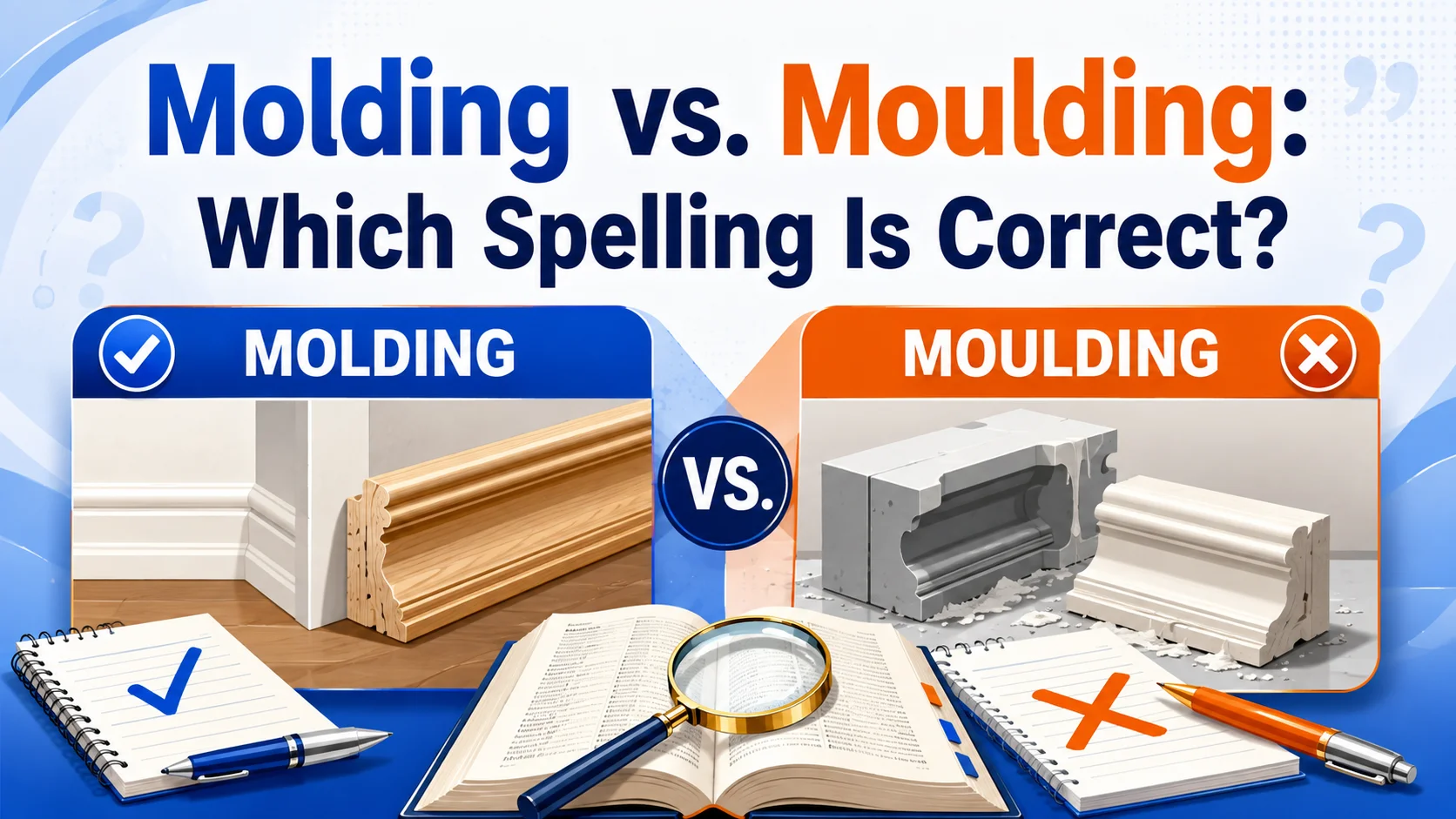
Molding and moulding are two spellings of the same word, but the version you should use depends largely on which variety of English you’re writing in. In American English, molding is the standard form; in British English, moulding is standard. The difference is not normally one of meaning. Both can describe the process of shaping material, a shaped object, decorative architectural trim, or the figurative act of influencing someone’s development.
The confusion becomes more noticeable because molding appears in several industries. A homeowner might ask about crown molding, while a manufacturer may discuss injection molding. A British writer would typically use crown moulding and injection moulding instead. The same regional distinction extends to related forms such as mold/mould and molded/moulded.
So, if you’re writing for a U.S. audience, use molding. If you’re following British English, use moulding. Neither is an inherently “wrong” spelling. The important thing is to match your audience and remain consistent throughout your writing. This guide explains the difference, where each form appears, how the words are pronounced, and which spelling to choose in construction, manufacturing, and everyday writing.
Molding vs. Moulding at a Glance
| Feature | Molding | Moulding |
| Main variety | American English | British English |
| Meaning | Same core meanings | Same core meanings |
| Pronunciation | Generally /ˈmoʊldɪŋ/ in U.S. English | Generally /ˈməʊldɪŋ/ in UK English |
| Decorative trim | Crown molding | Crown moulding |
| Manufacturing | Injection molding | Injection moulding |
| Related base word | mold | mould |
| Related past form | molded | moulded |
| Is it correct? | Yes | Yes |
| Best choice for U.S. readers | Yes | Usually no |
| Best choice for UK readers | Usually no | Yes |
Quick rule: American English → molding. British English → moulding.
Why Are There Two Spellings?
The difference is part of a much larger pattern in English: American and British English sometimes use different spellings for the same word.
You can see similar differences in:
- color / colour
- labor / labour
- center / centre
- neighbor / neighbour
- theater / theatre
Mold/mould belongs to this family of regional spelling differences.
Why Does American English Drop the “U”?
American spelling was influenced by efforts to establish a more distinct and simplified national spelling tradition. Noah Webster played an important role in promoting several American spellings, and mold became established as the American form.
That doesn’t mean Americans created a completely different word. Rather, mold and mould developed as regional spelling variants, with American usage favoring the shorter form.
The same pattern carries into the related forms:
- mold → molding
- mould → moulding
- molded → moulded
This is why changing only one word in the family can create an inconsistent-looking document.
What Does “Molding” Mean in American English?
Molding has several related meanings. The right interpretation depends on the context.
Molding as the Act of Shaping Something
In its broadest sense, molding refers to shaping or forming something into a particular form.
For example:
- “She was molding the clay into a small bowl.”
- “The machine is molding the plastic into panels.”
- “The artist spent hours molding the wax by hand.”
The underlying idea is simple: something flexible, soft, molten, or otherwise workable is given a particular shape.
Molding as a Manufacturing Process
In manufacturing, molding refers to processes in which material is shaped using a mold or similar forming method.
Manufacturers may mold:
- plastic
- rubber
- resin
- metal
- ceramic materials
- composite materials
The exact manufacturing method varies, but the central concept remains forming material into a desired shape.
For example:
“The manufacturer uses injection molding to produce plastic housings.”
Here, molding refers to an industrial production process rather than decorative trim.
Molding as Decorative Architectural Trim
This is one of the meanings most likely to cause confusion for homeowners, builders, and interior-design readers.
In architecture and interior design, molding is a shaped strip or profile used for decoration or finishing.
It can appear around:
- ceilings
- walls
- doors
- windows
- furniture
- fireplaces
- wall panels
Examples include crown molding, base molding, casing, and other decorative profiles.
For example:
“The room has traditional wood molding around the windows.”
Molding as a Figurative Idea
The word can also be used metaphorically.
Consider:
“Her childhood experiences helped mold her personality.”
Here, nobody is physically shaping anything. Mold means to influence or shape someone’s development.
That produces the related form:
“Her childhood experiences were important in molding her personality.”
The physical and figurative meanings are connected by the same basic idea: giving something a particular form.
Molding as a Noun and Verb Form
Molding can function as a noun or as a form of the verb mold.
Verb:
“The technician is molding the plastic component.”
Noun:
“The room has decorative molding around the ceiling.”
The spelling remains molding in both cases in American English.
What Does “Moulding” Mean?
Moulding has the same core meanings as molding. The main distinction is that moulding is the conventional British spelling.
Moulding in British English
A British writer might say:
- “The house has original ceiling moulding.”
- “The carpenter repaired the door moulding.”
- “The company specializes in injection moulding.”
- “The experience helped in moulding his character.”
None of these uses represents a different concept from the corresponding American forms.
Moulding in Construction and Interior Design
British architectural writing may use moulding for decorative shaped material around a building’s interior or exterior features.
For example:
“The original Victorian moulding was carefully restored.”
The spelling reflects British English rather than a different architectural technique.
Moulding in Manufacturing
British technical writing also retains the ou:
- injection moulding
- blow moulding
- compression moulding
- rotational moulding
So the regional spelling difference isn’t limited to interior design. It carries into technical and industrial terminology as well.
Molding vs. Moulding: Do They Mean the Same Thing?
Yes, in ordinary usage they have the same fundamental meanings.
The spelling itself doesn’t normally tell you whether the word refers to architecture, manufacturing, crafts, or personal development. Context does.
Compare:
“The molding around the door needs to be replaced.”
with:
“The moulding around the door needs to be replaced.”
The meaning is essentially identical. The spelling simply signals a different regional convention.
Likewise:
“The company uses injection molding.”
and:
“The company uses injection moulding.”
Both describe the same general manufacturing concept.
The Important Distinction Is Regional, Not Semantic
| Meaning or Context | American English | British English |
| Shaping material | molding | moulding |
| Decorative trim | molding | moulding |
| Manufacturing process | molding | moulding |
| Figurative influence | molding | moulding |
| Shaped decorative piece | molding | moulding |
This is why treating molding and moulding as two separate vocabulary words can make the issue seem more complicated than it really is.
Molding vs. Moulding in Construction and Architecture
Construction is one area where the choice is especially visible.
Crown Molding or Crown Moulding?
For a U.S. audience:
The living room has new crown molding.
For a British audience:
The living room has new crown moulding.
Both are correct within their respective spelling systems.
Crown molding/moulding generally refers to decorative trim installed where a wall meets a ceiling. The exact profile and design can vary considerably.
Other architectural uses include:
- base molding/moulding
- door molding/moulding
- window molding/moulding
- wall molding/moulding
- picture-frame molding/moulding
Baseboard Molding and Related Terminology
Regional differences sometimes extend beyond spelling.
For example, American English commonly uses baseboard, while British English commonly uses skirting board.
That means a British construction document isn’t always created simply by replacing every mold with mould. The terminology itself can differ.
This is an important point for translators, editors, and businesses:
Regional English is about more than individual spelling changes.
If you’re localizing construction content, check the vocabulary used by your target market rather than performing a mechanical letter substitution.
Door and Window Molding
In American English, you may see descriptions such as:
- door casing
- window casing
- decorative molding
- trim molding
British sources may use somewhat different terminology alongside moulding.
For professional writing, the best approach is to use the terminology your intended industry and audience actually recognize.
Injection Molding or Injection Moulding?
This is one of the most common practical questions.
American English: Injection Molding
In the United States, write:
injection molding
Example:
“The manufacturer uses injection molding to produce plastic housings.”
British English: Injection Moulding
In British English, write:
injection moulding
Example:
“The manufacturer uses injection moulding to produce plastic housings.”
The process hasn’t changed. Only the spelling convention has.
Common Manufacturing Variants
| American English | British English |
| injection molding | injection moulding |
| blow molding | blow moulding |
| compression molding | compression moulding |
| rotational molding | rotational moulding |
| molded plastic | moulded plastic |
| molding machine | moulding machine |
Should Technical Writers Care?
Absolutely.
In engineering, manufacturing, procurement, and product documentation, consistent terminology matters. A document that switches randomly between molding and moulding can look poorly edited even though both forms are legitimate.
If the document is written for an American manufacturer, use the American forms throughout. If it’s for a British engineering audience, follow British usage.
Molding vs. Moulding in Everyday Writing
You don’t need a specialized industry to encounter these words.
American English Examples
- “We replaced the old crown molding.”
- “The factory specializes in plastic molding.”
- “The experience helped mold her thinking.”
- “The contractor installed decorative wall molding.”
- “The machine is used for injection molding.”
British English Examples
- “We replaced the old crown moulding.”
- “The factory specializes in plastic moulding.”
- “The experience helped mould her thinking.”
- “The contractor installed decorative wall moulding.”
- “The machine is used for injection moulding.”
Notice that the regional difference also affects the base verb:
- American: mold
- British: mould
The derived form follows the same spelling pattern.
Molding, Moulding, Mold, and Mould: Keep the Word Family Consistent
The easiest way to understand the spelling is to start with the base word.
| American English | British English |
| mold | mould |
| molding | moulding |
| molded | moulded |
| molder | moulder |
The American/British distinction is therefore systematic rather than random.
What About “Mold” Meaning Fungus?
Here’s where context becomes important.
In American English, mold can mean either:
- a form used to shape something, or
- a fungus that grows in damp conditions.
For example:
“The pieces were cast in a mold.”
versus:
“There was mold growing on the damp wall.”
British English commonly spells both meanings mould.
So:
“The pieces were cast in a mould.”
and:
“There was mould growing on the damp wall.”
The meanings remain clear from context.
How Context Prevents Confusion
Consider these three sentences:
“The factory uses a metal mold.”
“The bathroom has visible mold.”
“The designer installed decorative molding.”
The first refers to a shaping form, the second to fungal growth, and the third to architectural trim.
The spelling alone doesn’t create the distinction in American English. Context and grammatical form do the work.
Common Mistakes With Molding and Moulding
Mistake 1: Thinking “Moulding” Is Wrong
It’s not.
Moulding is standard British English. If you’re reading a British book, website, construction specification, or technical document, seeing the u is completely normal.
Mistake 2: Thinking “Molding” Is a Typo
It isn’t.
Molding is standard American English. The missing u does not make the word incomplete.
Mistake 3: Mixing Both Spellings
Consider:
“The contractor installed crown molding and repaired the original moulding.”
This isn’t necessarily grammatically wrong, but unless there’s a specific reason for the difference, it creates an inconsistent regional style.
A cleaner American version would use molding throughout. A British version would normally use moulding throughout.
Mistake 4: Mixing Related Forms
A writer might use:
- molding
- moulded
- mold
- moulding
in the same document.
That combination may look accidental unless the terms are part of official names or quotations.
If you’re using American English, the normal pattern is:
mold → molding → molded
For British English:
mould → moulding → moulded
Mistake 5: Treating “Mold” and “Molding” as Synonyms
They aren’t.
Mold can be a noun or verb, while molding is a derived form with its own grammatical roles.
For example:
“The mold is made from silicone.”
doesn’t mean the same thing grammatically as:
“The molding process uses silicone.”
Understanding the word family prevents more errors than memorizing the spelling alone.
Which Spelling Should You Use?
The answer is straightforward once you identify your audience.
Use “Molding” for American English
Choose molding if your content is primarily aimed at:
- U.S. homeowners
- American contractors
- U.S. architects and designers
- American manufacturers
- U.S. students
- American consumers
- Readers of U.S.-focused publications
Examples:
- crown molding
- injection molding
- decorative molding
- plastic molding
- molded parts
Use “Moulding” for British English
Choose moulding when writing primarily for:
- UK readers
- British construction professionals
- British interior designers
- UK manufacturers
- British publications
- Organizations following British English conventions
Examples:
- crown moulding
- injection moulding
- decorative moulding
- plastic moulding
- moulded parts
What About International English?
This requires a little more judgment.
If your website serves an international audience, first decide which English variety you want as your editorial baseline. Don’t alternate spellings simply because readers from different countries visit the site.
For a U.S.-oriented website, molding is the natural default. For a UK-focused site, moulding is the natural choice.
If a product, organization, quotation, or official document uses a particular spelling, preserve it when accuracy requires the original form.
Best practice: Choose a regional English standard first, then apply it consistently rather than switching spellings from page to page.
How to Remember Molding vs. Moulding
A simple memory trick works well.
The “U” Rule
Think:
U.S. = molding
American English drops the u:
- mold
- molding
- molded
Think:
U.K. = moulding
British English keeps the traditional spelling:
- mould
- moulding
- moulded
You can also memorize the two complete families:
American:
mold → molding → molded
British:
mould → moulding → moulded
Once you remember the base word, the other forms become much easier.
Are Molding and Moulding Pronounced Differently?
Not because of the spelling alone.
The two forms are generally pronounced similarly, although the vowel can differ as part of broader American and British pronunciation patterns.
The written u in moulding doesn’t create an additional syllable.
Both words have two syllables:
mold-ing
mould-ing
So English learners shouldn’t pronounce moulding as though the u were a separate sound.
A Practical Editing Checklist
Before publishing a document containing molding or moulding, check these points:
- Audience: Is the reader primarily American or British?
- Base spelling: Are you using mold or mould?
- Derived forms: Does molding/moulding match the base form?
- Past participle: Are you consistently using molded/moulded?
- Industry: Does your construction or manufacturing terminology fit the target market?
- Official terminology: Have you preserved brand names and formal names where necessary?
- Consistency: Have you accidentally switched regional spelling halfway through?
- Grammar: Are you using mold/mould and molding/moulding in the correct grammatical form?
A Simple Decision Table
| If you are writing for… | Use… |
| United States | molding |
| United Kingdom | moulding |
| U.S. construction | molding |
| U.S. manufacturing | molding |
| UK construction | moulding |
| UK manufacturing | moulding |
| A mixed international audience | Choose one consistent style |
| A quoted source | Preserve the source’s spelling |
Conclusion
Molding and moulding are both correct spellings, but they belong to different regional varieties of English. American English normally uses molding, while British English uses moulding. The distinction applies whether you’re talking about crown molding, injection molding, decorative trim, or the process of shaping something. One final actionable tip: decide which English variety your audience expects before you begin writing, then keep the entire word family consistent. If you’re writing for U.S. readers, use mold, molding, and molded. For British readers, use mould, moulding, and moulded. A common mistake to avoid is assuming that one spelling is universally correct. It isn’t. Good editing isn’t about forcing every English-speaking reader into one spelling system; it’s about choosing the appropriate convention and using it deliberately. The best spelling is the one that fits your audience—and stays consistent.
Frequently Asked Questions
Q1. Is “molding” or “moulding” correct?
Both are correct. Molding is the standard American English spelling, while moulding is the standard British English spelling. They generally have the same meanings, including shaping material, manufacturing processes, and decorative architectural trim. Choose the form that matches the regional English used by your audience.
Q2. Is it crown molding or crown moulding?
Both spellings are correct, depending on the variety of English. Crown molding is standard in American English, while crown moulding is standard in British English. The architectural feature is the same; only the regional spelling changes.
Q3. Is it injection molding or injection moulding?
Use injection molding in American English and injection moulding in British English. Both refer to the same manufacturing process. If you’re writing technical documentation, product specifications, or industry content, keep the spelling consistent throughout the document.
Q4. Do molding and moulding have different meanings?
No, not normally. Molding and moulding are regional spelling variants, rather than separate words with different definitions. Context determines whether the term refers to a manufacturing process, decorative trim, physical shaping, or figurative influence.
Q5. Is “moulding” British or American spelling?
Moulding is primarily the British spelling. American English generally uses molding. The same regional distinction appears in the base forms mould/mold and related forms such as moulded/molded.