

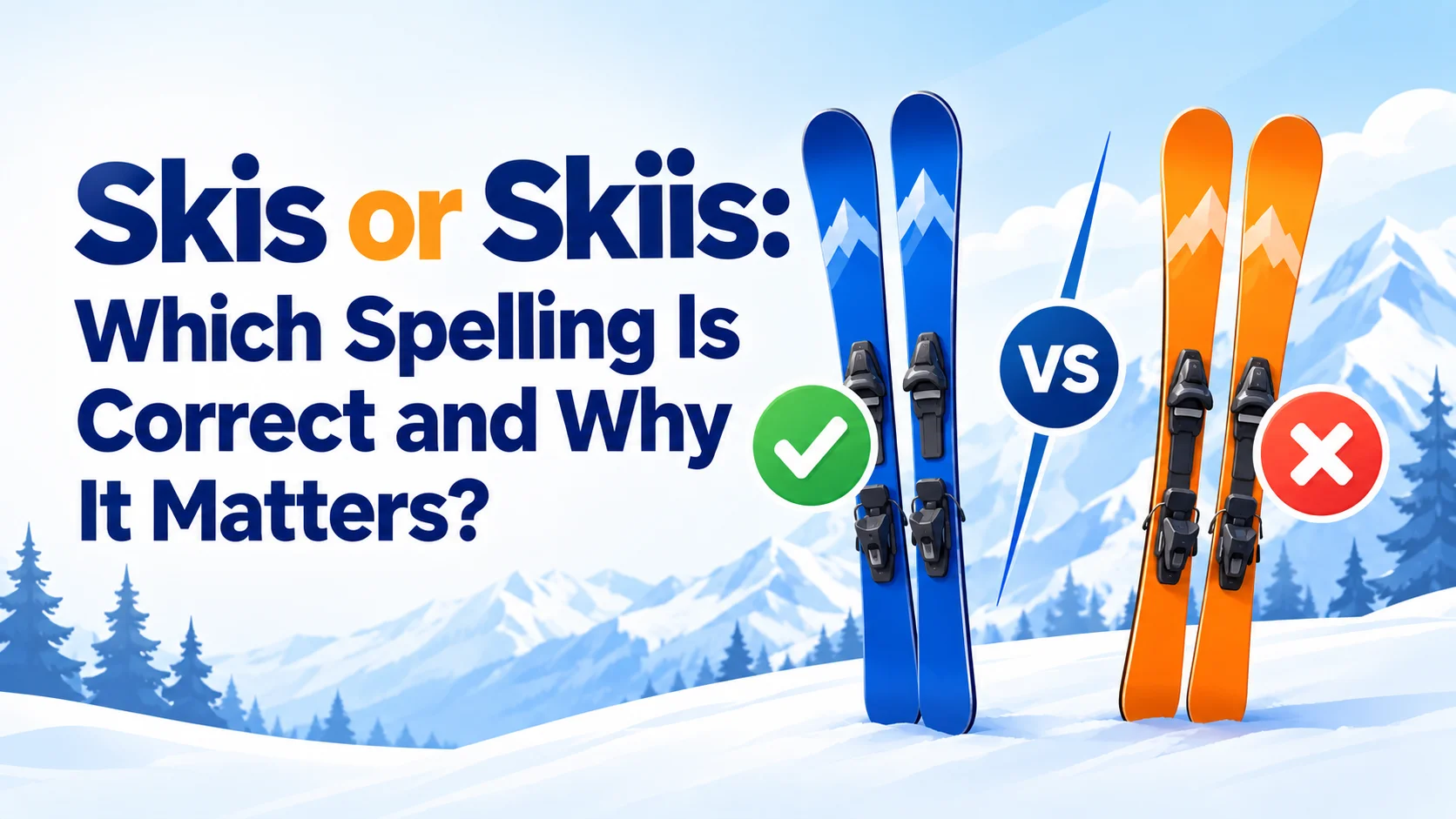
Skis or skiis can look like a tiny spelling question, but the extra i changes a correct word into a misspelling. If you are writing about winter sports, preparing a product description, checking schoolwork, or simply trying to settle an argument, the answer is straightforward: skis is the standard English spelling. The word ski forms its plural by adding -s, giving us skis. Major dictionaries, including Merriam-Webster and Oxford, list skis as the plural form.
The confusion is understandable because ski ends in the vowel i, and English has plenty of spelling patterns that are less predictable than they appear. Some writers instinctively insert another i, producing skiis. Others confuse skis with skiing, skied, or even skis. This guide explains not only which form is correct, but why the spelling works that way, how the word behaves as a noun and verb, and where common mistakes occur.
You will also see how skis, ski’s, skis’, and skies differ, why a pair of skis is the natural expression, and whether British and American English treat the word differently. We will also look briefly at the history of skiing, practical examples, editing situations, and a few useful memory tricks. By the end, you should be able to choose the correct form instantly without relying on guesswork.
Skis or Skiis: Quick Answer
Skis is correct. Skiis is incorrect in standard English.
The simplest rule is:
ski + s = skis
Not:
ski + is = skiis
Here are the forms in context:
| Meaning | Correct form | Example |
| One piece of equipment | ski | “One ski was damaged.” |
| More than one | skis | “The skis are ready.” |
| Verb, present tense | skis | “She skis every winter.” |
| Present participle | skiing | “They are skiing today.” |
| Past tense | skied | “He skied yesterday.” |
| Incorrect plural | skiis | ❌ Avoid this spelling |
Merriam-Webster lists ski as a noun with skis as its plural and also lists skis as a verb form. Oxford likewise gives skis as the noun’s plural.
So if you mean more than one ski, write skis.
What Does “Ski” Mean?
The word ski can function as both a noun and a verb. Understanding those two roles makes the different forms much easier to remember.
Ski as a Noun
As a noun, a ski is one of the long, narrow pieces of equipment used for moving over snow. A skier normally uses two, which is why the plural skis is so common.
For example:
- “I lost one ski.”
- “The ski has a damaged edge.”
- “She placed her skis beside the door.”
- “The resort rents skis to visitors.”
Oxford defines a ski as one of a pair of long, narrow pieces of wood, metal, or plastic attached to boots for movement over snow.
The noun can also refer to equipment used for water skiing, so the word is not limited strictly to snow.
Ski as a Verb
Ski is also a verb meaning to travel or move on skis.
For example:
- “I ski on weekends.”
- “He skis every winter.”
- “They are skiing today.”
- “She skied last year.”
This creates an interesting point: skis can be both a plural noun and a verb form.
Compare:
“Her skis are new.” — noun
“She skis every weekend.” — verb
The spelling is identical, but the grammatical function is different.
Ski and Its Main Forms
| Form | Function | Example |
| ski | Singular noun / base verb | “I bought a ski.” |
| skis | Plural noun / third-person verb | “The skis are ready.” |
| skiing | -ing form | “They enjoy skiing.” |
| skied | Past tense / past participle | “He skied yesterday.” |
| skier | Person who skis | “The skier reached the finish.” |
This is useful because spelling problems often happen when writers remember one form but accidentally apply its pattern to another.
Why Is “Skis” the Correct Plural?
English normally forms the plural of many nouns simply by adding -s. Ski follows that straightforward pattern.
ski → skis
There is no spelling change and no additional vowel.
Compare:
- book → books
- car → cars
- shoe → shoes
- radio → radios
- ski → skis
The fact that ski ends in i does not mean English needs another i before the plural ending.
Why “Skiis” Is Not Needed
The incorrect form skiis seems plausible because the singular already ends in i. A writer may mentally separate the word as:
ski + is
But the plural ending is -s, not -is.
The correct construction is simply:
ski + s → skis
This is one of those spelling questions where the shortest solution is also the right one.
Expert tip: When you are unsure, return to the singular word first. If the singular is ski, the ordinary plural is skis. Don’t insert an extra vowel simply because the resulting letter sequence looks unusual.
Skis vs. Skiis: Side-by-Side Comparison
| Feature | Skis | Skiis |
| Standard English spelling | ✅ Correct | ❌ Incorrect |
| Plural of ski | ✅ Yes | ❌ No |
| Found as a standard dictionary plural | ✅ Yes | ❌ No |
| Suitable for formal writing | ✅ Yes | ❌ No |
| Suitable for product descriptions | ✅ Yes | ❌ No |
| Correct in American English | ✅ Yes | ❌ No |
| Correct in British English | ✅ Yes | ❌ No |
| Example | “I packed my skis.” | “I packed my skiis.” ❌ |
The important distinction is not regional. Skiis is not a British alternative to skis, nor is it a special American form. It is simply a misspelling.
Why Do People Write “Skiis”?
If skiis is wrong, why does the mistake occur so often?
There are several reasonable explanations.
The Double-Vowel Trap
The final i in ski can make the plural look visually unusual:
ski + s = skis
Some writers expect an extra vowel to make the word easier to read. But English spelling does not require that here.
The same basic idea appears in other borrowed words ending in vowels. Their plural forms depend on established English usage rather than a universal rule that says every final vowel must be doubled or modified.
Confusion With “Skiing”
Another source of confusion is skiing.
The forms look like this:
- ski → skis
- ski → skiing
- ski → skied
Because skiing contains two consecutive i letters, a writer who remembers that spelling may incorrectly transfer the pattern to the plural and create skiis.
But these forms are produced by different spelling processes.
skiing contains the sequence ski + ing, while skis is simply ski + s.
Pronunciation Does Not Solve the Problem
The pronunciation of ski and skis does not provide a useful clue about whether there should be another i in writing.
That is why relying on sound can lead to hesitation. English spelling often preserves established written forms that cannot be predicted perfectly from pronunciation alone.
The safest approach is to remember the written pair:
one ski → two skis
Is “Skis” Different in British and American English?
No significant spelling difference exists here.
Both British English and American English use skis as the standard plural form.
Collins gives skis as a plural form in British English, while Merriam-Webster lists skis in its American dictionary.
There can be other vocabulary differences between British and American English, but this is not one of them.
| Variety | Singular | Standard plural |
| American English | ski | skis |
| British English | ski | skis |
| Standard international usage | ski | skis |
| Incorrect form | ski | skiis ❌ |
So if someone tells you that skiis is “the British spelling,” that explanation should not be accepted.
Ski vs. Skis vs. Skiing vs. Skied
One of the most useful ways to avoid spelling errors is to understand what each form does.
Ski
Use ski for one item or as the base form of the verb.
- “I need one ski.”
- “I want to ski this weekend.”
Skis
Use skis for more than one ski or for the third-person singular present-tense verb.
- “The skis are in the car.”
- “He skis every winter.”
Skiing
Use skiing for an ongoing activity or gerund.
- “We are skiing today.”
- “Skiing requires practice.”
Skied
Use skied for the standard past tense and past participle.
- “She skied in the mountains last year.”
- “They have skied there before.”
The dictionary evidence is particularly useful here: Merriam-Webster gives skied and skiing as the verb’s forms, while its noun entry gives skis as the plural.
Skis, Ski’s, Skis’, and Skies: Four Forms You Should Not Mix Up
The spelling problem becomes easier when you separate four visually similar forms.
Skis = Plural
Skis means more than one ski.
“The skis are outside.”
No apostrophe is needed.
Ski’s = Singular Possessive or Contraction
Ski’s is not the normal plural.
An apostrophe can indicate possession:
“The ski’s edge is damaged.”
Here, the edge belongs to one ski.
The apostrophe can also theoretically appear in a contraction, although that use is uncommon in ordinary writing.
Skis’ = Plural Possessive
Skis’ can indicate possession involving multiple skis.
“The skis’ edges were inspected.”
Here, the edges belong to multiple skis.
Skies = Plural of Sky
Skies is a completely different word.
“Dark skies covered the mountain.”
The word refers to multiple areas or appearances of the sky. It has nothing to do with the plural of ski.
Quick Comparison
| Word | Meaning | Example |
| ski | One ski / base verb | “I need a ski.” |
| skis | More than one ski / verb | “My skis are new.” |
| ski’s | Usually singular possessive | “The ski’s edge is sharp.” |
| skis’ | Plural possessive | “The skis’ bindings were adjusted.” |
| skies | Plural of sky | “The skies were cloudy.” |
| skiis | Misspelling | ❌ Avoid |
Why Do We Say “A Pair of Skis”?
You will frequently see a pair of skis rather than simply “two skis.”
That wording reflects how skis are normally used: a person typically wears one on each foot.
For example:
“She bought a pair of skis.”
This means she bought the two pieces that make up a usable set.
However, two skis is also grammatically correct when you are specifically counting individual pieces.
Compare:
- “I bought a pair of skis.” — emphasizes the equipment set.
- “The shop has two skis left.” — emphasizes individual items.
- “One ski was damaged.” — refers to a single piece.
The phrase a pair of skis is therefore not evidence that ski has an unusual plural. The plural is still skis.
Common Phrases Using “Skis”
Correct spelling becomes easier to recognize when you see it in natural combinations.
Common examples include:
- a pair of skis
- downhill skis
- cross-country skis
- water skis
- racing skis
- powder skis
- children’s skis
- rental skis
- ski boots and skis
- new skis
- used skis
- waxed skis
Notice that ski also frequently works as a modifier:
- ski boots
- ski resort
- ski trip
- ski season
- ski equipment
- ski lesson
In these expressions, ski is not being used as a plural noun. It modifies another noun.
That distinction matters when editing:
“I bought new ski boots.”
Here, ski describes the type of boots.
“I bought new skis.”
Here, skis is the plural noun referring to the equipment itself.
Common Mistakes With Skis
Mistake 1: Writing “Skiis”
Incorrect: “The skiis are expensive.”
Correct: “The skis are expensive.”
The extra i serves no grammatical purpose.
Mistake 2: Using “Ski’s” as the Plural
Incorrect: “We rented two ski’s.”
Correct: “We rented two skis.”
An apostrophe does not normally make an English noun plural.
Mistake 3: Confusing “Skis” With “Skies”
Incorrect: “The dark skis looked beautiful.”
If you mean the sky, the correct word is skies.
If you mean skiing equipment, use skis.
Mistake 4: Writing “Skiied”
The past tense is skied, not skiied.
“She skied down the slope.”
This is another example of why it is better to learn the actual word forms rather than inventing them by adding letters mechanically.
Mistake 5: Treating “Skiis” as a Regional Variant
There is no standard British-American distinction that makes skiis acceptable.
If you are writing for an international audience, skis is the safe standard form.
Why Correct Spelling Matters
A one-letter mistake may seem insignificant, but context determines how much it matters.
In School and Formal Writing
Spelling errors can distract readers and make otherwise strong work appear less carefully edited.
If you are writing:
“The athletes carried their skiis to the starting area.”
The reader will understand you, but skiis is still incorrect.
In Retail and Product Listings
Online stores need consistent product terminology.
A product page might contain:
“Choose from alpine skis, racing skis, and cross-country skis.”
Using the standard spelling makes the description look professional and consistent.
In Sports Journalism
News articles, competition reports, and equipment reviews benefit from precise terminology.
A professional publication has little reason to retain a known misspelling when the correct form is well established.
In SEO and Online Content
This is where context matters.
Someone might search for “skis or skis” precisely because they are unsure about the spelling. That does not make skiis the correct spelling.
For an article targeting this question, the sensible editorial approach is to mention the misspelling naturally while consistently using “skis” as the correct form.
Do not deliberately fill a page with the misspelled word simply because someone may search for it. Helpful content should answer the spelling question rather than normalize the error.
A Practical Editing Checklist
If you are proofreading an article, product page, school assignment, or social media caption, use this quick check:
| Question | Correct action |
| Do you mean one piece? | Use ski |
| Do you mean multiple pieces? | Use skis |
| Did you type skiis? | Remove the extra i |
| Did you type ski’s for a plural? | Remove the apostrophe |
| Do you mean the plural of sky? | Use skies |
| Do you mean an ongoing activity? | Use skiing |
| Do you mean past skiing? | Use skied |
| Are you unsure about UK vs. US spelling? | Use skis in both |
This checklist is more useful than memorizing a complicated grammar rule: identify the meaning first, then choose the established form.
How to Remember “Skis” Instantly
You do not need a complicated mnemonic.
The One-Line Memory Rule
One ski, two skis.
Or simply:
ski + s = skis
The key is to resist the temptation to copy the double i from skiing.
Use a Contrast Pair
Remember these three forms together:
ski → skis → skiing
That makes the difference visually obvious.
- one ski
- several skis
- the activity of skiing
Once these three forms are stored together, skiis starts to look as unusual as it actually is.
A Short Real-World Editing Example
Imagine editing this sentence for a winter travel website:
“Before your trip, check whether your skiis are properly fitted and make sure your ski boots are comfortable.”
There are two different concepts in the sentence.
First, skiis is incorrect. It should be skis.
Second, ski boots are already correct because ski is functioning as a modifier.
The edited sentence becomes:
“Before your trip, check whether your skis are properly fitted and make sure your ski boots are comfortable.”
This illustrates an important editorial principle: not every occurrence of “ski” should be changed into “skis.” The correct form depends on the grammatical job the word is performing.
Where the Word “Ski” Comes From
The history of skiing explains why the English word looks somewhat unusual.
Merriam-Webster traces the noun to Norwegian ski, from Old Norse skīth, referring to a piece or stick of wood. The dictionary records the English noun from the eighteenth century and the verb from around the nineteenth century.
Oxford similarly identifies the word’s origin as Norwegian, ultimately connected with Old Norse skíth, with the sense of a billet or snowshoe.
That Scandinavian history helps explain why ski does not behave like a native English word whose spelling developed gradually inside English. It was adopted into English in a form that has remained recognizable.
But etymology does not create an English plural skiis. Once the word is used as an English noun, its standard plural is skis.
What About “Skier”?
Another potentially confusing word is skier.
The standard spelling is:
ski + er = skier
Merriam-Webster lists skier as the ordinary form, while noting skier as a less common variant.
This is worth mentioning because someone who encounters variants such as skiers may become even less certain about the plural skis. The forms are not interchangeable:
- ski — the activity or equipment
- skis — plural equipment / third-person verb
- skier — a person who skis
- skiing — the activity
- skied — past tense
For ordinary modern writing, skier and skis are the forms most readers will expect.
Practice: Choose the Correct Form
Try these before checking the answers.
- We packed our skiis / skis before leaving.
- She loves skiing / skiis in winter.
- He skis / skiis every Saturday.
- One ski / skis was damaged.
- The mountain was hidden beneath dark skies / skis.
- They bought a new pair of skiis / skis.
- She skied / skied last weekend.
Answers
- skis
- skiing
- skis
- ski
- skies
- skis
- skied
The trickiest items are not really spelling problems once you identify the word’s meaning and grammatical role.
Five Expert Takeaways
- Skis is the standard plural of ski.
- Skiis is a misspelling, not an alternative British or American form.
- Ski’s and skis’ involve possession, not ordinary pluralization.
- Skies is the plural of sky, not ski.
- The verb forms ski, skis, skiing, and skied need to be learned as a set rather than generated by guesswork.
The most useful rule remains the simplest:
ski → skis
Conclusion
When choosing between skis or skis, there is no difficult exception to memorize: skis is the correct standard spelling, while skiis is a misspelling. The useful distinction is to understand what the word is doing in the sentence. One piece is a ski; more than one is skis; the activity is skiing; and the past tense is skied. British and American English use skis alike. One final actionable tip: whenever you catch yourself typing skis, return to the singular and build the plural directly: ski + s = skis. A common mistake to avoid is using an apostrophe—ski’s—just because you mean more than one. Once you separate plural, possessive, and verb forms, this spelling problem becomes almost impossible to repeat.
FAQs
Q1. Is “skiis” ever considered a correct spelling?
No, skiis is not the standard plural spelling in modern English. Standard dictionaries give skis as the plural of ski. Although skiis may appear in online writing because people make spelling mistakes, its appearance does not make it an accepted alternative.
Q2. Is “skis” both a noun and a verb?
Yes. Skis can be the plural noun meaning more than one ski, as in “The skis are ready.” It can also be the third-person singular present form of ski: “He skis every weekend.” The surrounding sentence tells you which grammatical function is intended.
Q3. Why is “skiing” spelled with two i’s but “skis” is not?
The two forms use different endings. Skiing combines skiing with -ing, producing skiing. The plural noun simply adds -s, producing skis. Therefore, the spelling of skiing should not be used as a model for forming the plural.
Q4. Is “ski’s” ever correct?
Yes, but not as the ordinary plural. Ski’s can show possession when something belongs to one ski, as in “The ski’s edge was damaged.” For multiple skis, a possessive construction may use skis’, depending on the sentence. The plain plural remains skis.
Q5. Should I use “skis” in American and British English?
Yes. Skis is the standard plural in both varieties. There is no need to switch to skiis for British writing. Collins lists skis in British English, while Merriam-Webster gives the same standard plural in American English.