

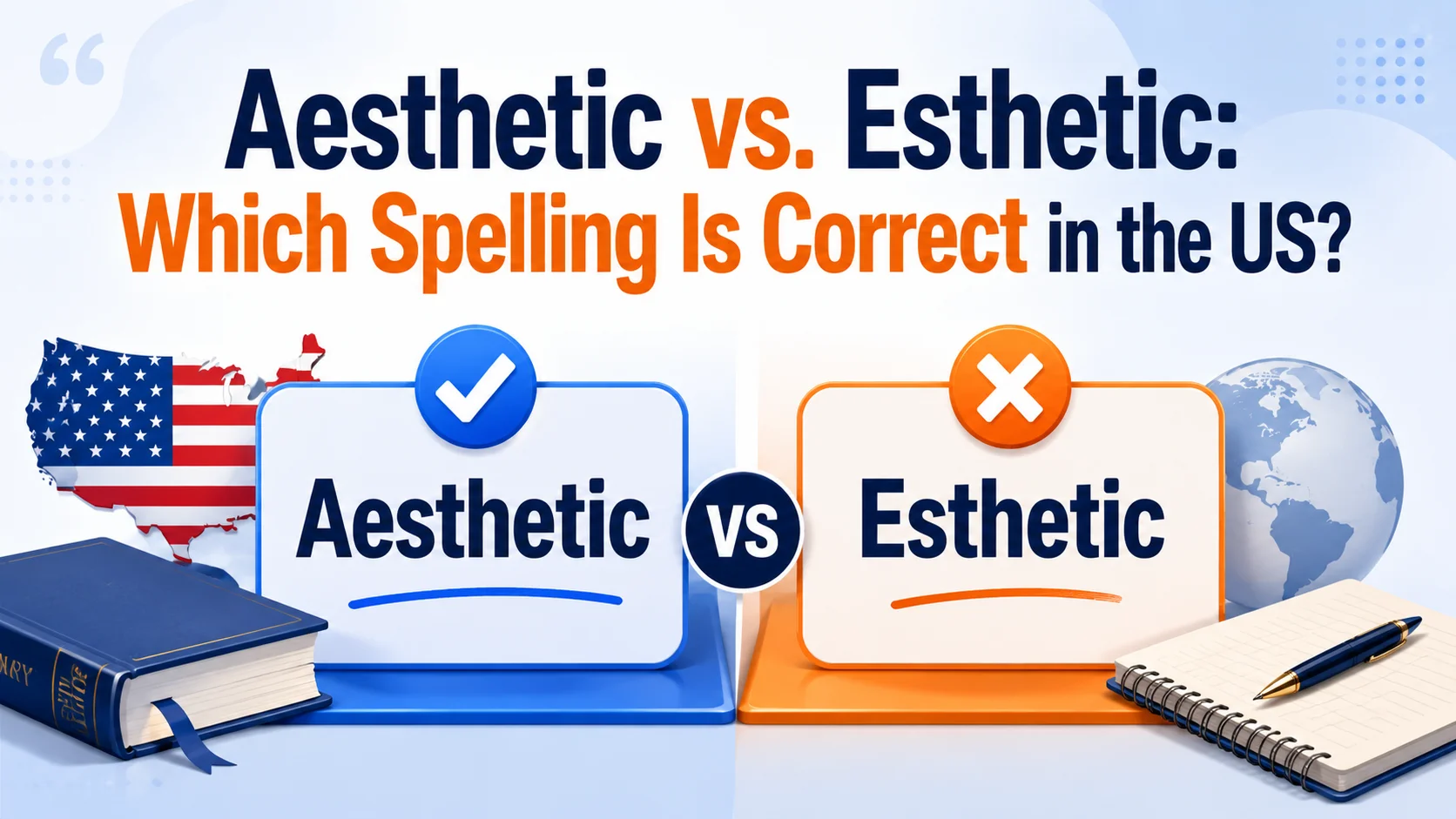
Aesthetic vs. esthetic is one of those spelling questions that looks simple until you encounter both forms in reputable writing. If you’re writing about beauty, art, design, style, or appearance, you may wonder whether the extra a matters. The short answer is that both spellings are legitimate, but they aren’t equally common in every setting. In general U.S. English, aesthetic is the safer and more widely recognized choice. Esthetic is a genuine variant, not a spelling mistake, and it appears particularly often in certain beauty and skincare contexts.
The confusion becomes greater when related words enter the picture. You may see aesthetician, esthetician, aesthetics, and esthetics, with different industries favoring different forms. Meanwhile, social media has given aesthetic another everyday meaning: a recognizable visual style or vibe. A minimalist bedroom can have a minimalist aesthetic; a fashion brand can develop a distinctive aesthetic; and a social-media account can be described by its overall aesthetic. Understanding these uses makes the spelling choice much easier.
This guide explains aesthetic vs. esthetic in American English, including their meanings, pronunciation, history, grammatical roles, professional uses, and common mistakes. You’ll also learn why esthetician is so familiar in the beauty industry, whether esthetic is acceptable in academic writing, and which spelling to choose when you simply want the most natural option. By the end, you won’t need to guess based on appearance or rely on spellcheck—you’ll be able to choose based on meaning, context, audience, and established usage.
Aesthetic vs. Esthetic: The Quick Answer
Both aesthetic and esthetic are correct spellings in U.S. English. The important point is that esthetic is a variant of aesthetic, rather than a completely separate word with a fundamentally different meaning. Dictionary sources recognize esthetic as an alternative form, while aesthetic is the more familiar general-purpose spelling.
For most readers, writers, editors, and students, aesthetic is the best default.
| Question | Best answer |
| Is aesthetic correct? | Yes. |
| Is esthetic correct? | Yes. |
| Are they different words? | They are spelling variants with the same core meaning. |
| Which is more familiar generally? | Aesthetic |
| Which may appear frequently in beauty terminology? | Esthetic and esthetician |
| Which should you use when unsure? | Aesthetic |
A simple rule
Use “aesthetic” as your default spelling. Use “esthetic” when a particular professional, organizational, or established usage calls for it.
That recommendation isn’t saying esthetic is wrong. It simply recognizes the difference between being a valid word and being the most natural choice for a particular audience.
Is “Esthetic” or “Aesthetic” More Common in the US?
The two forms are recognized in American English, but aesthetic has broader visibility and usage.
You’ll encounter aesthetic naturally in discussions of:
- art
- architecture
- design
- fashion
- photography
- literature
- philosophy
- branding
- visual culture
- social media
- beauty and appearance
For example:
- “The building has a striking aesthetic.”
- “The designer wanted a minimalist aesthetic.”
- “The study examines the aesthetic experience.”
- “The website needs a more consistent aesthetic.”
Esthetic can perform the same basic linguistic job, but it has a narrower feel in some contexts. It is particularly noticeable in terminology connected with beauty, skincare, and esthetics, although it isn’t restricted to those fields.
The distinction is therefore mostly one of usage and convention, not correctness.
Why “aesthetic” is the safer general choice
Suppose you’re writing an essay about modern architecture. You could technically encounter either spelling, but aesthetic architecture, aesthetic theory, and aesthetic judgment will generally feel more familiar to a broad educated audience.
Likewise, if you’re writing a website article for a general audience, changing every instance of aesthetic to esthetic doesn’t make the writing more correct. It may simply make it look less familiar.
Expert recommendation: If you aren’t following a specific house style or professional convention, choose aesthetic.
What Does “Aesthetic” Mean?
Aesthetic has both adjective and noun uses, and understanding that distinction explains much of its modern popularity.
Aesthetic as an Adjective
As an adjective, aesthetic relates to beauty, artistic principles, taste, appearance, or the appreciation of beauty.
Consider these examples:
- “The museum made several aesthetic improvements.”
- “The architect considered the building’s aesthetic qualities.”
- “The treatment was designed for aesthetic reasons.”
- “The two chairs are identical in function but different in aesthetic style.”
The word doesn’t necessarily mean “beautiful.”
That’s an important distinction.
Something can be aesthetic because it concerns appearance or artistic judgment even if someone doesn’t personally find it beautiful.
Aesthetic as a Noun
In modern English, aesthetic is also commonly used as a noun to describe a particular style, visual identity, or set of artistic preferences.
For example:
“The café has a warm, rustic aesthetic.”
Here, aesthetic means something like overall visual or stylistic character.
You can also say:
- “Her fashion aesthetic is minimalist.”
- “The brand has a playful aesthetic.”
- “The designer developed a distinctly industrial aesthetic.”
- “The room combines a traditional aesthetic with modern furniture.”
This noun use is especially common in contemporary design, fashion, branding, and online culture.
Aesthetic in Art and Design
In art and design, aesthetic can refer to the qualities that shape how something looks and feels.
A designer might think about:
- color
- proportion
- texture
- composition
- typography
- symmetry
- visual balance
- materials
- form
- style
The word therefore has more depth than simply pretty.
A website can have a minimalist aesthetic even if it isn’t “beautiful” in everyone’s opinion. The term describes the deliberate visual language of the design.
What Does “Esthetic” Mean?
Esthetic has essentially the same core meaning as aesthetic. It is an established alternative spelling rather than a word that describes an entirely different concept. Etymological references explicitly identify esthetic as an alternative form of aesthetic.
For example:
- “The clinic focuses on esthetic treatments.”
- “The procedure produced an esthetic improvement.”
- “The building has strong esthetic qualities.”
In each case, replacing esthetic with aesthetic generally preserves the meaning.
Why You See “Esthetic” in Beauty and Skincare
The spelling becomes especially noticeable in the beauty industry.
Words such as:
- esthetician
- esthetics
- esthetic services
- esthetic treatment
are established in American usage.
This creates an interesting situation: someone may normally write aesthetic when discussing design but encounter esthetician when visiting a skincare professional.
That isn’t a contradiction.
English contains many related words whose spelling conventions don’t always follow the most obvious pattern.
Does “Esthetic” Mean Something Different?
Usually, no major difference in meaning exists between aesthetic and esthetic.
The important distinction is contextual.
Aesthetic tends to be the more broadly familiar form, while esthetic can be favored in particular professional terminology and organizations.
So don’t assume:
aesthetic = art
esthetic = beauty
That shortcut is too rigid.
Both can relate to beauty, appearance, taste, and aesthetics. The spelling preference depends on usage.
Aesthetic vs. Esthetic: The Real Difference
If you want the simplest linguistic explanation, the difference is primarily spelling and usage preference, not meaning.
| Feature | Aesthetic | Esthetic |
| Core meaning | Beauty, taste, appearance, aesthetics | Same core meaning |
| Valid in U.S. English | Yes | Yes |
| General familiarity | Higher | Lower |
| Art and design | Very common | Possible but less usual |
| Philosophy | Strongly established | Recognized variant |
| Beauty/skincare | Common | Also common |
| Related professional term | Aesthetician exists | Esthetician is especially familiar in U.S. beauty contexts |
| Best default for general writing | Yes | Usually no |
The practical lesson is important:
Don’t treat the two spellings as if they represent two competing definitions.
Instead, think of them as variants whose frequency and naturalness change with context.
Aesthetic vs. Esthetic Pronunciation
For most American English speakers, aesthetic and esthetic are pronounced alike or essentially alike.
Dictionary.com gives American pronunciations for aesthetic beginning with sounds represented as “es-” or “ees-”, and it lists esthetic as a variant.
The spelling can therefore be misleading to learners.
The initial a in aesthetic doesn’t normally create an extra spoken syllable. That’s why you shouldn’t try to determine the spelling simply by listening.
Why pronunciation doesn’t settle the spelling
English has plenty of words where pronunciation doesn’t give you enough information to choose between spellings.
In this case:
- aesthetic
- esthetic
are close enough in pronunciation that the written context must do the work.
If you’re writing rather than speaking, the safest approach is to remember the standard form:
aesthetic
Then adjust only when a recognized professional or editorial convention calls for esthetic.
Why Are There Two Spellings?
The history of the word explains why this isn’t simply a case of one correct spelling and one careless abbreviation.
The Greek Origin of Aesthetic
Aesthetic ultimately traces back to Greek aisthētikos, associated with perception through the senses. The word entered English through German and French forms and became established in English in the late 18th century. Etymological sources date the English noun to 1798 and note its development from discussions of sensory perception toward the study and appreciation of beauty.
Its original intellectual territory was closely connected with philosophy, perception, art, and beauty.
Over time, its meaning expanded.
Today, the word can describe both philosophical ideas about beauty and very practical matters such as the visual style of a room.
How “Esthetic” Developed
Esthetic is an alternative spelling that removes the initial a.
That shorter form is not a recent social-media invention. It has a historical basis and is recorded as an alternative form of aesthetic.
The two forms therefore coexist because English has historically allowed variation in how words derived from classical and European sources are spelled.
Why Both Forms Survived
Language doesn’t always eliminate duplicate spellings.
Sometimes one spelling becomes dominant in general usage while another survives in:
- specialized fields
- regional varieties
- professional terminology
- institutional names
- established compounds
That’s essentially what makes aesthetic vs. esthetic interesting: the question isn’t “Which one did someone spell incorrectly?” but rather “Which established variant fits this context best?”
Aesthetic vs. Esthetic in American English
For general American English, aesthetic is the strongest default.
That includes most writing about:
- art
- beauty
- design
- fashion
- architecture
- visual culture
- literature
- philosophy
- branding
- photography
For instance:
“The company is developing a new visual aesthetic.”
This sounds completely natural to a general U.S. audience.
Is “Esthetic” More American Than “Aesthetic”?
Not in the sense that you should replace aesthetic with esthetic whenever you’re writing for Americans.
Both occur in American English.
The better way to understand the relationship is:
Aesthetic is the broadly established form; esthetic is a recognized variant that has stronger visibility in some specialized American contexts.
What About British English?
British English generally favors aesthetic as well.
So esthetic shouldn’t be thought of as “the American spelling” in the same way that some British/American spelling pairs have clearly divided conventions.
For example, color/colour represents a much stronger regional spelling distinction than aesthetic/esthetic.
With these words, both forms can occur in U.S. English, with aesthetic generally being the safer general-purpose choice.
Aesthetic vs. Esthetic in Different Contexts
Context is where the spelling question becomes genuinely useful.
Art, Literature, and Philosophy
Use aesthetic as your normal choice.
Common expressions include:
- aesthetic theory
- aesthetic experience
- aesthetic judgment
- aesthetic value
- aesthetic principles
- aesthetic appreciation
The word has deep roots in philosophical discussions of beauty, taste, art, perception, and judgment. Aesthetics itself is the name of the philosophical field concerned with questions surrounding beauty and artistic judgment.
In formal academic writing, aesthetic will usually be the most natural choice.
Design, Fashion, and Architecture
Again, aesthetic is usually the obvious choice.
Examples:
- “The architect wanted a restrained aesthetic.”
- “The collection has a distinctly retro aesthetic.”
- “The brand uses a consistent visual aesthetic.”
Here, aesthetic often means style or visual character.
Beauty, Skincare, and Cosmetics
This is where you may encounter both forms more frequently.
You might see:
- aesthetic treatment
- esthetic treatment
- aesthetic services
- esthetic services
- aesthetician
- esthetician
The exact terminology can depend on the organization, profession, educational program, or jurisdiction.
Don’t assume that every beauty-related term must use “esthetic.” Both spelling families exist.
Medicine and Cosmetic Procedures
The word aesthetic is very common when discussing procedures intended to alter or improve appearance.
Examples include:
- aesthetic medicine
- aesthetic procedures
- aesthetic treatment
- aesthetic surgery
- aesthetic outcomes
So if someone asks, “Is Botox aesthetic or esthetic?”, the natural general answer is that Botox can be discussed in an aesthetic or cosmetic context because its use may concern appearance. The spelling isn’t determined by the treatment itself.
A professional clinic may use esthetic in a particular service name, but that doesn’t make aesthetic incorrect.
Social Media and Internet Culture
Modern online English has expanded the noun aesthetic considerably.
People now talk about:
- a clean-girl aesthetic
- a vintage aesthetic
- a dark-academia aesthetic
- a minimalist aesthetic
- a cottagecore aesthetic
In these expressions, aesthetic usually means a coherent visual or stylistic identity.
This usage is now mainstream enough that dictionaries recognize the noun sense involving an individual’s or group’s ideas about style and taste.
Aesthetic vs. Aesthetician vs. Esthetician
This is one of the most useful distinctions to understand because the related professional terms don’t always mirror everyday spelling preferences.
Aesthetician
Aesthetician can refer to someone knowledgeable about aesthetics in the philosophical or artistic sense.
However, dictionary usage also recognizes the word in the beauty industry.
Esthetician
In U.S. English, esthetician is especially familiar as the term for a professional trained in skincare and related beauty services.
Such a professional may provide services such as:
- facials
- skincare consultations
- certain cosmetic treatments
- makeup-related advice
- hair or skin care services, depending on training and licensing
Dictionary.com specifically notes that esthetician is the usual form for a person trained to administer facials and advise customers about makeup and skin or hair care.
Why the Two Forms Don’t Match Perfectly
You might naturally write:
“The clinic offers aesthetic treatments.”
and then:
“I booked an appointment with an esthetician.”
That combination is perfectly understandable.
English doesn’t require every member of a word family to use exactly the same spelling convention.
Practical tip: When referring to a profession, use the spelling used by the professional, school, licensing organization, or business you’re discussing.
Aesthetic vs. Beautiful: Are They the Same?
They’re related, but aesthetic and beautiful aren’t interchangeable in every sentence.
Beautiful is usually a direct judgment:
“The painting is beautiful.”
You’re saying that the painting is pleasing or attractive.
Aesthetic is broader. It can describe the qualities, principles, style, or experience associated with beauty and artistic taste.
Compare:
“The room is beautiful.”
with:
“The room has a minimalist aesthetic.”
The first makes a judgment about the room’s attractiveness. The second identifies its style and visual character.
You can also discuss aesthetic qualities without declaring something beautiful:
“The film makes deliberately harsh aesthetic choices.”
That sentence doesn’t necessarily praise the film’s appearance. It describes the artistic choices being made.
Aesthetic, Aesthetics, Esthetic, and Esthetics
These forms are related, but their grammatical roles aren’t identical.
| Word | Typical role | Meaning | Example |
| aesthetic | Adjective/noun | Relating to beauty; a style or taste | “The design has a modern aesthetic.” |
| aesthetics | Noun | Study of beauty/art; principles of taste | “She studied aesthetics.” |
| esthetic | Adjective | Variant of aesthetic | “The treatment had an esthetic purpose.” |
| esthetics | Noun | Variant of aesthetics | “The course covers esthetics.” |
| aesthetician | Noun | Person concerned with aesthetics; also beauty professional | “The aesthetician discussed skincare.” |
| esthetician | Noun | Common U.S. beauty/skincare professional term | “The esthetician performed a facial.” |
Dictionary sources recognize esthetics as a variation of aesthetics, confirming that the shorter spelling isn’t limited to the adjective.
Common Mistakes With Aesthetic and Esthetic
Mistake 1: Assuming “Esthetic” Is Wrong
This is the most basic error.
Esthetic is a legitimate variant.
If you see it in a reputable source, don’t automatically correct it to aesthetic.
Mistake 2: Assuming Both Forms Are Equally Natural Everywhere
Validity and frequency aren’t the same thing.
A word can be perfectly legitimate while being less familiar in a particular context.
For general U.S. writing, aesthetic is usually the more comfortable choice.
Mistake 3: Treating “Esthetic” as Only a Beauty Word
That’s too narrow.
Esthetic can refer to the same broad concepts associated with aesthetic, including beauty and artistic taste. Its association with the beauty industry is strong, but it isn’t its only possible use.
Mistake 4: Confusing “Aesthetic” With “Aesthetics”
These aren’t interchangeable.
- Aesthetic: “The building has an unusual aesthetic.”
- Aesthetics: “The course explores the aesthetics of modern art.”
The first can describe a style. The second commonly refers to the broader field or principles concerning beauty and art.
Mistake 5: Assuming Social Media Invented the Modern Noun
Social media has certainly popularized the noun aesthetic in the sense of a visual identity, but the word has a much older history.
The English word dates to the late 18th century, and its development predates modern internet culture by centuries.
Which Spelling Should You Use?
Here’s the practical decision guide.
| Situation | Recommended choice | Reason |
| General U.S. writing | aesthetic | Most familiar default |
| School essay | aesthetic | Conventional and broadly recognized |
| Academic philosophy | aesthetic | Strong traditional usage |
| Art criticism | aesthetic | Standard terminology |
| Graphic design | aesthetic | Common industry usage |
| Fashion | aesthetic | Natural for style and visual identity |
| Social media | aesthetic | Dominant modern usage |
| Beauty industry | Check context | Both forms occur |
| Professional title | Follow established title | Industry convention matters |
| Company/service name | Use official spelling | Proper names should remain unchanged |
When “Esthetic” Is the Better Choice
There are situations where changing esthetic to aesthetic would be unnecessary or even undesirable.
Use the established spelling when:
- it’s part of an official business name;
- a school or certification program uses it;
- a professional’s title is conventionally spelled that way;
- an organization has a specific house style;
- you’re quoting or accurately reproducing a source.
In other words, don’t “correct” a legitimate variant simply because you personally prefer the longer spelling.
A Practical Proofreading Test
If you’re uncertain while editing, use this four-step test.
Step 1: Identify the audience
Ask whether you’re writing for:
- a general U.S. audience;
- academics;
- designers;
- beauty professionals;
- a specific company or institution.
Step 2: Check the surrounding terminology
If you’re writing about aesthetic theory, aesthetic is the natural choice.
If you’re writing about a specific esthetician training program, use the terminology that program uses.
Step 3: Check the organization’s preferred spelling
A professional context can override your general preference.
If the official name says Esthetics Institute, don’t rewrite it as “Aesthetics Institute.”
Step 4: Be consistent
Once you’ve chosen a general style, don’t switch between forms randomly.
Consistency makes professional writing look intentional.
Editor’s rule: Don’t confuse “less common” with “incorrect.” First determine whether the spelling is valid; then determine whether it fits the context.
Aesthetic vs. Esthetic: Real-World Examples
Examples With “Aesthetic”
- “The designer created a clean, modern aesthetic.”
- “The museum considered the building’s historical aesthetic.”
- “The brand’s visual aesthetic is instantly recognizable.”
- “She prefers a minimalist aesthetic.”
- “The article examines aesthetic judgment in contemporary art.”
Examples With “Esthetic”
- “The clinic offers several esthetic services.”
- “The treatment produced an esthetic improvement.”
- “The program teaches principles of esthetics.”
- “The spa employs licensed esthetician professionals.”
The point isn’t that the first group is “correct” and the second group is somehow inferior. The examples demonstrate how usage conventions influence what sounds most natural.
Why Spellcheck Isn’t Enough
Spellcheck can identify many spelling mistakes, but aesthetic vs. esthetic isn’t necessarily a spelling-error problem.
Both are legitimate English words.
If you type:
“The designer created a minimalist esthetic.”
a basic spellchecker may accept it because esthetic is correctly spelled.
But you may still decide that:
“The designer created a minimalist aesthetic.”
is the better choice for your audience.
This is a style and usage decision, not simply a spelling decision.
The same principle applies to many legitimate variants in English. Automated tools can tell you whether a word exists; they can’t always determine whether it’s the best word for your intended audience and context.
Expert Recommendation: What Should You Use in the US?
If you’re writing ordinary American English and have no special reason to choose otherwise, use aesthetic.
It’s the safest choice because it works naturally across a wide range of subjects:
- “aesthetic design”
- “aesthetic appeal”
- “aesthetic value”
- “aesthetic experience”
- “aesthetic style”
- “aesthetic treatment”
- “aesthetic judgment”
But don’t treat esthetic as an error.
When you encounter it in a legitimate professional or institutional context, recognize it as an established variant. In particular, esthetician is an important U.S. beauty-industry term, so forcing the spelling aesthetician into every context can actually make your writing less natural.
The best writers don’t merely memorize one “correct” spelling. They understand why different forms exist and when each one fits.
Conclusion: Aesthetic or Esthetic?
Aesthetic and esthetic are both legitimate spellings, but that doesn’t mean they’re equally useful in every situation. For most American English writing, aesthetic is the best default because it’s broadly familiar across art, design, philosophy, fashion, beauty, branding, and everyday discussions of style. Esthetic remains a valid variant and becomes especially relevant in certain professional and beauty-related contexts. The most useful distinction is therefore not “right versus wrong.” It’s general usage versus specialized convention. If you’re writing an essay, article, website, or general business copy, aesthetic will usually serve you well. If you’re referring to an established professional title, institution, or service, preserve the spelling that context uses. One final actionable tip: when you’re unsure, choose aesthetic unless the surrounding terminology gives you a clear reason to use esthetic. A common mistake to avoid is “correcting” a legitimate esthetic simply because it looks unfamiliar. Good editing respects both the dictionary and the context.
Frequently Asked Questions About Aesthetic vs. Esthetic
Q1. Is “esthetic” a correct spelling in American English?
Yes. Esthetic is a legitimate variant of aesthetic in American English. It isn’t a typo or an informal abbreviation. However, aesthetic is generally the more familiar spelling for broad audiences, especially in writing about art, design, philosophy, and visual style.
Q2. Which is more common in the US: aesthetic or esthetic?
Aesthetic is generally the better default for general U.S. English. Esthetic remains a recognized variant and appears frequently in certain specialized contexts, particularly beauty and skincare terminology. The difference is therefore primarily one of usage preference and context, not grammatical correctness.
Q3. Is “aesthetician” or “esthetician” correct?
Both forms exist, but esthetician is especially established in U.S. beauty terminology. Dictionary sources note esthetician as the usual term for a professional trained in services such as facials and skincare advice. Aesthetician also exists and can have broader or philosophical meanings.
Q4. Is Botox considered aesthetic or esthetic?
Botox can be described as aesthetic when discussing its cosmetic or appearance-related use. Esthetic is also a legitimate variant, but the spelling depends on the terminology used by the clinic, publication, or professional context. The treatment itself does not require one spelling; usage convention determines the choice.
Q5. Why is “aesthetic” so common on social media?
Social media helped popularize aesthetic as a noun meaning a recognizable visual or stylistic identity. People can describe a profile, outfit, room, brand, or collection as having a particular aesthetic. This modern usage builds on the older meaning involving beauty, taste, artistic principles, and sensory appeal.