
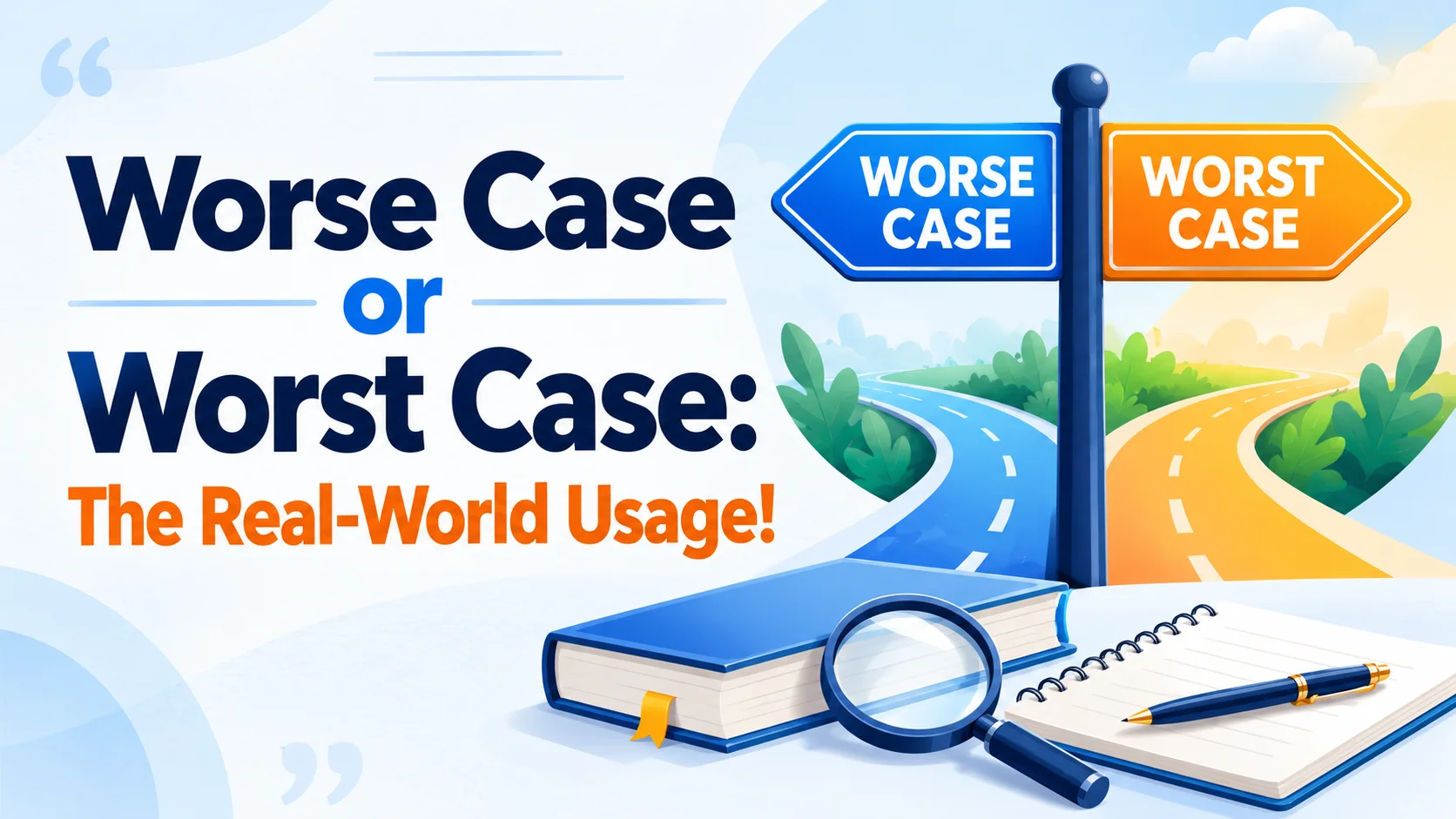
Worse case or worst case? If you’ve ever paused before writing this phrase, you’re not alone. The confusion comes from two closely related adjectives that serve different grammatical jobs. Worse is comparative: it normally tells you that one thing is less favorable than another. Worst is superlative: it identifies the most unfavorable option in a group or range of possibilities. That distinction makes “worst case” the standard expression when you mean the most negative possible outcome. Understanding why it works will help you avoid a surprisingly common mistake in emails, reports, essays, conversations, and everyday writing.
The phrase worst case appears whenever people think about uncertainty. A project might finish late, a flight might be delayed, a repair might cost more than expected, or a business might face an unexpected loss. In each situation, you can ask what would happen under the most unfavorable realistic outcome. That is the idea behind a worst-case scenario. By contrast, worse needs a comparison: one situation can be worse than another. Once you recognize that grammatical relationship, the difference stops being a matter of memorization and becomes much easier to apply.
There is one useful wrinkle: “worse case” is not impossible in every imaginable sentence. It can be grammatical when worse genuinely compares one case with another. That is different from using “worse case” as a mistaken version of the established phrase “worst case.” This guide explains that distinction, shows how the expressions work in real-world situations, explains worst case vs. worst-case, and gives you practical tests for choosing the right form. You’ll also see why the mistake happens and how to catch it before it reaches a professional document.
Worse Case or Worst Case: Which One Is Correct?
The standard phrase is worst case when you mean the most negative possible outcome or situation.
In the worst case, we may have to cancel the event.
Here, worst means the least favorable possibility among the relevant possibilities.
By contrast:
This is the worse case of the two.
can be grammatical if the writer is genuinely comparing two cases and saying that one is less favorable than the other.
So the practical rule is:
Use “worst case” for the most negative possibility. Use “worse” when you are making a comparison.
The Short Answer
| Expression | Correct? | Typical meaning |
| worst case | Yes | The most negative possible situation |
| worst-case | Yes | A compound adjective before a noun |
| worse case | Usually not for the intended idiom | A comparative description of one case against another |
| worse than | Yes | Comparing two things |
| at worst | Yes | The most negative expected possibility |
If you’re simply trying to say “the most unfavorable outcome,” choose “worst case.”
Why “Worst Case” Is the Standard Phrase
The expression describes an extreme point on a range of possible outcomes.
Imagine three possibilities:
- best case
- likely or expected case
- worst case
The worst case is the least favorable of those possibilities. Because you are identifying the extreme, the superlative worst is appropriate.
When “Worse Case” Can Be Grammatical
Suppose a company is comparing two proposed plans:
Plan A has a worse case than Plan B.
The wording may be grammatical if the writer means that the negative outcome associated with Plan A is worse than the corresponding outcome for Plan B.
The important point is that this is not the fixed expression “worst case.”
In ordinary writing, however, if you want to say:
“If everything goes as badly as reasonably possible…”
then worst case is the expression you want.
Worse vs. Worst: The Difference You Need to Know
The easiest way to understand the problem is to forget the phrase temporarily and look at the two adjectives themselves.
What “Worse” Means
Worse is the comparative form of bad.
It generally compares one thing, situation, experience, result, or condition with another.
Examples:
Today’s weather is worse than yesterday’s.
This problem is worse than the first one.
The second proposal is worse for the budget.
The word worse answers a comparative question:
Which of these two things is less good?
It can also appear without an explicit comparison when the comparison is understood from context:
Things are getting worse.
The implied comparison is between the current situation and an earlier or expected situation.
What “Worst” Means
Worst is the superlative form of bad.
It identifies the lowest or most negative position among relevant possibilities.
Examples:
This is the worst day of the week.
That was the worst mistake I’ve made.
What is the worst possible outcome?
The word worst answers a different question:
Which option is the least favorable of all the relevant options?
Comparative vs. Superlative Adjectives
| Form | Grammatical role | Typical pattern | Example |
| bad | Base adjective | Describes a negative quality | It was a bad result. |
| worse | Comparative | A is worse than B | This result is worse than expected. |
| worst | Superlative | The worst among relevant options | This is the worst result. |
This is why worst case works so naturally. A “case” in this expression represents one possible outcome, and the phrase identifies the most negative case.
Why “Worse” Normally Compares Two Things
If you say:
This situation is worse.
the listener may naturally wonder, “Worse than what?”
The comparison can be obvious from context, but the underlying idea remains comparative.
That is very different from:
This is the worst situation.
Now you’re identifying the extreme end of a range.
Why “Worst” Identifies the Lowest Possibility
If a project could finish:
- early,
- on time,
- slightly late, or
- extremely late,
you might describe the final possibility as the worst case.
You aren’t comparing just two cases. You’re identifying the least desirable outcome within the range being considered.
Why “Worst Case” Is the Correct Expression
The grammar becomes clear once you consider what case means here.
What “Worst Case” Means
Worst case means the most unfavorable situation or outcome that is being considered.
For example:
In the worst case, the repairs could take another week.
The speaker isn’t saying the repairs are worse than another set of repairs. The speaker is identifying the most negative outcome under consideration.
“Worst Case” as a Noun Phrase
In:
The worst case would be a complete shutdown.
worst case functions as a noun phrase.
The phrase identifies a particular possible situation.
How “Worst Case” Works in Everyday Sentences
You can use it in several structures:
In the worst case, we will need to postpone the meeting.
The worst case would be losing the entire order.
We should prepare for the worst case.
Even in the worst case, the damage should be manageable.
The grammar changes slightly from sentence to sentence, but the core meaning stays the same.
Why “Worse Case” Does Not Express the Intended Meaning
If you write:
In the worse case, we may have to leave.
most readers will interpret this as a mistake because “in the worst case” is the established expression.
There is no comparison being made between two cases. You’re referring to the most negative possibility, so worst is required.
Why People Say “Worse Case” So Often
The mistake is understandable because worse and worst are closely related forms.
The Influence of Spoken English
When people speak quickly, the distinction between the endings can be easy to overlook.
Someone who frequently hears:
worse
and
worst
may remember the general idea of “bad” without consciously processing the comparative or superlative grammar.
Why “Worse” and “Worst” Are Easy to Confuse
Both words come from the same adjective:
bad → worse → worst
They are irregular forms, so learners cannot simply add the usual comparative and superlative endings.
That makes the sequence worth learning as a set.
Sound-Based Spelling and Typing Habits
People often write what they think they hear. If worst is pronounced quickly, some speakers may mentally substitute the more familiar worse.
Autocorrect and typing habits can reinforce the error because both words are common English words.
The Influence of “Worse Than”
Another source of confusion is that worse appears constantly in comparisons:
worse than expected
worse than before
worse than yesterday
A writer who has internalized worse as meaning “more bad” may accidentally use it where the superlative worst is required.
Why Familiarity Does Not Make “Worse Case” Standard
You may encounter worse case online, in informal messages, or in user-generated content. Frequency alone does not establish the standard form of an English expression.
For edited writing, the established phrase remains:
worst case
Can “Worse Case” Ever Be Correct?
This is the exception worth understanding rather than simply memorizing away.
When “Worse” Can Legitimately Modify “Case”
Worse case can occur when worse is being used as a genuine comparative adjective.
For example:
Of the two alternatives, Option B creates the worse case for the supplier.
The sentence compares the negative cases associated with two alternatives.
Another example:
We need to decide which of the two plans has the worse case.
Again, the comparison is between two cases.
A Genuine Comparison Between Two Cases
Consider:
Case A results in a $5,000 loss, while Case B results in a $10,000 loss. Case B is the worse case.
Here, worse has a clear comparison.
If there were several possibilities and Case B represented the most negative one, you might instead say:
Case B is the worst case.
Why These Examples Are Different
The crucial distinction is grammatical:
worse case → one case is being compared with another.
worst case → one case represents the most unfavorable possibility in the relevant range.
This distinction is more useful than simply declaring “worse case is always wrong.”
A Practical Test
Ask yourself:
Am I comparing one case with another, or am I identifying the most negative possible outcome?
If you’re comparing:
worse
If you’re identifying the extreme:
worst
Worst Case vs. Worst-Case: When Should You Use the Hyphen?
Even people who know to use worst sometimes hesitate over the hyphen.
The answer depends on how the phrase functions in the sentence.
“Worst Case” as a Noun Phrase
When worst case functions as a noun phrase, it normally appears without a hyphen.
We need to prepare for the worst case.
In the worst case, the project will be delayed.
Here, worst describes the case, and the phrase acts as a noun phrase.
“Worst-Case” as a Compound Modifier
When worst-case comes before another noun as a combined modifier, a hyphen is commonly used.
We developed a worst-case scenario.
The team prepared a worst-case estimate.
The report includes a worst-case projection.
The hyphen helps show that worst-case functions together to modify the following noun.
Why the Hyphen Depends on Grammatical Position
Compare:
We prepared for the worst case.
with:
We prepared a worst-case plan.
In the first sentence, worst case is the thing being prepared for.
In the second, worst-case works together as a compound modifier describing plan.
Worst-Case Scenario
Worst-case scenario is one of the most common expressions containing the term.
It means the most unfavorable realistic situation being considered.
The worst-case scenario is that the launch will be delayed by a month.
Notice the hyphen because worst-case modifies scenario.
Worst-Case Outcome
We need a contingency plan for the worst-case outcome.
Again, worst-case works as a compound modifier before outcome.
In the Worst Case
In the worst case, we’ll have to start again.
No hyphen is needed because worst case functions as a noun phrase.
At Worst
At worst is another useful expression:
The repair will take two days at worst.
It means that two days represents the most negative expected limit under discussion.
Quick Hyphen Decision Table
| Sentence | Correct form | Why |
| Prepare for the worst case. | worst case | Noun phrase |
| In the worst case, we’ll cancel. | worst case | Noun phrase |
| Prepare a worst-case plan. | worst-case | Compound modifier |
| We modeled the worst-case outcome. | worst-case | Compound modifier |
| It will take three days at worst. | at worst | Fixed expression |
Quick tip: If worst and case are followed immediately by another noun that they jointly describe, worst-case is often the appropriate form.
“Worst Case” in Real-World English
The expression is not limited to grammar exercises. People use it whenever they plan around uncertainty.
Everyday Conversation
Worst case, we’ll order something else.
In the worst case, we can come back tomorrow.
The expression often sounds natural and informal in conversation.
Workplace Communication
In the worst case, the deadline may move to Friday.
Let’s estimate the worst-case impact before approving the change.
In professional writing, the phrase can be useful because it identifies a planning assumption clearly.
School and Academic Writing
Students might write:
In the worst case, the experiment may need to be repeated.
Academic writers should be careful, however, not to confuse a theoretical extreme with a likely result. A worst case is not necessarily a prediction.
Business and Financial Planning
Businesses often consider different scenarios:
- best case
- expected case
- downside case
- worst case
The exact terminology varies by industry, but the underlying idea is scenario planning.
Travel and Scheduling
In the worst case, we will arrive an hour late.
This is a natural way to discuss delays.
Technical and Professional Contexts
Technical fields may use worst-case analysis, worst-case performance, or worst-case complexity.
In these settings, the phrase can have a more specialized meaning. For example, computer science often examines how an algorithm behaves under its most demanding relevant input conditions.
Legal and Policy Discussions
A lawyer, policy analyst, or compliance professional may discuss a worst-case outcome when evaluating risk.
That does not mean the outcome is expected. It means it is important enough to consider when planning.
Real Examples: Worse Case vs. Worst Case
Seeing the forms next to each other makes the distinction easier to retain.
Correct Examples With “Worst Case”
In the worst case, we will need to replace the equipment.
The worst case would be a complete cancellation.
We have a backup plan for the worst case.
The worst-case scenario is a two-week delay.
Let’s calculate the worst-case cost before proceeding.
Incorrect Examples With “Worse Case”
When the intended meaning is the most negative possible outcome, these should be changed:
❌ In the worse case, we will cancel.
✅ In the worst case, we will cancel.
❌ The worse-case scenario is a complete shutdown.
✅ The worst-case scenario is a complete shutdown.
Examples Where “Worse” Is Actually Correct
This option is worse than the alternative.
The second case is worse than the first.
Of the two cases, this is the worse case.
The situation became worse overnight.
The word isn’t wrong. It simply has a different grammatical job.
Side-by-Side Sentence Corrections
| Incorrect or questionable | Better form | Reason |
| In the worse case, we’ll leave. | In the worst case, we’ll leave. | Most negative possibility |
| The worse-case scenario is expensive. | The worst-case scenario is expensive. | Superlative + compound modifier |
| This case is worse than that one. | This case is worse than that one. | Correct comparison |
| Of these two cases, this is the worse case. | This is the worse case of the two. | Genuine two-way comparison |
Worst Case in Business and Risk Planning
One of the clearest real-world applications of the phrase is scenario planning.
Best Case, Expected Case, and Worst Case
Suppose a company is planning a product launch.
It might consider:
| Scenario | Possible result |
| Best case | Strong demand and early success |
| Expected case | Moderate demand and normal launch costs |
| Worst case | Weak demand, delays, and additional costs |
The worst case is useful because it forces planners to ask what resources would be needed if conditions become unfavorable.
How Professionals Use Scenarios to Plan for Uncertainty
Professionals don’t normally use a worst-case scenario merely to frighten themselves. The useful question is:
If this happened, what would we do?
That turns an abstract possibility into a contingency plan.
A project manager might identify:
- the maximum reasonable delay,
- the largest expected cost overrun,
- critical dependencies,
- alternative suppliers,
- backup resources.
Worst-Case Thinking vs. Realistic Risk Assessment
There is an important limitation.
The worst imaginable outcome is not always the same as the worst realistic scenario.
For example, saying:
“The company could lose everything.”
may technically describe an imaginable outcome, but it isn’t necessarily a useful worst-case assumption.
Good planning defines the scenario carefully and explains its assumptions.
Example: Project Deadline
A team expects a project to finish in four weeks.
Possible scenarios:
- best case: three and a half weeks
- expected case: four weeks
- worst case: six weeks
The worst-case estimate gives the team a basis for contingency planning.
Example: Budget Planning
A renovation may have an expected cost of $20,000 but a worst-case budget of $25,000 because of plausible structural repairs.
The point isn’t to claim that $25,000 will definitely be spent. It’s to determine whether the project remains manageable under unfavorable conditions.
Example: Product Launch
A product launch may face:
- supplier delays,
- weaker-than-expected demand,
- technical problems,
- higher advertising costs.
A worst-case scenario combines the relevant risks into a defined planning model rather than simply listing every disaster imaginable.
Why “Worst Case” Does Not Mean the Outcome Will Happen
This distinction matters in professional communication.
If someone says:
“The worst case is a two-month delay,”
they are not necessarily predicting a two-month delay.
They are identifying the most negative scenario being considered.
That difference prevents unnecessary alarm.
Worst Case in Scheduling and Everyday Decisions
The phrase is especially useful when people need a practical upper limit.
“In the Worst Case” for Time Estimates
In the worst case, the repair will take three days.
This communicates a boundary under the assumptions being used.
“At Worst” for Limited Negative Outcomes
The journey will take two hours at worst.
This is often more concise than “in the worst case.”
Planning Around Delays
Instead of saying:
We might be late.
you can say:
In the worst case, we’ll arrive thirty minutes late.
The second statement is more useful because it gives the reader a concrete planning limit.
Weather and Travel Examples
In the worst case, the flight may be delayed overnight.
At worst, we may need to stay an extra night.
These expressions help distinguish ordinary uncertainty from the most serious reasonable possibility.
Work and Appointment Examples
In the worst case, I’ll finish the report tomorrow morning.
At worst, the meeting will run fifteen minutes over.
Both are natural, depending on the sentence structure.
Common Expressions Related to “Worst”
Worst-Case Scenario
The most unfavorable situation being considered.
We need a backup plan for the worst-case scenario.
In the Worst Case
Used to introduce the most negative possibility.
In the worst case, we will postpone the event.
At Worst
Used to describe the maximum negative extent being considered.
It will cost $100 at worst.
Prepare for the Worst
This expression means to make preparations for a very unfavorable outcome.
We should prepare for the worst, even if we expect things to go well.
Expect the Worst
This means to anticipate a very negative outcome, sometimes as a precaution.
He always expects the worst when something goes wrong.
If Worse Comes to Worst
This is a separate idiomatic expression.
If worse comes to worst, we’ll find another supplier.
It means that if the situation deteriorates to its most serious point, a particular action will be taken.
The Worst-Case Outcome
The worst-case outcome would be a complete loss of the investment.
The hyphen appears because worst-case jointly modifies outcome.
Worse Comes to Worst vs. Worst Case
These expressions are related but aren’t interchangeable.
What “Worse Comes to Worst” Means
If worse comes to worst describes a situation that deteriorates until it reaches its most serious point.
It is an idiom used to introduce a fallback response.
If worse comes to worst, we’ll cancel the trip.
Why “Worse” and “Worst” Appear Together
The idiom contains both forms because they perform different roles.
Worse represents deterioration: something becomes worse.
Worst represents the final extreme: the situation reaches its worst point.
What “Worst Case” Means Instead
Worst case simply identifies the most unfavorable possibility under consideration.
In the worst case, the project will take another month.
It doesn’t necessarily imply that the situation is actively getting worse.
Examples Showing the Difference
In the worst case, we’ll need to close the office.
This is scenario planning.
If worse comes to worst, we’ll close the office.
This presents closure as the fallback action if circumstances deteriorate badly.
Common Mistake: Treating the Two Expressions as Interchangeable
They overlap in meaning, but their grammatical structures differ.
Use worst case when discussing a scenario.
Use if worse comes to worst when discussing what you’ll do if a deteriorating situation reaches its most serious point.
Worse vs. Worst in Other Common Sentences
Learning a few recurring patterns makes the central distinction much easier.
“This Is Worse Than That”
This proposal is worse than the original one.
The presence of then is a strong clue that you need the comparative worse.
“This Is the Worst One”
This is the worst option available.
You’re selecting the most negative option from a group.
“Things Are Getting Worse”
Things are getting worse.
The situation is deteriorating relative to an earlier state.
“This Is the Worst It Has Been”
This is the worst the weather has been all month.
The speaker identifies the most negative point within the relevant period.
“It Could Be Worse”
Don’t worry. It could be worse.
The comparison is implicit: the current situation is bad, but another possible situation would be more negative.
“At Its Worst”
The traffic is at its worst during rush hour.
This identifies the most severe point of the condition.
Common Mistakes With Worse and Worst
Mistake: Writing “Worse Case Scenario”
This is the most common error related to the topic.
If you mean the most negative possible situation, write:
worst-case scenario
not:
❌ worse-case scenario
Mistake: Writing “Worst Than”
Worst is not the normal comparative form.
Write:
This is worse than before.
not:
❌ This is worst than before.
Mistake: Using “Worse” When Comparing More Than Two Possibilities
Suppose you have three alternatives and one is the least favorable.
You would normally say:
This is the worst option.
not simply:
This is the worse option.
The exact grammar can depend on the comparison structure, but when identifying the extreme among a group, worst is the natural choice.
Mistake: Using “Worst” When Only Two Things Are Being Compared
For a direct comparison between two things, worse is usually appropriate:
Of the two proposals, Proposal B is worse.
The superlative worst is used when identifying the lowest point among three or more possibilities, or more generally the extreme within a relevant range.
Mistake: Confusing “Worse” With “Worst” in Unrelated Expressions
Remember these patterns:
- worse than
- getting worse
- worse off
- worse for
versus:
- the worst
- worst case
- worst-case scenario
- at worst
- prepare for the worst
Mistake: Assuming “Worst-Case” Always Needs a Hyphen
The hyphen depends on grammatical function.
in the worst case ✅
a worst-case scenario ✅
The forms are not interchangeable mechanically.
Mistake: Mixing “Worst Case” and “Worse Comes to Worst”
Both are valid expressions, but they perform different jobs.
Understanding their structures is better than memorizing them as interchangeable phrases.
A Simple Test for Choosing Worse or Worst
When you’re uncertain, use a quick grammatical test.
Ask Whether You Are Comparing Two Things
If the sentence involves a direct comparison:
worse
Example:
This outcome is worse than the other one.
Ask Whether You Mean the Most Negative Possibility
If you’re identifying the extreme:
worst
Example:
In the worst case, the project will fail.
Look for “Than”
The word than often signals a comparative:
worse than
better than
This isn’t an absolute rule because comparisons can be implicit, but it’s a useful clue.
Look for “The” and Superlative Context
Expressions such as:
the worst
the best
the largest
the smallest
often identify an extreme within a group or range.
Apply the “Two vs. All” Test
A simple learner-friendly shortcut is:
Two → usually worse.
Extreme among possibilities → usually worst.
For example:
Of the two choices, this one is worse.
Of all the choices, this one is the worst.
This isn’t a substitute for understanding context, but it is an excellent starting point.
Apply the “Possible Outcome” Test to “Worst Case”
If you’re talking about the most negative possible outcome, use:
worst case
That single test resolves the vast majority of “worse case or worst case” questions.
Worse Case or Worst Case: Quick Comparison
| Expression | Standard use | Meaning | Example |
| worse | Comparative adjective | More negative than another | This result is worse than expected. |
| worst | Superlative adjective | Most negative | This is the worst result. |
| worst case | Noun phrase | Most unfavorable possibility | In the worst case, we’ll cancel. |
| worst-case | Compound modifier | Describes an extreme scenario/outcome | We planned for the worst-case outcome. |
| worse case | Comparative phrase | One case is worse than another | This is the worse case of the two. |
| worse than | Comparison | Compares two things | The delay is worse than expected. |
| at worst | Fixed expression | At the most negative level | It will take three days at worst. |
Which Form Should You Use?
The safest approach is to decide what you mean before choosing the word.
If You Mean the Most Negative Possible Outcome
Use:
worst case
Example:
In the worst case, we will have to start over.
If You Are Writing “Worst-Case Scenario”
Use:
worst-case scenario
Example:
We should prepare for the worst-case scenario.
If You Are Making a Direct Comparison
Use:
worse
Example:
This case is worse than the previous one.
If You Are Writing Formally or Professionally
Follow standard grammar and maintain consistency.
For a business report, legal document, academic paper, or professional email, worst case is the correct established expression when you mean the most unfavorable outcome.
If You Are Unsure, Use the Complete-Sentence Test
Don’t judge the phrase in isolation.
Write the entire sentence and ask:
What exactly am I comparing?
or:
Am I identifying the extreme possibility?
The answer usually reveals whether you need worse or worst.
Worst Case or Worse Case in Formal Writing
The distinction matters more in edited writing because small errors can undermine otherwise strong communication.
Business Reports
Use worst case when documenting risk scenarios.
The worst-case estimate assumes a six-week delay.
Academic Papers
Choose the form that fits the intended grammatical meaning.
In the worst case, the experiment would need to be repeated.
Emails and Workplace Messages
For a quick professional message:
In the worst case, we can move the meeting to Monday.
This is clear and natural.
Legal and Policy Documents
Precision is especially important when discussing possible outcomes. If a document defines a particular scenario, use terminology consistently throughout the document.
Journalism and Professional Publications
Edited publications generally favor established expressions and consistent style. Worst case should not be replaced with the nonstandard worse case merely because the latter appears frequently in informal online writing.
Why Consistency and Grammatical Function Matter
A professional document should not alternate between forms randomly.
If you’re using worst-case scenario in one section, don’t suddenly write worse-case scenario elsewhere unless there is a genuinely different grammatical reason.
Regional and Style Differences
Unlike pairs such as color/colour, this isn’t primarily a U.S.-versus-U.K. spelling issue.
Is “Worst Case” the Same in American and British English?
Yes. Worst case is standard in both American and British English when the intended meaning is the most unfavorable scenario.
Do American and British Writers Use Different Forms?
The core distinction between worse and worst remains the same across major standard varieties of English.
You might encounter differences in punctuation, style, or preferred terminology in specialized contexts, but the basic grammar does not change.
Why the Main Distinction Is Grammar Rather Than Regional Spelling
The problem isn’t that Americans prefer worse while British speakers prefer worst.
Both varieties distinguish:
worse = comparative
worst = superlative
So changing regional English does not turn worse case into the standard idiom.
When Style Guides Can Affect Punctuation or Hyphenation
Different publishers may have specific rules about compound modifiers and hyphenation. That’s why you may occasionally see variations in specialized editorial contexts.
When a style guide applies, follow it.
Why Official Terminology Should Be Preserved
If an organization, technical standard, title, or quoted source uses a particular form, don’t casually alter it to fit personal preference.
A Beginner-Friendly Memory Trick
You don’t need a complicated mnemonic.
Worse = Compare
Think:
worse than
If you’re comparing one thing with another, worse is likely the form you need.
Worst = The Extreme
Think:
the worst
If you’re identifying the most negative option, worst is the better choice.
“Worse Than” Gives You a Useful Clue
If you can naturally add than, you’re probably dealing with a comparative:
This is worse than that.
“Worst Case” Means the Most Negative Possibility
If you’re discussing an outcome at the extreme end of a range:
worst case
The Simple “Two vs. All” Rule
Remember:
Worse compares. Worst tops the scale.
That sentence is short enough to remember and broad enough to be useful.
Practical Editing Checklist
Before submitting an email, article, essay, report, or other document, run through these checks.
Check Whether “Worse” Has Something to Compare With
Ask:
Worse than what?
If the comparison is clear, worse may be appropriate.
Check Whether “Worst” Means the Extreme Possibility
If you’re talking about the most negative outcome, choose worst.
Check Whether “Case” Is Part of the Phrase “Worst Case”
If you mean “the most unfavorable possible situation,” write:
worst case
Check Whether “Worst-Case” Is Functioning as a Modifier
Before another noun:
worst-case scenario
worst-case estimate
worst-case outcome
A hyphen is commonly appropriate.
Check the Sentence for Unnecessary Hyphens
Don’t automatically hyphenate:
in the worst-case
when the intended structure is:
in the worst case
Read the Sentence Aloud Before Finalizing It
Reading aloud can reveal awkward wording, but don’t rely on sound alone. Worse and worst can sound similar enough in rapid speech that the grammatical test is more reliable.
Conclusion
The easiest way to settle worse case or worst case is to focus on the job each adjective performs. Worse is comparative, so it normally tells you that one thing is less favorable than another. Worst is superlative, so it identifies the extreme or most unfavorable possibility. That makes the worst case the standard expression when discussing a negative outcome. Use worst-case when the phrase acts as a compound modifier, as in worst-case scenario or worst-case outcome. Remember that worse case can be grammatical when two cases are genuinely being compared, so calling it universally impossible would be inaccurate. One final actionable tip: ask whether you’re comparing or identifying the extreme. A common mistake to avoid is choosing the word that sounds familiar instead of the one that matches the grammar. When the meaning is “the most unfavorable possibility,” worst case is the clear choice.
Frequently Asked Questions
Q1. Is it “worse case” or “worst case”?
The standard expression is “worst case” when you mean the most unfavorable possible situation or outcome. “Worse” is comparative and normally establishes a comparison. “Worse case” can be grammatical in a sentence genuinely comparing two cases, but it is not the standard version of the fixed phrase.
Q2. Is “worse case scenario” grammatically correct?
When you mean the most negative possible scenario, use “worst-case scenario.” Here, worst-case functions as a compound modifier before scenario. Writing “worse-case scenario” usually results from confusing the comparative worse with the superlative worst.
Q3. Can “worse case” ever be correct?
Yes, but only when worse is genuinely comparative. For example, if two cases are being compared, you can describe one as the worse case. That differs from worst case, which identifies the most unfavorable possibility within a relevant range of outcomes.
Q4. What is the difference between “worst case” and “worst-case”?
“Worst case” generally functions as a noun phrase: “In the worst case, we’ll cancel.” “Worst-case” commonly functions as a compound modifier: “We prepared a worst-case plan.” The hyphen helps show that the words work together before the following noun.
Q5. Is “worse comes to worst” the same as “worst case”?
Not exactly. “If worse comes to worst” is an idiom describing a situation deteriorating to its most serious point, usually followed by a fallback action. “Worst case” identifies the most unfavorable scenario being considered, without necessarily suggesting that circumstances are actively getting worse.