

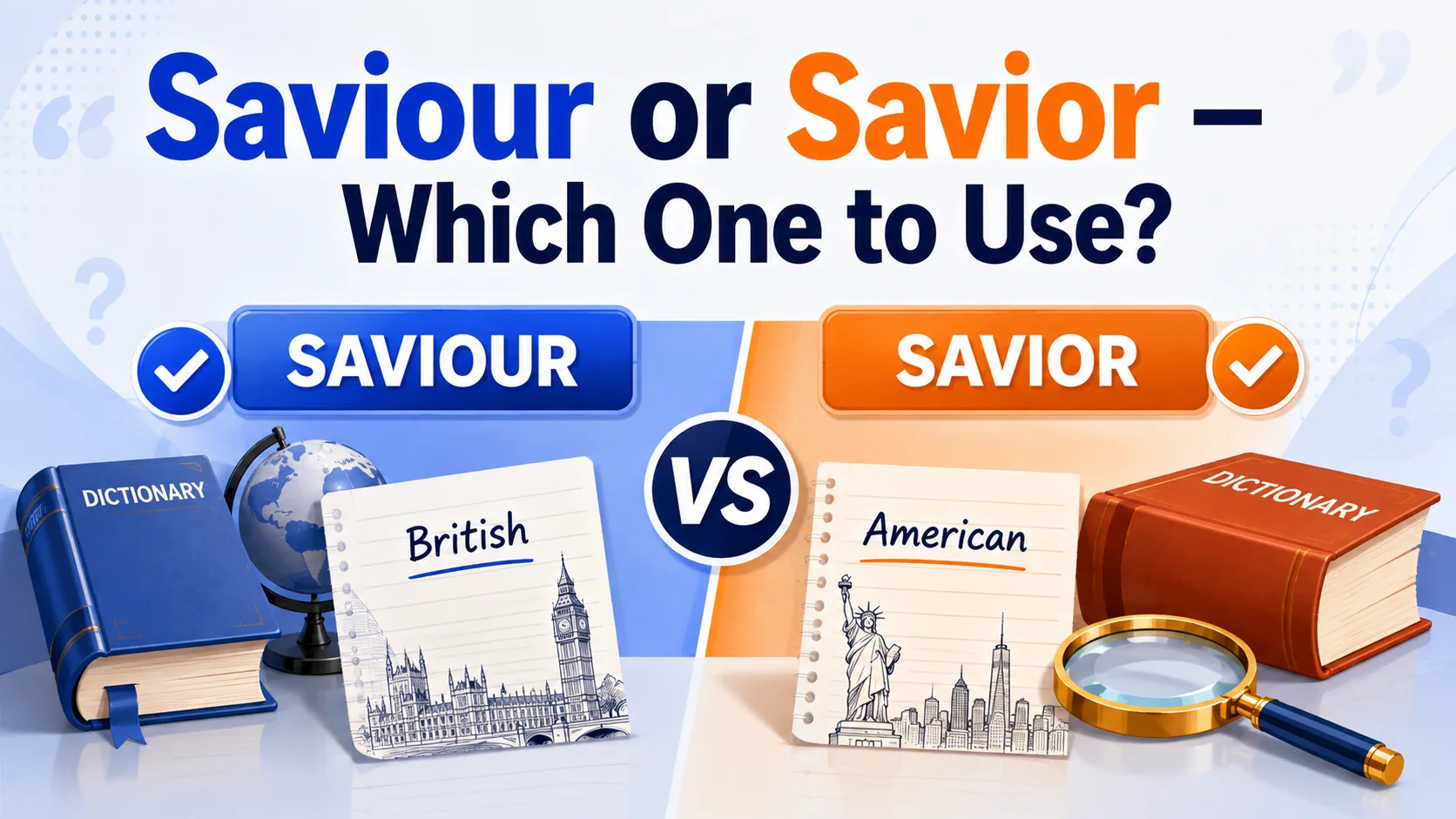
Saviour or Savior is a spelling question that often appears when you’re writing about religion, rescue, or someone who saves another person from danger. The good news is that both spellings are correct. The difference is mainly regional: “savior” is the standard spelling in American English, while “saviour” is more common in British English and several other varieties of English. Neither form changes the basic meaning of the word.
The choice becomes more important when you’re writing for a particular audience. A US publication will normally prefer savior, while British, Australian, and many other international publications may use saviour. Religious traditions and established titles can also influence the spelling you see. For example, Christian writing commonly refers to Jesus as the Savior in American English and the Saviour in British English. The underlying word and pronunciation remain essentially the same.
In this guide, you’ll learn exactly what savior and saviour mean, why the spellings differ, where each form is preferred, and how to choose the right version for your writing. You’ll also see examples from religious, historical, figurative, academic, and everyday contexts. By the end, you won’t need to guess whether the extra u belongs there—you’ll know when it does and why.
Quick Answer: Is It Savior or Saviour?
Both “savior” and “saviour” are correct spellings. The main distinction is the variety of English being used.
| Spelling | Most common in | Example |
| Savior | American English | He was hailed as a savior. |
| Saviour | British English and many other varieties | He was hailed as a saviour. |
| Meaning | Both | A person who saves or rescues someone |
The simplest rule
- Writing primarily for a US audience? Use savior.
- Writing primarily for a UK audience? Use saviour.
- Writing for an international audience? Choose one style and use it consistently.
- Following an organization’s established spelling? Follow its style guide.
Key point: “Saviour” isn’t a misspelling of “savior,” and “savior” isn’t an incorrect shortened form of “saviour.” They are regional spelling variants of the same noun.
What Does “Savior” or “Saviour” Mean?
A savior/saviour is someone or something that saves, rescues, or delivers another person from danger, difficulty, destruction, or an unwanted situation.
The word can be used in both literal and figurative contexts.
For example:
- “The firefighter was called a savior after rescuing the child.”
- “Her quick decision became the saviour of the project.”
- “In Christianity, Jesus is described as the Savior or Saviour.”
The exact meaning depends on context.
Religious meaning
In religious writing, Savior/Saviour often refers to a divine figure who is believed to save people from sin, spiritual death, or another form of spiritual separation.
In Christianity, Savior is commonly used as a title for Jesus in American English:
“Christ is described as the Savior of humanity.”
British English would normally write:
“Christ is described as the Saviour of humanity.”
The spelling changes, but the religious meaning does not.
Other religious traditions can also use related concepts of a savior, rescuer, deliverer, or redeemer, although the theological meaning isn’t necessarily identical.
Figurative meaning
You don’t have to be discussing religion to use the word.
A person can be called a savior figuratively when they solve a serious problem or rescue someone from a difficult situation.
Examples:
- “The technician was our savior when the computer system crashed.”
- “That extra funding was the saviour of the small business.”
- “A last-minute goal made the goalkeeper the team’s savior.”
Here, the word is often expressive rather than literal. The person didn’t necessarily save someone from physical death; they prevented a bad outcome.
Savior vs. Saviour: What’s the Difference?
The difference is primarily spelling convention, not meaning.
| Feature | Savior | Saviour |
| Basic meaning | A person who saves | A person who saves |
| Extra “u” | No | Yes |
| American English | Preferred | Less common |
| British English | Less common | Preferred |
| Canadian English | Commonly used | Also encountered |
| Australian English | Less common | Commonly used |
| Religious usage | Common in US writing | Common in UK-style writing |
| Pronunciation | Essentially the same | Essentially the same |
| Part of speech | Noun | Noun |
The spelling difference follows a broader pattern found in several English words.
For example:
- color / colour
- honor / honour
- favor / favour
- behavior / behaviour
- neighbor / neighbour
- savior / saviour
American English often uses the shorter -or form, while British English traditionally retains -our in these words.
Does one spelling sound more correct?
No.
If you grew up reading American English, savior may look natural while saviour may look unusually formal or foreign. A British English reader may have the opposite reaction.
That visual familiarity shouldn’t be confused with correctness.
Why Does “Saviour” Have a U?
The extra u reflects the historical development of English spelling, particularly the influence of French spelling conventions.
Words such as honour, colour, favour, and saviour preserve spelling patterns associated with British English. American English later adopted a number of simplified spellings, especially during the development of American dictionary traditions.
This doesn’t mean American English simply “removed unnecessary letters” from every British word. Spelling differences developed through a combination of historical usage, standardization, dictionaries, education, and regional convention.
That’s why it’s better to think of savior and saviour as two established standards rather than one original spelling and one incorrect modification.
Is “Savior” Correct in American English?
Yes. Savior is the standard American English spelling.
You’ll commonly see it in:
- American newspapers
- US academic writing
- American religious publications
- American fiction
- Government and institutional writing
- Everyday conversation and online communication
Examples:
- “The doctor became a savior to the community.”
- “Many Christians refer to Jesus as their Savior.”
- “The new technology was considered a savior for the struggling company.”
If you’re writing specifically for readers in the United States, savior is usually the safest choice.
Is “Saviour” Correct in British English?
Yes. Saviour is the traditional and more common British English spelling.
Examples:
- “The firefighter was regarded as a saviour.”
- “Christians believe Jesus is the Saviour.”
- “The new policy proved to be the saviour of the organization.”
British-style spelling also commonly uses forms such as favour, colour, honour, and behaviour, so “saviour” fits naturally into that spelling system.
However, British English isn’t completely isolated from American usage. You may still encounter savior in British contexts, particularly in imported American material, brand names, quotations, or publications that follow another style.
When Should You Use Savior?
Use savior when your writing follows American English conventions or when the publication, organization, or audience expects US spelling.
Common situations
Religious writing
“Jesus is regarded by Christians as the Savior.”
News writing
“The rescue worker was praised as a savior.”
Fiction
“She arrived just in time and became his unexpected savior.”
Figurative writing
“The new software was a savior for the struggling team.”
Academic writing
“The leader was portrayed as a political savior.”
The important thing isn’t merely choosing “savior.” It’s making sure the spelling matches the overall language style of the document.
If your article uses color, behavior, and organization, then savior is the natural match.
When Should You Use Saviour?
Use saviour when you’re following British English or another variety of English that traditionally retains the -our spelling.
For example:
“The volunteer was described as a saviour.”
Or:
“The king was presented as the country’s saviour.”
If the rest of your article uses colour, honour, favour, and behaviour, switching suddenly to “savior” can make your spelling look inconsistent.
A useful consistency test
Look at a few other words in your document:
| If your writing uses… | You will probably want… |
| color | savior |
| colour | saviour |
| honor | savior |
| honour | saviour |
| favor | savior |
| favour | saviour |
| behavior | savior |
| behaviour | saviour |
This isn’t an absolute grammatical rule, but it’s a useful style clue.
Does Savior or Saviour Change the Meaning?
No.
The spelling does not create two different meanings.
Consider these sentences:
“The firefighter was hailed as a savior.”
“The firefighter was hailed as a saviour.”
Both mean that the firefighter was regarded as someone who saved or rescued others.
The only meaningful difference is the spelling convention associated with the variety of English.
What about religious capitalization?
That’s a separate issue.
You may see:
- Jesus is the Savior.
- Jesus is the Saviour.
- a savior of the community
- a saviour of the community
Capitalization can reflect religious title conventions, editorial style, or context, rather than the spelling difference itself.
If you’re writing religious content, check the publication’s preferred capitalization style instead of assuming every use of the word should be capitalized.
Savior/Saviour as a Noun
Savior/saviour is primarily a noun.
It identifies a person or, sometimes, something regarded as providing rescue or salvation.
Examples
- “The nurse became the patient’s savior.”
- “The charity was seen as a saviour for the community.”
- “He regarded his mentor as his savior.”
- “The new treatment was described as a potential saviour.”
The noun can refer to:
- Someone who physically rescues another person.
- Someone who prevents failure or disaster.
- A person who solves a serious problem.
- A religious figure associated with salvation.
Savior/Saviour in Singular and Plural Forms
The plural follows the same regional spelling distinction.
| Singular | Plural |
| savior | saviors |
| saviour | saviours |
Examples:
- “The firefighters were hailed as saviors.”
- “The volunteers became local saviours.”
Notice that the spelling difference continues into the plural. If you’re using saviour, don’t switch to saviors later unless there’s a specific reason.
Possessive forms
You can also use possessives normally:
- “The savior’s actions were praised.”
- “The saviour’s actions were praised.”
- “The saviors’ efforts saved the village.”
- “The saviours’ efforts saved the village.”
Savior vs. Saviour in Religious Writing
Religious writing deserves special attention because Savior/Saviour can function as a title rather than an ordinary descriptive noun.
For example:
“Christ is the Savior.”
Here, Savior is being used as a religious title or designation.
In British English:
“Christ is the Saviour.”
Should “Savior” always be capitalized?
No.
Capitalization depends on context and editorial or religious style.
Compare:
“The firefighter became a savior to the trapped passengers.”
Here, savior is an ordinary noun.
But:
“Christians believe Jesus is the Savior.”
Here, Savior is being used as a title or distinctive religious designation.
The same principle applies to Saviour.
Expert tip: Don’t treat spelling and capitalization as the same issue. First decide whether you’re writing savior or saviour based on regional style; then decide capitalization based on context and your chosen style guide.
Savior or Saviour in Different Types of Writing
The best choice can depend on the audience and purpose of your writing.
| Type of writing | American English | British English |
| Blog article | Savior | Saviour |
| Academic paper | Savior | Saviour |
| News article | Savior | Saviour |
| Religious publication | Savior | Saviour |
| Fiction | Savior | Saviour |
| Business writing | Savior | Saviour |
| Casual communication | Savior | Saviour |
The principle is simple: the genre doesn’t normally determine the spelling by itself; the English variety does.
A British novelist can write “saviour,” while an American novelist writes “savior.” Both are perfectly natural within their respective varieties.
Common Phrases With Savior and Saviour
The word appears in several expressions and constructions.
“Savior of”
This construction identifies what or whom someone has supposedly saved.
“She became the savior of the company.”
“He was remembered as the saviour of the village.”
“A savior”
This emphasizes someone’s role as a rescuer.
“The stranger became a savior during the emergency.”
“My savior”
This can be literal, figurative, dramatic, humorous, or religious depending on context.
“You brought an umbrella? You’re my savior!”
The last example is obviously not necessarily religious. It’s an informal way of expressing strong gratitude.
“Savior complex”
The expression savior complex describes a tendency to feel responsible for rescuing or fixing other people, often beyond what is reasonable or appropriate.
In British English, you’ll also encounter a saviour complex.
The spelling follows the same regional pattern.
Savior vs. Hero: Are They the Same?
Not exactly.
A hero is someone admired for courage, achievements, or admirable actions. A savior specifically emphasizes rescue or deliverance.
Someone can be both.
For example:
“The firefighter was a hero for risking his life and a savior because he rescued the trapped family.”
The distinction becomes especially useful in careful writing.
| Word | Main idea |
| Savior/Saviour | Someone who saves or rescues |
| Hero | Someone admired for courage or exceptional actions |
| Rescuer | Someone who physically saves another person |
| Protector | Someone who guards another person |
| Deliverer | Someone who frees another from danger or difficulty |
| Redeemer | Someone who restores, saves, or makes amends; often religious |
These words overlap, but they aren’t interchangeable in every sentence.
Common Mistakes With Savior and Saviour
Mistake 1: Thinking “saviour” is always wrong
It isn’t.
Saviour is the standard spelling in British English and is also used in other varieties.
Fix: Check which variety of English you’re using.
Mistake 2: Thinking “savior” is always wrong
Again, it isn’t.
Savior is the standard American English spelling.
Fix: Don’t automatically add the u simply because you see “saviour” in religious or British writing.
Mistake 3: Mixing the two styles
A document that consistently uses British spelling may look odd if it suddenly switches to American spelling.
For example:
“The organisation praised the volunteer as a savior for his behaviour.”
The mixture of organisation, behaviour, and savior may not be desirable in a consistently British document.
A more consistent British version would be:
“The organisation praised the volunteer as a saviour for his behaviour.”
Mistake 4: Assuming the spelling changes pronunciation
For most speakers, savior and saviour are pronounced essentially the same.
The extra u is a spelling distinction, not a separate pronunciation rule.
Mistake 5: Capitalizing every use
Don’t capitalize the word simply because you’re discussing religion.
Compare:
“The firefighter was called a savior.”
with:
“Christians worship Jesus as the Savior.”
The capitalization depends on how the word functions and the style being followed.
How to Choose the Correct Spelling
When you’re unsure, use this four-step process.
Step 1: Identify your audience
Are you writing mainly for:
- Americans?
- British readers?
- Australians?
- Canadians?
- An international audience?
Your intended readership is the first clue.
Step 2: Check your existing spelling style
Look at words such as:
- color/colour
- favor/favour
- honor/honour
- behavior/behaviour
- organization/organisation
If your document consistently uses one regional style, savior/saviour should normally follow it.
Step 3: Check house style
If you’re writing for a school, newspaper, company, journal, church, or website, it may have a specific editorial style.
That style takes priority over your personal preference.
Step 4: Stay consistent
Once you’ve chosen savior or saviour, use it consistently throughout your own writing.
Quick decision:
US English → Savior
British English → Saviour
A Practical Editing Checklist
Before publishing an article containing this word, check the following:
- Have I identified my target English variety?
- Does my spelling match the rest of the document?
- Am I using savior or saviour consistently?
- Does capitalization fit the context?
- Is the word being used literally, figuratively, or religiously?
- Have I avoided treating one regional spelling as incorrect?
- If I’m quoting a source, have I preserved its original spelling?
- Does the chosen form match the organization’s style guide?
This takes only a few seconds and prevents one of the easiest forms of regional spelling inconsistency.
Savior and Saviour: Example Sentences
Examples with “Savior”
- “The paramedic became a savior to the injured hiker.”
- “Many Christians refer to Jesus as their Savior.”
- “The engineer was hailed as the savior of the project.”
- “She jokingly called her friend a savior after he brought coffee.”
- “The goalkeeper became the team’s savior during the final minutes.”
Examples with “Saviour”
- “The paramedic became a saviour to the injured hiker.”
- “Many Christians refer to Jesus as their Saviour.”
- “The engineer was hailed as the saviour of the project.”
- “She jokingly called her friend a saviour after he brought coffee.”
- “The goalkeeper became the team’s saviour during the final minutes.”
Notice that the meaning and sentence structure stay the same. Only the regional spelling changes.
Savior vs. Saviour vs. Savior’s vs. Saviours
These forms can become confusing when you’re writing quickly.
| Form | Function | Example |
| savior | Singular noun, American spelling | He became a savior. |
| saviour | Singular noun, British spelling | He became a saviour. |
| saviors | Plural, American spelling | The rescuers were called saviors. |
| saviours | Plural, British spelling | The rescuers were called saviours. |
| savior’s | Singular possessive, American spelling | The savior’s actions mattered. |
| saviour’s | Singular possessive, British spelling | The saviour’s actions mattered. |
Understanding the base spelling makes all of these forms much easier to handle.
Does the Same Difference Apply to Related Words?
Yes, although related words don’t always follow an identical pattern.
For example, English has regional differences such as:
- favor / favour
- favorite / favourite
- honor / honour
- neighbor / neighbour
- color / colour
- labor / labour
These examples help explain why savior/saviour shouldn’t be treated as a spelling mistake.
However, don’t assume that every English word ending in a similar sound will automatically have an -or/-our variation. Regional spelling patterns have developed word by word over time.
A Note About Quotes, Titles, and Names
There is one important situation where you shouldn’t “correct” the spelling to match your preferred variety: quoted or officially named material.
If an organization, book title, publication, quotation, or proper name uses Saviour, preserve that spelling when accuracy requires it.
Likewise, if you’re reproducing an American source that uses Savior, don’t change it to Saviour simply to make it look British.
Best practice: Your own prose should follow your chosen style, while quoted or official wording should generally retain its original form.
This distinction is especially useful for editors, researchers, journalists, and academic writers.
Is “Savior” More Correct Than “Saviour”?
No.
Savior is not more correct than saviour, and saviour is not more correct than savior.
They belong to different spelling conventions.
Calling one “correct” without mentioning the variety of English can be misleading. A US editor may correct saviour to savior, while a British editor may make the opposite change. Each editor can be following a legitimate regional standard.
The better question is:
Which spelling is appropriate for my audience and style?
That question produces a much more useful answer than simply asking which spelling is “right.”
Is “Saviour” Old-Fashioned?
Not necessarily.
To an American reader, saviour may look unusual, formal, or old-fashioned because American English generally uses savior. But in British English, saviour is an established standard spelling and isn’t automatically archaic.
Context can influence perception, though.
A religious text may use Saviour as part of a traditional style, while a modern British news article can use saviour in an entirely ordinary sentence.
So don’t confuse regional unfamiliarity with age.
Quick Reference: Savior or Saviour?
| Question | Answer |
| Are both spellings correct? | Yes |
| Which is standard in American English? | Savior |
| Which is standard in British English? | Saviour |
| Do they have different meanings? | No |
| Are they pronounced differently? | Generally no |
| Can both refer to Jesus? | Yes |
| Can both be used figuratively? | Yes |
| Should you mix them freely? | No; stay consistent |
| Does capitalization depend on spelling? | No |
| Is “saviour” a misspelling in British English? | No |
| Is “savior” a misspelling in American English? | No |
Conclusion
Savior and saviour are both correct; the choice depends mainly on the variety of English you’re using. Savior is the standard American spelling, while saviour is the traditional British spelling and is common in other English varieties influenced by British usage. Neither spelling changes the word’s meaning, whether you’re talking about a religious figure, a rescuer, or someone who solves a difficult problem. When editing your work, don’t judge the spelling in isolation. Look at the audience, surrounding vocabulary, publication style, and context. If the rest of your article uses American spellings such as “color” and “favor,” choose savior. If it uses “colour” and “favour,” saviour will usually fit better. One final actionable tip: choose your regional spelling before you begin editing and apply it consistently.
FAQs
Q1. Is Savior or Saviour correct in American English?
Savior is the standard spelling in American English. Saviour is recognizable but is generally associated with British or other varieties of English. If you’re writing for a US audience, use savior unless you’re preserving a quotation, title, or established name.
Q2. Is Saviour British or American spelling?
Saviour is primarily associated with British English and is also common in several other varieties that follow British spelling conventions. American English normally uses savior. The two forms have the same meaning and are pronounced essentially alike.
Q3. Should Savior be capitalized when referring to Jesus?
It depends on the religious and editorial style you’re following. Many Christian publications capitalize Savior when using it as a title for Jesus. In ordinary figurative uses, such as “a savior of the project,” lowercase is normally appropriate.
Q4. Does Saviour mean something different from Savior?
No. Saviour and savior have the same basic meaning: someone who saves, rescues, or delivers another person. The difference is regional spelling. British English generally prefers saviour, while American English generally prefers savior.
Q5. What is the plural of Savior and Saviour?
The American plural is saviors, while the British plural is saviours. For example, an American writer might say “the rescuers were hailed as saviors,” whereas a British writer would normally write “the rescuers were hailed as saviours.”