

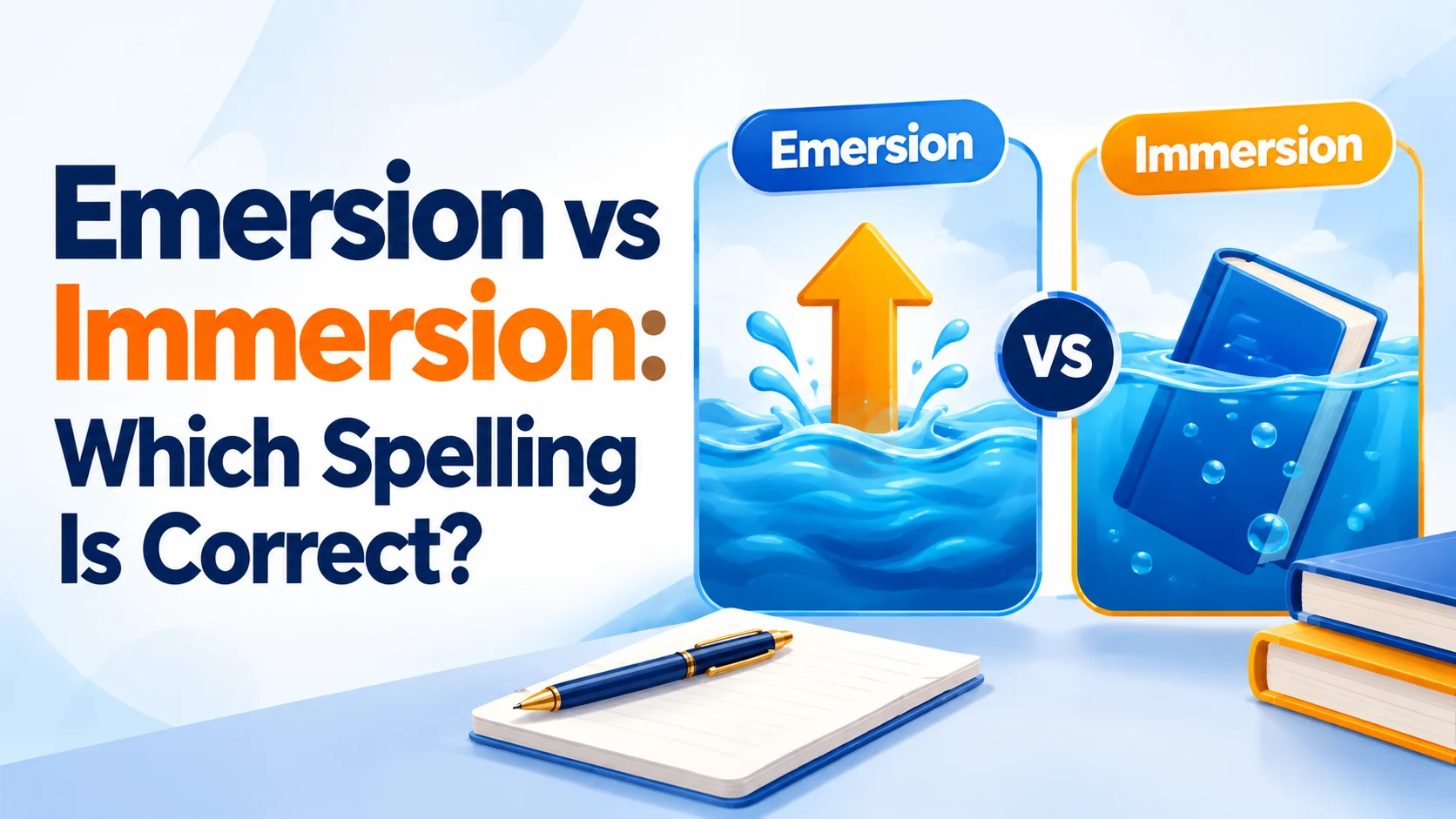
Emersion vs immersion is a spelling comparison that looks simple until you discover that both words are legitimate English words. The important difference is not spelling alone; it is meaning and context. Immersion usually describes being put into something or becoming deeply involved in it, while emersion describes emerging or coming out, particularly in specialized scientific and astronomical language.
The confusion is understandable because the two words share the same -mersion ending and are historically related to Latin verbs involving the idea of plunging or emerging. Yet the prefixes point in different directions. Immersion developed from Latin immergere, associated with going into, whereas emersion comes from emergere, associated with rising out.
For everyday writing, immersion is overwhelmingly the word you are more likely to need. You use it for language immersion, cultural immersion, immersion in a book, immersion in water, and many other situations involving deep involvement or being covered by a liquid. Emersion is much less common and is most useful when you specifically mean emergence or reappearance, especially in technical contexts such as astronomy.
Emersion vs Immersion: The Quick Answer
If you’re checking a sentence and wondering which spelling is correct, start with the meaning rather than the letters.
| Word | Basic meaning | Typical use | Example |
| Immersion | Going into something or becoming deeply involved | Everyday English, education, language, culture, water, technology | Her immersion in Spanish helped her improve quickly. |
| Emersion | Emerging, coming out, or reappearing | Specialized, scientific, and astronomical writing | Astronomers recorded the star’s emersion after the occultation. |
Both spellings are correct, but they are not interchangeable. Merriam-Webster defines emersion as “an act of emerging,” while Cambridge defines immersion in terms of both complete involvement and being placed completely under a liquid.
Quick rule: Immersion = going in or becoming deeply involved. Emersion = coming out or emerging.
That simple distinction will solve most spelling and usage questions.
Why Do Emersion and Immersion Get Confused?
The two words are unusually easy to mix up for several reasons.
They look almost identical
Only the beginning changes:
- emersion
- immersion
Both contain -mersion, and both are pronounced similarly. Someone who has encountered immersion hundreds of times may naturally assume emersion is simply a misspelling.
It isn’t.
They describe related but contrasting ideas
The words are connected conceptually. Imagine an object going beneath the surface of water and later coming back out.
- Going into the water → immersion
- Coming out of the water → emersion
The same contrast appears in astronomy, where an object can disappear from view during an occultation and later reappear. Astronomical literature explicitly uses immersion for disappearance and emersion for reappearance.
Immersion is far more familiar
Most English speakers encounter immersion regularly:
- language immersion
- cultural immersion
- immersion in a subject
- immersion in water
- immersive games
- immersive experiences
By contrast, emersion is relatively specialized. Dictionaries identify it primarily with emerging and, particularly, the astronomical reappearance of a celestial body.
So if emersion looks unfamiliar, that does not make it incorrect.
What Does Immersion Mean?
Immersion is a noun describing either being placed deeply into something or becoming completely involved in something.
Cambridge gives two especially useful senses: being completely involved in something and being put completely beneath the surface of a liquid.
Immersion as being placed into a liquid
The literal meaning involves putting someone or something under the surface of a liquid.
For example:
- The treatment requires immersion in water.
- The object was damaged after prolonged immersion.
- The experiment involved complete immersion of the sample.
This is the physical sense of the word.
Immersion as deep involvement
English also uses immersion figuratively. Someone can be immersed in a subject without getting anywhere near water.
For example:
After weeks of immersion in the subject, she understood the research much better.
Here, immersion means intense involvement or concentration.
Collins similarly defines immersion as complete involvement in a subject as well as the physical act of putting something completely into liquid.
Immersion in language learning
Language immersion means learning or using a language through sustained exposure and communication rather than relying exclusively on isolated grammar exercises.
For instance:
The students joined an English immersion program.
The idea is that learners spend substantial time using and encountering the target language.
Cambridge specifically describes an immersion course as one in which the learner uses the language or skill being studied as the primary means of learning.
Cultural immersion
Cultural immersion describes becoming deeply engaged with another culture, often through direct experience.
A traveler might participate in local traditions, communicate with residents, learn everyday customs, and experience the culture beyond ordinary sightseeing.
The important idea is involvement, not simply physical location.
Immersion in education, work, and training
You can also be immersed in:
- a research project
- professional training
- a new workplace
- a subject of study
- a creative project
For example:
The internship gave students an opportunity for immersion in professional practice.
In these cases, immersion suggests sustained attention and participation.
Immersion in gaming and digital experiences
Modern English frequently uses immersion when discussing games, films, virtual environments, and interactive media.
An immersive experience is designed to make a person feel deeply involved in the environment or activity. Cambridge describes immersive experiences as those that seem to surround the participant and make them feel completely involved.
That is why phrases such as immersive game, immersive storytelling, and immersive experience are common.
What Does Emersion Mean?
Emersion is a real English noun meaning the act or process of emerging.
Merriam-Webster defines it as “an act of emerging,” while Collins gives both the general sense of emerging and a specialized astronomical meaning.
In plain English, think:
emersion → emergence → coming out
For example, if something has been hidden, submerged, or obscured and then becomes visible again, emersion can describe that event.
The basic meaning of emersion
The broad meaning is simply emerging or coming out.
The word is uncommon in ordinary conversation, however. Most writers would normally choose emergence, reappearance, or coming out, depending on the sentence.
For example, everyday English would usually say:
The emergence of the plant from the soil was gradual.
Rather than:
The emersion of the plant from the soil was gradual.
The second sentence is possible in specialized or historical usage, but it is not the natural choice for most modern readers.
Where is emersion actually used?
One of its clearest modern uses is astronomy.
When a celestial object is temporarily hidden during an eclipse or occultation and then becomes visible again, astronomers can refer to that reappearance as an emersion. Collins specifically identifies this astronomical sense as the reappearance of a celestial body after an eclipse or occultation.
Emersion in astronomy
Consider a star passing behind the Moon from an observer’s perspective.
There are two important moments:
- The star disappears from view.
- The star reappears.
Astronomical terminology can describe these as:
- Immersion — the disappearance
- Emersion — the reappearance
A Cambridge astronomy text describes this exact distinction for occultations, while modern astronomical research also uses immersion and emersion timings to analyze stellar occultations.
NASA technical material likewise discusses immersion and emersion timings in stellar occultation studies.
Emersion vs Immersion: What Is the Main Difference?
The easiest way to understand the distinction is to focus on direction.
| Question | Immersion | Emersion |
| What happens? | Something goes into or becomes deeply involved | Something comes out or becomes visible again |
| Physical idea | Being placed under liquid | Emerging from a liquid or covering |
| Figurative idea | Deep involvement | Emerging or reappearing |
| Common in everyday English? | Yes | No, relatively uncommon |
| Language learning? | Yes | No |
| Cultural experiences? | Yes | No |
| Astronomy? | Yes | Yes |
| Related verb | Immerse | Emerge |
| Useful memory word | Into | Emerge |
Going into vs coming out
This is the central distinction.
Immersion points inward:
The swimmer’s immersion in the water lasted several minutes.
Emersion points outward:
The diver’s emersion marked the end of the underwater phase.
The latter is grammatically possible but sounds formal. In normal conversation, emergence or coming out of the water would usually be more natural.
Being surrounded by vs emerging from
The figurative meaning makes the difference even clearer.
She was immersed in her research.
This means she was deeply involved.
You would not normally replace immersed with immersed to describe that state. The meaning would change completely.
Common everyday meaning vs specialized usage
This is an important writing judgment.
If your audience is general, immersion is often the natural word when you mean deep involvement. Emersion should generally be reserved for cases where its precise technical meaning is useful.
That isn’t because emersion is incorrect. It is because correctness and naturalness are not always the same thing.
Emersion vs Immersion in Real Sentences
Examples are often more useful than definitions when two words are this similar.
Correct examples of immersion
Physical:
The equipment must undergo complete immersion in water.
Language:
Language immersion gave the students daily opportunities to practice Spanish.
Culture:
Living with a local family provided a deeper cultural immersion.
Work:
Her immersion in the project helped her understand the problem from several angles.
Entertainment:
The game’s sound design contributes to a more immersive experience.
These uses reflect the modern, common meanings of immersion.
Correct examples of emersion
General emergence:
The emersion of the object from the water was observed from the shore.
Astronomy:
The astronomers recorded the star’s emersion after the occultation.
Scientific observation:
The immersion and emersion times were compared with the predicted values.
The astronomical example is particularly well established: scientific literature routinely distinguishes the disappearance and reappearance of an occulted star using these terms.
Side-by-side sentence pairs
| If you mean… | Use… | Example |
| Deep involvement | Immersion | His immersion in history lasted several years. |
| Going beneath liquid | Immersion | The immersion of the sample took ten minutes. |
| Language learning | Immersion | The school offers French immersion. |
| Reappearing after an occultation | Emersion | The telescope recorded the star’s emersion. |
| Emerging or coming out | Emersion | The emersion was gradual. |
Is “Emersion” a Misspelling of “Immersion”?
No. Emersion is a legitimate English word with its own definition and history.
Merriam-Webster records emersion as a noun meaning an act of emerging and dates its first known use to the 17th century.
The word’s history helps explain the distinction. Emersion comes from Latin emergere, meaning to rise or come out, while immersion comes from Latin immergere, associated with plunging or dipping into something.
So this is not a case where one spelling is correct and the other is simply a typo.
The real question is:
What does your sentence mean?
If it means deep involvement or being put into something, choose immersion.
If it means emerging or reappearing, emersion may be appropriate.
When Should You Use Immersion?
Use immersion when the idea is entering deeply into something or becoming completely involved.
Use immersion for physical submerging
The immersion of the object in the solution was carefully controlled.
Use immersion for deep involvement
She spent the summer in complete immersion in her research.
Use immersion for language and cultural experiences
The program provides students with language immersion.
Use immersion for education, training, games, and technology
The course offers an intensive immersion in data analysis.
The film creates an immersive environment.
Expert writing tip: If replacing immersion with deep involvement still makes sense, you probably have the right word.
When Should You Use Emersion?
Use emersion when you specifically need the noun for emerging or reappearing.
Use emersion when something emerges
It can describe something coming out of a covering, medium, or environment.
Use emersion in specialized scientific contexts
The word can be useful when technical precision matters and the concept is explicitly one of emergence.
Use emersion in astronomy
This is its clearest specialized use. During an occultation, the hidden celestial body becomes visible again; that reappearance is its emersion.
Avoid emersion when you mean deep involvement
This is the most important practical warning.
Don’t write:
He had complete emersion in his studies.
if you mean:
He was completely involved in his studies.
Use:
He had complete immersion in his studies.
Common Mistakes With Emersion and Immersion
Mistake: Using emersion to mean deep involvement
Incorrect for the intended meaning:
She experienced complete emersion in the subject.
Better:
She experienced complete immersion in the subject.
The second sentence clearly communicates deep involvement.
Mistake: Treating emersion as a spelling error
A dictionary lookup can prevent this mistake. Emersion is independently recorded by major dictionaries.
Mistake: Using immersion when the meaning is reappearance
If an astronomical object becomes visible again after being hidden, emersion is the specialized term.
Mistake: Assuming immersion only refers to water
Modern English uses immersion extensively in education, language learning, culture, entertainment, technology, and professional development.
Immersion, Emergence, and Submersion: What’s the Difference?
These related words create another layer of confusion.
| Word | Meaning | Example |
| Immersion | Being put into something or becoming deeply involved | Her immersion in the language was intense. |
| Submersion | Being completely covered or placed under something, especially water | The device survived a brief submersion. |
| Emergence | The act or process of becoming visible, known, or developed | The emergence of new technology changed the field. |
| Emersion | Emerging or reappearing; especially a technical astronomical term | The star’s emersion was recorded. |
Immersion vs submersion
The words overlap in physical contexts, but immersion has a much broader modern meaning.
Submersion strongly emphasizes being under a surface, especially water.
Immersion can describe physical placement in liquid, but it can also mean psychological or intellectual involvement.
Immersion vs emergence
These are almost conceptual opposites in many contexts:
- Immersion → going into
- Emergence → coming out
But emergence is much more common than emersion in ordinary English.
Emersion vs emergence
The two can overlap semantically because both relate to coming out or becoming visible. However, emersion is more specialized, particularly in astronomy.
If you’re writing for a general audience and simply mean “the process of appearing or developing,” emergence will often be the more natural choice.
Related Words: Immerse, Immersed, Immersive, Emerge, and Emersion
Understanding the word families makes the spelling easier.
Immerse
Immerse is the verb.
She immersed herself in the project.
It can mean becoming completely involved or putting something under liquid.
Immersed
Immersed is the past or participle form.
He was completely immersed in the book.
Immersive
Immersive is an adjective.
The museum created an immersive experience.
Cambridge defines immersive in terms of making someone feel completely involved in an experience.
Emerge
Emerge is the verb associated with emersion.
The moon emerged from the shadow.
Emergence
Emergence is the much more familiar noun for the process of emerging.
The emergence of the new species attracted scientific attention.
Emersion
Emersion is a less common noun associated with emerging or reappearing.
The emersion of the star was recorded precisely.
A Simple Memory Trick for Emersion vs Immersion
Use the first part of each word as a reminder:
IMmersion → think IN
Something goes in.
- in water
- in a subject
- in a culture
- in an experience
Emersion → think EMERGE
Something emerges.
- comes out
- reappears
- becomes visible again
Immersion goes in. Emersion comes out.
This is a useful memory aid, but always check the actual meaning of the sentence rather than relying on the trick mechanically.
Is Immersion More Common Than Emersion?
Yes, by a substantial practical margin in ordinary English.
You encounter immersion in everyday discussions of learning, entertainment, water, work, culture, and technology. Cambridge’s dictionary entries show its broad range of current meanings and related expressions such as immersion course.
Emersion, by comparison, has a narrower modern footprint. Dictionaries emphasize its meaning as emergence and its specialized astronomical sense.
That difference matters when editing.
A practical decision table
| Your intended meaning | Best word |
| Completely involved in a subject | Immersion |
| Learning through extensive exposure | Immersion |
| Put completely under water | Immersion |
| Deeply involved in a culture | Immersion |
| An engaging digital experience | Immersion / immersive |
| Emerging from something | Emersion or emergence, depending on context |
| Celestial body reappearing after occultation | Emersion |
| General appearance or development | Usually emergence |
How to Choose the Correct Word in Your Writing
When you’re proofreading a sentence, don’t stare at the spelling. Ask three questions.
1. Is the idea going in?
If something is being placed into a liquid, environment, subject, activity, or experience, immersion is likely correct.
2. Is the idea deep involvement?
If someone is intensely focused on a subject or experience, choose immersion.
3. Is something coming out or reappearing?
If the sentence specifically describes emergence, especially a celestial body’s reappearance, emersion may be correct.
A five-second editing test
Replace the word mentally:
- Can you substitute “deep involvement”? → Immersion
- Can you substitute “emergence” or “reappearance”? → Emersion
- Does the sentence concern an astronomical occultation? → Emersion may be the precise technical term.
This method is more reliable than simply remembering which spelling “looks right.”
Conclusion
Emersion and immersion are both correct spellings, but they serve different purposes. Immersion is the everyday choice for deep involvement, language learning, cultural experiences, physical submersion, and immersive media. Emersion is much less common and refers to emerging or reappearing, with a particularly established technical use in astronomy. One final actionable tip: when proofreading, replace the disputed word with either “deep involvement” or “emergence/reappearance.” The replacement that preserves your intended meaning usually reveals the answer immediately. A common mistake to avoid: don’t assume immersion is simply a misspelling of immersion. It is a genuine word; it just belongs to a much narrower vocabulary. Immersion goes in; emersion comes out. That distinction is simple enough to remember and precise enough to guide professional writing.
Frequently Asked Questions
Q1. Is “immersion” a correct spelling?
Yes. Emersion is a correctly spelled English noun, not a typo. It means an act of emerging and has a specialized astronomical meaning involving the reappearance of a celestial body after an occultation or eclipse. However, it is much less common than immersion in everyday writing.
Q2. Is “immersion” the correct spelling?
Yes. Immersion is the standard spelling when you mean being placed into something or becoming deeply involved in an activity or subject. It is widely used in expressions such as language immersion, cultural immersion, immersion in water, and immersive experience.
Q3. Is immersion the opposite of immersion?
In a useful conceptual sense, yes. Immersion can describe entering or being covered, while emersion describes emerging or reappearing. This contrast is especially precise in astronomy, where immersion refers to a celestial body’s disappearance and immersion to its reappearance during an occultation.
Q4. Can I use “immersion” in normal conversation?
You can, but it will often sound formal or specialized. In ordinary conversation, people usually say emergence, reappearance, coming out, or another simpler expression. Emersion is most natural when technical precision is important, particularly in astronomical writing.
Q5. What is the easiest way to remember immersion vs immersion?
Think “immersion = in” and “immersion = emerge.” If someone is becoming deeply involved in a subject or going under water, choose immersion. If something is emerging or reappearing, emersion may fit. Always let the meaning and context make the final decision.