

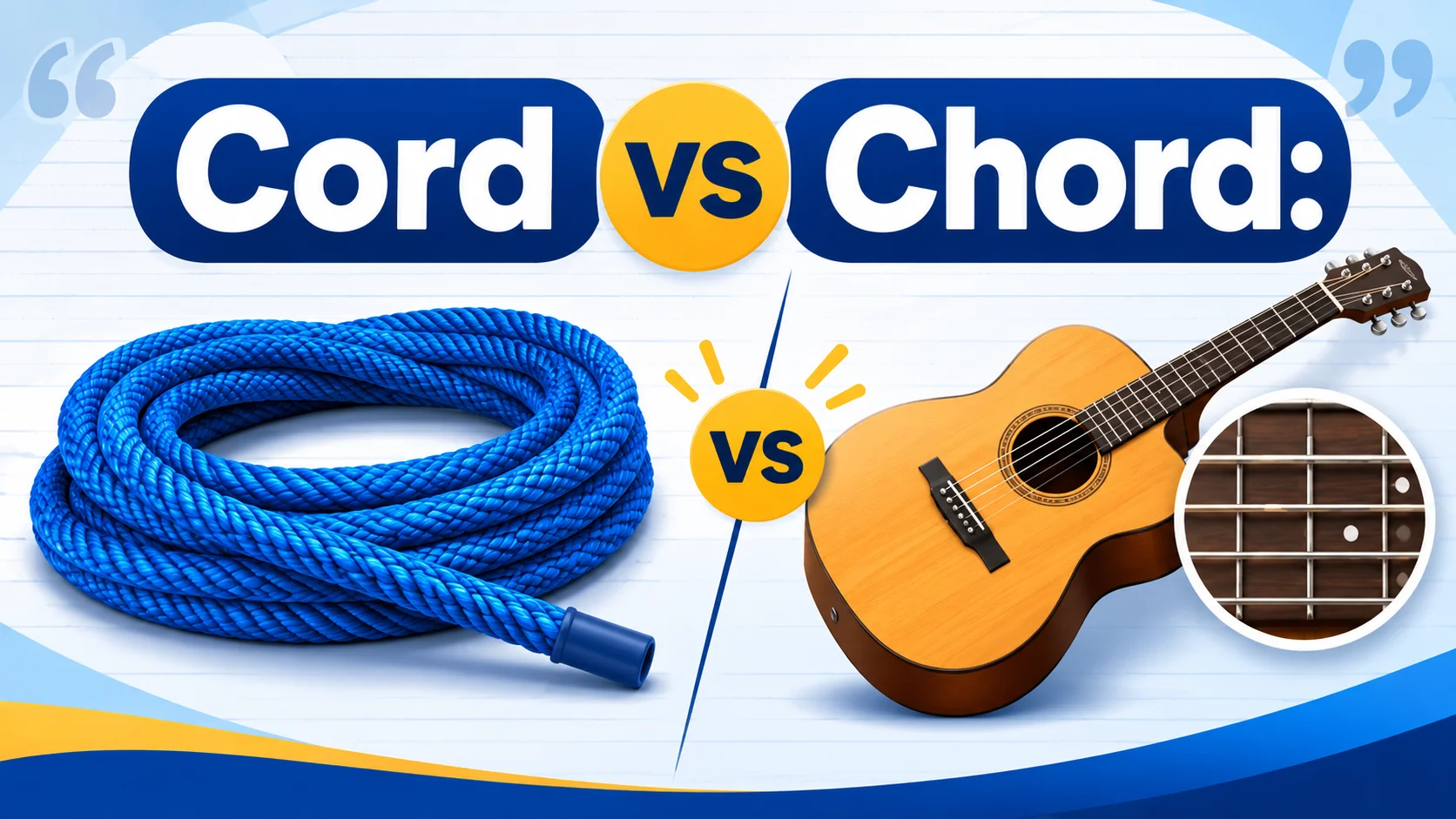
Cord vs chord is a classic English spelling confusion because the two words are generally pronounced alike but have completely different meanings. If you are talking about an electrical cable, a body structure, or a length of rope, you need cord. If you mean a group of musical notes or a line segment connecting two points on a circle, the correct spelling is chord.
The difficulty is that both words are legitimate English words, so a spell-checker may not catch the mistake. Writing “guitar cord” instead of “guitar chord” is not a spelling error in the narrow sense—the word cord itself is spelled correctly. It is a word-choice error caused by confusing homophones. Understanding the meaning behind each spelling is therefore more useful than trying to memorize the letters alone.
This guide explains cord vs chord from several angles: their definitions, grammar, pronunciation, common collocations, musical and geometric meanings, anatomical uses, idioms, and frequent mistakes. You will also find side-by-side examples, practical memory tricks, a decision table, and exercises that make it easier to choose the right word when the pronunciation gives you no clue.
Cord vs Chord: The Quick Answer
The easiest distinction is this:
Cord usually refers to a rope-like object, wire, cable, or elongated structure. Chord usually refers to music or geometry.
For example:
- “Unplug the cord from the wall.”
- “She played a beautiful chord on the piano.”
- “The doctor examined the spinal cord.”
- “The line segment is a chord of the circle.”
Both words are pronounced essentially the same in standard English, making them homophones. Their spellings, however, signal different meanings.
Cord vs chord at a glance
| Word | Main meaning | Common contexts | Example |
| cord | Rope, string, cable, or elongated structure | Everyday objects, electricity, anatomy | “The power cord is damaged.” |
| chord | Group of musical notes | Music | “He played a major chord.” |
| chord | Line segment joining two points on a circle | Geometry | “AB is a chord of the circle.” |
A useful shortcut is:
Cord = cable, rope, or body structure.
Chord = music or geometry.
What Does “Cord” Mean?
Cord is primarily a noun. Its central idea is something long, narrow, and flexible or cord-like.
The word can describe an actual piece of material, an electrical connection, or certain structures in the body. It also has some specialized meanings.
Cord as rope, string, or a flexible material
In its most concrete sense, a cord is a length of material made from fibers, threads, or similar substances. It is generally thicker or more substantial than ordinary thread or string.
Examples include:
- “Tie the package with a strong cord.”
- “She pulled the curtain cord.”
- “The bag has an adjustable cord.”
- “He wrapped the wire with a protective cord.”
The exact difference between cord, string, and rope depends on the object and context. They form an overlapping group rather than a perfectly rigid hierarchy.
A cord is often flexible and relatively narrow. A rope tends to suggest a thicker, stronger construction, while string often suggests something thinner.
Cord as an electrical wire or cable
One of the most common modern uses of cord refers to a covered electrical wire used to connect equipment to a power source or another device.
Common expressions include:
- power cord
- extension cord
- electrical cord
- charging cord
- telephone cord
- computer cord
For example:
“The printer’s power cord is too short.”
“I need an extension cord for the lamp.”
This is one of the easiest places to make the cord/chord mistake. Because cord and chord sound alike, you may hear “power cord” correctly but later write the wrong spelling.
Cord in anatomy
Cord is also used for long structures in the human body and other organisms.
Common examples include:
- spinal cord
- vocal cords
- umbilical cord
- nerve cord
- spermatic cord
The anatomical meaning is based on the idea of a long, narrow structure resembling a cord. Dictionaries specifically recognize this body-related sense.
Consider these examples:
“The spinal cord carries signals between the brain and the rest of the body.”
“The baby’s umbilical cord was cut after birth.”
“The singer damaged one of her vocal cords.”
These are always spelled with cord, not chord.
Cord as a measurement of firewood
There is another, less familiar meaning of cord: a traditional unit used for measuring stacked firewood.
If you encounter the word in a discussion about buying or selling firewood, cord may refer to this measurement rather than rope or wire.
For example:
“They ordered a cord of firewood for the winter.”
This specialized sense is easy to miss if you know cord only as an electrical cable or piece of string.
What Does “Chord” Mean?
Chord has two major meanings that are especially important: music and geometry.
Unlike cord, it does not normally refer to a cable, rope, or anatomical structure.
Chord in music
In music, a chord is a combination of notes sounded together as a harmonic unit.
For example:
“She played a C major chord.”
“The guitarist changed to a different chord.”
“The song has a simple three-chord progression.”
You will commonly see chord with words such as:
- major
- minor
- seventh
- diminished
- augmented
- progression
- change
- chart
- sequence
- symbol
A chord progression is a sequence of chords used in a piece of music.
Chord in geometry
In geometry, a chord has nothing to do with music.
A chord of a circle is a line segment whose two endpoints lie on the circle.
Imagine a circle with two points marked on its circumference. Draw a straight line connecting those points. That line segment is a chord.
This gives us an important relationship:
Every diameter is a chord, but not every chord is a diameter.
A diameter is a special type of chord because it passes through the center of the circle.
Chord vs diameter vs radius
| Geometry term | Meaning |
| Chord | A line segment connecting two points on a circle |
| Diameter | A chord that passes through the center |
| Radius | A segment from the center to a point on the circle |
| Arc | A portion of the circle’s curved boundary |
| Tangent | A line that touches a circle at one point |
This is why writing cord in a geometry problem is incorrect:
“The chord of the circle is 12 cm.”
The word refers to a mathematical object, not a rope or cable.
Cord vs Chord: Detailed Comparison
| Feature | Cord | Chord |
| Pronunciation | Generally pronounced the same as chord | Generally pronounced the same as cord |
| Part of speech | Primarily noun | Primarily noun |
| Rope/string meaning | Yes | No |
| Electrical cable meaning | Yes | No |
| Anatomical meaning | Yes | No |
| Musical meaning | No | Yes |
| Geometry meaning | No | Yes |
| Common phrase | Power cord | Guitar chord |
| Another common phrase | Spinal cord | Chord progression |
| Memory association | Cable/body | Music/circle |
The most important point is that pronunciation does not determine spelling.
You must determine what the sentence means first.
Why Are “Cord” and “Chord” So Easy to Confuse?
They are homophones
A homophone is a word that has the same pronunciation as another word but a different meaning and spelling.
Examples include:
- pair / pare
- right / write
- flower / flour
- sea / see
- cord / chord
With cord and chord, the problem is particularly persistent because both words are common enough to be familiar, yet their meanings belong to completely different subject areas.
The “h” in “chord” is silent
The h in chord does not create a different pronunciation from cord.
That means hearing the word alone does not tell you whether the speaker means:
- an electrical cord,
- a spinal cord,
- a musical chord,
- or a geometric chord.
You have to use context.
Context usually solves the problem
Consider these sentences:
“Plug in the ___.”
The answer is cord.
“Play the ___ on the guitar.”
The answer is chord.
“The surgeon examined the spinal ___.”
The answer is cord.
“The line segment is a ___ of the circle.”
The answer is chord.
The surrounding words act as clues.
Cord vs Chord in Everyday Language
In ordinary conversation, cord appears far more often in connection with physical objects, electronics, and body structures.
Common examples of “cord”
- power cord
- extension cord
- charging cord
- electrical cord
- headphone cord
- telephone cord
- curtain cord
- shoelace cord
- spinal cord
- vocal cords
- umbilical cord
Examples:
“Where did you put the charging cord?”
“The extension cord isn’t long enough.”
“The doctor said there was no damage to the spinal cord.”
Common examples of “chord”
In everyday conversation, chord is most often associated with music.
“That song has a catchy chord progression.”
“I can’t remember the final chord.”
“She learned the basic guitar chords.”
The second major everyday encounter with chord is the idiom strike a chord, discussed below.
Cord vs Chord in Music
If you are talking about notes, harmony, instruments, or musical progressions, the spelling is almost certainly chord.
Common musical expressions
| Expression | Meaning |
| major chord | A chord with a major quality |
| minor chord | A chord with a minor quality |
| guitar chord | A chord played on guitar |
| piano chord | A chord played on piano |
| chord progression | A sequence of chords |
| chord chart | A chart showing chord information |
| chord change | Movement from one chord to another |
| chord symbol | Notation identifying a chord |
Why “guitar cord” is wrong
A guitar can certainly have a cord in some physical sense—for example, an electrical cable connecting an electric guitar to equipment.
But when you mean the combination of notes played by pressing strings and strumming, the correct word is chord.
Compare:
“I need a new guitar cord.”
This could refer to a physical cable.
“I need to learn this guitar chord.”
This refers to a musical combination of notes.
That small spelling difference completely changes the meaning.
Cord vs Chord in Geometry
The geometric meaning of chord is one of the most important meanings for students to understand.
What is a chord of a circle?
A chord is a straight line segment connecting two points on the circumference of a circle.
For example, if points A and B lie on a circle, the segment connecting A and B is chord AB.
A chord can be:
- short,
- long,
- close to the edge,
- or positioned across the circle.
It does not have to pass through the center.
Why a diameter is also a chord
A diameter connects two points on a circle and passes through its center.
Therefore, it satisfies the definition of a chord.
So:
A diameter is a special kind of chord.
But a chord that does not pass through the center is not a diameter.
Example
Suppose a circle contains a line segment joining two points on its circumference. The segment measures 8 cm and does not pass through the center.
You would call it an 8-cm chord, not a cord.
Cord vs Chord in Anatomy
Medical and biological terminology provides several common examples of cord.
Spinal cord
The spinal cord is part of the central nervous system.
Correct:
“The injury affected the spinal cord.”
Incorrect:
“The injury affected the spinal chord.”
Vocal cords
The vocal cords are structures involved in producing sound.
Correct:
“The singer rested her vocal cords.”
Incorrect:
“The singer rested her vocal chords.”
The second version looks plausible because chord is associated with sound and music. That association can actually make this particular error more tempting.
But vocal cords are anatomical structures, so the correct spelling is cords.
Umbilical cord
Correct:
“The umbilical cord connects the developing fetus with the placenta.”
Again, this is a physical anatomical structure, so cord is the correct spelling.
“Strike a Chord” or “Strike a Cord”?
The correct expression is:
strike a chord
not:
strike a cord
The expression comes from the musical sense of chord and is now commonly used figuratively.
To strike a chord means to create a strong emotional, personal, or intellectual response.
For example:
“The speaker’s story struck a chord with the audience.”
“The film struck an emotional chord with viewers.”
“Her comments struck a familiar chord with many parents.”
Why “strike a cord” is wrong
A cord is a rope, wire, cable, or cord-like structure. It does not supply the musical meaning behind the idiom.
The metaphor depends on music, so the spelling is chord.
Memory tip: If something resonates emotionally, think music → chord.
Common Cord vs Chord Mistakes
Mistake 1: “Power chord”
Incorrect when referring to an electrical cable:
“The power chord is unplugged.”
Correct:
“The power cord is unplugged.”
However, power chord is also a legitimate musical term in guitar music. Context matters.
That is an excellent example of why you should never choose a spelling based on the phrase alone.
Mistake 2: “Guitar cord”
If you mean a musical combination of notes:
“This guitar chord is difficult.”
If you mean an actual cable:
“The guitar cord is damaged.”
Both words can appear in guitar-related writing, but they describe completely different things.
Mistake 3: “Spinal chord”
Correct:
spinal cord
The word chord has no anatomical meaning here.
Mistake 4: “Vocal chords”
Correct:
vocal cords
The fact that vocal cords produce sound does not make them musical chords.
Mistake 5: “Circle cord”
Correct:
circle chord or chord of a circle
In geometry, the term is chord.
Why Spell-Checkers May Not Catch a Cord/Chord Error
This is an important point for writers and editors.
Suppose you write:
“Please plug in the computer chord.”
A conventional spell-checker may not flag chord because chord is spelled correctly and is a legitimate English word.
The problem is context, not spelling.
The same thing happens with many homophones:
- “Their going home.”
- “I ate too much flour.”
- “She has good patients.”
- “The principle is on the phone.”
Automated tools can identify many mechanical errors, but a human—or a context-aware editing system—may be needed to determine whether the selected word actually fits the meaning.
A better proofreading habit
When proofreading a sentence containing a homophone, ask:
“What does this word mean here?”
Do not ask only:
“Is this word spelled correctly?”
That distinction catches many errors that ordinary spell-checking misses.
Common Expressions With “Cord”
Here are some useful collocations to recognize.
Electrical and household expressions
- power cord
- extension cord
- electrical cord
- charging cord
- telephone cord
- appliance cord
- cord organizer
- cord holder
Anatomical expressions
- spinal cord
- vocal cords
- umbilical cord
- nerve cord
- spermatic cord
Other expressions
- cord of wood
- corded device
- cordless device
- cut the cord
The expression cut the cord can be literal or figurative. Figuratively, it can mean ending a dependency or, in modern media usage, canceling traditional cable television service.
Common Expressions With “Chord”
Music
- guitar chord
- piano chord
- major chord
- minor chord
- chord progression
- chord chart
- chord change
- chord sequence
- chord symbol
Geometry
- chord of a circle
- chord length
- equal chords
- intersecting chords
Figurative language
- strike a chord
- strike an emotional chord
- strike a familiar chord
- strike a responsive chord
These expressions reinforce the two main semantic areas of chord: music and geometry.
Cord vs Chord: How to Remember the Difference
You do not need a complicated mnemonic.
Remember “cord” as something you can connect, tie, or find in the body
Think:
Cord → cable → rope → body structure
Examples:
- power cord
- extension cord
- spinal cord
- vocal cords
- umbilical cord
Remember “chord” as music or a circle
Think:
Chord → harmony → music
and:
Chord → circle → geometry
Examples:
- guitar chord
- piano chord
- chord progression
- chord of a circle
The five-second test
When unsure, ask:
- Is it a cable or rope? → cord
- Is it part of the body? → cord
- Is it a musical combination of notes? → chord
- Is it a line segment in a circle? → chord
- Is it an idiom involving emotional resonance? → chord
That covers the vast majority of situations.
Cord vs Chord in Formal and Professional Writing
The distinction matters more in professional writing because the wrong word can change the apparent meaning of a technical statement.
Medical writing
Use:
- spinal cord
- vocal cords
- umbilical cord
Electrical or technical writing
Use:
- power cord
- extension cord
- electrical cord
Music writing
Use:
- musical chord
- major chord
- chord progression
Mathematics writing
Use:
- chord of a circle
- chord length
- intersecting chords
The best professional practice is simple: identify the field first, then select the word.
A Practical Decision Table
| If you mean… | Correct word | Example |
| A piece of rope or string | cord | “Tie it with a cord.” |
| An electrical cable | cord | “The power cord is loose.” |
| A spinal structure | cord | “The spinal cord was examined.” |
| Vocal anatomy | cord | “Her vocal cords were strained.” |
| Umbilical structure | cord | “The umbilical cord was cut.” |
| A firewood measurement | cord | “They bought a cord of wood.” |
| Several musical notes played together | chord | “Play a C major chord.” |
| A guitar or piano harmony | chord | “Learn this chord.” |
| A line segment across a circle | chord | “AB is a chord.” |
| An emotional resonance idiom | chord | “The story struck a chord.” |
Practice: Choose Cord or Chord
Test yourself before looking at the answers.
- Please unplug the power ___ before moving the machine.
- She learned her first guitar ___ yesterday.
- The doctor examined the patient’s spinal ___.
- The line segment is a ___ of the circle.
- The speech struck an emotional ___ with the audience.
- We need an extension ___ for the outdoor lights.
- The singer rested her vocal ___.
- The pianist played a beautiful minor ___.
- The baby was still attached to the umbilical ___.
- The geometry problem asks you to calculate the length of a ___.
Answer key
| No. | Answer | Reason |
| 1 | cord | An electrical cable is a cord. |
| 2 | chord | A musical combination of notes is a chord. |
| 3 | cord | The anatomical term is spinal cord. |
| 4 | chord | A line segment joining two points on a circle is a chord. |
| 5 | chord | The idiom comes from the musical sense. |
| 6 | cord | An extension cord is an electrical cable. |
| 7 | cord | Vocal cords are anatomical structures. |
| 8 | chord | A minor chord is a musical harmony. |
| 9 | cord | The anatomical term is umbilical cord. |
| 10 | chord | Chord length is a geometric concept. |
A harder example: “power chord” vs “power cord”
Consider these two sentences:
“The guitarist played a powerful power chord.”
“The amplifier’s power cord was damaged.”
Both are correct.
This is a useful reminder that the surrounding context determines the spelling. The words power and guitar do not automatically determine the answer; the meaning of the phrase does.
Cord vs Chord: Quick Recap Checklist
Before choosing the spelling, check the meaning:
- Cable or electrical wire? → cord
- Rope or thick string? → cord
- Spinal anatomy? → cord
- Vocal anatomy? → cord
- Umbilical anatomy? → cord
- Firewood measurement? → cord
- Musical notes? → chord
- Guitar or piano harmony? → chord
- Circle geometry? → chord
- “Strike a ___” expression? → chord
Best memory rule: Cord connects or forms a long structure; chord belongs to music or geometry.
Conclusion
The difference between cord vs chord becomes straightforward once you stop relying on sound and start with meaning. Use cord for ropes, strings, electrical cables, and anatomical structures such as the spinal cord, vocal cords, and umbilical cord. Use chord for music and geometry, including guitar chords, chord progressions, and chords of a circle. The same distinction explains why we say “strike a chord” rather than “strike a cord.” One final actionable tip: when proofreading, ask what the word actually refers to before checking its spelling. A common mistake to avoid is trusting spell-check alone, because both cord and chord are correctly spelled English words. If the meaning is a cable or body structure, choose cord; if it is music, geometry, or emotional resonance, choose chord. Once that semantic connection becomes automatic, this homophone pair becomes much easier to handle.
Frequently Asked Questions
Q1. What is the main difference between “cord” and “chord”?
Cord usually refers to a rope-like material, electrical cable, or anatomical structure. Chord refers mainly to a group of musical notes or a line segment in geometry. The words are generally homophones, so their pronunciation is the same or nearly the same despite their different meanings.
Q2. Is it “guitar cord” or “guitar chord”?
When you mean a group of notes played on a guitar, the correct expression is guitar chord. However, a physical cable connecting an electric guitar to an amplifier can be called a cord. The correct choice therefore depends on whether you mean music or equipment.
Q3. Is it “vocal cords” or “vocal chords”?
The correct expression is vocal cords. Vocal cords are anatomical structures involved in producing sound. Although they are associated with singing and music, they are not musical chords. Chord is reserved for the musical or geometric meaning.
Q4. Is a diameter a chord?
Yes. In geometry, every diameter is a chord because it connects two points on a circle. A diameter is a special type of chord because it passes through the circle’s center. A chord that does not pass through the center is not a diameter.
Q5. Why are “cord” and “chord” pronounced the same?
They are homophones, meaning their spellings and meanings differ while their pronunciations are generally the same. The silent h in chord does not create a separate sound. Because pronunciation cannot distinguish them, context determines which spelling is correct.