

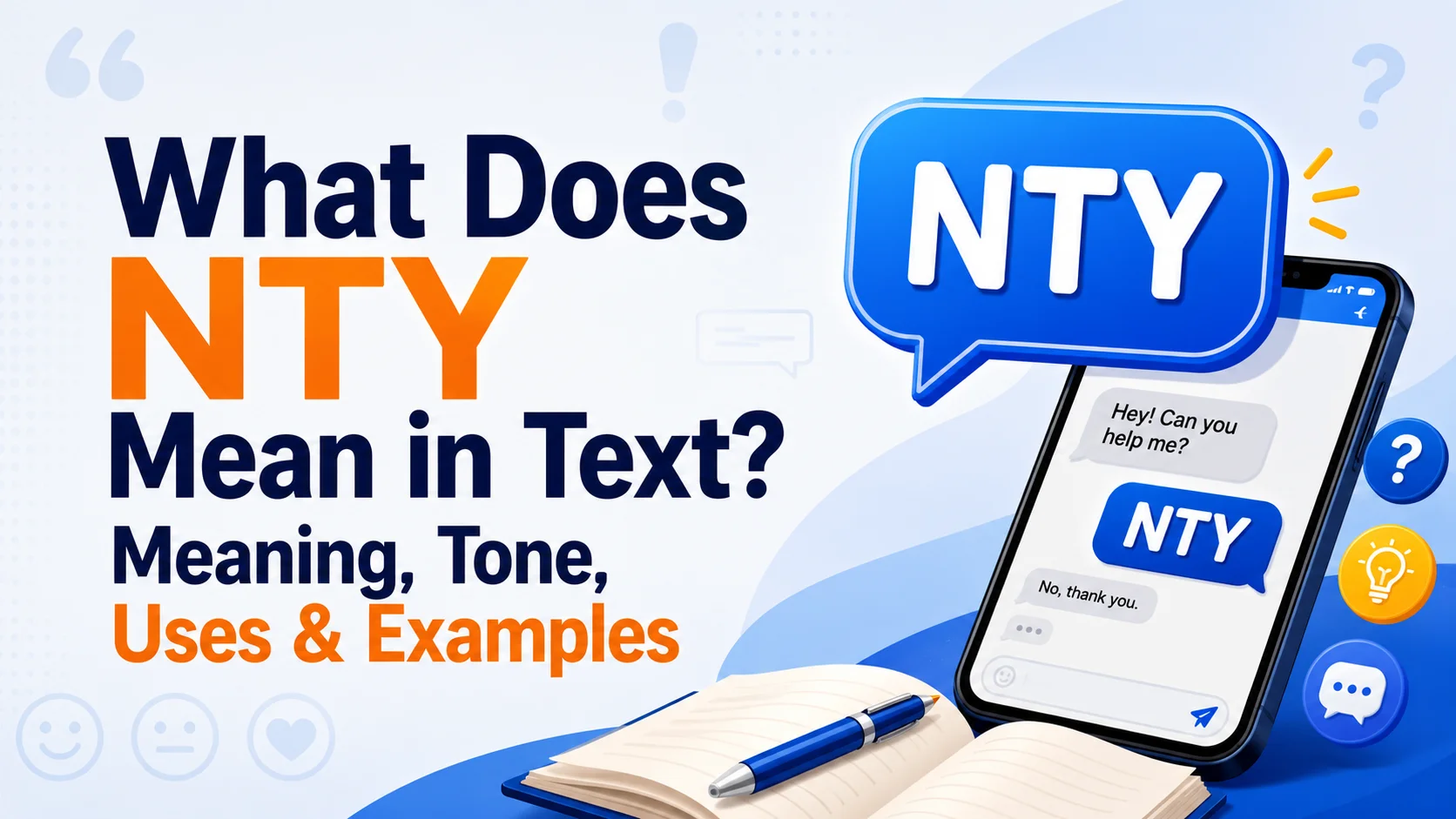
What does NTY mean in text? In most texting and online conversations, NTY means “No Thank You.” It’s an informal abbreviation people use when they want to decline an offer, invitation, suggestion, request, or proposal without typing the entire phrase. For example, if someone asks, “Want to come to the movies tonight?” you might reply, “NTY, I’m staying home.” The expression is generally a polite refusal, although a bare “NTY” can sometimes feel brief or slightly dismissive depending on the relationship and context. Current slang references consistently identify “No Thank You” as its main meaning in texting.
Although the meaning is simple, tone is where NTY gets interesting. Digital messages remove many of the cues you would normally get from someone’s voice, facial expression, or body language. As a result, “NTY,” “nty 😂,” and “No, thank you!” can all communicate the same basic refusal while creating very different impressions. If you’re trying to understand a message you’ve received—or decide whether you should use NTY yourself—context matters more than the three letters alone.
In this guide, you’ll learn what NTY stands for, how people use it, whether it sounds rude or polite, when to use it, when to avoid it, and how it compares with expressions such as “no thanks” and “I’m good.” You’ll also see realistic text examples, common mistakes, alternative meanings, and practical ways to respond. By the end, you should be able to recognize NTY instantly and understand the difference between its literal meaning and conversational tone.
Quick Answer: What Does NTY Mean in Text?
NTY usually means “No Thank You.”
People use it as a short, informal way to decline something while retaining the basic politeness of “no, thank you.” It can appear in text messages, direct messages, online chats, gaming conversations, social media interactions, and other casual digital settings.
For example:
Friend: Want another slice of pizza?
You: NTY, I’m full.
Here, NTY = No Thank You.
The abbreviation doesn’t necessarily mean the person is angry, uninterested in you, or trying to end the relationship. They’re simply declining the particular thing being offered.
However, a short response can still sound dry, cold, friendly, playful, or dismissive depending on the surrounding conversation.
What Does NTY Mean in Texting?
NTY Stands for “No Thank You”
NTY is an initialism formed from the first letters of No Thank You. It functions as internet shorthand, allowing someone to communicate a familiar phrase quickly.
You may see it written as:
- NTY
- nty
- Nty
Capitalization usually doesn’t change the meaning. In casual texting, lowercase “nty” may look more relaxed, while uppercase “NTY” can appear slightly more emphatic simply because of its visual presentation.
The phrase itself isn’t new. What changes in digital communication is the compressed form. Instead of typing “No, thank you,” a person can use three letters and move on.
What NTY Means in Different Situations
The basic meaning stays the same, but the situation determines what exactly is being declined.
| Situation | Example | What NTY Communicates |
| Invitation | “Want to come over?” — “NTY” | I don’t want to come |
| Food or drink | “Want some coffee?” — “NTY” | No, I don’t want any |
| Offer | “Want to buy this?” — “NTY” | I’m declining the offer |
| Suggestion | “You should try this.” — “NTY 😂” | No, that’s not for me |
| Request | “Can I send you another link?” — “NTY” | Please don’t |
| Online trade | “Would you trade this item?” — “NTY” | I’m declining the trade |
Notice that NTY doesn’t explain why someone is saying no. It simply communicates the decision.
NTY vs. “No Thanks” vs. “No”
These expressions overlap, but they don’t always create the same impression.
- “No” is the most direct and can sound abrupt.
- “No thanks” is casual and polite.
- “No, thank you” is clearer and slightly more conventional.
“NTY” carries the same basic idea in an informal digital form.
If you’re talking to someone you don’t know well, “No, thank you” often provides more warmth and clarity than a three-letter abbreviation.
Is NTY Polite, Rude, or Dismissive?
There isn’t a single answer.
The literal phrase “No Thank You” is polite, but abbreviating it can change how the message feels. Digital communication depends heavily on context, and a short response gives the reader fewer clues about the sender’s attitude.
When NTY Sounds Polite
NTY can sound perfectly friendly when the conversation is already casual.
For example:
Friend: Want to play later?
You: NTY, I have homework tonight.
The added explanation makes the intention obvious: you’re declining the activity, not rejecting the person.
Another example:
Friend: Want me to grab you anything from the store?
You: NTY, I’m good!
The second phrase softens the refusal.
When NTY Can Sound Cold
A standalone “NTY” can feel abrupt when the other person has made a personal effort or when the topic is sensitive.
Consider:
Person: I spent all afternoon putting this together for you.
Reply: NTY.
Technically, the abbreviation could mean “No Thank You,” but the lack of explanation may make the response feel dismissive.
This is an important distinction:
Meaning and tone aren’t always the same thing.
The dictionary-level meaning may be polite while the conversational effect feels less warm.
How Context Changes the Meaning
When interpreting NTY, look at five things:
- What was offered?
- Who sent the message?
- What was said immediately before it?
- Were emojis or punctuation used?
- Does the sender normally communicate this way?
For instance:
- “NTY 😂” → likely playful or humorous.
- “nty haha” → casual and relaxed.
- “NTY.” → may feel more final or serious.
- “NTY, but I appreciate it!” → clearly polite.
- “sorry nty” → a softer refusal.
The letters haven’t changed. The surrounding language has.
Expert tip: If you’re concerned that NTY might sound too blunt, add a short softener such as “but thanks,” “I’m good,” “maybe another time,” or “I appreciate it.”
NTY Examples: What It Means in Different Conversations
Understanding NTY is easier when you see it in realistic exchanges.
NTY When Declining an Invitation
Alex: Want to come to dinner with us?
Sam: NTY, I already have plans.
Here, NTY is simply a quick refusal.
Another example:
Alex: Movie tonight?
Sam: nty, I’m exhausted 😭
The emoji and explanation make the response feel less formal.
NTY When Rejecting an Offer
Seller: I can give you this one for $20.
Buyer: NTY, I’ll pass.
In online marketplaces or casual trading communities, abbreviations can make repeated interactions much faster.
NTY When Turning Down a Suggestion
Friend: You should definitely try the spicy version.
You: NTY 😂 I know my limits.
The expression here isn’t necessarily serious. It can be part of a playful exchange.
NTY in a Friendly Conversation
Friend: Want some of my fries?
You: NTY, but I appreciate you offering!
The extra wording makes the social intention unmistakable.
NTY in a More Serious Conversation
Suppose someone asks:
“Would you like to discuss this right now?”
Replying only “NTY” may sound colder than intended because the subject is more serious.
A better response might be:
“No, thank you. I’d rather talk about it tomorrow.”
The principle is simple: the more sensitive the situation, the more useful complete language becomes.
When Should You Use NTY?
NTY works best when your audience already understands casual internet shorthand.
Good Situations for NTY
You can reasonably use NTY in:
- Texts with close friends
- Casual group chats
- Informal DMs
- Gaming chats
- Social media conversations
- Online communities
- Quick everyday responses
It is particularly useful when the other person has offered something and a detailed explanation isn’t necessary.
Situations Where You Should Avoid NTY
Be more cautious in:
- Formal emails
- Job applications
- Customer-service correspondence
- Academic writing
- Official notices
- Business proposals
- Sensitive personal discussions
- Messages to someone unfamiliar with texting slang
For example, if a recruiter asks whether you’re available for an interview, don’t respond:
NTY
Even if you mean “No, thank you,” it can appear careless or overly casual.
A professional response would be:
“Thank you for reaching out, but I’m not available at this time.”
The issue isn’t that NTY is grammatically wrong. It’s a register problem.
Better Alternatives When You Need More Warmth
Choose the wording according to the relationship and situation:
| Situation | Better Response |
| Close friend | “NTY, I’m good!” |
| Casual acquaintance | “No thanks, but I appreciate it.” |
| Sensitive situation | “No, thank you. I’d rather not.” |
| Professional message | “Thank you, but I’ll have to decline.” |
| Formal refusal | “Thank you for the offer, but I’m unable to accept.” |
This approach gives you control over both meaning and tone.
NTY in Social Media, DMs, and Online Culture
NTY belongs to the broader world of digital shorthand, where users routinely shorten familiar phrases.
You may encounter it in:
- Private messages
- Group chats
- Social media comments
- Gaming communities
- Online marketplaces
- Forums
- Instant messaging
The exact frequency varies between communities, so it shouldn’t be treated as universal internet vocabulary. Some people use abbreviations constantly; others prefer writing full phrases.
Why Short Abbreviations Work Online
There are several practical reasons people shorten phrases:
Speed: Three letters take less effort than typing a full sentence.
Familiarity: People who regularly use online shorthand recognize it immediately.
Informality: Abbreviations help conversations feel less formal.
Efficiency: If the answer is simply “no,” there may be little reason to write a paragraph.
This doesn’t mean abbreviations are automatically better. They work because the participants share enough context to understand them.
NTY in Comments, Replies, and Memes
Online, NTY can also be used humorously.
For example:
“Want to wake up at 5 a.m. and go running?”
“NTY 😭”
The speaker isn’t necessarily making a serious social refusal. The abbreviation becomes part of the joke.
That’s why interpreting slang requires more than expanding the letters. You should consider the entire conversational scene.
NTY vs Similar Texting Abbreviations
- NTY is easy to confuse with other short expressions because digital slang often compresses entire phrases into just a few characters.
| Term | Meaning | Main Function | Typical Tone |
| NTY | No Thank You | Decline something | Neutral/polite |
| TY | Thank You | Express gratitude | Positive |
| NVM | Never Mind | Withdraw or dismiss a topic | Context-dependent |
| IDC | I Don’t Care | Express indifference | Can sound blunt |
| NP | No Problem | Reassure or accept thanks | Friendly |
| TBH | To Be Honest | Introduce an honest opinion | Conversational |
| I’m good | No, thanks | Decline casually | Usually friendly |
NTY vs TY
These are almost opposites in function.
- TY = Thank You
- NTY = No Thank You
Someone might even combine related ideas:
“NTY, but TY for offering.”
That means:
“No thank you, but thank you for offering.”
NTY vs NVM
NVM means “Never Mind.”
It usually indicates that the speaker is withdrawing a question, request, thought, or topic.
“Can you send me the address? NVM, I found it.”
NTY, by contrast, specifically communicates a refusal or decline.
NTY vs IDC
IDC means “I Don’t Care.”
That’s a different message. IDC focuses on indifference, while NTY focuses on declining something.
Compare:
“Want pizza?” — “NTY.”
The person doesn’t want pizza.
“Which pizza should we get?” — “IDC.”
The person doesn’t care which option is chosen.
Using IDC when you mean NTY can therefore make your response sound more dismissive than intended.
NTY vs “I’m Good”
“I’m good” is often one of the most natural alternatives to NTY in everyday American English.
“Want another drink?”
“I’m good, thanks.”
It usually communicates a refusal without making the refusal feel especially formal.
Common NTY Mistakes and Misunderstandings
Assuming NTY Is Always Friendly
Because the phrase expands to “No Thank You,” some people assume the abbreviation can never sound rude.
That’s not quite right.
A bare abbreviation can feel dry or dismissive, especially if the recipient expects more explanation. Online discussions show that people don’t always agree about how blunt “nty” feels; some consider it perfectly polite, while others prefer adding context.
Using NTY in Formal Communication
The biggest practical mistake is using informal shorthand where the audience expects conventional written English.
The abbreviation isn’t inherently incorrect. The setting determines whether it’s appropriate.
Giving NTY Without Enough Context
If your refusal could reasonably be misunderstood, add a few words.
Instead of:
NTY
try:
“NTY, I can’t make it tonight.”
Now the recipient knows exactly what you’re declining.
Confusing NTY With Other Abbreviations
Don’t assume every abbreviation beginning with NT has the same meaning. Specialized communities may use the same letters differently.
Reading Too Much Emotion Into a Short Reply
If someone sends “nty”, you shouldn’t automatically conclude that they’re angry.
A short response might mean:
- They’re busy.
- They’re typing quickly.
- They’re accustomed to shorthand.
- They don’t think an explanation is necessary.
- They’re simply declining the offer.
Text alone doesn’t provide enough evidence to determine someone’s emotions with certainty.
Does NTY Have Other Meanings?
In ordinary texting, “No Thank You” is the key interpretation. However, abbreviations can have unrelated meanings in specialized contexts.
Abbreviation databases list several non-chat expansions for NTY, including organizational, geographic, and other specialized meanings.
That distinction matters.
If someone writes:
“Do you want another slice?” — “NTY.”
the intended meaning is almost certainly “No Thank You.”
But if you encounter NTY in a technical document, database, organization name, or specialized industry, don’t automatically apply the texting definition.
A Simple Context Test
Ask:
Is someone responding to an offer, invitation, request, or suggestion?
If yes, NTY = No Thank You is the most likely interpretation.
If NTY appears as part of a proper name, code, organization, or technical context, investigate the surrounding material instead.
How to Reply When Someone Says NTY
You don’t usually need to do anything complicated.
Friendly Replies
If someone declines your invitation:
“No worries!”
“All good!”
“Sure, maybe next time.”
“No problem 😊”
These responses acknowledge the refusal without pressuring the person.
When You Want to Ask Why
If the reason genuinely matters, ask gently rather than challenging the decision.
For example:
“No worries—just wondering, are you busy tonight?”
That’s very different from:
“Why not?”
The second can sound demanding depending on the situation.
When the Conversation Should End
Sometimes NTY is simply a clear refusal.
If someone declines an offer, you don’t need to persuade them repeatedly.
For example:
You: Want to come with us?
Them: NTY, I’m staying home.
You: No worries!
That’s enough.
A good digital communicator recognizes when a short answer is actually a complete answer.
A Simple Way to Remember NTY
The “N-T-Y” Memory Trick
Remember the three letters:
- N = No
- T = Thank
- Y = You
Put them together:
NTY = No Thank You
It’s one of those abbreviations where remembering the expansion is easier than memorizing a complicated slang definition.
A Quick Context Test
When you see NTY, ask:
“Is the person politely saying no to something?”
If the answer is yes, you’ve probably solved it.
For example:
“Want to join us?”
“NTY.”
The person is declining the invitation.
“Want another cookie?”
“NTY.”
The person is declining the offer.
“Do you want to trade?”
“NTY.”
The person is declining the proposal.
NTY Meaning at a Glance
| Question | Answer |
| What does NTY mean? | No Thank You |
| What type of language is it? | Informal digital shorthand |
| What does it usually communicate? | A refusal or polite decline |
| Is it always rude? | No; tone depends on context |
| Can it be used with friends? | Yes |
| Can it be used formally? | Usually not recommended |
| Does capitalization matter? | Usually no |
| Can emojis change its tone? | Yes |
| Does it have other meanings? | Yes, in specialized contexts |
| Best formal alternative | “Thank you, but I’ll have to decline.” |
Conclusion
NTY usually means “No Thank You,” and its main job is simple: it lets someone decline an offer, invitation, suggestion, or request quickly. The important part isn’t the abbreviation itself but the context surrounding it. A standalone “NTY” may feel dry, while “NTY, but thanks!” can sound warm and appreciative. That’s why you shouldn’t automatically interpret a short digital response as anger or rejection of you personally. One final actionable tip: match your wording to the relationship and situation. Use NTY freely in casual chats when everyone understands texting shorthand, but switch to complete sentences when clarity or professionalism matters. A common mistake to avoid is assuming that polite words automatically create a warm tone. In digital communication, a few extra words can make all the difference. When the relationship matters, clarity is worth the extra keystrokes.
Frequently Asked Questions
Q1. What does NTY mean in text?
NTY usually means “No Thank You.” It’s an informal abbreviation used to decline an offer, invitation, request, or suggestion. The expression is generally polite in meaning, but a standalone “NTY” may sound brief or dry depending on the conversation and relationship between the people texting.
Q2. Is NTY rude or polite?
NTY is generally a polite refusal, because it represents “No Thank You.” However, tone depends on context. A message such as “NTY, but thanks!” sounds warmer than simply “NTY.” In sensitive conversations, writing the full phrase can prevent your response from appearing dismissive or overly abrupt.
Q3. What does NTY mean from a girl or guy?
NTY doesn’t have a special gender-specific meaning. Whether a girl, guy, friend, coworker, or stranger sends it, the usual interpretation remains “No Thank You.” If you’re wondering what the person means emotionally, look at the surrounding conversation rather than trying to assign a different meaning based on gender.
Q4. Can I use NTY in professional messages?
You generally shouldn’t use NTY in formal professional communication. It may be understandable, but it can look overly casual. For workplace emails, applications, or official messages, use “No, thank you,” “Thank you, but I’ll decline,” or another complete sentence that matches the level of formality required.
Q5. What is the difference between NTY and “no thanks”?
There is very little difference in basic meaning: both communicate a polite refusal. The main difference is register. “No thanks” is ordinary conversational English, while NTY is abbreviated digital shorthand. If you’re unsure which one to choose, “No thanks” is usually clearer and more universally understood.