

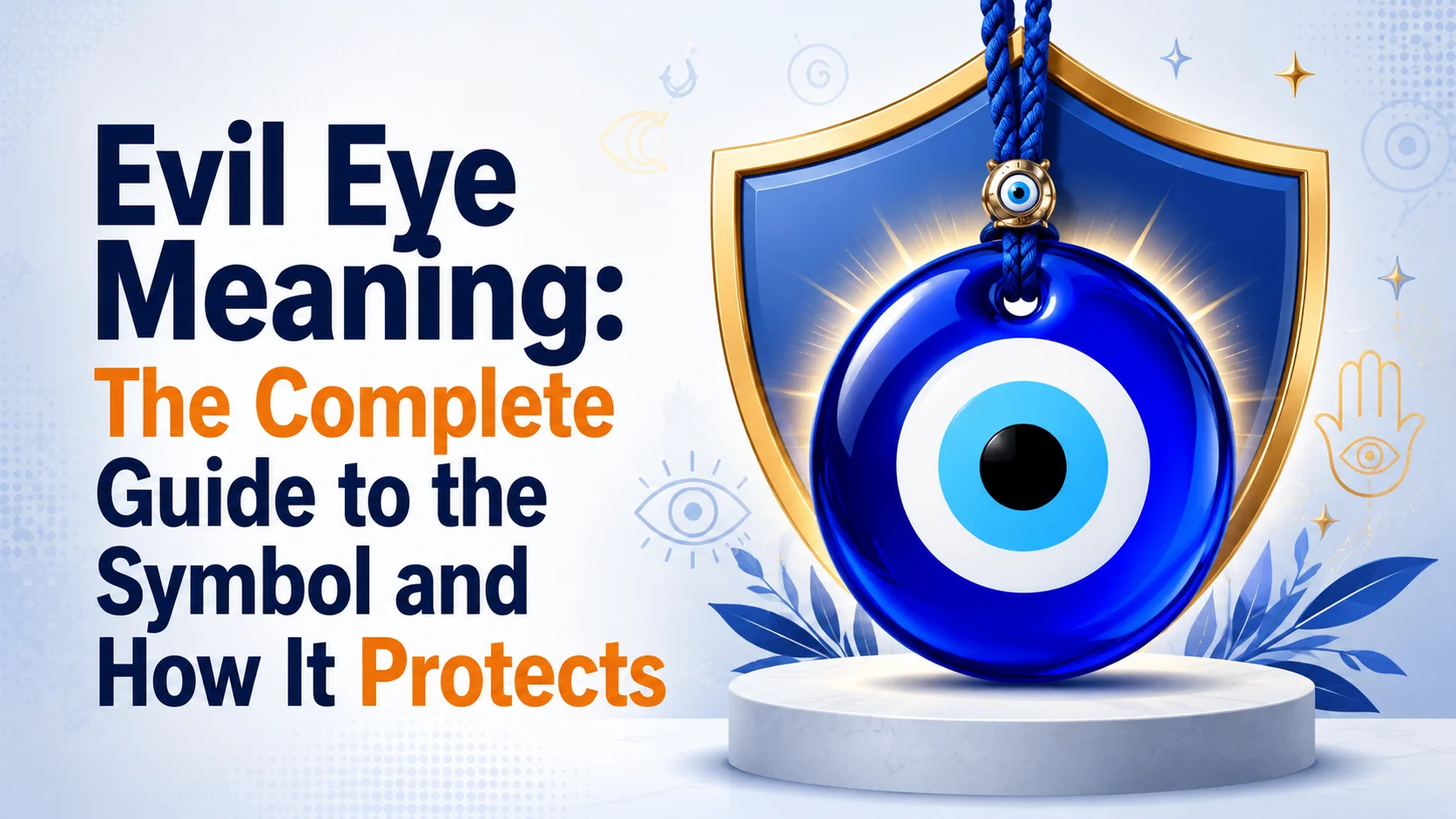
Evil Eye Meaning is rooted in an ancient belief that envy, jealousy, or a harmful gaze can bring misfortune to another person. Over centuries, this idea developed into a wide range of protective customs, amulets, symbols, and traditions across the Mediterranean, Middle East, North Africa, South Asia, and other regions. Today, the familiar blue-and-white eye is often seen on bracelets, necklaces, home décor, clothing, and artwork.
But there’s an important distinction: the evil eye is a cultural and folkloric belief, while the eye-shaped charm is a symbol traditionally used for protection. Historical objects show that eye imagery has been used in protective contexts for centuries, although its exact meaning can vary from one culture to another. The Metropolitan Museum of Art, for example, identifies several ancient and medieval objects with eye-like motifs that may have served an apotropaic, or evil-repelling, purpose.
In this guide, you’ll learn what the evil eye means, where the belief came from, why the symbol is usually blue, how the nazar differs from the broader evil-eye concept, what different cultures believe, and what an evil-eye bracelet or necklace can symbolize today. We’ll also separate traditional interpretations from claims that have no scientific basis, so you can understand the symbol without oversimplifying its history.
Evil Eye Meaning at a Glance
The evil eye generally refers to a belief that a person’s gaze—often motivated by envy, jealousy, admiration, or ill will—can cause harm or misfortune.
The term can describe two related but different things:
- The evil eye belief: the idea that a harmful gaze can negatively affect someone.
- The evil eye symbol or amulet: an object traditionally intended to protect against that harmful influence.
That distinction matters because not every eye-shaped decoration is necessarily a religious or protective object. Some are worn for cultural identity, some for personal meaning, and others simply because the design is attractive.
What Does the Evil Eye Symbolize?
Depending on the tradition, the evil eye symbol may represent:
- Protection
- Warding off envy
- Deflecting harmful attention
- Good luck
- Well-being
- Spiritual protection
- Cultural heritage
- A wish for safety and prosperity
There isn’t one universal interpretation. A person wearing an evil-eye bracelet might see it as a traditional protective charm, while another person may regard it as a meaningful connection to family or culture.
Evil Eye vs. Evil Eye Symbol
These terms are often used interchangeably online, but they’re not exactly the same.
| Term | Meaning |
| Evil eye | The belief that a harmful gaze can cause misfortune |
| Evil eye symbol | An image representing or associated with protection from the evil eye |
| Nazar | A term commonly associated with the evil-eye belief and protective bead in Turkish and related contexts |
| Amulet | An object believed traditionally to provide protection or good fortune |
| Apotropaic symbol | A symbol or object intended to ward off evil or harm |
The word apotropaic is particularly useful when discussing the history of protective symbols. Museums and historians use it to describe objects or images believed to repel danger or evil. The Met’s collections include several objects whose eye-like motifs are interpreted as having such a function.
What Is the Evil Eye Belief?
At its simplest, the evil eye is the belief that someone can unintentionally or deliberately cause harm through their gaze.
The person responsible doesn’t always have to consciously intend harm. In many traditions, intense envy, excessive admiration, or jealousy can be enough to create the feared effect.
That makes the concept different from ordinary jealousy.
Evil Eye vs. Ordinary Jealousy
Jealousy is a recognizable human emotion. The evil eye is a cultural interpretation of how that emotion—or the attention associated with it—might affect another person.
For example, imagine someone receives an expensive new car. A traditional belief might suggest that another person’s intense envy could expose the owner to misfortune. A protective charm could then be used symbolically to guard against that attention.
The important point is that this describes a traditional belief, not an established scientific mechanism.
Why Is Admiration Sometimes Connected to the Evil Eye?
One of the more interesting aspects of evil-eye traditions is that the dangerous gaze isn’t always portrayed as openly hostile.
In some cultural settings, excessive praise or admiration can also be treated cautiously. This helps explain why evil-eye customs have historically appeared around particularly vulnerable or valued things, including children, livestock, possessions, and personal success.
The underlying concern is often the same: something valuable attracts attention, and attention can create vulnerability.
The History and Origins of the Evil Eye
It’s tempting to ask, “Who invented the evil eye?” The historically responsible answer is that there probably wasn’t a single inventor.
Beliefs concerning harmful gazes developed in different societies and periods, and similar ideas appear in various cultural settings. Ancient artifacts provide evidence that eye imagery could have protective associations, but researchers must be cautious about assigning one meaning to every eye-shaped design.
The Metropolitan Museum of Art, for instance, catalogs several objects excavated at Nishapur in present-day Iran dating from roughly the 8th through 10th centuries. Their dot-in-circle designs are interpreted as possible abstract eyes intended to ward off the evil eye. The museum also notes that such motifs could eventually become decorative or have meanings that are no longer known.
That qualification is important: historical symbolism isn’t always perfectly recoverable.
Ancient Protective Eye Symbols
The eye is an especially powerful protective image because it can be understood as confronting the threatening gaze directly.
Rather than hiding from the evil eye, the protective eye symbol can be interpreted as watching back.
Ancient and later cultures used many different protective images, including eyes, hands, animals, gestures, divine figures, and other amulets. The exact design and explanation changed across regions.
A museum object can therefore tell us that a symbol existed and may have had a protective role without proving precisely what every person who saw it believed.
The Evil Eye in the Ancient Mediterranean
The concept of harmful envy and protective responses was significant in parts of the ancient Mediterranean world.
Protective objects could be worn on the body, placed on buildings, or incorporated into everyday items. Other apotropaic images served related purposes.
The Metropolitan Museum’s research on ancient protective imagery describes several symbols and gestures associated with efforts to ward off the evil eye or harmful envy, demonstrating that protection could take forms far beyond the familiar modern blue eye.
How the Tradition Continued
The evil eye didn’t survive because one specific object remained unchanged for thousands of years.
Instead, the basic concern about envy, harmful attention, and protection was repeatedly adapted.
Different communities created their own rituals, charms, colors, gestures, prayers, and interpretations. That’s why modern discussions that treat the evil eye as having exactly one meaning can be misleading.
Evil Eye Across Cultures: Similar Belief, Different Traditions
One of the biggest mistakes in explaining the evil eye is treating every tradition as though it were identical.
The concept has appeared in many societies, but the details differ considerably.
The Nazar in Turkish and Mediterranean Traditions
The nazar is strongly associated with the familiar blue-and-white eye-shaped bead often seen in Turkey and neighboring cultural contexts.
The design typically consists of concentric circles resembling an eye. It is commonly used in jewelry, household decorations, gifts, and other objects associated with protection.
However, nazar and evil eye aren’t perfect synonyms in every context. “Evil eye” can refer to the broader belief, while “nazar” can refer to the gaze, concept, or protective object depending on language and usage.
Evil Eye Traditions in the Middle East and North Africa
Protective traditions involving the evil eye occur in numerous Middle Eastern and North African communities.
Objects, gestures, prayers, and household practices can all play a role. Some practices overlap with religious traditions, while others belong more clearly to local folklore or customary culture.
The important lesson is to avoid assuming that one blue bead represents every community’s understanding.
For example, The Met’s collection includes Moroccan beads associated with both devotional practices and protection from the evil eye, illustrating how religious and protective functions could coexist in particular cultural contexts.
South Asian Beliefs About Nazar
South Asian traditions commonly use concepts such as nazar or buri nazar to describe the harmful effects associated with an envious or negative gaze.
Protective customs can involve:
- Children
- Newborns
- Homes
- Vehicles
- New possessions
- Weddings
- Major life events
The practices vary significantly by region, family, religion, and community.
This is why reducing South Asian nazar traditions to a blue glass eye can erase much of their cultural context.
Mediterranean and European Traditions
Greek, Italian, and other Mediterranean traditions have their own histories of beliefs concerning harmful envy and protective practices.
Ancient Mediterranean societies also used protective gestures and objects. Research published through The Metropolitan Museum of Art discusses protective imagery such as the Medusa head and apotropaic gestures, showing that the broader concern with harmful forces and envy extended beyond the eye-shaped charm familiar today.
What These Traditions Share
Across many traditions, recurring themes include:
- Envy
- Vulnerability
- Harmful attention
- Protection
- Good fortune
- Personal or household safety
What changes is how the danger is understood and how protection is performed.
Why Is the Evil Eye Usually Blue?
The familiar evil-eye design is often blue, white, and dark blue or black.
But the blue eye shouldn’t be treated as the only historically authentic form of the symbol.
The Meaning of Blue
Blue has become strongly associated with the modern nazar bead, particularly in Turkish and Mediterranean contexts.
Modern explanations often assign specific symbolic meanings to each color, but those explanations aren’t universally standardized. Some come from contemporary cultural interpretations or commercial descriptions rather than a single ancient system.
What Do the White, Blue, and Black Circles Mean?
You may see explanations such as:
- White: purity or positive intentions
- Blue: protection, peace, or traditional association
- Black: strength or protection
These interpretations can be useful when discussing modern symbolism, but they shouldn’t be presented as universal historical facts.
The safest approach is to say that the colors have different interpretations depending on tradition and context.
Are All Evil Eye Symbols Blue?
No.
Eye-related protective imagery appears in different materials, colors, and artistic styles. Historical objects from Iran, for example, include simple dot-in-circle designs that museums interpret as possible abstract eyes rather than modern blue nazar beads.
So the blue glass bead is one influential form of the symbol, not the entire history of evil-eye imagery.
How Is the Evil Eye Supposed to Protect You?
Traditional explanations vary, but the basic idea is that the protective object somehow guards against or turns away harmful attention.
Different communities may understand the mechanism differently.
The Traditional Idea of Protection
A protective charm may be thought of as:
- Deflecting negative attention
- Reflecting the harmful gaze
- Absorbing unwanted influence
- Interrupting misfortune
- Guarding a person or household
These are traditional or spiritual interpretations, not scientifically established effects.
Why People Wear Evil Eye Jewelry
Evil-eye jewelry is popular because it combines symbolism with something people can carry every day.
Common forms include:
- Bracelets
- Necklaces
- Pendants
- Rings
- Anklets
- Earrings
A person may wear one because of family tradition, cultural identity, spiritual belief, personal symbolism, or simply appreciation of the design.
Why People Display Evil Eye Symbols at Home
Protective symbols may appear near:
- Front doors
- Windows
- Living rooms
- Children’s rooms
- Vehicles
- Workspaces
Historically, protective objects weren’t always hidden. Some were deliberately placed where they could be seen.
The Met, for example, documents beads and other objects associated with protection from the evil eye in domestic and religious contexts.
What Happens If an Evil Eye Charm Breaks?
There is no single universal interpretation.
Some people believe a broken charm has absorbed or intercepted negative energy. Others simply replace it because it is damaged. Some regard the event as entirely ordinary.
If someone tells you their charm broke and therefore “protected” them, that is their cultural or personal interpretation. It shouldn’t be presented as a scientifically established fact.
Evil Eye Symbol vs. Evil Eye Belief: Why the Difference Matters
The distinction becomes especially important when discussing modern jewelry.
The Evil Eye Is a Belief
The evil eye refers to a belief about harmful attention or a harmful gaze.
It belongs to the history of folklore, religion, cultural practice, and popular belief.
The Nazar Is a Specific Symbol
The nazar bead is one particular form of protective imagery associated with this broader concept.
A person might say they wear a nazar for protection without believing every historical explanation of the evil eye.
Modern Decorative Use
Today, the eye design may appear on:
- Fashion accessories
- Home décor
- Tattoos
- Phone cases
- Artwork
- Clothing
- Logos
In these situations, the symbol may have little or no spiritual significance.
A design can retain cultural meaning while simultaneously becoming a fashion motif. Those two uses aren’t necessarily contradictory.
What Does the Evil Eye Mean in Modern Life?
Modern interpretations have expanded well beyond traditional protection.
Protection and Good Luck
Many people associate the symbol with good luck, safety, positive energy, and protection.
Whether someone understands those ideas spiritually or symbolically depends on the individual.
Love, Friendship, and Family Protection
An evil-eye charm can also function as a meaningful gift.
For example, someone might give a bracelet to a friend before they travel, move into a new home, start a new job, or enter another major stage of life.
In that context, the gift can communicate:
“I want you to be safe.”
The charm becomes a physical representation of goodwill, regardless of whether the recipient believes in its supernatural function.
Fashion and Personal Identity
For some wearers, the symbol represents:
- Family heritage
- Cultural identity
- Spiritual interests
- Connection to tradition
- Personal beliefs
For others, it is simply attractive.
Spiritual Meaning vs. Personal Meaning
Two people can wear the same symbol for completely different reasons.
| Reason for wearing it | Possible meaning |
| Cultural tradition | Connection to heritage |
| Spiritual belief | Protection |
| Gift from family | Love and good wishes |
| Fashion | Aesthetic preference |
| Personal symbolism | Reminder of safety or positivity |
| Home décor | Tradition, protection, or decoration |
Where Do People Use the Evil Eye Symbol?
Evil Eye Jewelry
Jewelry is probably the most visible modern use.
A bracelet can be especially meaningful because it stays close to the wearer. Necklaces and pendants place the symbol near the body, while earrings and rings can make it more subtle.
Home and Interior Décor
Evil-eye designs can appear as:
- Wall hangings
- Decorative plates
- Ceramic pieces
- Glass ornaments
- Door decorations
- Artwork
Here, the symbol may combine decoration and tradition.
Clothing, Accessories, and Tattoos
Fashion designers frequently reinterpret traditional symbols.
Tattoos are different because they tend to represent a more permanent personal choice. Someone might choose the evil eye as a reminder of protection, heritage, spirituality, or resilience.
Social Media and Digital Design
The symbol has also become common in:
- Digital illustrations
- Social media graphics
- Spiritual content
- Lifestyle branding
- Fashion posts
Online usage can broaden awareness, but it can also strip away cultural context. A symbol that carries centuries of meaning may be reduced to “good vibes” in a caption.
Is the Evil Eye a Religious Symbol?
The answer depends heavily on the tradition being discussed.
The evil eye is not exclusive to one religion. Related beliefs and protective practices have existed in multiple cultural and religious environments.
Why the Answer Isn’t Simply Yes or No
Religion, folklore, family customs, and local traditions often overlap.
A person may practice an evil-eye custom because it was part of their upbringing without considering the practice a formal religious obligation.
Another person may interpret the same practice through a religious framework.
Religious Tradition vs. Folk Practice
This distinction matters when writing about the subject.
Don’t automatically label every evil-eye bracelet, bead, or ritual as a religious requirement. Instead, identify it as a cultural, folkloric, spiritual, or religiously interpreted practice when the evidence supports that description.
Religious Symbol vs. Cultural Symbol
A symbol can be culturally significant even when it isn’t a formal religious emblem.
That is one reason the evil eye remains relevant in modern life: its meaning can exist simultaneously at the levels of heritage, spirituality, folklore, fashion, and personal identity.
Is the Evil Eye Real? Belief, Tradition, and Evidence
This question deserves a careful answer.
What Traditional Beliefs Say
Many traditions treat the evil eye as a genuine source of harm. Protective practices developed in response to that belief.
For believers, the symbol can therefore have serious spiritual significance.
What Historical Evidence Can Establish
Historical evidence can establish that:
- People believed in harmful or envious gazes.
- Protective objects existed.
- Eye imagery was used in some protective contexts.
- These practices appeared across different periods and cultures.
The Met’s collection provides examples of historical objects whose eye-like designs are interpreted as possible protective motifs.
What Science Can and Cannot Establish
There is no established scientific evidence that an evil-eye amulet physically blocks a supernatural force or guarantees protection from misfortune.
That doesn’t make the tradition historically unimportant.
A cultural belief can have real social, emotional, historical, and psychological significance even when its supernatural explanation isn’t scientifically verified.
That’s the distinction a responsible explanation should maintain.
Evil Eye Colors and Their Modern Meanings
Color symbolism can be useful, but it should be treated cautiously.
| Color | Common modern association | Important qualification |
| Blue | Protection, peace, traditional nazar imagery | Strongly associated with the familiar nazar design |
| White | Purity, peace, positive intentions | Meaning varies |
| Black | Strength, protection, mystery | Not a universal historical definition |
| Red | Courage, energy, vitality | Often a modern interpretation |
| Green | Growth, hope, well-being | Meanings vary by tradition |
Why Color Meanings Aren’t Universal
Online shops sometimes give every color a fixed meaning. That can make symbolism appear much more standardized than it actually is.
When discussing color, use phrases such as “often associated with” rather than “always means.”
That small distinction makes your interpretation much more accurate.
Common Evil Eye Symbols and Protective Alternatives
The evil eye isn’t the only protective symbol associated with cultures that have traditions concerning harmful forces.
Nazar Bead
The nazar bead is the familiar eye-shaped charm, especially associated with Turkish cultural traditions.
Its distinctive concentric-eye design has become one of the world’s most recognizable forms of evil-eye imagery.
Hamsa Hand
The hamsa is a hand-shaped symbol associated with protection in several Middle Eastern and North African contexts.
It can appear with an eye in the center, which is why people sometimes confuse the two.
But hamsa and evil eye are not simply different names for the same symbol.
Protective Gestures and Amulets
Historical cultures used many protective forms.
The Met’s scholarship on ancient Mediterranean art discusses gestures and objects associated with warding off harmful influences, including envy and the evil eye.
This broader history helps explain why the protective function shouldn’t be reduced to one bead design.
Common Misconceptions About the Evil Eye
Myth: Every Evil Eye Symbol Has the Same Meaning
Reality: The meaning changes across cultures, communities, and individuals.
The blue nazar bead, a South Asian nazar custom, and an ancient eye motif may share a conceptual connection without being culturally identical.
Myth: The Blue Eye Is the Only Authentic Evil Eye
Reality: Historical eye-like protective imagery appears in different forms, materials, and regions. Some ancient objects are much simpler than the modern blue-and-white bead.
Myth: Wearing It Guarantees Protection
Reality: Protection is a traditional belief or personal interpretation, not a scientifically established guarantee.
Myth: The Symbol Always Has Religious Meaning
Reality: It may be religiously interpreted, culturally meaningful, spiritually significant, decorative, or simply fashionable.
Myth: A Broken Charm Has One Universal Meaning
Reality: Some traditions interpret a broken charm as having absorbed negativity, but others don’t. There is no single universal rule.
Is Wearing the Evil Eye Cultural Appropriation?
This question doesn’t have a one-line answer.
The evil eye is connected to multiple cultures, so context matters. Wearing a symbol from another culture isn’t automatically disrespectful, but using it without understanding, mocking its significance, or reducing a living tradition to a costume can be problematic.
Why Context Matters
Ask yourself:
- Do I understand what the symbol represents?
- Am I treating the tradition respectfully?
- Am I making claims about its meaning that aren’t accurate?
- Am I presenting it as an exotic novelty?
- Am I profiting from the symbol while erasing its cultural context?
Cultural Appreciation vs. Commercial Exploitation
There’s a meaningful difference between learning about a symbol and treating it as a meaningless trend.
For example, buying a traditional-style bracelet because you appreciate its history and explaining its cultural background is different from making exaggerated claims that a product possesses guaranteed supernatural powers.
How to Wear the Symbol Respectfully
A thoughtful approach is simple:
- Learn its background.
- Don’t claim every culture uses it in exactly the same way.
- Avoid mocking or trivializing beliefs.
- Don’t invent historical meanings.
- Be honest if your use is primarily decorative.
Respect doesn’t require pretending you share a belief. It requires understanding what the symbol means to people who do.
How to Interpret an Evil Eye Gift
Suppose someone gives you an evil-eye bracelet. What does it mean?
In many situations, the safest interpretation is protection or good wishes, but the giver’s personal meaning matters more than a generic internet definition.
What It Can Mean When Someone Gives You One
It may communicate:
- “Stay safe.”
- “I wish you good luck.”
- “I want to protect you.”
- “This reminds me of our culture.”
- “I thought you’d appreciate the symbolism.”
Does an Evil Eye Gift Always Have Spiritual Meaning?
No.
The person giving it may be religious, spiritual, culturally connected to the symbol, or simply interested in its design.
If you’re unsure, asking “What does this symbol mean to you?” is often more respectful than assuming.
How to Respond to an Evil Eye Gift
A simple thank-you is enough.
If the cultural meaning interests you, you can also ask about the giver’s connection to it. That turns a decorative object into an opportunity to learn about family history, tradition, and personal belief.
Evil Eye Meaning by Context
The same symbol can communicate different things depending on where and why it appears.
| Context | Possible meaning | Best interpretation |
| Jewelry | Protection, heritage, fashion | Consider the wearer’s intention |
| Gift | Good wishes, safety, affection | Consider the giver’s explanation |
| Home décor | Protection, heritage, decoration | Look at household context |
| Tattoo | Personal symbolism, identity | Meaning is highly individual |
| Social media | Spirituality, aesthetics, protection | Read the surrounding content |
| Religious setting | Tradition-specific meaning | Use the relevant cultural context |
The most reliable rule is simple:
Context beats assumption.
How to Choose an Evil Eye Symbol or Gift Respectfully
If you’re buying an evil-eye item for yourself or someone else, don’t choose solely based on appearance.
Choose Based on Meaning, Not Just Design
Learn what the particular style represents before presenting it as a traditional protective object.
Consider the Recipient’s Background
If you’re giving the item to someone with a particular cultural connection, learning the relevant tradition can make the gift much more thoughtful.
Check Whether It’s Decorative or Traditionally Protective
A product description may call something an “evil eye,” but that doesn’t necessarily tell you how historically authentic or culturally specific it is.
Avoid Supernatural Guarantees
Be cautious with claims such as:
- “This will definitely protect you.”
- “This blocks all negative energy.”
- “This prevents bad luck.”
Those are belief-based claims, not established facts.
Explain the Symbol’s Background
If you’re giving the charm to someone unfamiliar with it, a brief explanation can make the gesture more meaningful:
“I chose this because the evil-eye symbol is traditionally associated with protection and good wishes.”
That’s accurate without claiming more than the evidence supports.
Evil Eye Meaning: A Practical Guide to Remember
If you only remember a few points, remember these:
- Evil eye usually refers to a belief involving a harmful gaze.
- The evil eye symbol is commonly used as a protective representation.
- Nazar is closely associated with the evil-eye tradition and the familiar eye-shaped bead.
- The modern blue-and-white eye is only one form of a much broader history.
- Different cultures interpret the symbol differently.
- Protection is a traditional or spiritual belief, not a scientifically proven effect.
- An evil-eye gift can communicate good wishes, safety, affection, or cultural connection.
- The symbol can be religious, cultural, personal, decorative, or some combination of these.
- Context matters more than a single fixed definition.
Conclusion
The evil eye meaning is much richer than the familiar blue bead seen on bracelets and necklaces. At its core, the evil eye describes a longstanding belief about envy, harmful attention, vulnerability, and protection. Over time, different cultures developed their own charms, gestures, rituals, and interpretations, which is why no single definition can explain every version of the tradition. Historical objects demonstrate that eye imagery has been used in protective contexts for centuries, including artifacts from regions such as Iran that museums interpret as possible apotropaic symbols. At the same time, historical evidence doesn’t prove that supernatural protection actually works. One final actionable tip: whenever you encounter an evil-eye symbol, look at its cultural and personal context before assigning it a meaning.
FAQs
Q1. What does the evil eye symbol mean?
The evil eye symbol generally represents protection against envy, harmful attention, or misfortune in traditions that use it. Its meaning varies across cultures and individuals. Some people wear it for spiritual reasons, while others value it for cultural heritage, personal symbolism, or decoration.
Q2. What does the blue evil eye mean?
The familiar blue evil eye, often associated with the nazar bead, is commonly understood as a protective symbol. Blue became strongly associated with this design in Turkish and Mediterranean contexts. However, color meanings aren’t universal, so modern explanations shouldn’t be treated as one fixed historical system.
Q3. Is the evil eye a symbol of protection or bad luck?
The evil eye itself refers to the feared harmful influence, while the eye-shaped amulet is generally associated with protection from it. This distinction prevents a common misunderstanding. In most modern decorative contexts, the eye symbol carries a protective or good-luck association rather than representing bad luck itself.
Q4. What does it mean when someone gives you an evil eye bracelet?
An evil-eye bracelet can symbolize protection, good wishes, affection, or cultural connection. The exact meaning depends on the giver. If someone gives you one, don’t assume it has a particular religious meaning. Their personal explanation is the best guide to what the gift represents.
Q5. Is the evil eye connected to a specific religion?
No single religion exclusively owns the evil eye belief. Related beliefs and protective practices have appeared across different cultures and religious environments. Some communities incorporate them into religious life, while others treat them as folklore or family tradition. Always distinguish a formal religious teaching from a local custom.