

Have you ever paused while writing and wondered whether tying or tieing is the correct spelling? You’re not alone. This is one of those deceptively simple English spelling questions that catches students, professionals, native speakers, and English learners alike. At first glance, tieing seems logical because the base verb is tie, yet dictionaries, style guides, and grammar experts consistently recognize tying as the standard spelling. Understanding why this happens helps you write with greater accuracy, confidence, and clarity in both formal and everyday communication.
English spelling isn’t always intuitive, especially when verbs change form. Some words simply drop a letter before adding -ing, while others follow special spelling rules that aren’t immediately obvious. The verb tie belongs to one of these exceptions. In this guide, you’ll learn why tying is correct, why tieing is usually considered a misspelling, how the spelling rule works, where people commonly make mistakes, and how to remember the correct form every time. We’ll also compare similar words such as dying, lying, and tying to reveal the pattern behind these unusual spellings.
Whether you’re writing an academic paper, composing a business email, helping a child with homework, preparing for an English exam, or simply satisfying your curiosity, this guide provides practical explanations rather than memorization tricks alone. Along the way, you’ll find real-world examples, grammar tips, comparison tables, common mistakes, and expert recommendations that make the rule easy to understand and apply. By the end, you’ll know not only which spelling is correct but also why professionals use it and how to avoid this mistake permanently.
Quick Answer: Is It Tying or Tieing?
If you’re looking for the short answer, here it is:
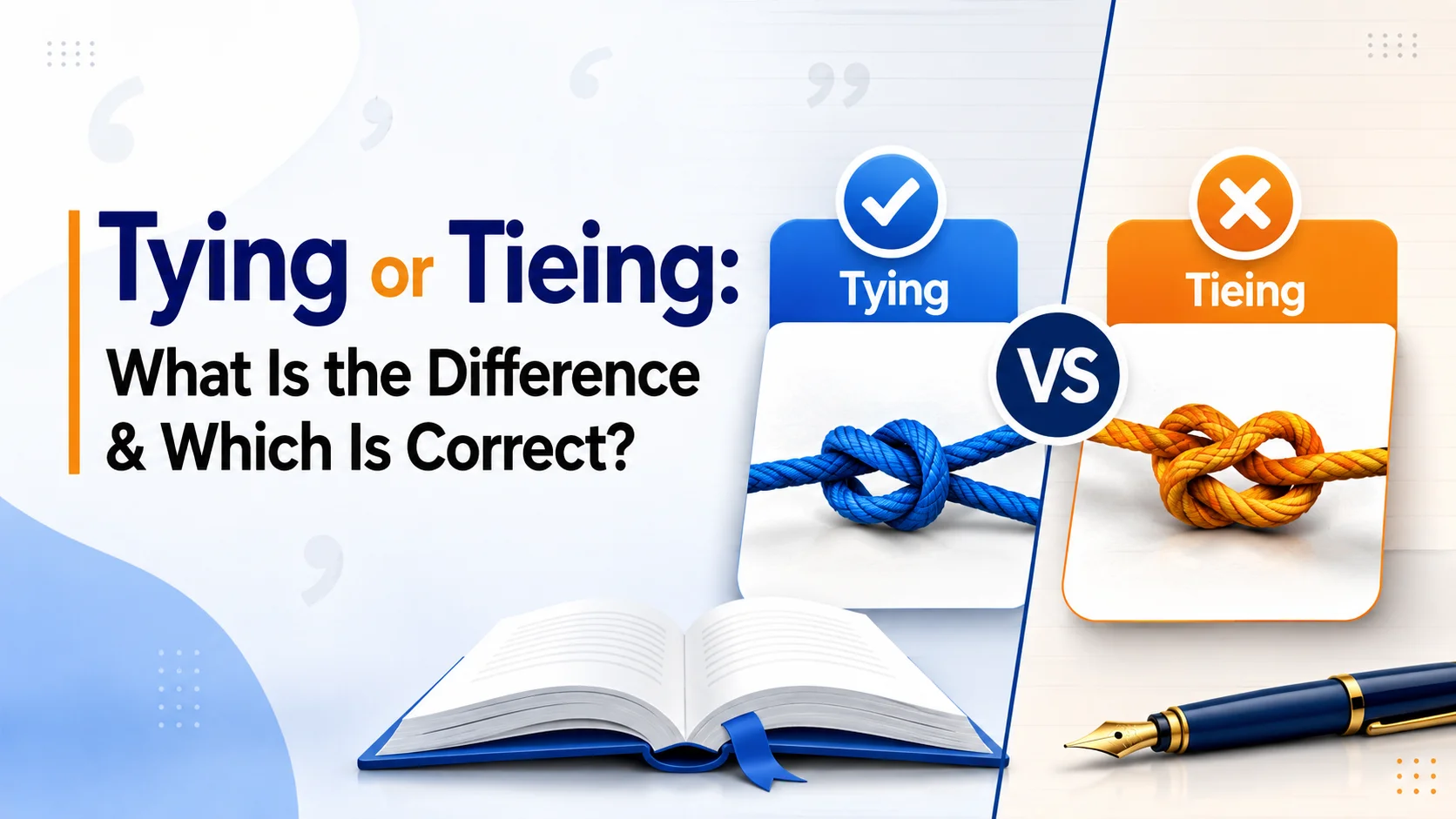
✅ Tying is the correct spelling in modern English.
❌ Tieing is generally considered a misspelling in standard English.
Whether you’re referring to tying your shoes, tying a knot, tying a ribbon, or tying a game, the accepted spelling is always tying.
Quick Comparison
| Word | Correct? | Standard English | Recommended for Writing |
| Tying | ✅ Yes | Yes | Yes |
| Tieing | ❌ Usually No | No | No |
If you’re writing for school, work, publishing, or professional communication, always choose tying.
Expert Tip: If your spell checker suggests tying, accept the correction. Nearly every major English dictionary and style guide recognizes this as the standard form.
What Does Tying Mean?
Tying is the present participle and gerund form of the verb tie.
The verb tie means to fasten, secure, connect, bind, or make a knot using rope, string, ribbon, fabric, or another flexible material. Depending on the context, it can also mean creating a connection between ideas, matching a score in sports, or linking events together.
Dictionary Meaning
Tie (verb):
- To fasten with a knot.
- To secure something in place.
- To connect two or more things.
- To finish with equal scores.
- To establish a relationship or association.
What “Tying” Can Describe
The word appears in many everyday situations.
For example:
- Tying shoelaces
- Tying balloons
- Tying a fishing knot
- Tying gift ribbons
- Tying two teams in the final minutes
- Tying ideas together in an essay
Although the situations differ, the spelling remains exactly the same.
Tying as a Present Participle
A present participle helps form continuous verb tenses.
Examples:
- She is tying her shoes.
- They were tying the boat to the dock.
- We have been tying decorative bows all afternoon.
Here, tying functions as part of the verb phrase.
Tying as a Gerund
A gerund is a verb ending in -ing that acts as a noun.
Examples:
- Tying requires patience.
- Tying fishing knots takes practice.
- Tying packages neatly saves time.
Although tying comes from a verb, it functions like a noun in these sentences.
Why Is Tying Spelled Without the “E”?
This is where many writers become confused.
The base verb is:
tie
Naturally, many people assume adding -ing creates:
tie + ing = tieing
That seems reasonable—but English follows a different rule.
The Spelling Rule
When a verb ends in -ie, the ie changes to y before adding -ing.
Instead of keeping both letters, English simplifies the spelling.
The pattern looks like this:
| Base Verb | Incorrect | Correct |
| tie | tieing | tying |
| die | dieing | dying |
| lie | lieing | lying |
Notice that every verb ending in -ie follows the same transformation.
Rather than:
- tieing
- dieing
- lieing
English changes them to:
- tying
- dying
- lying
This spelling rule has been part of standard English for centuries.
Why Doesn’t English Keep the “E”?
Imagine writing:
tieing
The combination iei creates an awkward sequence of vowels that is harder to read and pronounce naturally.
Changing ie to y makes the word simpler:
- tying
- dying
- lying
This change improves readability and keeps the spelling pattern consistent.
Similar Verbs That Follow the Same Rule
Many learners memorize only tying, but recognizing the larger pattern makes it much easier.
Examples include:
| Verb | Correct -ing Form |
| tie | tying |
| die | dying |
| lie | lying |
Whenever you encounter another verb ending in -ie, ask yourself whether the spelling changes to y before -ing.
Why So Many People Write “Tieing”
If tying is correct, why does tieing appear so often online?
Several factors contribute to the confusion.
The Base Word Looks Misleading
Most English verbs simply add -ing.
Examples:
- walk → walking
- jump → jumping
- clean → cleaning
Writers naturally expect:
- tie → tieing
Unfortunately, tie belongs to an exception.
People Apply the Wrong Grammar Rule
Many people remember the rule about dropping a silent e.
Examples:
- make → making
- write → writing
- drive → driving
Because tie ends with e, writers incorrectly assume it follows the same pattern.
However, the ending is -ie, not just -e, so a different spelling rule applies.
Pronunciation Doesn’t Reveal the Difference
Interestingly, both spellings are pronounced almost identically.
Since pronunciation doesn’t help, many writers rely entirely on intuition.
That’s why even fluent English speakers occasionally type tieing before correcting themselves.
Autocorrect Isn’t Always Enough
Although modern spell checkers usually correct tieing, they don’t always catch the mistake immediately.
Some software:
- delays correction
- ignores context
- accepts uncommon variants temporarily
Professional writers still proofread carefully instead of relying solely on technology.
English Learners Look for Consistency
Students learning English often search for predictable spelling patterns.
Unfortunately, English includes numerous historical spelling rules that don’t always appear logical at first.
Understanding the -ie → y + ing rule eliminates much of this confusion.
Is Tieing Ever Correct?
For almost every writer, the answer is no.
Modern dictionaries, educational institutions, publishers, and professional editors overwhelmingly recommend tying.
However, you may occasionally encounter tieing in very old books, historical documents, archived texts, or user-generated online content.
That doesn’t make it the preferred spelling today.
What Major Dictionaries Recommend
Leading English dictionaries consistently list tying as the standard spelling because it follows accepted English grammar conventions.
Professional editors, teachers, journalists, publishers, and academic institutions also expect writers to use tying in formal contexts.
Best Practice: If you’re writing for an exam, university assignment, business report, article, website, or publication, always use tying.
Tying vs Tieing: Side-by-Side Comparison
| Feature | Tying | Tieing |
| Correct modern spelling | ✅ Yes | ❌ No |
| Accepted by dictionaries | ✅ Yes | Rarely |
| Suitable for formal writing | ✅ Yes | ❌ No |
| Used in academic writing | ✅ Yes | ❌ No |
| Used in business communication | ✅ Yes | ❌ No |
| Based on English spelling rules | ✅ Yes | ❌ No |
| Recommended by editors | ✅ Yes | ❌ No |
When to Use Tying
Once you know that tying is the correct spelling, the next step is understanding when to use it. In modern English, tying appears whenever you’re describing the ongoing action of fastening, connecting, binding, securing, or making something equal. Because it is the present participle and gerund form of tie, it works naturally in both everyday conversations and formal writing.
Professionals, teachers, editors, and publishers consistently use tying because it follows standard English spelling conventions. Whether you’re describing someone tying a knot, tying shoelaces, tying two teams in a match, or tying ideas together in an essay, the spelling never changes.
Tying Physical Objects Together
This is the meaning most people learn first.
Examples include:
- She is tying her shoes before going for a run.
- He spent several minutes tying the fishing line securely.
- They were tying balloons for the birthday party.
- The gardener was tying plants to wooden stakes for support.
In each example, tying refers to fastening or securing something.
Tying Scores in Sports
The verb tie is also common in sports.
Examples:
- The home team is tying the game in the final minute.
- A late goal prevented either team from tying the match.
- The runners finished tying for first place.
Here, tying means reaching the same score or result.
Tying Ideas Together
Not every use is physical.
Writers often use tying figuratively to describe creating logical connections.
Examples:
- The conclusion does an excellent job of tying the main ideas together.
- Good transitions help tying different sections into one smooth article.
- The speaker focused on tying historical events to modern issues.
This figurative meaning appears frequently in academic and professional writing.
Tying Relationships and Connections
Sometimes tie means creating a relationship.
Examples:
- The research is tying education to career success.
- Scientists are tying climate changes to ocean temperatures.
- Historians are tying newly discovered letters to important historical events.
Instead of rope or string, the connection is conceptual.
Common Expressions That Use Tying
Many English idioms and phrasal verbs include the word tie. Learning them helps you sound more natural in conversation and writing.
Tie the Knot
Meaning: To get married.
Example:
They are finally tying the knot next summer.
Tie Up
Meaning:
- Finish remaining work.
- Secure something physically.
Examples:
- I’m tying up a few loose ends before leaving.
- They are tying up the boat at the dock.
Tie In
Meaning:
To connect something with another idea.
Example:
The teacher did an excellent job tying in today’s lesson with last week’s discussion.
Tie Together
Meaning:
To connect multiple ideas or objects.
Example:
The final chapter ties together everything introduced earlier.
Tie Down
Meaning:
To secure something firmly or make definite plans.
Examples:
- Workers are tying down equipment before the storm.
- We still need to tie down the meeting schedule.
Real-World Examples of Tying in Different Contexts
Understanding grammar is easier when you see it used naturally.
Everyday Conversation
- She’s tying her hair before exercising.
- I’m tying the gift ribbon now.
- Dad is tying the canoe to the trailer.
Academic Writing
- The researcher is tying recent findings to previous studies.
- The conclusion succeeds in tying every argument together.
Academic writing often uses tying metaphorically rather than literally.
Business Communication
- We’re tying this proposal to the client’s long-term objectives.
- The finance department is tying project expenses to quarterly reports.
Business writing frequently uses tie to indicate relationships and strategic alignment.
Sports Reporting
- The striker is tying the score late in the second half.
- Their final goal ended up tying the championship game.
Sports journalists use this meaning every day.
DIY and Craft Instructions
- Begin by tying a simple overhand knot.
- Finish by tying the ribbon into a bow.
- Continue tying each section securely before cutting.
Instructional writing relies heavily on the present participle.
Grammar Rules You Should Know
Understanding the grammar behind tying makes the spelling easier to remember.
Is Tying a Verb?
Yes.
When used with a helping verb, tying forms part of a continuous tense.
Examples:
- She is tying her shoes.
- They were tying decorations yesterday.
- We have been tying packages all afternoon.
Is Tying a Noun?
Yes—when it functions as a gerund.
Examples:
- Tying takes patience.
- Tying fishing knots requires practice.
- Tying ribbons neatly improves presentation.
Although it looks like a verb, it acts as a noun.
Present Participle vs Gerund
| Form | Function | Example |
| Present Participle | Forms continuous tenses | She is tying the rope. |
| Gerund | Acts as a noun | Tying ropes takes skill. |
Recognizing the difference helps improve sentence construction.
Tying vs Similar -ing Spellings
Many learners confuse tying because other verbs follow similar—but not identical—patterns.
| Base Verb | Correct Form |
| Tie | Tying |
| Die | Dying |
| Lie | Lying |
| Ski | Skiing |
| See | Seeing |
Notice that only verbs ending in -ie change ie to y before adding -ing.
Tying vs Dying
Both follow exactly the same spelling rule.
- tie → tying
- die → dying
Neither keeps ie before -ing.
Tying vs Lying
Again, the same pattern applies.
- lie → lying
- tie → tying
Remembering one helps you remember the other.
Why These Patterns Matter
Instead of memorizing individual words, learn the spelling rule itself.
Whenever a verb ends in -ie, change it to y before adding -ing.
This single rule helps you spell several commonly used English words correctly.
Common Mistakes and How to Avoid Them
Even experienced writers occasionally type tieing. Fortunately, the mistake is easy to avoid once you understand why it happens.
Adding an Extra “E”
Incorrect:
She is tieing her shoes.
Correct:
She is tying her shoes.
Applying the Wrong Grammar Rule
Many writers remember dropping a silent e.
Examples:
- make → making
- write → writing
However, tie ends in -ie, so a different rule applies.
Trusting Spellcheck Too Much
Spellcheck is useful, but context matters.
Always proofread your work, especially in:
- essays
- business emails
- reports
- published articles
- academic assignments
Forgetting the Pattern
A simple memory aid:
If a verb ends in -ie, change it to y before adding -ing.
Examples:
- tie → tying
- die → dying
- lie → lying
Easy Memory Tricks to Remember the Correct Spelling
Remember the -ie → y Rule
Don’t think about tie alone.
Think about the group:
- tie → tying
- die → dying
- lie → lying
Associate It with Familiar Words
Most people already know dying and lying.
Once you remember those, tying feels natural.
Picture the Word
Visual learners often remember:
❌ tieing
✅ tying
The shorter spelling quickly becomes familiar.
Use the “Three Friends” Method
Whenever you’re unsure, mentally repeat:
- dying
- lying
- tying
Because they all follow the same rule, they’re easier to recall together.
Mini Practice Quiz
Choose the Correct Spelling
- She is ______ her shoes.
A. tieing
B. tying
✅ Answer: B
- They are ______ the rope to the tree.
A. tying
B. tieing
✅ Answer: A
Fill in the Blank
Complete the sentence.
The children were ______ colorful ribbons around the gifts.
✅ tying
Correct the Sentence
Incorrect:
He is tieing the boat to the dock.
Correct:
He is tying the boat to the dock.
Answer Key
If you answered tying every time, you’ve mastered one of English’s most commonly misspelled verb forms.
Quick Reference Cheat Sheet
Need a fast reminder? Use this cheat sheet whenever you’re unsure whether to write tying or tieing.
| If You Want to Write About… | Correct Word | Example |
| Fastening shoelaces | tying | She is tying her shoes. |
| Making a knot | tying | He is tying a secure knot. |
| Wrapping gifts | tying | They are tying ribbons around the boxes. |
| Equal scores in sports | tying | The team is tying the game. |
| Connecting ideas | tying | The author is tying the chapters together. |
| Formal, academic, or business writing | tying | Always use tying. |
| Writing tieing | ❌ Avoid | Considered a misspelling in modern English. |
Quick Rule: If the base verb ends in -ie, change ie to y before adding -ing.
Decision Guide: Which Spelling Should You Use?
If you’re still uncertain, this simple decision guide will help.
| Question | Yes | No |
| Are you using the verb tie? | Continue | Check another spelling rule. |
| Are you adding -ing? | Change ie to y | Use the base verb. |
| Does the word become tying? | ✅ Correct | ❌ Don’t use tieing. |
In modern English, you’ll almost never need to write tieing. Whether you’re writing an email, school assignment, article, or report, tying is the spelling readers and editors expect.
Proofreading Checklist
Before you submit your writing, ask yourself these questions:
- ✅ Did I write tying instead of tieing?
- ✅ Am I describing the action of fastening, connecting, or making equal?
- ✅ Does the sentence follow standard English grammar?
- ✅ Have I checked my spelling instead of relying only on autocorrect?
- ✅ Would this spelling be accepted in professional or academic writing?
Taking a few seconds to review these points can prevent an avoidable spelling mistake.
Editor’s Tip: Search your document for the word tieing before publishing. If you find it, it almost certainly needs to be changed to tying.
Common Myths About Tying and Tieing
Many misconceptions continue to circulate online. Let’s separate fact from fiction.
| Myth | Reality |
| Tieing is an acceptable alternative spelling. | ❌ Modern dictionaries and style guides recommend tying. |
| English always adds -ing without changing the base word. | ❌ Some verbs, including those ending in -ie, follow special spelling rules. |
| Both spellings are equally common in professional writing. | ❌ Editors, teachers, and publishers overwhelmingly use tying. |
| Spellcheck always catches tieing. | ❌ Some tools may miss it depending on the software and context. |
Understanding these myths helps you write with greater confidence and avoid repeating common online mistakes.
Frequently Asked Questions
Q1. Is tying the correct spelling?
Yes. Tying is the standard and universally accepted spelling in modern English. It is the present participle and gerund form of the verb tie and should be used in academic, professional, and everyday writing.
Q2. Is tieing ever correct?
In modern standard English, tieing is generally considered incorrect. While you may occasionally encounter it in historical texts or user-generated content, reputable dictionaries and style guides recommend using tying instead.
Q3. Why does tie become tying instead of tieing?
English follows a spelling rule for verbs ending in -ie. Before adding -ing, the ie changes to y, producing tying. The same rule explains dying from die and lying from lie.
Q4. Is tying a verb or a noun?
It can function as both. As a present participle, it forms continuous verb tenses, such as She is tying the rope. As a gerund, it acts as a noun, as in Tying knots takes practice.
Q5. How can I remember the correct spelling?
A simple trick is to remember the trio tie → tying, die → dying, and lie → lying. Once you know the -ie to y spelling rule, you’ll rarely make the mistake again.