

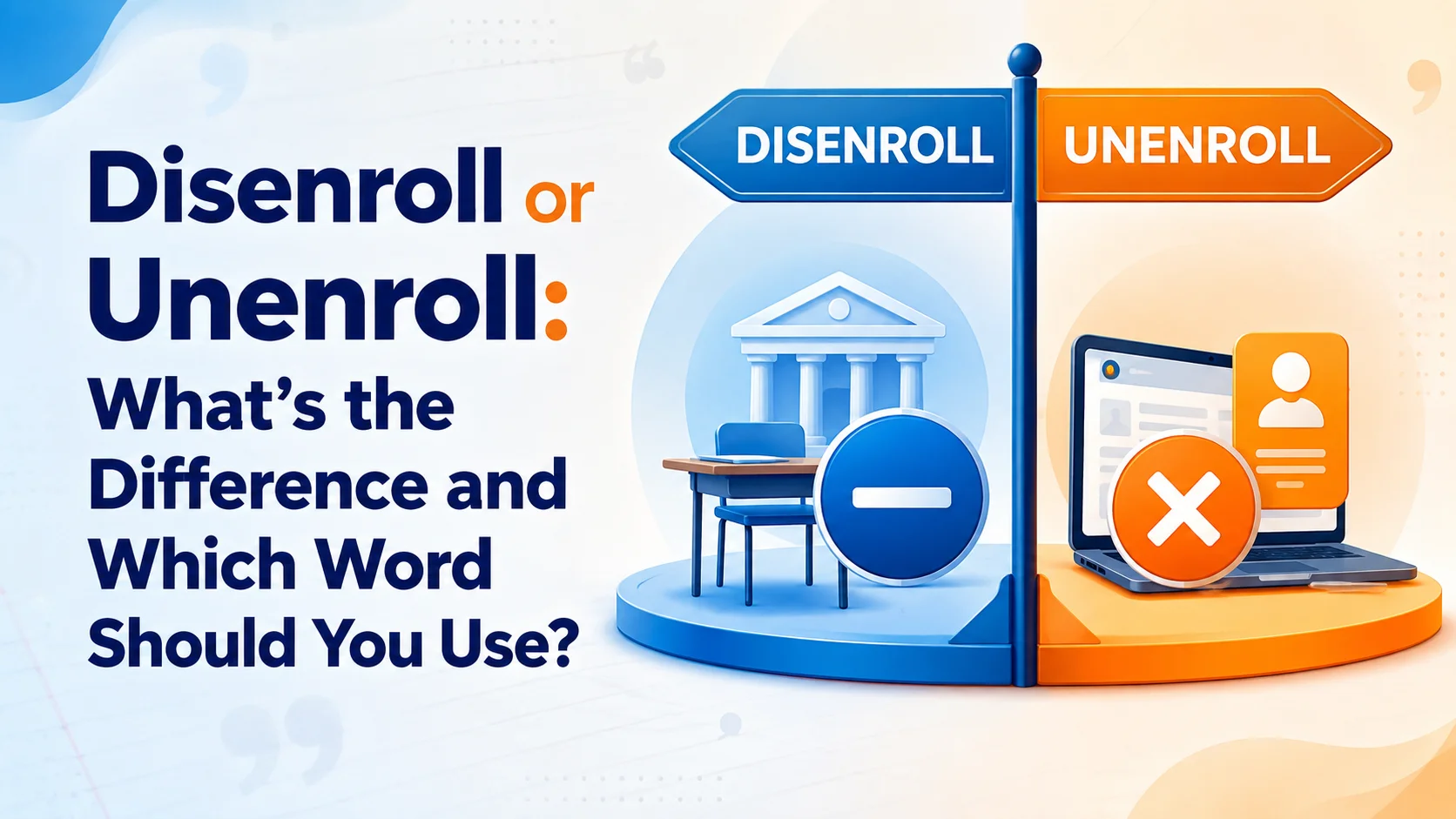
Choosing between disenroll and unenroll can be surprisingly confusing because both words appear in schools, universities, healthcare systems, government programs, and online learning platforms. At first glance, they seem interchangeable, and in many situations they are. However, their usage often depends on context, industry conventions, and the terminology preferred by a particular organization. If you’ve ever wondered whether one spelling is more correct, more formal, or more widely accepted, you’re asking a question that many English learners, writers, and professionals ask as well. This guide explains the differences clearly, helping you choose the right word with confidence while avoiding common mistakes.
English often offers more than one way to express the same idea, but those choices usually carry subtle differences in style, tone, or usage. That’s exactly what happens with disenroll and unenroll. One may appear in a university’s course catalog, while the other shows up in a Medicare notice or insurance document. Although both describe removing someone from enrollment, understanding where and why each term is used can improve your writing and make your communication sound more natural. You’ll also learn why dictionaries recognize both words and why modern digital platforms increasingly favor one over the other.
In this guide, we’ll go beyond simple definitions. You’ll discover the grammar behind these words, explore real-world examples, compare their usage across different industries, and learn practical rules that professional editors and experienced writers follow. Whether you’re writing an email, editing educational content, completing official paperwork, or simply expanding your vocabulary, this article will help you understand when to use disenroll, when to use unenroll, and how context influences the best choice.
Quick Answer: Disenroll vs Unenroll
Are Both Words Correct?
Yes. Disenroll and unenroll are both recognized English verbs that mean to remove someone from enrollment in a class, program, membership, or service. Neither word is grammatically incorrect, but they are not always equally common. The preferred choice usually depends on the organization, industry, or audience you’re writing for.
Which Word Should You Use?
If you’re writing for a general audience, unenroll often feels more natural because it follows familiar English patterns like unsubscribe, unlock, and unfollow. On the other hand, disenroll remains common in healthcare, insurance, government agencies, and many official administrative documents.
The Simple Rule to Remember
- Use unenroll when referring to modern online platforms, digital courses, or general communication unless the platform uses different terminology.
- Use disenroll when referring to official institutional processes, especially if the organization itself uses that term.
- Whenever possible, match the wording used by the organization or system you’re discussing.
Expert Tip: Consistency matters more than preference. If an institution uses disenroll throughout its documentation, don’t switch to unenroll midway through your writing.
Why People Confuse Disenroll and Unenroll
Both Words Mean Almost the Same Thing
The biggest reason for the confusion is that both words describe ending an enrollment. Whether someone leaves a college course, withdraws from an insurance plan, or exits an online training program, either word may appear depending on the context. Since their meanings overlap almost completely, many writers assume one must be wrong when, in reality, both are accepted.
The Prefixes Make the Difference Seem Bigger Than It Is
English frequently creates opposite meanings by adding prefixes such as un- and dis-. The prefix un- often indicates reversing an action, while dis- commonly suggests removal, separation, or cancellation. Because both prefixes can reverse the meaning of enroll, English has ended up with two accepted forms instead of one.
For example:
| Base Word | Opposite Form |
| Lock | Unlock |
| Pack | Unpack |
| Connect | Disconnect |
| Approve | Disapprove |
| Enroll | Unenroll / Disenroll |
Unlike many verbs, enroll has two commonly accepted opposites, making it unique and occasionally confusing.
Different Industries Prefer Different Terms
Language isn’t determined only by dictionaries. Organizations also develop their own preferred terminology over time.
For example:
- Universities may ask students to unenroll from a course.
- Medicare documents often refer to disenrollment.
- Insurance providers commonly use disenroll in official notices.
- Online learning platforms frequently display an Unenroll button.
These differences aren’t based on grammar—they’re based on long-standing usage within specific industries.
What Does Unenroll Mean?
Dictionary Definition
Unenroll means to remove yourself or another person from enrollment in a class, course, program, membership, or service. It is the opposite of enroll and usually describes ending participation after someone has already signed up. Modern dictionaries recognize unenroll as a standard English verb, and its use has grown significantly with the rise of online education and digital services.
The word is easy to understand because the prefix un- commonly means to reverse an action. Just as you unlock a door after locking it or unwrap a gift after wrapping it, you unenroll after you enroll. This makes the term feel intuitive to many English speakers.
Common Uses of Unenroll
Today, unenroll appears most often in situations where individuals manage their own accounts or course registrations. It is especially common in digital environments where users can join and leave programs with a single click.
You’ll commonly see unenroll in:
- Online learning platforms
- College and university student portals
- Corporate training systems
- Educational apps
- Certification programs
- Virtual workshops
- Webinars
- Membership portals
Because these platforms focus on user-friendly language, unenroll has become the preferred term for many technology companies and educational websites.
Examples of Unenroll in Sentences
Seeing the word in context makes its meaning much clearer.
Education
- I decided to unenroll from the evening economics class because my work schedule changed.
- Students may unenroll before the registration deadline without paying a penalty.
- She forgot to unenroll from an optional workshop after completing the required course.
Online Learning
- Click Unenroll if you no longer wish to participate in the course.
- You can unenroll from the training program at any time through your dashboard.
- After finishing the certification, many learners unenroll from discussion groups they no longer need.
Membership Programs
- Members can unenroll from premium services through their account settings.
- Employees may unenroll from optional professional development courses whenever necessary.
These examples show that unenroll usually describes a voluntary decision made by the participant.
Why Unenroll Has Become More Common
One reason unenroll continues to grow in popularity is the expansion of online education and subscription-based services. Digital platforms often favor words that users immediately recognize.
Think about other common internet actions:
- Sign up
- Log in
- Log out
- Subscribe
- Unsubscribe
- Follow
- Unfollow
- Enroll
- Unenroll
Notice the consistent pattern. The prefix un- creates an obvious opposite, making instructions easier for users to understand.
Another reason is simplicity. Many people naturally interpret unenroll without needing further explanation because it follows familiar English word-building rules.
Expert Tip: If you’re writing help articles, user guides, or software documentation, check the terminology used by the platform itself. Matching the interface language improves clarity and creates a better user experience.
What Does Disenroll Mean?
Dictionary Definition
Disenroll also means to remove someone from enrollment in a program, organization, institution, or service. In practice, its meaning is almost identical to unenroll. The main difference lies not in the definition but in the situations where the word is traditionally used.
Unlike unenroll, disenroll has long been associated with official administrative processes. It frequently appears in healthcare, insurance, government records, and legal documents.
Common Uses of Disenroll
Organizations often use disenroll when the removal from enrollment follows formal procedures or administrative policies.
You’ll frequently encounter disenroll in:
- Medicare and Medicaid programs
- Health insurance plans
- Government assistance programs
- Employer benefit systems
- School administrative records
- Official enrollment documents
In many of these settings, the organization—not the individual—initiates or records the action.
Examples of Disenroll in Sentences
Healthcare
- The insurance company may disenroll members who no longer meet eligibility requirements.
- Patients who move outside the service area may be disenrolled from the health plan.
Education
- The registrar may disenroll students who fail to meet enrollment requirements.
- Schools occasionally disenroll students because of administrative errors that must later be corrected.
Government Programs
- Participants who fail to renew required documentation could be disenrolled automatically.
- Agencies must notify beneficiaries before they are officially disenrolled.
Notice that these examples often involve administrative action rather than personal choice.
Why Some Organizations Still Prefer Disenroll
Many institutions continue using disenroll simply because it has been part of their official terminology for decades.
Healthcare organizations, insurance providers, and government agencies maintain detailed policy manuals, legal documents, and standardized forms. Changing established terminology across thousands of documents would require considerable time and resources. As a result, disenroll remains deeply rooted in these industries.
Another reason is consistency. If every regulation, policy, and official notice uses disenrollment, organizations are unlikely to replace it with unenrollment unless regulations or style guides change.
Disenroll vs Unenroll: Side-by-SSide Comparison
Although the meanings are nearly identical, choosing the right word depends on the audience and context.
| Feature | Unenroll | Disenroll |
| Primary Meaning | Remove from enrollment | Remove from enrollment |
| Modern Usage | Very common | Common in formal institutions |
| Digital Platforms | Frequently used | Less common |
| Education Websites | Often preferred | Sometimes used |
| Healthcare | Occasionally used | Frequently preferred |
| Insurance Documents | Rare | Very common |
| Government Programs | Less common | Common |
| Tone | Simple, user-friendly | Formal, administrative |
Meaning
There is virtually no difference in meaning between the two words. Both describe ending enrollment in a program, service, or organization.
Tone and Style
The main distinction is stylistic.
- Unenroll sounds more conversational and modern.
- Disenroll sounds more formal and institutional.
Neither tone is inherently better. The appropriate choice depends on the audience.
Which One Should You Choose?
If you’re writing:
- a help article,
- a blog,
- software documentation,
- educational content,
unenroll will often feel more natural.
If you’re discussing:
- Medicare,
- Medicaid,
- insurance,
- government regulations,
- official policies,
disenroll is usually the term readers expect.
The safest approach is to follow the terminology already used by the organization or platform you’re referring to.
When Should You Use Disenroll or Unenroll?
Choosing between disenroll and unenroll depends less on grammar and more on context, audience, and the terminology used by the organization. Both words describe removing someone from an enrolled status, but they appear in different settings. If you’re writing for a general audience, unenroll often sounds more natural because it’s commonly used on websites, apps, and online learning platforms. On the other hand, disenroll is the preferred term in many formal, legal, healthcare, and government documents.
Before deciding which word to use, consider where your readers are most likely to encounter it. Matching the language used by the platform or institution makes your writing clearer and more professional.
Use Unenroll When:
Use unenroll in situations involving modern digital services, education, or self-service actions. It is especially common in user interfaces where people click a button or manage their own accounts.
Typical situations include:
- Leaving an online course
- Removing yourself from a training program
- Exiting a learning management system (LMS)
- Managing educational subscriptions
- Using school or university student portals
- Following website or app instructions
Examples:
- You can unenroll from the course before the deadline.
- Students may unenroll through the online portal.
- Click Unenroll if you no longer want to receive course updates.
Use Disenroll When:
Choose disenroll when writing about official administrative processes, regulated programs, or institutional records. This word frequently appears in healthcare, insurance, and government documentation.
Common examples include:
- Medicare or Medicaid programs
- Health insurance plans
- Employee benefit programs
- Government assistance programs
- Official enrollment records
- Legal or policy documents
Examples:
- The member was disenrolled from the health plan.
- The agency issued a disenrollment notice.
- Failure to meet eligibility requirements may result in disenrollment.
Are Disenroll and Unenroll Interchangeable?
Technically, yes—both words describe ending an enrollment. However, they are not always the best stylistic choice in every situation.
For example, replacing unenroll with disenroll on an online learning platform may sound overly formal. Likewise, replacing disenrollment with unenrollment in an insurance policy could make the document inconsistent with official terminology.
The safest approach is to follow the wording already used by the organization or platform.
| Situation | Preferred Word | Reason |
| Online courses | Unenroll | Matches modern educational platforms |
| School learning portals | Unenroll | User-friendly wording |
| Medicare programs | Disenroll | Official government terminology |
| Health insurance | Disenroll | Industry-standard language |
| Government benefits | Disenroll | Common in regulations and policies |
| General blog writing | Unenroll | More familiar to most readers |
Common Mistakes People Make
Even experienced writers sometimes misuse these words. Most mistakes happen because people assume there is only one correct form.
1: Thinking One Word Is Incorrect
Many people believe disenroll is outdated or that unenroll isn’t a real word. In reality, major dictionaries recognize both spellings, and each has established usage.
2: Ignoring Industry Standards
Different industries develop their own preferred terminology over time. A healthcare provider may consistently use disenroll, while an online learning platform uses unenroll. Switching between the two without considering the audience can make writing appear inconsistent.
3: Confusing Related Terms
These words don’t always mean the same thing as:
- Withdraw
- Cancel
- Remove
- Unsubscribe
- Opt out
Each has its own specific meaning depending on the context. For example, a student may withdraw from a course after classes begin, while another may unenroll before the course starts.
Similar Words You Might Encounter
Understanding related terms helps you choose the most accurate word for different situations.
| Word | Typical Use |
| Enroll | Join a course or program |
| Enrollment | The process or status of joining |
| Unenroll | Leave a course or online program |
| Disenroll | Remove enrollment in formal systems |
| Withdraw | Leave an academic course after enrollment |
| Cancel | Stop a subscription or service |
| Unsubscribe | Stop receiving emails or notifications |
Expert Tips for Choosing the Right Word
Professional editors often follow a few simple rules when deciding between disenroll and unenroll:
- Use the terminology already adopted by the organization.
- Keep the same word throughout your document for consistency.
- Consider your audience before choosing the more formal or informal option.
- Read the surrounding content to ensure the word fits naturally.
- When writing for a broad audience, favor the term readers are most likely to recognize.
A consistent style not only improves readability but also builds trust with your audience.
Conclusion
Although disenroll and unenroll share the same core meaning, choosing the right one depends on context, audience, and industry conventions rather than strict grammar rules. Unenroll is usually the preferred choice for online courses, educational platforms, and general communication because it feels more natural to modern readers. Disenroll, however, remains the standard in many healthcare, insurance, and government settings where formal terminology matters. When writing, focus on consistency and match the language used by the organization or platform you’re discussing. One final actionable tip: check official documentation before deciding which term to use. A common mistake to avoid: assuming one word is always correct and the other is always wrong. Both are valid English words when used in the appropriate context.
Frequently Asked Questions
Q1. What is the difference between disenroll and unenroll?
Both words mean to remove someone from an enrolled program, course, or service. The main difference is usage, not grammar. Unenroll is more common in education, online learning platforms, and everyday communication, while disenroll appears more often in healthcare, insurance, government programs, and formal administrative documents.
Q2. Is unenroll or disenroll more common in modern English?
In modern everyday English, unenroll is generally more familiar because many online courses, universities, and learning management systems use it in their interfaces. However, disenroll remains the preferred term in many official industries, particularly those involving legal, medical, and government processes.
Q3. Are disenroll and unenroll accepted by dictionaries?
Yes. Both disenroll and unenroll are recognized by major English dictionaries. Although they have the same basic meaning, their popularity varies by region, organization, and industry. The best choice depends on the context and the terminology your audience expects to see.
Q4. Can I use disenroll and unenroll interchangeably?
In many situations, you can. However, it’s better to follow the wording used by the organization or platform you’re referring to. For example, if a university’s website says “Unenroll from Course,” you should use unenroll rather than changing it to disenroll.
Q5. How can I remember which word to use?
A simple memory trick is to associate unenroll with online courses and self-service platforms, where users remove themselves from enrollment. Think of disenroll as the term commonly used by institutions, healthcare providers, and government agencies when they officially remove someone from a program.