

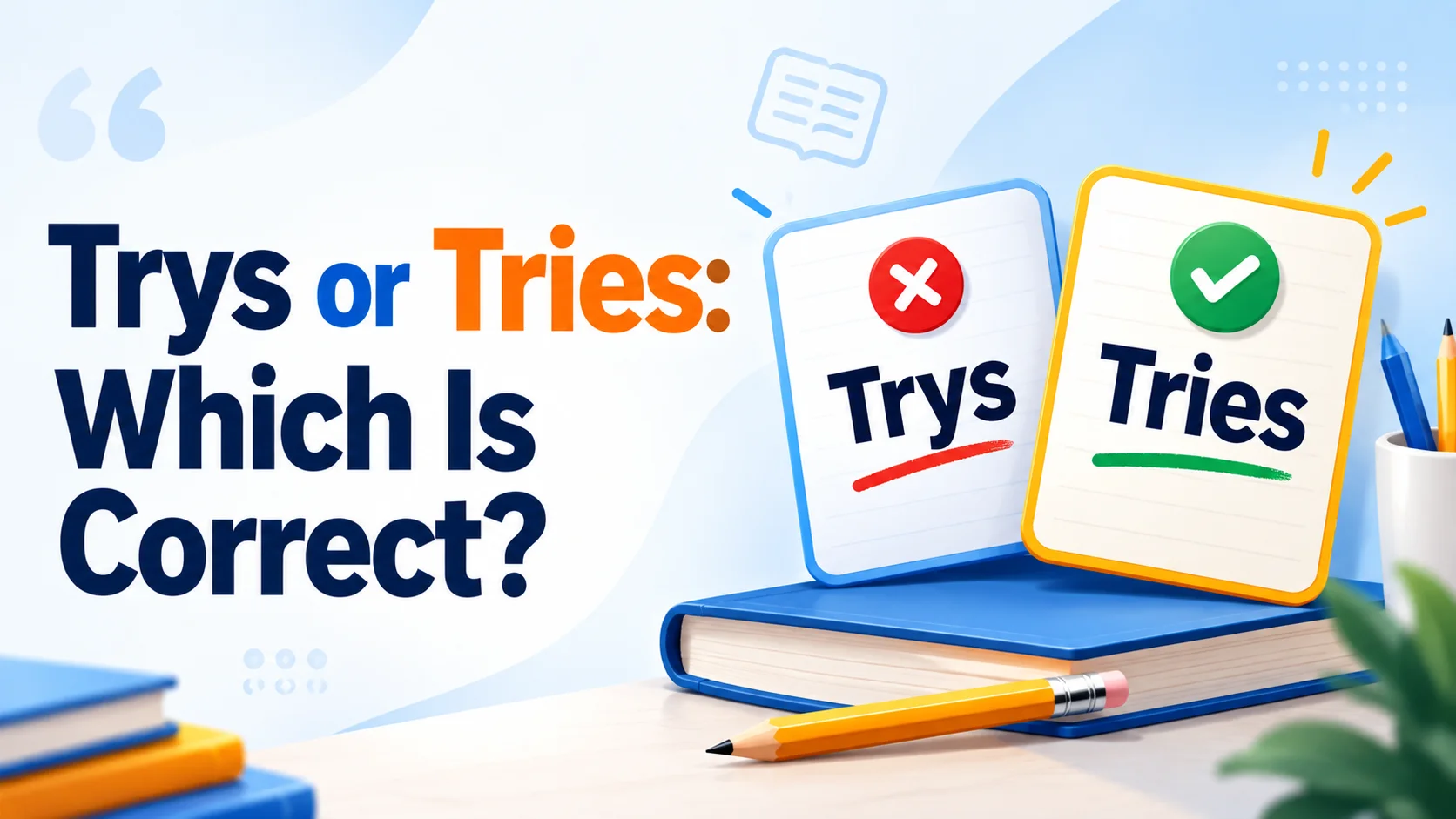
Trys or tries is a common spelling question, especially for English learners who know that many verbs form the third-person singular by simply adding -s. The correct spelling, however, is tries. The reason is a small but important spelling rule: when a word ends in a consonant + y, the y usually changes to i before the appropriate ending. That gives us try → tries, not try → tries. Understanding this pattern also makes words such as cry → cries and study → studies easier to spell.
The confusion becomes more interesting because tries has two common grammatical jobs. It can be the third-person singular form of the verb try, as in “She tries again,” or the plural form of the noun try, as in “He needed three tries.” Meanwhile, tried and trying follow different spelling patterns. This guide explains each form, shows when to use it, and tackles mistakes such as tries, tries, tries, and tries after to.
By the end, you will know exactly when to write try, tries, tried, or trying. You will also see why the spelling changes, how the rule works with similar words, and where learners commonly go wrong. The explanations use practical examples from everyday conversation, school writing, workplace communication, and digital communication, so you can apply the rule rather than simply memorize one spelling. Dictionaries such as Merriam-Webster list tries as both the plural of try and the third-person singular present form.
Trys or Tries: Which Spelling Is Correct?
The correct spelling is tries.
Correct: She tries to finish her homework.
Incorrect: She tries to finish her homework.
Correct: He solved the problem after three tries.
Incorrect: He solved the problem after three tries.
Trys is not the standard spelling of either the third-person singular verb or the plural noun. When try takes the relevant -s/-es ending, the final y changes to i and the ending becomes -ies.
The basic pattern is:
try → tries
This is the same spelling pattern seen in:
- cry → cries
- fly → flies
- study → studies
- carry → carries
- worry → worries
The important point is that English does not use -ies after every word ending in y. The letter before y matters, which is why play becomes plays, not plaies. We will look at that distinction in detail below.
What Does “Tries” Mean?
Tries can have two main grammatical functions: it can be a verb or a plural noun.
“Tries” as a Verb
As a verb, tries is the third-person singular present form of try.
Use it when the subject is he, she, it, or another singular third-person subject.
Examples:
- She tries to arrive early.
- He tries his best.
- The machine tries to restart automatically.
- My brother tries a different approach.
- The teacher tries to explain the idea clearly.
Merriam-Webster defines try as a verb meaning, among other things, to make an effort or attempt or to do something to see whether it works or succeeds.
Notice the subject-verb relationship:
| Subject | Correct form | Example |
| I | try | I will try again. |
| You | try | You try again. |
| We | try | We will try again. |
| They | try | They try again. |
| He | tries | He tries again. |
| She | tries | She tries again. |
| It | tries | It tries again. |
That table explains one of the most common mistakes. Try and tries are not interchangeable.
“Tries” as a Noun
Tries is also the plural of the noun try.
Here, try means an attempt or an effort to accomplish something.
Examples:
- I passed on my third try.
- She needed two tries.
- We gave it several tries.
- His first try failed.
- After five tries, the program finally worked.
Merriam-Webster lists the noun try with the plural tries, defining it in this sense as an experimental trial or attempt.
“Tries” in Sports
In rugby, a try is also a specific scoring play. Its plural is tries.
For example:
The team scored three tries during the match.
This is a specialized sporting meaning, but the spelling rule remains exactly the same.
Why Is “Trys” Wrong?
The mistake usually comes from applying a very common English pattern too literally:
add -s to make a word plural or to form the third-person singular verb.
That works with many words:
- play → plays
- read → reads
- work → works
- jump → jumps
But words ending in consonant + y follow a different spelling pattern when forming the relevant -s or -es form.
So:
try + s → tries
not:
try + s → trys
The change is not a pronunciation trick. It is a conventional English spelling rule.
A useful distinction
Compare these two groups:
Consonant + y
- try → tries
- cry → cries
- study → studies
- carry → carries
Vowel + y
- play → plays
- enjoy → enjoys
- stay → stays
- employ → employs
The letter immediately before y determines which pattern applies.
The Spelling Rule: When Does Y Change to I?
Consonant + Y → Change Y to I and Add -ES
When a word ends in a consonant followed by y, the y generally changes to i before the -es ending.
For example:
- try → tries
- cry → cries
- fly → flies
- study → studies
- copy → copies
- hurry → hurries
- reply → replies
So the spelling logic is:
try → tr + y → tr + i + es → tries
The same pattern applies to both verbs and nouns where the appropriate plural or third-person form requires it.
Vowel + Y → Keep the Y and Add -S
If a vowel comes immediately before y, the y normally stays.
Examples:
- play → plays
- stay → stays
- enjoy → enjoys
- obey → obeys
- destroy → destroys
So:
She plays tennis.
Not:
She plays tennis.
And:
He enjoys reading.
Not:
He enjoyed reading.
The Easiest Way to Remember the Rule
Don’t memorize dozens of individual words. Look at the letter immediately before y.
Consonant + y → y changes to i + es
Vowel + y → keep y + s
Tip: In try, the letter before y is r, a consonant. Therefore, try → tries.
This simple check is much more reliable than trying to remember whether tries “looks right.”
Try, Tries, Tried, or Trying? The Complete Word Family
Knowing the entire word family prevents several related spelling errors.
| Form | Grammatical use | Example |
| try | Base verb; singular noun | I will try again. |
| tries | Third-person singular verb; plural noun | She tries again. / Three tries |
| tried | Past tense; past participle | He tried yesterday. |
| trying | Present participle; gerund | They are trying again. |
| trys | Incorrect standard form | Avoid it. |
Try — Base Form
Use try after:
- I
- you
- we
- they
- to
- modal verbs such as can, will, should, and might
Examples:
- I will try to help.
- They try every day.
- I want to try again.
- She can try tomorrow.
- We should try a different method.
Tries — Third-Person Singular and Plural Noun
Use tries in two major situations:
- He/she/it + tries
- More than one try = tries
Examples:
- He tries to understand.
- The software tries to reconnect.
- She made three tries.
- We succeeded after several tries.
Tried — Past Tense and Past Participle
The past tense is tried, not tried.
Examples:
- I tried yesterday.
- She tried several solutions.
- They have tried everything.
The spelling follows the same general consonant + y → i pattern before -ed.
try → tried
Trying — The -ing Form
The present participle is trying, not trying.
Examples:
- I am trying to learn.
- She is trying again.
- They were trying to solve the problem.
Here, the spelling behaves differently because the y is retained before -ing.
try → trying
When Should You Use “Try” Instead of “Tries”?
The choice depends primarily on the grammatical structure of the sentence.
After I, You, We, and They
Use try:
- I will try my best.
- You try again.
- We try different methods.
- They try to help.
After He, She, and It
Use tries:
- He tries his best.
- She tries again.
- It tries to connect.
This also applies to singular nouns:
The student tries again.
The computer tries to restart.
After “To”
After to, use the base form try:
I want to try again.
She needs to try harder.
They decided to try another method.
Not:
I want to tries again.
The reason is grammatical rather than simply orthographic: to + base verb is the normal infinitive construction.
After Modal Verbs
After modal verbs, use try, not tries.
Correct:
- He can try again.
- She will try tomorrow.
- They should try this method.
- We might try later.
Incorrect:
- He can tries again.
- She will tries tomorrow.
The modal already controls the verb form.
“Try” vs. “Tries” as a Noun
When try is a noun, the distinction is straightforward:
one try → two tries
Examples:
- Give me one more try.
- He passed on his second try.
- She needed several tries.
- The first two tries failed.
- After three tries, the answer was correct.
A useful test is to place a number before the word.
If you can say:
one try
two tries
five tries
then you are dealing with the noun.
One Common Trap
The plural noun is tries, but a phrase containing to normally takes the base verb:
I want to try again.
Compare:
I made three tries.
The first uses try as a verb. The second uses tries as a plural noun.
“Try to” vs. “Try -ing”: What’s the Difference?
These constructions are related but can communicate different ideas.
Try to Do Something
Try to + verb usually means to make an effort to accomplish something.
Examples:
- Try to arrive on time.
- She tried to open the door.
- He is trying to solve the problem.
The focus is on the effort or goal.
Try Doing Something
Try + -ing often suggests experimenting with an action to see whether it helps.
Examples:
- Try restarting the computer.
- Try adding less water.
- If you’re having trouble, try changing the settings.
The focus is often on testing a possible solution.
Consider this distinction:
Try to restart the computer.
Make an effort to restart it.
Try restarting the computer.
Test restarting it as a possible solution.
The context can make the difference subtle, but this distinction is especially useful in instructions and troubleshooting.
Trys vs. Tries: Common Mistakes and Corrections
Mistake 1: “He tries to help.”
Correct: He tries to help.
The subject requires the third-person singular form, and try becomes tries.
Mistake 2: “She tried again.”
Correct: She tried again.
The past form changes y to i before -ed.
Mistake 3: “They made two trys.”
Correct: They made two tries.
Here, tries is the plural noun.
Mistake 4: “I want to tries again.”
Correct: I want to try again.
The verb following to is in its base form.
Mistake 5: “She can tries again.”
Correct: She can try again.
A modal verb such as can is followed by the base form.
Mistake 6: “He is tiring.”
Correct: He is trying.
The -ing form does not produce tiring.
Correct and Incorrect Examples at a Glance
| Incorrect | Correct | Reason |
| He tries again. | He tries again. | Consonant + y changes to ies |
| Two tries | Two tries | Plural of try |
| She tried yesterday. | She tried yesterday. | Past-tense spelling |
| I want to tries. | I want to try. | To take the base form |
| He can tries. | He can try. | Modal + base verb |
| They are tiring. | They are trying. | Y remains before -ing |
“Tries” in Everyday English
Everyday Conversation
Natural conversation often uses try and tries when talking about effort:
- “I’ll try again.”
- “She tries really hard.”
- “Give it another try.”
- “How many tries did you need?”
These are ordinary, flexible uses rather than formal grammar constructions.
School and Academic Writing
In schoolwork, correct verb agreement matters:
The student tries to explain the experiment.
Researchers try different methods.
The first two tries produced similar results.
Notice how the spelling changes with the grammatical role, not with the general meaning of “attempt.”
Workplace and Professional Writing
You might see sentences such as:
The system tries to reconnect automatically.
We should try another approach.
The team made several tries before finding the cause.
In professional writing, a small spelling error such as trys can make otherwise clear writing look less polished. Getting the underlying rule right is more useful than relying on spell-check alone.
Emails and Messages
For example:
I’ll try the process again and let you know what happens.
Or:
She tries to respond to every request promptly.
The same grammar applies whether the message is formal or casual.
Common Collocations With “Try” and “Tries”
Certain combinations occur frequently in natural English.
Common patterns with “try”
- try again
- try to help
- try to understand
- try your best
- try something new
- give it a try
- try doing something
- try out a method
Common patterns with “tries”
- tries to help
- tries to explain
- tries again
- tries to solve
- several tries
- three tries
- another two tries
For example:
She tries to explain the problem.
But:
They try to explain the problem.
The difference is driven by the subject.
Try vs. Attempt: Are They the Same?
- Try and attempt are close in meaning, but they are not always equally natural.
- Try is extremely common in everyday English:
I’ll try to fix it.
Attempt can sound more formal:
The team will attempt to fix the issue.
Merriam-Webster treats attempt as a synonym of try, while noting that the words can have different shades of meaning depending on context.
A practical rule:
| Situation | More natural choice |
| Casual conversation | try |
| Simple instructions | try |
| Friendly email | try |
| Formal report | attempt may fit |
| Technical description | Either, depending on context |
| Repeated everyday effort | try |
This is a style choice, not a spelling rule. There is nothing grammatically wrong with try simply because attempt sounds more formal.
Is “Trys” Ever Correct?
For normal English grammar, no: trys is not the standard form of the verb try or the plural of the noun try.
However, you may occasionally encounter Trys as a deliberately chosen name, username, brand, title, or other proper name. A person or organization can create a name with an unusual spelling.
That does not change the standard grammar.
For example, if a fictional company were named “Trys,” its name could legitimately appear in that form. But you would still write:
She tries to contact the company.
not:
She trys to contact the company.
Likewise, creative branding should not be used as evidence that tries is an accepted spelling in ordinary English.
British English vs. American English: Is “Tries” Spelled Differently?
No. Tries is the standard spelling in both British and American English.
This is not one of the spelling differences that separate varieties of English. Words such as colour/color and centre/center vary by regional convention, but try → tries follows the same spelling pattern in both.
So whether you are writing for:
- a British audience,
- an American audience,
- an international audience,
- a school assignment, or
- a professional workplace,
tries is the safe standard form.
How Do You Pronounce “Try” and “Tries”?
Try is pronounced approximately like /traɪ/.
Tries is pronounced approximately /traɪz/.
The important point for learners is that tries is normally one syllable. The spelling -ies does not mean you pronounce an extra syllable such as “try-eez.”
Compare:
- try → /traɪ/
- tries → /traɪz/
This is another reason spelling cannot always be predicted simply from pronunciation. English spelling represents established word patterns rather than providing a perfectly consistent sound-by-sound system.
Why Do People Write “Trys”?
The error is understandable because -s is the normal ending for many third-person singular verbs and plural nouns.
A learner may know:
play → plays
and assume:
try → trys
The problem is that try belongs to the consonant + y spelling pattern.
Other factors can contribute:
- typing quickly
- relying too heavily on pronunciation
- confusing try with play
- not knowing the y → ies rule
- assuming every plural simply adds -s
- trusting an informal online spelling
The best solution is not to memorize “trys is wrong.” Instead, learn the pattern:
consonant + y → ies
Once you recognize that pattern, many other words become easier.
A Simple Decision Guide: Should You Write “Try” or “Tries”?
Use this quick checklist whenever you hesitate.
Step 1: Is the word after to?
→ Try.
I want to try.
Step 2: Is it after a modal such as can, will, or should?
→ Try.
She will try.
Step 3: Is the subject he, she, or it in the present tense?
→ Use tries.
He tries.
Step 4: Does the word mean more than one attempt?
→ Use tries.
Three tries.
Step 5: Are you talking about the past?
→ Use tried.
She tried yesterday.
Step 6: Does the sentence use the -ing form?
→ Use trying.
They are trying again.
Quick Decision Table
| If you mean… | Use | Example |
| Base verb | try | I will try. |
| He/she/it in present tense | tries | She tries. |
| More than one attempt | tries | Three tries. |
| Past action | tried | He tried. |
| Ongoing action | trying | He is trying. |
| Standard English spelling of the forms above | Never tries | — |
A Simple Memory Trick for “Tries”
Remember this sentence:
“A consonant before Y makes Y say goodbye.”
In spelling terms:
consonant + y → ies
So:
- try → tries
- cry → cries
- fly → flies
- study → studies
But when a vowel comes before y, keep the y:
- play → plays
- stay → stays
- enjoy → enjoys
If you remember only one thing from this article, remember to look at the letter immediately before the final y.
Test Yourself: Trys or Tries?
Choose the correct form.
1. She ___ to finish the project today.
Answer: tries
“She” is a third-person singular subject, so the present-tense form is tries.
2. I want to ___ one more time.
Answer: try
The verb follows to, so use the base form try.
3. He succeeded after three ___.
Answer: tries
Here, tries is the plural noun meaning attempts.
4. The system ___ to restart automatically.
Answer: tries
“The system” is singular, so the verb is tries.
5. They ___ different methods every week.
Answer: try
“They” takes the base present form try.
A More Advanced Check
Consider this sentence:
“She can tries three times.”
It contains two grammar problems. The correct version is:
“She can try three times.”
Why? The modal can require the base verb try, and three times already expresses the number of attempts. You do not need to turn try into tries merely because the number is three.
Conclusion
When choosing between tries or tries, the answer is straightforward: tries is the correct standard spelling. The key is understanding why. When try needs the third-person singular -s form or becomes the plural noun, its final y changes to i, producing tries. The same pattern appears in cry → cries, study → studies, and carry → carries. But remember that try remains unchanged after to, modal verbs, and subjects such as I, you, we, and they. One final actionable tip: when you see a word ending in y, check the letter immediately before it before adding an ending. A common mistake to avoid is treating every y-ending word the same way. Master that small distinction, and tries becomes an easy spelling choice rather than a recurring doubt.
Frequently Asked Questions
Q1. Is “trys” a correct English word?
Trys is not the standard spelling of the verb try or its plural noun. The correct form is tries. You might encounter Trys as a name, username, or brand, but those special uses do not establish it as standard English grammar.
Q2. Is it “try’s” or “tries”?
For the ordinary plural or third-person verb, use tries. Try’s contains an apostrophe and therefore has a different grammatical purpose, such as indicating possession in a rare context. An apostrophe should not be used simply to make a plural.
Q3. What is the plural of “try”?
The plural noun is tries. For example, “She passed after three tries.” The spelling follows the consonant + y pattern: the final y changes to i, followed by -es. The same pattern appears in words such as cry → cries and study → studies.
Q4. Why is it “tried” but “trying”?
These forms use different endings. Before -ed, try becomes tired, while before -ing, it becomes trying. Therefore, tried and trying are incorrect standard spellings. Learning the complete word family helps prevent these related errors.
Q5. Is “he trys” ever correct?
In standard English, he tries to be correct. The subject he requires the third-person singular present form, and try changes to tries because it ends in consonant + y. He trys is a spelling error, not a British or American variation.