

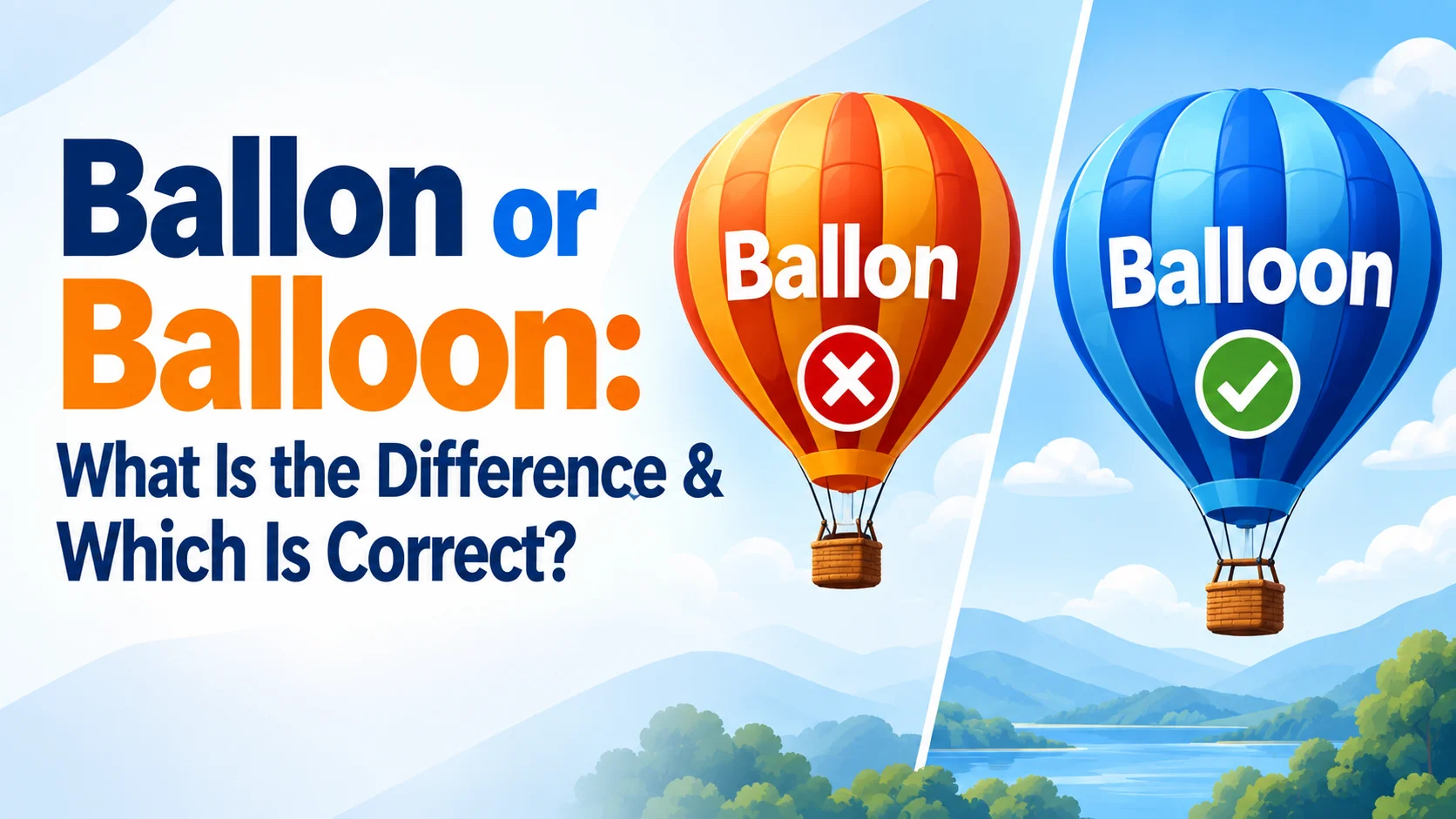
Ballon or balloon can be confusing because the two spellings differ by only one letter, yet they do not have the same everyday meaning. If you are writing about a party decoration, a toy, a hot-air balloon, or something that increases rapidly, the standard English spelling is balloon. However, a balloon is not always an error. It appears as a specialized word, particularly in ballet terminology, and some dictionaries also record it for a type of large, rounded drinking glass.
The confusion usually comes from dropping the second “o.” When spoken aloud, balloon does not make its spelling obvious, so it is easy to write balloon by accident. That mistake is especially common for learners who hear the word before seeing it written. In ordinary English, though, balloon is the form you should choose. This guide explains the difference, shows how each word works in context, and gives you a practical way to decide which spelling belongs in your sentence.
There is also an important exception that many simple spelling guides overlook. Ballon can be a legitimate English dictionary word when the context calls for it. In ballet, a balloon describes the lightness or buoyancy of a dancer’s movement during a jump. Cambridge also records balloon as a noun for a large, round glass, particularly one used for brandy. Understanding that distinction is more useful than memorizing “balloon is wrong.” The better rule is use balloon for the ordinary word and recognize balloon when it belongs to a specialized context.
Ballon vs. Balloon: The Quick Answer
If you are talking about an inflatable object, the correct spelling is balloon.
If you mean something that expands or increases rapidly, the correct verb is also balloon.
Examples:
- We bought colorful balloons for the party.
- The balloon floated above the crowd.
- Housing costs have ballooned in recent years.
- The skirt ballooned out in the wind.
By contrast, balloon has specialized meanings. Merriam-Webster defines ballon as a ballet term describing the lightness of movement that can make a dancer’s jump appear to last longer. Cambridge separately records balloons for a large, round drinking glass.
Ballon vs. Balloon at a Glance
| Feature | Balloon | Ballon |
| Standard everyday English | Yes | No |
| Inflatable object | Yes | No |
| Hot-air balloon | Yes | No |
| Verb meaning “increase rapidly” | Yes | No |
| Ballet terminology | No | Yes |
| Large rounded drinking glass | No | Yes, in dictionary-recorded usage |
| Common spelling mistake | — | Often, when intended meaning is balloon |
| Best choice for general writing | Balloon | Only when the specialized meaning applies |
Quick rule: If you are unsure and you mean the familiar inflatable object, write balloon.
What Does “Balloon” Mean?
Balloon is an established English word used as a noun, verb, and in some related adjective and compound forms. Its everyday meaning is much broader than the party decoration many people first associate with it.
Balloon as a Noun
A balloon can be an inflatable bag made from a light material and filled with air or gas. Balloons can be used as toys, decorations, scientific instruments, aircraft, and in certain medical applications. Merriam-Webster and Oxford both recognize these different senses.
For example:
- The children played with a red balloon.
- We tied several balloons to the chairs.
- The weather balloon collected atmospheric information.
- They traveled in a hot-air balloon.
The word can also refer to the outline surrounding dialogue or thoughts in cartoons and comics. That meaning is less obvious but still standard English.
Balloon as a Verb
A balloon can also describe something becoming larger, rounder, or more extensive.
Oxford gives examples involving something forming a rounded shape and something increasing rapidly.
Consider these sentences:
- Her dress ballooned in the strong wind.
- The balloon ballooned out as more air entered it.
- The project’s costs ballooned unexpectedly.
- Demand for the product ballooned after the announcement.
This figurative use is important because balloons are not limited to physical objects. A problem, cost, debt, population, or workload can balloon when it grows quickly.
Common Balloon Compounds
You will encounter balloon in many established expressions:
- hot-air balloon
- weather balloon
- helium balloon
- balloon animal
- balloon payment
- balloon ride
- balloon flight
- balloon sleeve
These compounds are another reason learning the correct base spelling matters. Once you know the balloon, related expressions become much easier to spell.
What Does “Ballon” Mean?
The interesting part of this spelling question is that ballon is not completely nonexistent in English.
It is a specialized term, and its meaning depends on context.
“Ballon” in Ballet
In ballet, balloon refers to a quality of lightness or buoyancy in a dancer’s movement, particularly during jumps. The effect can make a dancer appear to float or momentarily suspend in the air. Merriam-Webster records this specialist meaning, while Collins and Dictionary.com also identify ballon as a ballet term.
For example:
The dancer demonstrated exceptional balloons during the leap.
Here, replacing balloon with balloon would not preserve the specialized ballet terminology.
This is a good example of why blanket rules such as “balloon is always wrong” are too simplistic.
“Ballon” as a Type of Glass
There is another dictionary-recorded use. Cambridge defines ballon as a large, round glass, typically associated with drinking brandy.
So a sentence such as:
He held a balloon of brandy.
can use ballon intentionally rather than as a spelling mistake.
This meaning is much less common in everyday writing than balloon, which explains why most learners will rarely encounter it.
Expert tip: Don’t “correct” every instance of balloon automatically. First determine what the writer means. A spelling that looks unusual may be a legitimate technical, artistic, historical, or specialized term.
The Main Difference Between Balloon and Balloon
The easiest way to understand the distinction is to separate ordinary vocabulary from specialized vocabulary.
One Extra “O” Changes the Word
The ordinary word is:
B-A-L-L-O-O-N → balloon
The common misspelling is:
B-A-L-L-O-N → ballon
That missing o matters. You should not write ballon when you mean the inflatable object.
Compare:
- ❌ We bought ten ballons.
- ✅ We bought ten balloons.
The plural is formed from a balloon, so the double-o spelling remains.
Their Meanings Are Not Interchangeable
If you write:
The balloon floated into the sky.
Most readers will interpret that as a spelling mistake because the intended word is almost certainly balloon.
But:
The dancer showed excellent balloons.
is potentially correct if balloon is being used as the ballet term.
The surrounding context therefore matters more than simply counting letters.
Standard English vs. Specialized Vocabulary
For school assignments, general articles, emails, everyday conversations, and most professional writing, balloon is overwhelmingly the form you need when discussing the familiar object or the verb meaning “expand.”
Ballon belongs to a narrower vocabulary. Its legitimate uses are worth knowing, but they should not cause you to second-guess the normal spelling.
Why Do People Write “Ballon” Instead of “Balloon”?
The error is understandable. The word contains a repeated vowel, and English spelling does not always allow readers to predict exactly how many letters they need from pronunciation alone.
The Missing Second “O”
The most straightforward explanation is simple omission.
A writer remembers:
ball + on
and produces ballon instead of remembering:
ball + oon
This is particularly easy when typing quickly.
Pronunciation Does Not Clearly Reveal the Spelling
Oxford gives the pronunciation of balloon as /bəˈluːn/.
When you hear the long “oo” sound, you hear one sound rather than two separate letters. Nothing in normal pronunciation literally tells you, “There are two o’s here.”
That is why spelling should be learned visually as well as phonetically.
Influence From Other Languages
English borrowed balloon through French and Italian history; Merriam-Webster traces the word to French balloon and Italian dialect ballone. Oxford similarly identifies French ballon or Italian ballone in the word’s history.
This history helps explain why both spellings can exist in related languages or specialized English vocabulary. It does not, however, make balloon the standard modern English spelling for an inflatable party balloon.
Typing and Speech-to-Text
Digital tools can introduce spelling errors when someone types quickly or relies on speech recognition. If you repeatedly see ballon and assume it is correct, the mistake can become habitual.
A quick visual check—a balloon has two o’s—is usually enough to prevent it.
How to Spell Balloon Correctly
The correct everyday spelling is:
B-A-L-L-O-O-N
The part most likely to be forgotten is:
OO
Think of the word in two chunks:
BALL + OON
That visual pattern is more reliable than trying to reconstruct the spelling from pronunciation.
A Simple Memory Trick
Imagine the two o’s as two small round balloons sitting next to each other:
ball + oo + n
It is not a formal spelling rule, but it gives your memory a visual cue.
Another useful habit is to check the word whenever you type related forms:
- balloon
- balloons
- ballooned
- ballooning
The double o stays present throughout these forms.
Balloon in Real Sentences
Seeing the word in different grammatical roles is one of the fastest ways to understand its usage.
Everyday Examples
- The balloon floated toward the ceiling.
- She carried a bunch of balloons home.
- The children decorated the room with balloons.
- A hot-air balloon appeared above the hills.
- The balloon burst when it touched the branch.
In every example, balloon is the correct spelling.
Balloon as a Verb
The verb becomes particularly useful in formal writing:
- The company’s expenses ballooned during the project.
- The number of applications ballooned after the announcement.
- Her skirt ballooned in the wind.
- The problem ballooned into a much larger issue.
Notice the difference between physical and figurative growth. The first three examples can involve literal expansion or rapid increase; the final example uses the word figuratively.
Correct vs. Incorrect Examples
| Incorrect | Correct | Reason |
| I bought a balloon. | I bought a balloon. | Everyday inflatable object |
| The balloon popped. | The balloon popped. | Standard noun |
| Prices ballooned last year. | Prices ballooned last year. | Verb requires balloon |
| Three balloons were floating outside. | Three balloons were floating outside. | Correct plural |
| The dancer showed impressive balloons. | The dancer showed impressive balloons. | Specialized ballet term |
The final example is deliberately different: balloon can be correct when it has its specialized meaning.
When Is “Ballon” Actually Correct?
This is the distinction worth remembering if you want an accurate rather than oversimplified answer.
Use balloon when the word is being used in a recognized specialized sense.
In Ballet
Use a balloon when discussing the quality of buoyancy or lightness in a dancer’s jumps.
For example:
The instructor praised the dancer’s balloon.
The term is associated with the appearance of floating or extended suspension during movement.
For a Large Rounded Drinking Glass
Cambridge records balloon as a noun for a large, round glass, particularly one used for brandy.
This is uncommon vocabulary for many English learners, so encountering it does not necessarily indicate a typo.
When You Should Not Use “Ballon”
Do not use ballon simply because you want a shorter spelling of balloon.
For example:
- ❌ ballon animal
- ❌ hot-air ballon
- ❌ weather ballon
- ❌ birthday ballon
- ❌ ballon ride
The standard forms are:
- ✅ balloon animal
- ✅ hot-air balloon
- ✅ weather balloon
- ✅ birthday balloon
- ✅ balloon ride
Balloon, Balloons, Ballooning, and Other Word Forms
One useful way to stop making this mistake is to learn the entire word family.
| Word | Part of Speech | Example |
| balloon | Noun | The balloon popped. |
| balloon | Verb | Costs ballooned rapidly. |
| balloons | Plural noun / verb | The balloons filled the room. |
| ballooned | Past tense | Expenses ballooned unexpectedly. |
| ballooning | -ing form | Ballooning costs became a concern. |
The double o remains part of the spelling.
A common mistake is to remember balloon correctly but then accidentally write balloon or ballooning. The same visual pattern solves both problems.
Which One Should You Use? A Practical Decision Guide
When you encounter the choice in your own writing, ask one question:
What do I mean by the word?
| If you mean… | Use |
| An inflatable party object | balloon |
| A helium-filled object | balloon |
| A hot-air aircraft | balloon |
| A weather instrument | balloon |
| Something increasing rapidly | balloon |
| Something swelling or expanding | balloon |
| A ballet quality of buoyant movement | ballon |
| A specialized rounded drinking glass | ballon |
For ordinary readers, the answer will almost always be balloon.
Quick decision rule: If you could replace the word with “inflatable object,” “hot-air aircraft,” or “increase rapidly,” choose balloon. If you are discussing a specialized dictionary term, check the context before changing ballon.
Common Mistakes With Balloon and Balloon
Mistake 1: Dropping One “O”
This is the most common problem:
ballon ❌ → balloon ✅
If you mean the party decoration, there is no reason to remove the second o.
Mistake 2: Assuming “Ballon” Is Always Wrong
This is the opposite error.
Because ballon is uncommon, some writers assume it cannot be a legitimate English word. Dictionaries show otherwise: it has established specialist meanings.
Mistake 3: Applying the Specialized Meaning to Everyday Writing
Knowing that ballon exists does not mean you should use it for ordinary objects.
A birthday ballon is not an acceptable alternative spelling of birthday balloon.
Mistake 4: Forgetting the Double “O” in Derived Forms
Writers sometimes remember balloon but make mistakes with:
- balloons
- ballooned
- ballooning
Keep the base spelling intact.
A Quick “Ballon or Balloon?” Test
Choose balloon or balloon in each sentence.
- We filled twenty ______ for the celebration.
- The company’s expenses ______ after the delay.
- A hot-air ______ crossed the valley.
- The ballet teacher discussed the dancer’s ______.
- The weather ______ was released early in the morning.
- The skirt ______ out in the wind.
Answers
- balloons
- ballooned
- balloon
- ballon
- balloon
- ballooned
The fourth answer is the important exception. It refers to the specialized ballet term, not an inflatable object.
Final Verdict
For almost every everyday English situation, balloon is the correct spelling. Use it for an inflatable object, a hot-air balloon, a weather balloon, and the verb meaning to expand, swell, or increase rapidly. Major dictionaries such as Merriam-Webster and Oxford document these ordinary meanings and grammatical forms. The important exception is that balloon is a real word in specialized contexts. In ballet, it describes a quality of lightness or buoyancy in a dancer’s movement; another dictionary-recorded use refers to a large, rounded drinking glass. One final actionable tip: whenever you mean the familiar inflatable object, remember BALL + OO + N. A common mistake to avoid is treating every unusual balloon as an error—or, conversely, using a balloon simply because you forgot the second o. The right spelling follows the meaning.
Frequently Asked Questions
Q1. Is “balloon” a correct spelling in English?
Yes, but only in specific contexts. Ballon is a recognized English word in specialized vocabulary, including ballet, where it describes a quality of buoyancy or lightness in a dancer’s movement. Cambridge also records it for a large, rounded drinking glass. For ordinary inflatable objects, use balloon.
Q2. Is “ballon” a misspelling of “balloon”?
Usually, yes, when the writer means an inflatable object or the verb meaning “to expand rapidly.” However, calling every occurrence of ballon a mistake is inaccurate. It can be a legitimate specialized term, particularly in ballet. Always consider the sentence’s subject and context before correcting it.
Q3. Why does “balloon” have two O’s?
The spelling balloon developed through the word’s history in French and Italian and became established in English with the double-o form. Modern pronunciation does not make the number of written letters obvious, so memorizing the visual form ball + oo + n is a practical way to avoid dropping an o.
Q4. What is the plural of “balloon”?
The plural is balloons. The double-o spelling remains unchanged before the plural ending -s. For example: “The children released several balloons.” Similarly, the verb forms ballooned and ballooning retain the double-o sequence.
Q5. How can I quickly remember “balloon” instead of “ballon”?
Use the visual pattern BALL + OO + N. The two consecutive os are the part most often omitted. If you are writing about a party decoration, hot-air aircraft, weather balloon, or rapid increase, mentally check for two o’s before moving on.