

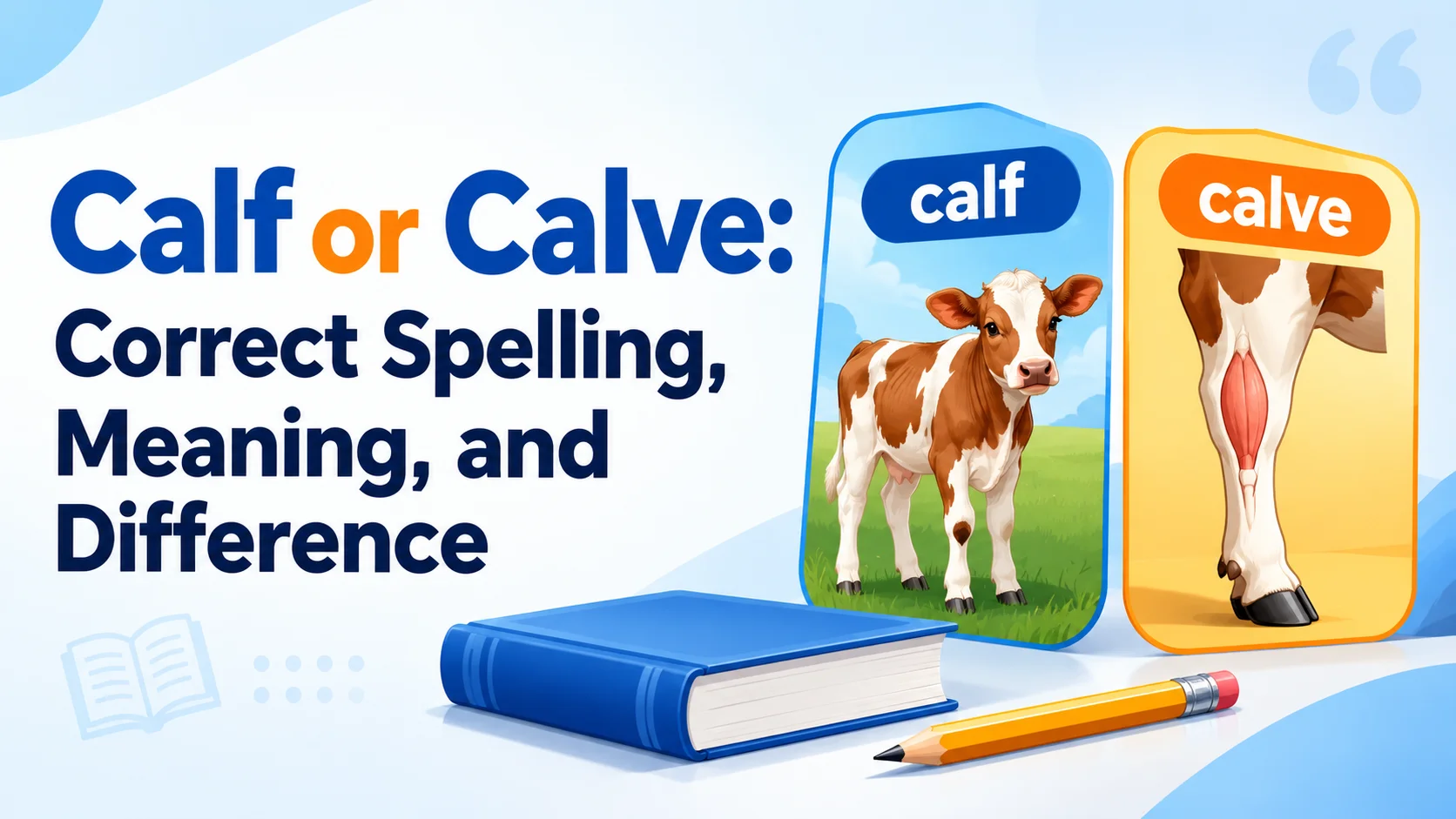
Calf or calve can be confusing because the two words look almost identical and are closely related in meaning, but they do completely different jobs in a sentence. Calf is primarily a noun, while calve is a verb. The difference becomes especially important when writing about animals, farming, anatomy, or glaciers. In addition, calves creates another layer of confusion because it can be the plural of calf or a verb form of calve. Cambridge Dictionary lists calf as a noun for a young cow or certain other large mammals and for the back of the lower leg.
The easiest way to understand the distinction is to focus on what the word is doing in the sentence. If you are naming a young animal or the back part of a leg, use calf. If you are describing an animal giving birth, use calves. The spelling becomes even clearer when you look at related forms: calf → calves, while calve → calved → calving. These forms belong to different grammatical patterns, even though they share the same basic letters.
This guide explains calf vs. calve, their meanings, grammar, pronunciation, plural forms, common mistakes, and real-world usage. You will also see why calfs is normally incorrect as the plural of calf, how calves can sometimes function as a verb, and why calve is also used in glaciology. By the end, you should be able to choose the correct form quickly without relying on guesswork.
Quick Answer: Calf vs. Calve
The simplest distinction is:
- Calf = a noun meaning a young animal or the back part of the lower leg.
- Calve = a verb meaning to give birth to a calf; it is also used when ice breaks away from a glacier or ice shelf.
- Calves = the plural of calf.
- Calves can also be the third-person singular form of the verb calve.
- Calfs is not the standard plural when you mean more than one calf.
| Word | Grammar | Main meaning | Example |
| calf | Noun | Young animal or part of the leg | The calf stayed near its mother. |
| calve | Verb | Give birth; break away as ice | The cow will calve soon. |
| calves | Noun | More than one calf | The calves are in the field. |
| calves | Verb | Gives birth | The cow calves every spring. |
| calved | Verb | Past tense of calve | The cow calved last night. |
| calving | Verb/noun | Giving birth or ice breaking away | Calving season has begun. |
What Does “Calf” Mean?
Calf is a noun with two common meanings. The first relates to animals, while the second refers to human anatomy.
Calf Means a Young Animal
A calf is a young cow, but the word can also describe the young of several other large mammals. Cambridge Dictionary specifically includes young animals such as elephants and whales in its definition.
Examples:
- The farmer checked on the newborn calf.
- The elephant stayed close to her calf.
- The whale traveled with its calf.
This is an important point for beginners: calf does not mean only a baby cow. Context determines which animal is being discussed.
For example:
The elephant protected her calf.
Here, calf clearly means a young elephant, not a young cow.
Calf Also Means Part of the Leg
The second common meaning of calf has nothing to do with animals. It refers to the thick, curved part at the back of the lower leg, between the knee and foot.
Examples:
- My calf hurts after the long walk.
- He injured his calf muscle during practice.
- She felt a tightness in her left calf.
This meaning is common in everyday conversation, fitness, sports, medicine, and anatomy.
Helpful distinction:
When calf refers to anatomy, its plural is still calves: both calves were sore.
The Plural of Calf Is “Calves”
If you are talking about more than one calf, the standard plural is calves, not calfs. Cambridge gives calves as the plural of calf in both British and American English.
- One calf
- Two calves
- One calf muscle
- Two calves
The change from -f to -ves is one reason English learners often hesitate over this word.
What Does “Calve” Mean?
Unlike calf, calve is a verb.
Calve Means to Give Birth
When a cow calves, it gives birth to a calf. Cambridge defines calve as an intransitive verb used when a cow gives birth.
Compare:
The cow had a calf.
Here, the calf names the young animal.
The cow will calve tomorrow.
Here, calves describe the action of giving birth.
This is the central difference between the two words.
Calve Can Apply to Other Large Animals
The verb is strongly associated with cattle and animal husbandry, but calving is also used in descriptions of other animals in appropriate contexts.
For example:
The herd was monitored closely during calving season.
In agricultural writing, calving is a standard term for the process surrounding the birth of calves.
Calve Also Describes Breaking Ice
There is another specialized meaning that many basic grammar articles leave out.
A glacier or ice shelf can calve, meaning a large piece of ice breaks away from it and forms an iceberg or floating ice mass. Cambridge’s examples of calving include scientific discussion of ice fronts and glaciers.
For example:
A large section of the glacier calved into the sea.
This has nothing to do with an animal giving birth. The word is being used in a specialized geographical and glaciological sense.
Calf or Calve: The Main Grammar Difference
The most useful way to separate these words is by part of speech.
Use “Calf” When You Name Something
Use calf when the word functions as a noun.
It can name:
- a young animal
- the lower-leg muscle
- a specific young mammal in an appropriate context
Examples:
- The calf followed its mother.
- My right calf is sore.
- The elephant’s calf stayed close.
Use “Calve” When You Describe an Action
Use calves when you need a verb.
Examples:
- The cow may calve tonight.
- Several cows calved during the night.
- The glacier began calving.
The word therefore answers a different grammatical question:
What is the animal or body part called? → calf
What is the animal doing? → calve
A Simple Grammar Test
When you’re unsure, replace the word mentally.
If the sentence needs a thing or animal, calf is likely correct.
If the sentence needs an action, calve is likely correct.
For example:
The farmer expects the cow to ___ soon.
The blank needs an action, so:
The farmer expects the cow to calve soon.
But:
The farmer checked the newborn ___.
The blank needs a noun:
The farmer checked the newborn calf.
Calf vs. Calves vs. Calve
These three forms deserve special attention because calves can belong to either the noun or verb family.
| Form | Meaning | Example |
| calf | One young animal / one leg | The calf is sleeping. |
| calves | More than one young animal / more than one leg | The calves are sleeping. |
| calve | Base verb | The cow may calve soon. |
| calves | Third-person singular verb | The cow calves every year. |
| calved | Past tense | The cow calved yesterday. |
| calving | -ing form | The farmer is preparing for calving. |
Context determines what calves means.
Consider these two sentences:
The calves are in the field.
Here, calves is a plural noun.
The cow calves every spring.
Here, calves is a verb.
The spelling is identical, but the grammatical function is different.
Why Is the Plural of Calf “Calves” Instead of “Calfs”?
English has several nouns whose plural changes more substantially than simply adding -s.
With calf, the standard form is:
calf → calves
The same type of spelling change appears in words such as:
- half → halves
- leaf → leaves
- knife → knives
- wife → wives
However, this is not a universal rule for every word ending in -f or -fe. For example, roofs normally become roofs, not roofs.
That is why it is better to learn the standard plural of each word rather than assuming every -f word must change to -ves.
Is “Calfs” Ever Correct?
For ordinary modern English, if you mean multiple young animals or multiple lower-leg muscles, use calves.
- ❌ The farmer raised five calfs.
- ✅ The farmer raised five calves.
- ❌ My calfs hurt after running.
- ✅ My calves hurt after running.
For standard writing, schoolwork, professional communication, and published content, calves is the form to choose.
Examples of Calf, Calve, and Calves in Real Sentences
1. Using “Calf”
- The newborn calf stayed close to its mother.
- The veterinarian examined the calf.
- I strained my calf during the match.
- The elephant gently pushed her calf toward the water.
2. Using “Calve”
- The farmer expects the cow to calve soon.
- The cow calved during the night.
- The herd is approaching its calving season.
- A section of the glacier calved into the ocean.
3. Using “Calves”
- The farmer moved the calves into a separate enclosure.
- Both calves stayed close to their mothers.
- My calves were tired after the hike.
- The cow calves regularly during the breeding cycle.
Incorrect vs. Correct
| Incorrect | Correct | Why |
| The cow has a new calf. | The cow has a new calf. | The young animal is a noun. |
| The cow will calf tonight. | The cow will calve tonight. | The action requires a verb. |
| We saw three calves. | We saw three calves. | Calves is the standard plural. |
| My calves hurt. | My calf hurts. | The body part is a noun. |
| The cow calves were healthy. | The cow’s calf was healthy. | Calf is the young animal here. |
Common Mistakes With Calf and Calve
Mistake 1: Using “Calve” for the Baby Animal
A baby cow is a calf, not a calf.
Correct:
The cow gave birth to a healthy calf.
Incorrect:
The cow gave birth to a healthy calf.
The confusion usually happens because calve looks like it could be a noun, but in standard English it functions as a verb.
Mistake 2: Using “Calf” as the Verb
You may hear or see sentences where someone treats a calf as an action.
Standard usage calls for calve:
The cow will calve soon.
Not:
The cow will calf soon.
Mistake 3: Writing “Calfs”
When you mean more than one calf, use calves.
This applies to both major noun meanings:
- animal → calves
- leg → calves
Mistake 4: Assuming “Calves” Always Means Animals
It doesn’t.
Her calves were sore after the hike.
Here, calves means lower legs.
Mistake 5: Assuming “Calves” Always Means a Plural Noun
It can also be a verb:
The cow calves every spring.
A quick look at the subject can help. If calves follows a singular subject such as the cow, it may be the verb. If it follows a number or determiner such as three, it is likely a plural noun.
Calf and Calve in Different Contexts
Farming and Agriculture
In farming, both words may appear in the same paragraph:
The farmer moved the calf to a clean pen and recorded the date when the cow calved.
This sentence demonstrates the relationship perfectly. The calf is the young animal; calved describes what the mother did.
Agricultural writing may also use terms such as:
- calving season
- calving date
- calving difficulty
- newborn calf
- dairy calves
Cambridge’s dictionary examples include established agricultural uses of calving and calving season.
Anatomy and Fitness
In anatomy, the calf refers to the back portion of the lower leg.
Common expressions include:
- calf muscle
- calf injury
- calf pain
- calf stretch
- calf muscles
- sore calves
In this context, calves are unrelated.
Correct: My calf muscle is sore.
Incorrect: My calf muscle is sore.
Wildlife
Wildlife writing often uses calf for the young of large mammals.
For example:
The elephant protected her calf.
The same word can therefore appear in zoological writing without referring to cattle.
Glaciers and Ice
In scientific or geographical writing, calve has a specialized meaning related to ice breaking away from a glacier or ice shelf.
The glacier calved a massive piece of ice.
This is a useful example of why context matters: the sentence may contain no animals at all, yet calve is still the correct word.
British English vs. American English
There is no major spelling difference between British and American English for calf, calve, or calves.
The pronunciation of calf does differ between the two varieties. Cambridge lists UK calf as /kɑːf/ and US calf as /kæf/. It likewise lists different UK and US pronunciations for calve.
| Word | British English | American English |
| calf | Same spelling | Same spelling |
| calves | Same spelling | Same spelling |
| calve | Same spelling | Same spelling |
| calved | Same spelling | Same spelling |
| calving | Same spelling | Same spelling |
So if your concern is spelling, you do not need separate British and American versions.
How to Remember Calf vs. Calve
A practical memory trick is:
Calf = the thing. Calve = the action.
Think of a simple sequence:
The cow has a calf → the cow calves → the cow has calves.
For example:
The cow has a calf.
The cow will calve soon.
The farm has several calves.
There is also a useful word-family pattern:
calf → calves
calve → calved → calving
Keeping those two families separate prevents most spelling and grammar mistakes.
Quick memory rule: If you can replace the word with “young animal” or “lower leg,” choose calf. If you can replace it with “give birth” or, in glaciology, “break away,” choose calves.
A Practical Case Study: One Cow, Several Forms
Imagine a farmer preparing for the birth of a young cow.
Before birth, the farmer might say:
The cow is expected to calve this week.
After birth:
The cow has a healthy calf.
If there are several young animals:
The farmer checks all the calves each morning.
If describing what happens to the mother:
The cow calved early in the morning.
This small scenario demonstrates the entire word family without relying on memorization.
| Situation | Correct form | Reason |
| One young animal | calf | Singular noun |
| Several young animals | calves | Plural noun |
| Animal gives birth | calve | Base verb |
| Animal gave birth | calved | Past tense |
| Animal is giving birth | calving | -ing form |
| One cow regularly gives birth | calves | Third-person singular verb |
A Fast Decision Guide
When proofreading, use this checklist:
1. Choose calf if:
- You mean one young animal.
- You mean the back of the lower leg.
- You are using a singular noun.
2. Choose calves if:
- You mean multiple young animals.
- You mean both lower legs.
- It is the third-person singular form of calve.
3. Choose calve if:
- You mean an animal giving birth.
- You are discussing a glacier or ice shelf breaking off.
- The sentence requires the base form of a verb.
4. Choose calved if:
- The birth or ice-breaking event already happened.
5. Choose calving if:
- You are describing the ongoing process or using the process as a noun.
Conclusion
Choosing between calf or calve becomes straightforward once you separate the noun from the verb. Calf names a young animal or the back of the lower leg, while calve describes an action—most commonly giving birth, and in specialized scientific writing, the breaking away of ice from a glacier or ice shelf. The related form calves deserves special attention because it can mean more than one calf or function as a verb. One final actionable tip: when proofreading, ask whether the sentence needs a thing or an action. A thing is usually a calf; an action is a calf. A common mistake to avoid is treating calve as the name of a baby cow or writing calves as its plural. Once you remember calf → calves and calve → calved → calving, the distinction becomes much easier to apply naturally.
Frequently Asked Questions
Q1. Is a baby cow called a calf or a calf?
A baby cow is called a calf. The word calve is a verb, not the standard noun for the young animal. For example, “The cow has a calf” is correct, while “The cow has a calve” is not. The plural form is calves.
Q2. Is “calfs” a correct plural of calf?
For standard modern English, the plural of calf is calves, not calfs. This applies whether calf refers to young animals or the back of the lower leg. For example, “The calves are healthy” and “Both calves are sore” are standard constructions.
Q3. Can “calves” be a verb?
Yes. Calves can be the third-person singular present form of calve. For example, “The cow calves every spring.” It can also be a plural noun, as in “The calves are in the field.” The surrounding sentence tells you which grammatical function is intended.
Q4. What does “calve” mean when talking about glaciers?
In glaciology, calve describes the breaking away of a large piece of ice from a glacier or ice shelf. For example, “The glacier calved an iceberg.” This meaning is separate from the agricultural meaning of calve, although both uses involve something breaking or being produced from a larger source.
Q5. Is calf spelled differently in British and American English?
No. Calf, calves, and calve have the same standard spellings in British and American English. The pronunciation of calf differs between the varieties, however. Cambridge lists /kɑːf/ for UK English and /kæf/ for US English.