

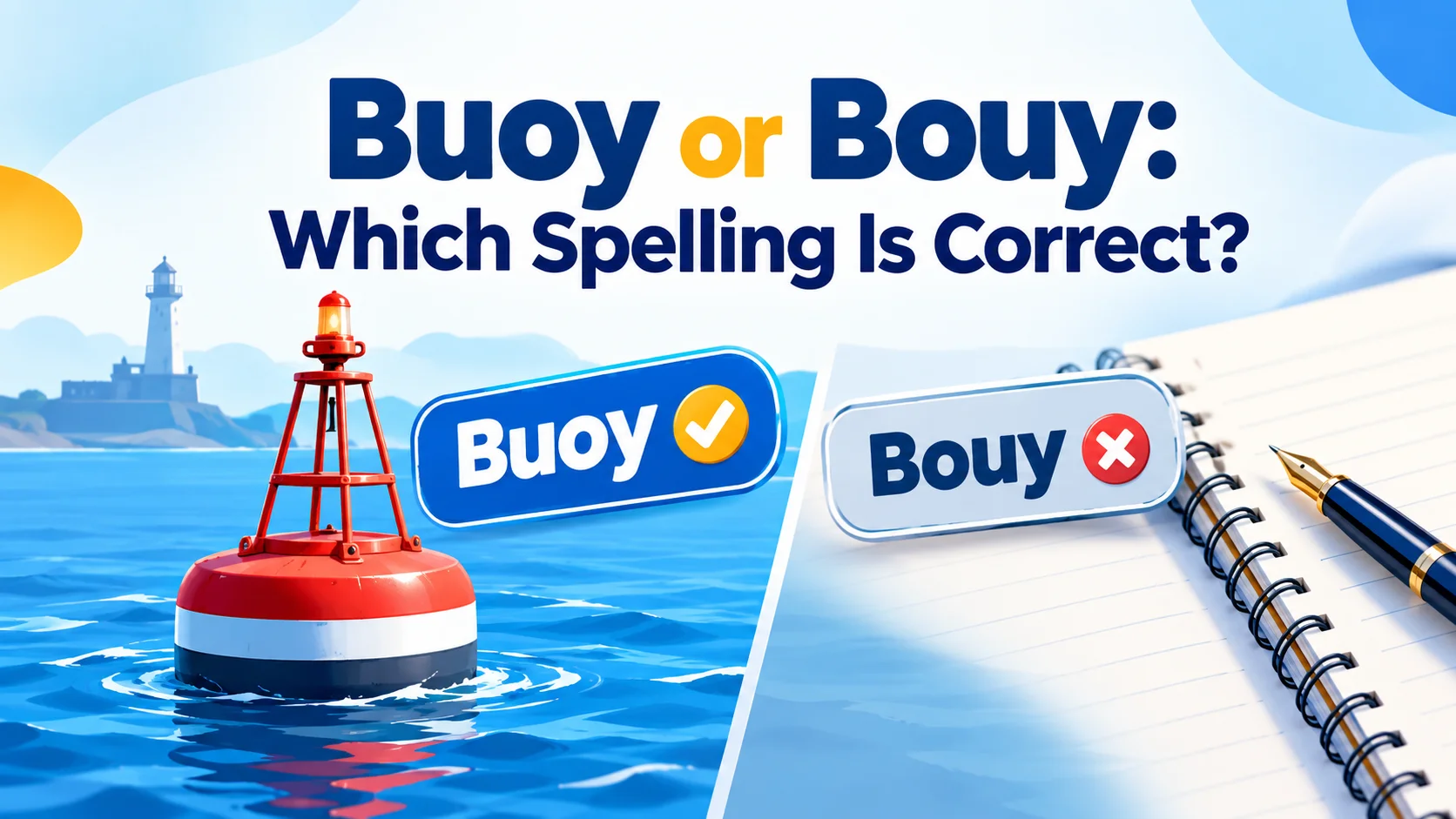
Buoy or Bouy is a common spelling question because the word does not look the way many people expect it to sound. Buoy is the correct standard spelling, while bouy is a misspelling. The confusion becomes even more understandable when you encounter the word in different contexts: a floating marker at sea, a navigation aid, or the verb meaning to support or strengthen something. Getting the spelling right matters in schoolwork, professional writing, technical communication, and everyday English, especially because several related forms—such as buoys, buoyed, and buoying—can cause additional mistakes.
The word is also more versatile than it first appears. In its literal sense, a buoy is a floating object used to mark, signal, or identify something in water. As a verb, buoy can describe keeping something afloat, but it is frequently used figuratively for giving someone or something encouragement or support. That is why you may see expressions such as “buoyed by strong results” in business reporting or “buoy someone’s spirits” in ordinary writing. Understanding these meanings makes the spelling much easier to remember.
This guide settles buoy vs. buoy first, then explains pronunciation, grammar, word forms, maritime uses, common expressions, and easily confused words. You will also see practical examples that show how the word behaves in real sentences rather than simply memorizing a dictionary definition. By the end, you should know which spelling to use, why the error happens, how to spell its related forms, and when buoy is appropriate as a noun or verb.
Buoy or Buoy: The Correct Spelling at a Glance
- Buoy is the correct spelling.
- Buoy is a common misspelling and should not be used as an alternative spelling in standard English.
| Word | Status | Meaning |
| buoy | Correct | A floating marker; also a verb meaning to support or encourage |
| bouy | Incorrect | Common misspelling of buoy |
| buoys | Correct | Plural of buoy |
| buoyed | Correct | Past tense/past participle of the verb |
| buoying | Correct | Present participle/gerund |
Correct Example
The boat passed a buoy marking the edge of the channel.
Here, buoy is a noun referring to a floating marker.
Incorrect Example
The boat passed a buoy marking the edge of the channel.
The meaning is understandable, but the spelling is incorrect.
Quick rule: If you mean the floating marker or the verb meaning to support, encourage, or keep afloat, use buoy.
What Does “Buoy” Mean?
The word buoy has both a literal and a figurative use.
As a noun, it generally refers to a floating object positioned in water for a particular purpose. A buoy may mark a navigation route, identify a hazard, indicate a boundary, provide a mooring point, or collect environmental information.
As a verb, buoy can mean to keep something afloat or to support it. In figurative English, it commonly means to raise someone’s confidence, spirits, or morale or to help strengthen a situation.
For example:
- The sailor steered around the buoy.
- The rescue team placed a buoy near the designated area.
- Her teacher’s encouragement buoyed her confidence.
- Strong sales buoyed the company’s outlook.
The figurative meaning is particularly important because it explains why buoy appears outside maritime contexts.
Buoy as a Noun
A noun buoy identifies a physical object.
Depending on its design and purpose, a buoy can:
- Mark a navigation channel
- Identify a hazard
- Indicate a boundary
- Provide a mooring point
- Support safety equipment
- Collect weather or ocean data
Example:
The captain used the red buoy as a navigation reference.
The plural is buoys:
Several buoys were visible from the shore.
Buoy as a Verb
The verb buoy has a literal sense related to flotation and a common figurative sense related to support.
Literal:
The device was designed to buoy the platform.
Figurative:
The encouraging news buoyed the team’s morale.
In modern general writing, the figurative sense is often more noticeable than the literal verb.
Why Is “Bouy” Incorrect?
The problem with bouy is mainly a spelling-order mistake. English readers often expect the letters to follow the way they perceive the sounds, but buoy has an unusual vowel sequence.
When people hear the word without seeing it written, they may mentally reconstruct the spelling as bouy. That version looks plausible enough to survive in informal writing, searches, messages, and user-generated content.
However, the frequency of an error does not turn the error into a standard spelling.
This is especially important for learners who find buoy repeatedly on the internet. A misspelled word can appear thousands of times online and still remain incorrect.
The same problem appears in related forms:
- buoys → buoys
- bouyed → buoyed
- buoying → buoying
Once you learn the base spelling buoy, the other forms become easier to recognize.
How Is “Buoy” Pronounced?
Pronunciation is one of the main reasons this spelling causes trouble.
The spelling buoy does not provide an obvious pronunciation clue to many English learners. Depending on the varietyoy. British English also has established pronunciations, with regional variation possible.
of English, you may encounter somewhat different pronunciations, but this does not change the spelling.
In American English, the word is commonly pronounced with a sound similar to the vowel combination heard in buoy (boy)
The important lesson is simple: do not try to spell the word solely from its pronunciation.
American English Pronunciation
In common American usage, buoy is pronounced similarly to “boy.”
That creates an interesting spelling trap. If someone learns the word by hearing it before seeing it written, the unusual spelling may not be obvious.
For example:
The boat moved toward the buoy.
Knowing the correct written form separately from the sound is useful, particularly when writing the word in school or professional contexts.
British English Pronunciation
British English includes a pronunciation of buoy that differs from the common American pronunciation for many speakers.
The key point for spelling learners is that pronunciation variation does not create a spelling variation. Whether you use British or American English, the standard spelling remains buoy.
Why Do People Misspell Buoy as Buoy?
Several factors make buoy unusually easy to misspell.
1. The spelling is not phonetic for many learners
English spelling frequently preserves historical forms that are not immediately predictable from pronunciation. Buoy is one of the words where memorizing the written form is more reliable than attempting to derive it from sound.
2. The vowel order looks unfamiliar
The sequence u-o-y is visually unusual. A writer may instinctively rearrange the first two vowels and produce buoy.
3. The word is less common in everyday conversation
Someone who rarely encounters maritime vocabulary may hear buoy occasionally but have little opportunity to reinforce its written form.
4. Related words create another opportunity for error
Even after learning buoy, writers may hesitate over buoys, buoyed, and buoying.
5. Search results can reinforce mistakes
Informal websites, comments, social media posts, and user-generated content sometimes contain bouy. Seeing an incorrect spelling repeatedly can create the false impression that it is an accepted variant.
Expert tip: Treat buoy as a spelling to memorize as a complete unit. Trying to “sound out” every letter is more likely to produce buoy.
Common Forms of Buoy
Learning the word family prevents mistakes beyond the basic buoy vs. buoy question.
| Form | Correct spelling | Example |
| Singular noun | buoy | The boat passed a buoy. |
| Plural noun | buoys | Several buoys marked the channel. |
| Base verb | buoy | The device can buoy the structure. |
| Past tense | buoyed | The news buoyed investor confidence. |
| Past participle | buoyed | She was buoyed by the support. |
| Present participle | buoying | The announcement is buoying morale. |
Buoys: The Plural Form
The plural of buoy is buoys.
The harbor contained several buoys.
Do not change the word into buoys. The u-o sequence stays intact.
Buoyed: Past Tense and Past Participle
The past form is buoyed.
The team’s success buoyed public confidence.
A frequent mistake is buoyancy. The incorrect form usually comes from rearranging the vowels before adding -ed.
Buoying: The -ing Form
The present participle is buoying.
The positive results are buoying investor sentiment.
The spelling does not become bounding. Keep the base word intact and add -ing.
Different Types of Buoys
Not every buoy performs the same job. The term describes a broad category of floating devices, and its exact purpose depends on location, design, and the system in which it is being used.
Navigation Buoys
Navigation buoys help vessels understand where they should travel or identify particular features of a waterway.
They can be part of a larger system of navigational markers used by mariners.
Mooring Buoys
A mooring buoy provides a designated point to which a vessel can be secured.
Unlike a buoy whose primary role is simply to mark a location, a mooring buoy can have a practical connection to the vessel being secured.
Marker and Channel Buoys
Some buoys mark:
- Channel boundaries
- Designated areas
- Waterway features
- Restricted zones
- Other locations important to navigation
Their colors, shapes, lights, and markings can carry specific meanings under the relevant navigation system.
Warning and Hazard Buoys
These communicate information about potential hazards or areas requiring caution.
The exact meaning of a buoy depends on the local maritime marking system, so it is not safe to assume that every buoy has the same purpose.
Weather and Scientific Buoys
Buoys can also carry instruments used to monitor environmental conditions.
Depending on their design, scientific or weather buoys may collect information such as:
- Wind conditions
- Wave characteristics
- Water temperature
- Atmospheric measurements
- Ocean conditions
This is one reason buoy appears in scientific and environmental writing as well as nautical vocabulary.
Life or Rescue Buoys
A life buoy is associated with water safety and flotation. The expression is common in general safety vocabulary and should not be confused with navigation buoys, which serve different purposes.
Common Phrases and Expressions With Buoy
The verb appears in several useful expressions.
Buoy Up
Buoy up means to encourage or support someone or something.
The unexpected praise buoyed him up after a difficult week.
The expression is more common in certain varieties and registers of English than in casual American conversation, where alternatives such as cheer up or encourage may sound more natural.
Buoy Someone’s Spirits
To buoy someone’s spirits means to make them feel more hopeful, confident, or encouraged.
Her friends’ messages buoyed her spirits.
This is a figurative use; nothing is literally floating.
Buoy Confidence or Morale
The verb can describe an increase in confidence, morale, or optimism.
The team’s early success buoyed morale.
This construction is useful in formal and professional writing.
Buoy the Economy or Market
News reports often use buoy figuratively when discussing economic conditions.
Lower borrowing costs could buoy the housing market.
Here, buoy means to support or strengthen—not to physically float.
Buoyed by
- Buoyed by is one of the most useful constructions to recognize.
- Buoyed by strong customer demand, the company expanded production.
- The phrase identifies something that provides support or encouragement.
Buoy in Different Contexts
The correct word becomes easier to remember when you see how widely it is used.
Maritime Writing
The vessel changed course after passing the navigation buoy.
Here, buoy has its literal nautical meaning.
News and Journalism
The positive economic figures buoyed investor confidence.
This is figurative and often appears in business reporting.
Academic and Technical Writing
The research team deployed a buoy to collect measurements.
The word can refer to scientific equipment as well as navigation markers.
Everyday Writing
Her kind message buoyed my spirits.
This use has nothing directly to do with boats, but it is completely standard.
Buoy vs. Similar-Looking or Similar-Sounding Words
Buoy vs. Boy
- Buoy and boy can sound similar in common pronunciation, but they have completely different meanings.
- Buoy = a floating marker or something that supports/encourages.
- Boy = a male child or young male person.
The boat approached the buoy.
The boy watched the boats from the shore.
Buoy vs. Buy
Buy is a verb meaning to obtain something by paying for it.
I want to buy a new jacket.
Buoy has no connection with purchasing.
The words can sound similar enough in some contexts to cause confusion, but their meanings, spellings, and grammatical functions differ.
Buoy vs. Buoyant
These words are related but are not interchangeable.
Buoy can be a noun or verb.
Buoyant is an adjective meaning capable of floating or characterized by optimism, resilience, or a lively quality.
The buoy marked the channel.
The material is buoyant.
She remained buoyant despite the setback.
Buoy vs. Beacon
A buoy is generally a floating marker or device in water, while a beacon is a signaling or guiding light or other prominent marker.
They can both assist navigation, but they are not synonyms.
Common Buoy Spelling Mistakes
| Common mistake | Correct form | Why it is wrong |
| bouy | buoy | Letters are reversed |
| buoys | buoys | Incorrect plural spelling |
| buoyed | buoyed | Incorrect spelling of the past form |
| buying | buoying | Incorrect spelling of the -ing form |
The safest approach is to learn the entire family around the correct base word.
If you remember only one pattern, remember:
buoy → buoys → buoyed → buoying
That sequence prevents most of the common errors.
When Should You Use “Buoy”?
Use buoy when the context calls for the standard English word.
Use “Buoy” When:
- Referring to a floating marker in water
- Describing a device used for navigation
- Referring to a mooring or warning device
- Talking about scientific or weather-monitoring equipment
- Using the verb meaning to support or encourage
- Writing expressions such as buoyed by
- Writing formal, academic, professional, or educational material
Do Not Use “Bouy” When:
- Writing a school assignment
- Preparing a report
- Writing an article
- Sending professional correspondence
- Writing technical or academic material
- Completing an English-language exam
If you see buoy in an informal post, do not copy it simply because it appears frequently.
A Practical Way to Remember Buoy
Instead of inventing a complicated mnemonic, focus on visual recognition.
Memory Strategy
Write the correct sequence several times:
B-U-O-Y
Then connect it with a familiar image: a floating buoy on water.
Next, practice the word in three forms:
- buoy
- buoys
- buoyed
This works better than trying to reconstruct the spelling every time you hear the word.
Memory tip: The word begins with BUO-, not BOU-. Once that three-letter opening is familiar, the most common spelling error becomes much easier to catch.
Buoy or Buoy: Quick Decision Checklist
Before submitting or publishing your writing, check these points:
- The floating marker is spelled buoy.
- The plural is buoys.
- The past form is buoyed.
- The -ing form is buoying.
- You are not treating buoy as a British or American variant.
- You distinguish buoy from similar words such as boy and buy.
- You consider context when using the figurative verb.
Conclusion
The answer to “Buoy or Buoy?” is straightforward: buoy is correct, and buoy is a misspelling. The unusual letter sequence is what makes the word troublesome, especially when someone tries to spell it according to its pronunciation. Once the base form is familiar, the related forms—buoys, buoyed, and buoying—become much easier to handle. One final actionable tip: memorize BUOY as a complete spelling rather than trying to rebuild it from sound. Then practice it in both literal and figurative sentences, because seeing the word used in different contexts strengthens recognition. A common mistake to avoid is assuming that buoy must be a British or American variation simply because you encounter it online. It is not. Whether you’re writing about navigation, ocean research, business confidence, or someone’s morale, the standard spelling remains buoy.
Frequently Asked Questions
Q1. Is “bouy” ever an accepted spelling of “buoy”?
No. Buoy is the standard spelling in English, while bouy is generally a misspelling. You may encounter buoy online or in informal writing, but its repeated appearance does not make it a standard alternative. For school, professional, academic, and edited writing, use buoy.
Q2. Why is “buoy” pronounced differently from how it looks?
English spelling contains many words whose pronunciation cannot be predicted perfectly from their letters. Buoy has an unusual vowel sequence, so its spoken form does not make the written form obvious to many learners. The safest approach is to learn its spelling separately rather than spelling it from sound.
Q3. What is the plural of “buoy”?
The plural is buoys, not bouys. The base spelling remains unchanged and simply takes the plural ending. For example: “Several buoys marked the entrance to the harbor.” Learning buoys alongside buoy is useful because the plural is a common place for the same vowel-order mistake to reappear.
Q4. Is “buoyed” the correct past tense?
Yes. The past tense and past participle of the verb buoy are buoyed. For example, “The encouraging announcement buoyed public confidence.” Bouyed is a common misspelling. The same buoy- spelling remains at the beginning of the word before the -ed ending.
Q5. Can “buoy” be used for something that is not in water?
Yes. Although the noun usually refers to a floating object, the verb “buoy” has a broader figurative meaning. It can describe something that raises confidence, morale, optimism, or strength. For example, strong sales can buoy a company’s outlook, while encouragement can buoy someone’s spirits.