

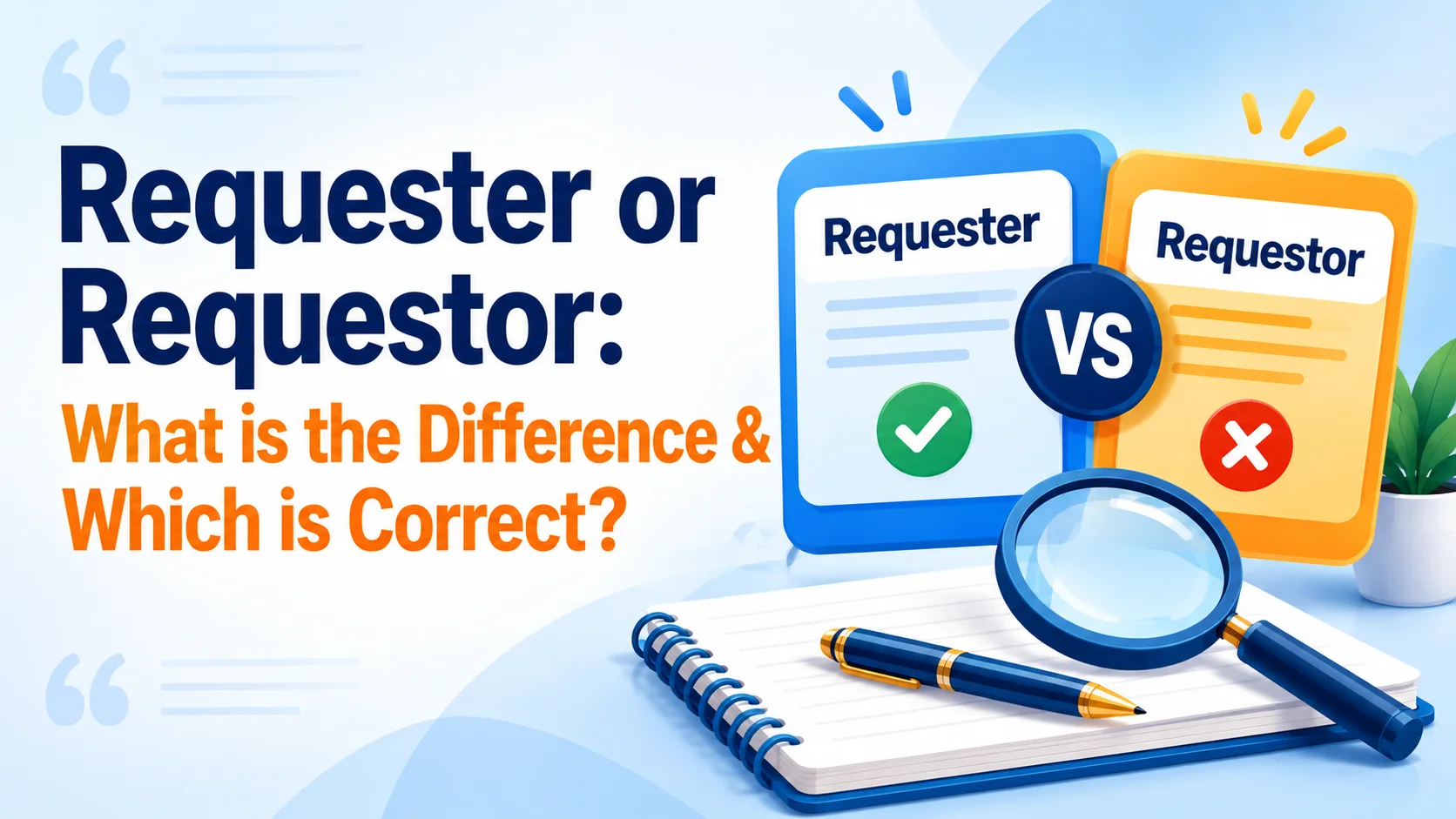
Requester or requestor can leave writers second-guessing a single letter: should the word end in -er or -or? The good news is that this is not a case where one spelling is simply “wrong.” Both requester and requestor are recognized English nouns for someone who makes a request. Cambridge lists requestor as an alternative form of requester, while Merriam-Webster likewise recognizes requestor.
The real question is which form should you choose in a particular context. For general English, requester is usually the clearest and most familiar choice. Requestor also has legitimate usage, especially in technical, administrative, legal, and institutional contexts. The two words generally describe the same role, so the choice is usually about spelling convention, audience, and established terminology rather than a difference in meaning.
That distinction matters when you are writing a report, designing a form, documenting software, responding to a customer, or editing an official document. You do not want to “correct” requestor automatically if it is an organization’s established term. At the same time, you do not need to use requestor merely because a document sounds formal. This guide explains the difference, shows both forms in real sentences, and gives you a practical rule for deciding which one to use.
Requester or Requestor: The Quick Answer
Requester is the usual general-English choice
- Requester means a person or organization that makes a request.
For example:
The requester submitted the form yesterday.
The requester asked for a copy of the report.
It is a straightforward noun formed from request + -er, following a familiar English pattern seen in words such as teacher, writer, and listener.
Requestor is also correct
Requestor has essentially the same meaning:
The requestor submitted the form yesterday.
The requestor asked for a copy of the report.
Major dictionaries recognize it as an alternative rather than treating it as a simple spelling error. Cambridge explicitly gives “requestor” alongside “requester,” and Merriam-Webster does the same.
The safest choice for general writing
If you are writing for a broad audience and nobody has specified a preferred terminology, requester is generally the safer choice.
It is familiar, clear, and works in everyday as well as formal writing.
When requestor may be the better choice
Choose requestor when:
- an organization already uses it;
- it appears in an established software or database label;
- a legal, administrative, or technical document consistently uses it;
- you are referring to an official role or field name;
- changing it would make your terminology inconsistent.
Bottom line: Both forms are valid. Requester is usually the better default; requestor is appropriate when established usage calls for it.
What Does Requester Mean?
Definition of requester
A requester is a person or organization that asks for something.
That “something” could be:
- information;
- permission;
- assistance;
- a document;
- access;
- a service;
- a refund;
- a change;
- an explanation.
Cambridge defines requester as a person who asks to see or have something, while Dictionary.com includes both people and organizations in its definition.
How requester is formed
The word can be understood as:
request + -er = requester
The suffix -er commonly creates nouns for people or things associated with an action:
- teach → teacher
- write → writer
- drive → driver
- manage → manager
- request → requester
That does not mean English always uses -er. English has several noun-forming suffixes, and historical usage explains many of the apparent inconsistencies.
Requester in everyday English
You might write:
The requester wants to know when the order will arrive.
Please contact the requester for additional information.
The requester provided the wrong address.
These sentences sound natural because requester is immediately understandable to most readers.
What Does Requestor Mean?
Definition of requestor
A requestor is also someone who makes a request.
For example:
The requestor must provide proof of identity.
The requestor submitted the application online.
Please contact the requestor if additional information is required.
Dictionary.com describes requestor as a variation of requester, while Cambridge treats it as an alternative form.
Why requestor exists
The spelling uses the suffix -or:
request + -or = requestor
English contains many nouns ending in -or, including:
- actor
- creator
- operator
- administrator
- translator
- contributor
However, there is no simple rule saying that a particular verb must produce either an -er or -or noun. Word formation is influenced by history, analogy, borrowing, professional terminology, and established usage.
Is requestor a misspelling?
No.
That is one of the most important points in this entire discussion.
You may personally prefer requester, and a spell-checker may flag requestor depending on its dictionary, but that does not make requestor universally incorrect. Major dictionaries recognize the form.
Requester vs. Requestor: What Is the Difference?
The simplest answer is that the core meaning is the same.
| Feature | Requester | Requestor |
| Basic meaning | Someone who makes a request | Someone who makes a request |
| Part of speech | Noun | Noun |
| Standard English | Yes | Yes |
| General writing | Usually preferred | Less common |
| Specialized usage | Common | Also established |
| Meaning difference | Usually none | Usually none |
| Formality | Not inherently informal | Not inherently more formal |
| Best default | Yes | Context-dependent |
The difference becomes noticeable when you look at frequency, audience, terminology, and institutional preference.
That is why “Which is correct?” has a more useful answer than simply “requester.”
Why Are Requester and Requestor Both Correct?
English allows variation in word formation
English has never been perfectly systematic about suffixes.
Compare:
- adviser / advisor
- receiver / receptor
- creator / creator
- translator / translator
- administrator / administrator
Some variations become strongly associated with particular fields or styles. Others remain interchangeable.
The spelling does not automatically change the role
If Sarah asks a government office for a document, Sarah can be described as the requester.
In a system that labels the same role requestor, Sarah is still the person making the request.
The terminology changes; the underlying role does not.
Institutional vocabulary can become self-reinforcing
Suppose a company builds a database with a field called:
Employees then see that term every day. Internal documentation uses it. Training materials use it. Software notifications use it.
At that point, requestor is no longer merely an unusual spelling someone happened to choose. It has become established terminology within that system.
Changing it to requester may make general-language sense but could create unnecessary inconsistency.
Is “Requester” or “Requestor” More Common?
Requester is generally the more familiar form
Evidence from dictionary treatment and usage references supports treating requester as the normal general-purpose choice. Cambridge presents requester as the main headword and requestor as an alternative. Dictionary.com similarly lists requestor as a variation of requester.
That makes requester a sensible default when you have no special terminology to follow.
Frequency does not determine correctness
A less common word is not automatically wrong.
Consider a technical term that appears thousands of times inside one software ecosystem. It may be less common in general English while being completely normal within that system.
The better question is:
What form does my audience or context expect?
rather than:
Which spelling exists more often?
Be careful with unsupported frequency claims
Some online articles publish precise percentages for requester versus requestor without providing a transparent methodology. Those figures should not be treated as established linguistic facts simply because they appear in a table.
For practical writing, the stronger evidence is the dictionary status and actual context of use.
Is Requester or Requestor Correct?
Both are recognized
If the question is:
“Can I use requestor?”
The answer is yes.
If the question is:
“Is requester correct?”
The answer is also yes.
If you mean “Which should I normally choose?”
Choose requester unless your context gives you a reason to use requestor.
This is especially sensible for:
- general articles;
- ordinary emails;
- customer-facing content;
- broad professional audiences;
- educational writing;
- plain-language documents.
If an official term already exists
Follow the established terminology.
For example:
Requestor ID
may be a field name in a software system.
Do not casually rewrite it to:
Requester ID
just because you personally prefer the -er spelling.
The first version may be part of the system’s defined vocabulary.
Requester vs. Requestor in American English
Both forms appear in American English
This is not a simple American-versus-British spelling difference like color/colour or center/centre.
American English uses requester, and requestor also appears.
Requester in American usage
Examples include:
The requester submitted a public-records application.
The requester must provide identification.
Requestor in American usage
You may encounter:
The requestor must authenticate before accessing the information.
The presence of requestor does not automatically indicate poor English. It may reflect institutional, legal, administrative, or technical terminology.
Requester vs. Requestor in British English
Is requester used in British English?
Yes.
Cambridge’s English Dictionary lists requester and identifies requestor as an alternative.
So this is not a reliable “American uses requester, British uses requestor” distinction.
Why regional labels can be misleading
Some words genuinely divide along regional lines. These two do not behave that neatly.
If you are writing for British readers, requester is not an error. If you are writing for American readers, requestor is not automatically an error.
Audience matters, but established terminology matters more.
Requester vs. Requestor in Business Writing
Requester in workplace communication
For a normal business audience, requester is usually the smoother choice:
The requester will receive a confirmation email.
Please ask the requester to provide the missing information.
Requestor in internal systems
A company may use requestor in:
- procurement systems;
- approval workflows;
- IT service platforms;
- internal forms;
- access-management tools.
If employees already recognize that terminology, consistency has practical value.
Customer-facing versus internal language
There is a useful distinction here.
Customer-facing:
The requester will receive an update.
Internal system label:
Requestor ID
You do not necessarily want the same editorial decision in both places.
Requester vs. Requestor in Legal Writing
Neither spelling is automatically “more legal”
A common misconception is that requestor is the legal spelling and requester is the ordinary spelling.
That is too simplistic.
Both forms can appear in legal and administrative contexts.
Follow the governing terminology
If a statute, court, agency, contract, or established legal process uses a particular term, preserve that terminology where appropriate.
If you are writing new plain-language material without a mandated term, requester is often the clearer general choice.
Legal clarity matters more than appearance
Legal writing sometimes develops specialized vocabulary for consistency and precision.
But a word does not become legally superior merely because it ends in -or.
Requester vs. Requestor in Technical and IT Writing
Technical writing is where the distinction can become especially practical.
Requester in software documentation
You might see:
The requester receives a notification after approval.
This is perfectly understandable.
Requestor in technical terminology
You may also see:
The requestor sends the authentication request to the server.
In some technical systems, requestor becomes an established role name.
A dictionary record for requestor includes examples from technical material, including networking and resource-allocation contexts.
Why technical consistency matters
Suppose an API documentation set consistently defines a role as requestor.
Changing individual references to requester can make the documentation less precise because readers may wonder whether the two labels represent different system roles.
Once terminology is formally defined, consistency becomes part of accuracy.
Requester vs. Requestor in Government and Administrative Writing
Public-facing records requests
Government documents may refer to a person who asks for records as a requester.
The term is natural in plain-language communication:
The requester must provide sufficient information to identify the records.
Administrative forms may use requestor
A particular agency or system may instead use requestor.
That does not create a universal rule that government writing must use one spelling.
Follow the agency’s established language
If an agency has already defined its role as “requestor,” changing it throughout a document can introduce needless inconsistency.
If you are creating new general-audience content, prioritize clarity and consistency.
Requester vs. Requestor in Customer Service
Requester is usually clearer for customers
Customer-facing writing should minimize unnecessary terminology.
For example:
The requester will receive a response within three business days.
Most readers will immediately understand it.
Internal teams may use requestor
An internal support platform might classify someone as:
Requestor
That can be perfectly reasonable if the term is consistently defined within the system.
The key distinction is reader familiarity, not grammatical correctness.
Requester vs. Requestor in Forms, Policies, and Procedures
Choosing a form label
If you are creating a new form for the general public, consider:
Requester name
rather than:
Requestor name
The first is likely to feel more familiar to a broad audience.
When an existing label should stay unchanged
If your organization’s approved terminology is:
Requestor Name
do not silently change it during proofreading.
A style editor’s job is not to “correct” every unfamiliar word. It is to improve the document without breaking established terminology.
Requester vs. Requestor in Software Interfaces
User-facing labels
Software interfaces should favor terminology that users understand quickly.
Internal database terminology
A database may contain a field such as:
requestor_id
That field name may be tied to code, APIs, integrations, reports, or database queries.
Changing it is not a simple spelling edit.
API documentation
If an API specification defines requestor as a particular role, use that spelling consistently.
This is a case where terminological precision outweighs general spelling preference.
Real-World Examples of “Requester”
Everyday English
The requester asked for directions.
Business
The requester will receive confirmation by email.
Government
The requester must provide enough information to identify the requested records.
Customer service
We contacted the requester for additional details.
Technical writing
The requester receives a response after authentication.
Notice that none of these contexts makes requester informal.
Real-World Examples of “Requestor”
Administrative
The requestor must complete the verification process.
Technical
The system records the requestor’s identity.
Software
The requestor receives a status notification after approval.
Institutional
The requestor is responsible for providing accurate information.
Legal or regulatory context
The requestor must satisfy the applicable documentation requirements.
In each case, the underlying meaning remains the party making the request.
Requester vs. Requestor: Side-by-Side Sentence Examples
| Context | Requester | Requestor |
| General | The requester submitted the form. | The requestor submitted the form. |
| Business | We contacted the requester. | We contacted the requestor. |
| Technical | The requester receives a response. | The requestor receives a response. |
| Administrative | The requester provided identification. | The requestor provided identification. |
| Software | The requester initiated the process. | The requestor initiated the process. |
The sentences demonstrate the central point: the meaning generally stays the same.
The choice changes the spelling and, potentially, the sense of institutional familiarity.
Grammar: How to Use Requester and Requestor in a Sentence
Both words are nouns
Neither requester nor requestor functions as the ordinary verb in a sentence.
They identify the person or entity making the request.
Subject position
The requester submitted the application.
The requestor submitted the application.
Object position
We contacted the requester.
We contacted the requestor.
With a preposition
Please send the information to the requester.
Please send the information to the requestor.
The grammatical role is identical.
Requester and Requestor: Plural and Possessive Forms
The plural of requester is:
requesters
The plural of requestor is:
requestors
For possession:
the requester’s name
the requestor’s name
For plural possession:
the requesters’ applications
the requestors’ applications
| Form | Requester | Requestor |
| Singular | requester | requestor |
| Plural | requesters | requestors |
| Singular possessive | requester’s | requestor’s |
| Plural possessive | requesters’ | requestors’ |
The important rule is simple: the suffix stays consistent when you form the plural or possessive.
Requester vs. Requestor: Common Collocations
Requester collocations
Common combinations include:
- requester information
- requester details
- requester name
- requester email
- requester identity
- requester account
- requester access
- requester response
- requester request
Requestor collocations
You may encounter:
- requestor information
- requestor details
- requestor name
- requestor identity
- requestor account
- requestor access
- requestor ID
- requestor approval
A particularly useful clue is terminology already embedded in a system. If a software platform consistently uses “requestor ID,” preserve it rather than substituting a different spelling.
Which Form Sounds More Natural?
Requester usually sounds more natural to a general audience
If a reader has never encountered either form, requester is likely to be immediately understandable.
It resembles many familiar English agent nouns.
Requestor can sound institutional
That does not mean it is inherently more formal.
It can simply sound more specialized because people often encounter it in forms, software systems, administrative language, and technical documentation.
Formality is not the deciding factor
Consider:
The requester submitted the legal application.
There is nothing informal about this sentence.
Likewise:
The requestor submitted the legal application.
There is nothing automatically more formal about the second version.
Professional tone comes from the whole sentence, not from choosing -or instead of -er.
Is Requestor a Misspelling of Requester?
No
This is the misconception worth correcting most clearly.
Merriam-Webster lists requestor as an alternative, and Cambridge does the same.
Why spell-checkers sometimes object
Spell-checking software relies on a particular dictionary or language model. A less frequent form may be flagged even when it is legitimate.
A red underline is therefore not linguistic proof that a word is incorrect.
When correcting requestor would be a mistake
If an official software system calls a user a “requestor,” changing the term throughout documentation merely to satisfy a spell-checker can create more problems than it solves.
Is Requestor More Formal Than Requester?
Not inherently
The idea that -or automatically makes a noun more formal is tempting but unreliable.
English has many formal nouns ending in -er:
- employer
- examiner
- researcher
- purchaser
- publisher
- administrator
And many nouns ending in -or:
- operator
- director
- contributor
- administrator
The suffix alone does not determine register.
Why requestor may feel formal
People may associate it with institutional or technical documents because that is where they encounter it.
That is a usage association, not a grammatical rule.
Common Mistakes With Requester and Requestor
Assuming requestor is always wrong
It is not.
Assuming requester is too informal
It is not.
Treating the two as different roles
In ordinary usage, both refer to the party making a request.
Mixing spellings
Avoid:
The requester submitted the form, and the requestor later received an email.
Unless you deliberately mean two separately defined roles, the inconsistency looks accidental.
Changing official terminology
If a system defines the role as requestor, do not casually rename it.
Letting autocorrect decide
Spell-checkers can identify possible problems, but they do not determine terminology policy.
Requester vs. Requestor: When Should You Use Each?
Use requester for general English
This is the best default for most readers.
Use requester for customer-facing content
It is familiar and easy to understand.
Use requestor when an organization already uses it
Consistency can be more valuable than forcing general-language preference onto an established system.
Use requestor when it is part of a defined technical term
If a specification, interface, database, or workflow explicitly uses requestor, preserve it.
Follow a style guide when one exists
A publication or organization may have its own preferred vocabulary.
The key is not to invent a rule that the organization does not have.
A Practical Decision Guide
| If you are writing… | Best approach |
| General English | Requester |
| Everyday email | Requester |
| Customer-facing website | Requester |
| Educational content | Requester |
| General business writing | Requester |
| Existing company workflow | Follow established terminology |
| Software interface | Preserve defined terminology |
| API documentation | Follow the specification |
| Government form | Follow the agency’s terminology |
| Legal document | Follow the governing terminology/style |
| No preference is specified | Requester |
Quick rule: When there is no established terminology to follow, choose requester. When there is an established label, specification, or institutional preference, follow it—even if that spelling is requestor.
When NOT to Change Requester to Requestor
Do not make the substitution simply because:
- you think requestor sounds more professional;
- you want the document to look more technical;
- someone told you -or is “more formal”;
- your spell-checker suggests another form;
- you want to vary the wording.
If requester is already clear and consistent, there is usually nothing to fix.
When NOT to Change Requestor to Requester
Likewise, do not automatically “correct” requestor when:
- it is an official system label;
- it appears in an API specification;
- it is defined in organizational policy;
- it is part of a database field;
- it appears in a legal or administrative template;
- changing it could confuse users or developers.
Consistency is part of good technical editing.
Requester or Requestor in Official Names and Labels
Official terminology deserves special treatment.
Imagine a company has a workflow containing:
- Requestor Name
- Requestor ID
- Requestor Department
- Requestor Approval
Changing only one field to Requester Name creates an inconsistent interface.
Even if requester is the preferred general-English form, the system’s established vocabulary may legitimately use requestor.
When editing technical or institutional content, ask:
Am I correcting English, or am I changing a defined term?
Those are not always the same task.
Requester vs. Requestor in Search, SEO, and Web Content
Which spelling should general websites use?
For broad consumer-facing content, requester is generally the better default.
It is immediately recognizable and allows the page to communicate naturally without unnecessary terminology.
Should a page mention requestor?
Yes, when the search intent calls for it.
Someone searching “requester or requestor” wants to understand both forms. Ignoring requestor would leave an important question unanswered.
The strongest approach is to explain the relationship naturally rather than repeatedly forcing both words into every paragraph.
Avoid keyword stuffing
A useful article should not repeatedly write:
requester or requestor, requester versus requestor, requester vs requestor…
Instead, use natural variations such as:
- the requester;
- the requestor;
- the two forms;
- the spelling difference;
- the alternative form;
- the general-English choice;
- the established terminology.
Conclusion
Requester and requestor are both legitimate forms for someone who makes a request, so treating this as a simple right-versus-wrong spelling test misses the real issue. For ordinary English, requester is usually the strongest default because it is familiar, clear, and widely recognized. But requestor has legitimate usage, particularly where a technical system, organization, administrative process, or established document already uses it. One final actionable tip: if no terminology has been prescribed, choose requester and use it consistently. A common mistake to avoid is “correcting” requestor simply because it looks unusual. Good editing is not about making every document match your personal preference; it is about choosing language that is accurate, clear, consistent, and appropriate for its readers.
Frequently Asked Questions
Q1. Is requester or requestor correct?
Both requester and requestor are recognized English forms for someone who makes a request. Requester is generally the better default for general writing, while requestor is appropriate when an organization, technical system, or established terminology specifically uses that form.
Q2. Is requestor a real word?
Yes. Requestor is a legitimate English noun, not merely a typographical error. Cambridge lists it as an alternative to requester, and Merriam-Webster also recognizes it. Its lower general frequency does not make it grammatically incorrect.
Q3. Is requester more formal than requestor?
Neither is inherently more formal. Requester can appear in formal legal, government, business, and administrative writing. Requestor may feel more specialized because of its use in certain institutional or technical settings, but the suffix itself does not determine formality.
Q4. Should I use requestor in legal writing?
Not automatically. Requestor is not exclusively a legal term, and requester can also be appropriate in legal and administrative contexts. If a particular court, agency, contract, statute, or established process specifies terminology, follow that convention rather than applying a general rule.
Q5. Can requester and requestor be used interchangeably?
Usually, yes, when they simply mean the person or organization making a request. However, do not switch between them casually inside a defined system or document. If one spelling represents an established role or field name, maintain that terminology consistently.