

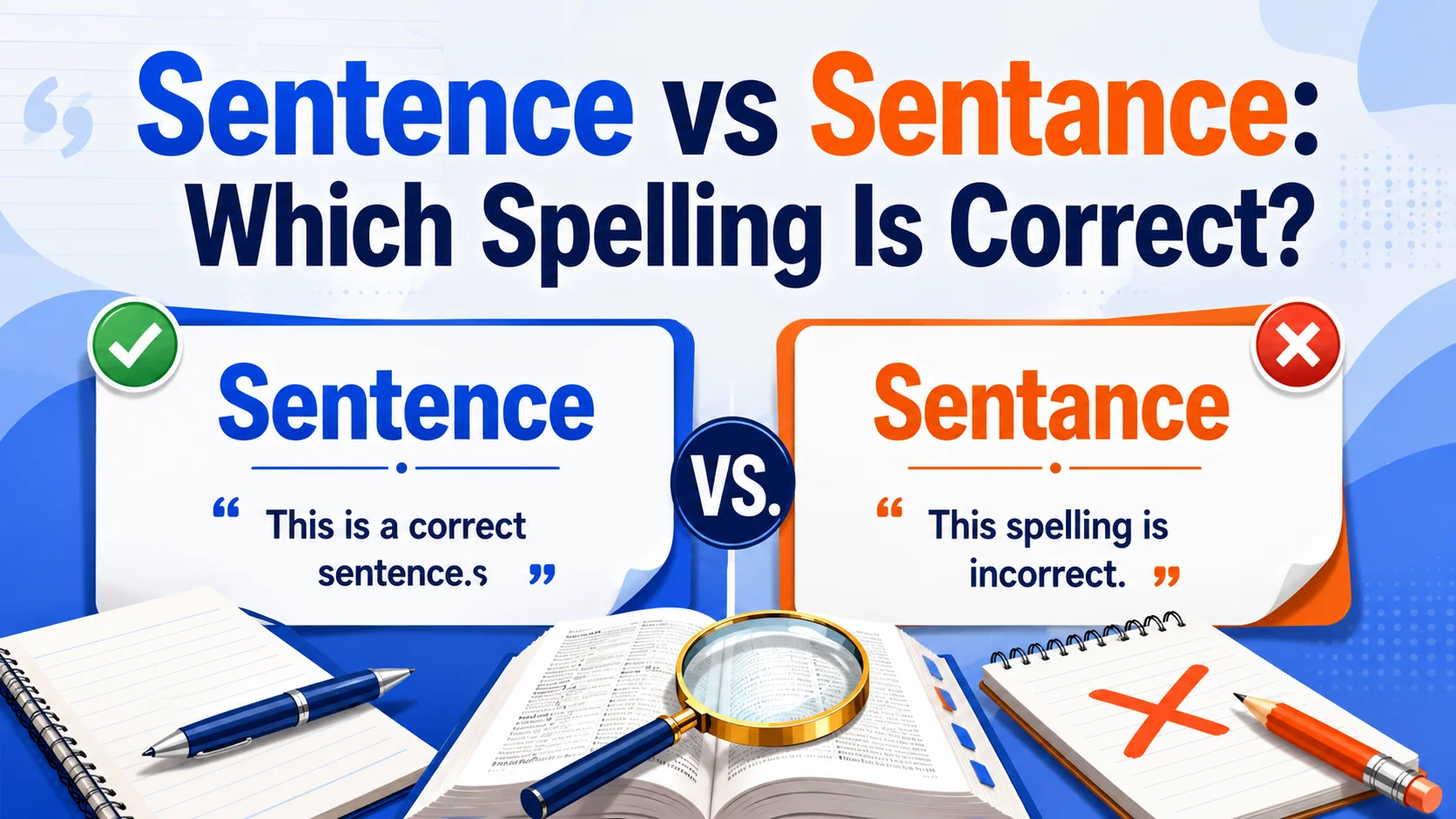
Sentence is the correct spelling; sentance is a misspelling. If you’ve ever hesitated between these two forms, you’re not alone. The confusion usually comes from the way sentence sounds and from the many English words that end in -ance. However, standard English uses sentence in both American and British English. The word can refer to a grammatical unit, a written statement, or a legal punishment, and it can also function as a verb. In this guide, you’ll learn why sentence is correct, why sentance is wrong, how to remember the spelling, and how to use sentence naturally.
The difference is only one letter, but that letter matters. Writing sentance in a school assignment, professional email, article, or legal document can make an otherwise polished piece of writing look careless. More importantly, sentance isn’t an alternative spelling with a different meaning; it is simply an incorrect form of sentence. You’ll also see why the mistake happens, how pronunciation contributes to it, and why adding endings creates forms such as sentenced and sentencing rather than sentanced or sentenceing. By the end, the spelling should feel automatic rather than something you have to stop and check.
There’s another reason this word deserves a closer look: sentence has several important meanings. In grammar, it describes a unit of language that communicates a complete thought or functions as a complete grammatical construction. In law, a sentence is the punishment imposed after a person is convicted. As a verb, sentence means to impose that punishment. Understanding these meanings helps you use the word accurately instead of treating this as a spelling question alone. Whether you’re a student checking an assignment or an experienced writer polishing a document, the practical rule is simple: write sentence, never sentance.
Quick Answer: Sentence or Sentance?
Sentence is correct. Sentance is incorrect.
There is no standard English context in which sentance should replace sentence. This applies to:
- American English
- British English
- Academic writing
- Business writing
- Legal writing
- Journalism
- Everyday communication
- Formal and informal writing
Correct
Please write one complete sentence about the topic.
The judge imposed a five-year sentence.
Incorrect
Please write one complete sentance about the topic.
The judge imposed a five-year sentance.
The easiest rule is:
Remember the ending: sentence = -ence, not -ance.
If you’re unsure while writing, don’t let the pronunciation decide the spelling. Check the word visually: sentence.
Sentence vs Sentance at a Glance
| Feature | Sentence | Sentance |
| Standard English spelling | ✅ Correct | ❌ Incorrect |
| Used in American English | ✅ | ❌ |
| Used in British English | ✅ | ❌ |
| Grammar meaning | ✅ | ❌ |
| Legal meaning | ✅ | ❌ |
| Verb form | ✅ | ❌ |
| Dictionary-standard word | ✅ | ❌ |
| Example | “Write a sentence.” | “Write a sentance.” ❌ |
The important point is that this isn’t a case like color/colour, where both spellings are accepted in different varieties of English. Sentence has one standard spelling in both major varieties of English.
What Does “Sentence” Mean?
The word sentence has more than one meaning, so its interpretation depends on context.
Sentence as a Grammar Term
In grammar, a sentence is a grammatical construction used to communicate a complete statement, question, command, exclamation, or another complete communicative unit.
For example:
The children played outside.
Did you finish your homework?
Close the window.
Each performs a different function, but each is a sentence.
A sentence commonly contains a subject and a predicate, although English sentence structures can become more complex. The important distinction for beginners is that a sentence must work as a complete grammatical unit rather than simply being a random group of words.
Compare:
- The dog barked. — complete sentence
- Because the dog barked. — dependent construction that needs additional information
- The barking dog. — phrase, not a complete sentence
Sentence as a Legal Term
In law, sentence has a completely different sense.
A legal sentence is the punishment or legal penalty imposed on someone after conviction.
For example:
The judge gave him a three-year sentence.
She received a suspended sentence.
This meaning appears frequently in court reporting, legal documents, and news stories.
Don’t confuse sentence with verdict or conviction. A verdict determines whether a defendant is guilty or not guilty. A sentence concerns the punishment imposed after a conviction.
Sentence as a Verb
Sentence can also be a verb.
When a judge sentences someone, the judge formally imposes a legal punishment.
The court sentenced him to five years in prison.
Here, sentenced isn’t referring to a grammatical sentence. It’s the past tense of the verb sentence.
This distinction is useful because you’ll encounter the word in both ordinary grammar discussions and legal contexts.
Why Is “Sentance” Incorrect?
Sentance is a spelling error, not a separate English word.
The mistake probably feels natural because English contains many familiar words ending in -ance, including:
- importance
- appearance
- distance
- performance
- attendance
That pattern can tempt writers to produce sentance. But English spelling isn’t always predictable from similar-looking words.
The standard spelling is:
sentence
not:
sentance
The safest approach is to learn the word as a complete spelling rather than trying to reconstruct it from pronunciation.
Why the Error Is So Easy to Make
The middle vowel in sentence isn’t strongly pronounced in everyday speech. When people hear the word, they may not clearly distinguish the spelling of the final unstressed syllable.
That creates a classic spelling problem: the sound doesn’t provide enough information to reconstruct the letters reliably.
This is why reading the word regularly can help. Familiarity with its written form creates a visual memory that pronunciation alone cannot provide.
Why Do People Spell Sentence as “Sentance”?
Several factors can contribute to the error.
The Pronunciation Doesn’t Clearly Reveal the Spelling
English spelling often contains information that isn’t obvious from pronunciation. Sentence is one example.
A person may hear the word and think the final sound resembles the ending in another familiar word. They then choose -ance instead of -ence.
That isn’t a problem with intelligence or grammar knowledge. It’s simply a common spelling-pattern error.
Familiar Words Influence the Spelling
When you’re writing quickly, your brain often relies on familiar patterns.
If you’ve recently written words ending in -ance, your hand may automatically produce that ending in another word that sounds similar.
This is especially likely when you’re:
- Writing quickly
- Taking notes
- Typing from memory
- Proofreading your own work
- Learning English as an additional language
Pronunciation and Spelling Are Not the Same Thing
One of the most useful lessons here is broader than sentence:
You can’t always determine English spelling from pronunciation alone.
When a word is difficult to spell, pay attention to its written pattern rather than trying to spell it entirely by sound.
How to Spell “Sentence” Correctly
The correct spelling is:
S-E-N-T-E-N-C-E
A useful visual breakdown is:
sen + tence
The ending is -ence.
A Simple Memory Trick
Think:
sentence → sense + tence
The word sense begins with the same important sen- pattern, and seeing the e in sentence can help reinforce the correct spelling.
Another practical trick is to remember the pair:
sentence — sentences
When you visualize the plural, the correct spelling becomes easier to recognize.
Don’t overcomplicate the mnemonic, though. The strongest long-term method is repeated exposure and correct use.
A Quick Self-Test
Cover the word and complete this:
I wrote a complete ______.
If you instinctively choose sentance, pause and remember:
The ending is -ence: sentence.
Sentence in Grammar: Examples and Correct Usage
The word sentence appears in virtually every discussion of English grammar, but sentences themselves come in different forms.
Declarative Sentences
A declarative sentence makes a statement.
The library closes at six.
Maria finished her report.
These are the most common sentences in ordinary writing.
Interrogative Sentences
An interrogative sentence asks a question.
Where are you going?
Did you finish the assignment?
These normally end with a question mark.
Imperative Sentences
An imperative sentence gives a command, instruction, request, or direction.
Please close the door.
Take your seat.
The subject you is often understood rather than explicitly written.
Exclamatory Sentences
An exclamatory sentence expresses strong emotion.
What an incredible performance!
I can’t believe we won!
Exclamation marks are common, although punctuation alone doesn’t determine whether a construction is grammatically complete.
Expert tip: Don’t confuse sentence types with sentence structures. Declarative, interrogative, imperative, and exclamatory describe communicative functions, while concepts such as simple, compound, and complex describe structural relationships.
Sentence vs Phrase vs Clause vs Fragment
These terms often appear together in grammar lessons, but they aren’t interchangeable.
| Term | Basic meaning | Example |
| Sentence | A complete grammatical unit | The rain stopped. |
| Phrase | A group of words functioning together without a complete subject-predicate structure | After the rain |
| Clause | A group of words containing a subject and predicate | because the rain stopped |
| Independent clause | A clause that can stand alone | The rain stopped. |
| Dependent clause | A clause that cannot normally stand alone | because the rain stopped |
| Fragment | An incomplete construction presented as a sentence | Because the rain stopped. |
Sentence vs Phrase
A phrase contributes meaning but doesn’t normally express a complete thought on its own.
under the table — phrase
The cat is under the table. — sentence
Sentence vs Clause
A clause contains a subject and a predicate. An independent clause can stand alone as a sentence.
The students studied.
This is both an independent clause and a complete sentence.
A dependent clause requires another clause:
Because the students studied…
The reader naturally expects more information.
Sentence vs Fragment
A sentence fragment looks like a sentence but lacks something needed to function independently.
After the meeting.
As written, this is a fragment.
We went home after the meeting.
This is a complete sentence.
Recognizing fragments is particularly important in academic and professional writing.
Sentence in Different Contexts
Academic and School Writing
In academic writing, sentence most often refers to a grammatical unit.
The paragraph contains five sentences.
The final sentence summarizes the argument.
Students should also pay attention to sentence structure, because repeated short or poorly connected sentences can make an essay difficult to read.
A spelling mistake such as sentance is easy to overlook during drafting, so proofreading specifically for frequently confused words can help.
Professional Emails and Documents
Professional writing demands clarity, especially when instructions or important information could be misunderstood.
Please review the second sentence of the contract.
Could you shorten this sentence for clarity?
In workplace editing, sentence may also appear when discussing sentence length, sentence structure, sentence fragments, and readability.
Everyday Conversation and Texting
People use sentence naturally when talking about language:
That sentence doesn’t make sense.
I don’t understand the last sentence.
Informal writing may tolerate fragments, abbreviations, or unconventional punctuation, but that doesn’t make sentance a valid spelling.
Legal and News Writing
The legal meaning appears frequently in formal contexts:
The defendant received a ten-year sentence.
The judge sentenced the defendant after the hearing.
News writing often uses both the noun and verb:
The court handed down a sentence on Tuesday.
The judge sentenced the defendant to two years.
The surrounding words make the intended meaning clear.
Common Misspellings of Sentence
Knowing the mistakes that resemble the correct word can make proofreading faster.
| Incorrect form | Correct form | What went wrong? |
| sentance | sentence | Wrong vowel in the ending |
| sentense | sentence | Incorrect final vowel pattern |
| sentince | sentence | Incorrect internal vowel |
| sentanced | sentenced | Incorrect past-tense spelling |
| sentenceing | sentencing | Unnecessary extra e |
| sentancing | sentencing | Incorrect stem and suffix combination |
Sentancing vs Sentencing
This deserves special attention.
The correct form is:
sentencing
not:
sentancing
When -ing is added to sentence, the final silent e is dropped:
sentence → sentencing
The same pattern appears in many English verbs:
make → making
write → writing
use → using
Sentanced vs Sentenced
The correct past tense is:
sentenced
not:
sentanced
The spelling retains the -ence pattern:
sentence → sentenced
Sentence vs Sentance: Real-World Examples
Seeing the word in different contexts is often more useful than memorizing a definition.
Grammar Examples
This sentence contains an independent clause.
Add a period to the end of the sentence.
The paragraph begins with a short sentence.
Can you rewrite this sentence more clearly?
Legal Examples
The judge announced the sentence after the hearing.
He received a five-year sentence.
The court sentenced her to probation.
Professional Examples
Please revise the final sentence of the report.
That sentence could be clearer if you remove the unnecessary phrase.
Incorrect Examples
❌ This sentance is too long.
✅ This sentence is too long.
❌ The judge announced the sentance.
✅ The judge announced the sentence.
❌ The court sentanced him to prison.
✅ The court sentenced him to prison.
British English vs American English: Is “Sentance” Ever Correct?
No. Sentance isn’t an accepted British English spelling or an American English spelling.
This distinction matters because English genuinely does have regional spelling differences. For example:
- colour / color
- favour / favor
- centre / center
- organise / organize
But sentence isn’t one of those words.
| Variety | Correct spelling |
| American English | sentence |
| British English | sentence |
| Canadian English | sentence |
| Australian English | sentence |
So if you’ve seen sentance online, don’t assume it represents a regional variation. In standard English, it’s simply a misspelling.
Sentence Pronunciation and Spelling
The pronunciation of sentence can partly explain why the spelling causes trouble.
In standard pronunciations, the word is commonly represented approximately as:
SEN-təns
The middle vowel is relatively weak in ordinary speech. As a result, the spoken form doesn’t neatly reveal every letter.
That’s an important distinction for English learners:
Pronunciation tells you how a word sounds; spelling tells you how it is conventionally written.
When a word has an unclear unstressed vowel, visual familiarity becomes especially valuable.
Practical tip: If you repeatedly misspell sentence, write the correct form several times in meaningful phrases rather than copying it in isolation. For example: “complete sentence,” “first sentence,” “legal sentence,” and “sentence structure.”
Related Words and Word Forms
Once you know sentence, the related forms become easier to manage.
Sentences
The plural is:
sentence → sentences
Example:
The article contains several short sentences.
Sentenced
The past tense and past participle of the legal verb are:
sentence → sentenced
Example:
The defendant was sentenced after the trial.
Sentencing
The -ing form is:
sentence → sentencing
Example:
The court scheduled the sentencing for Friday.
Notice that the final e disappears before -ing.
Common Expressions With Sentence
You may encounter sentence in phrases such as:
- complete sentence
- sentence structure
- sentence fragment
- sentence length
- sentence pattern
- sentence case
- opening sentence
- closing sentence
- final sentence
- life sentence
- prison sentence
The meaning depends heavily on context. Sentence structure belongs to grammar, while prison sentence belongs to law.
Sentence vs Similar-Looking Words
Some confusion comes from nearby vocabulary rather than from spelling alone.
Sentence vs Sense
Sentence and sense are different words.
- Sentence — a grammatical unit or legal punishment
- Sense — meaning, perception, or good judgment
Example:
That sentence has three clauses.
I can’t make sense of this explanation.
The words overlap visually at the beginning, but they serve entirely different purposes.
Sentence vs Statement
A statement is something expressed or declared. A sentence is a grammatical construction.
In some contexts, a sentence can be a statement, but the words aren’t always interchangeable.
For example:
“The meeting starts at nine” is a sentence.
It is also a statement because it communicates information.
However, statement can refer more broadly to an expression, declaration, or official communication.
Sentence vs Sentiment
Sentiment refers to a feeling, attitude, or opinion.
The article expressed positive sentiment toward the proposal.
It isn’t related to the grammatical meaning of sentence.
How to Use “Sentence” Correctly in a Sentence
A useful way to master a confusing word is to see it performing different grammatical jobs.
As a Grammar Noun
This sentence needs a stronger verb.
As a Legal Noun
The judge reduced his sentence.
As a Verb
The court sentenced the defendant to community service.
In a Plural Form
The editor removed several unnecessary sentences.
In a Compound Expression
Check the sentence structure before submitting the essay.
Notice how the meaning changes according to context while the core spelling remains stable.
Quick Practice
Choose sentence or sentance:
- Please read the first ______ carefully.
- The judge announced the ______.
- This paragraph needs a shorter ______.
- The defendant was ______ after the trial.
- The essay contains twelve ______.
Answers:
- sentence
- sentence
- sentence
- sentenced
- sentences
A Practical Proofreading Checklist
If sentence is a word you often misspell, use this quick check before submitting important writing.
- Is the word spelled sentence?
- Did you accidentally write sentance?
- Did you write sentenced, not sentanced?
- Did you write sentencing, not sentenceing?
- If you’re discussing grammar, does the sentence express a complete thought?
- If you’re discussing law, are you using sentence, conviction, and verdict accurately?
- Have you checked the surrounding sentence for punctuation and grammar?
This approach catches more than a single spelling error. It helps you distinguish the word’s different meanings and related forms.
Quick Rules to Remember
If you don’t want to memorize everything in this guide, remember these rules:
- Sentence is always the correct spelling.
- Sentance is a misspelling.
- The correct ending is -ence, not -ance.
- Sentence is used in both British and American English.
- The plural is sentences.
- The legal past tense is sentenced.
- The -ing form is sentencing.
- Sentence can be a noun or a verb.
- In grammar, a sentence is a complete grammatical unit; in law, it refers to an imposed punishment.
- Don’t rely entirely on pronunciation when spelling the word.
The single most useful visual reminder is:
SENTENCE = S-E-N-T-E-N-C-E
Conclusion
When you’re deciding between sentence vs sentance, the answer is straightforward: sentence is the correct spelling, and sentance is a misspelling. The important detail to remember is the -ence ending, which stays consistent in sentence, sentences, and sentenced. When the word takes -ing, the final e drops to form sentencing. Beyond spelling, remember that sentence has both grammatical and legal meanings and can function as either a noun or a verb. One final actionable tip: if you frequently make this mistake, add sentence to a personal proofreading list and deliberately check its spelling until the correct form becomes automatic. A common mistake to avoid: don’t assume sentance is a British or American variation. It isn’t. When in doubt, choose sentence—the spelling that works across standard varieties of English.
Frequently Asked Questions
Q1. Is “sentance” a correct spelling?
No. Sentance is not a standard English spelling. The correct form is sentence, regardless of whether you’re writing American, British, Canadian, or Australian English. If you encounter sentance in an email, article, assignment, or social-media post, it’s normally a spelling mistake rather than a regional variant.
Q2. Why is sentence spelled with “-ence” instead of “-ance”?
English spelling doesn’t always follow a rule that can be predicted from pronunciation. The spelling of sentence is established as -ence, even though the ending may sound unclear in normal speech. The best approach is to remember the written form rather than choosing the ending based solely on how the word sounds.
Q3. Is “sentenceing” correct?
No. The correct form is sentencing. When sentence takes the -ing ending, its final silent e is dropped: sentence → sentencing. Similarly, the correct past-tense form is sentenced, not sentanced. These forms follow normal English spelling conventions for adding suffixes.
Q4. Can sentence be both a noun and a verb?
Yes. As a noun, sentence can mean a grammatical unit or a legal punishment. As a verb, it means to impose a legal punishment. For example, “The sentence was lengthy” uses the noun, while “The judge sentenced him” uses the verb.
Q5. Is there a difference between a sentence and a statement?
Yes. A sentence is a grammatical construction, while a statement is an expression or declaration that communicates information, an opinion, or a claim. A sentence can be a statement, but not every use of statement emphasizes grammatical structure. The context determines which term is more precise.