

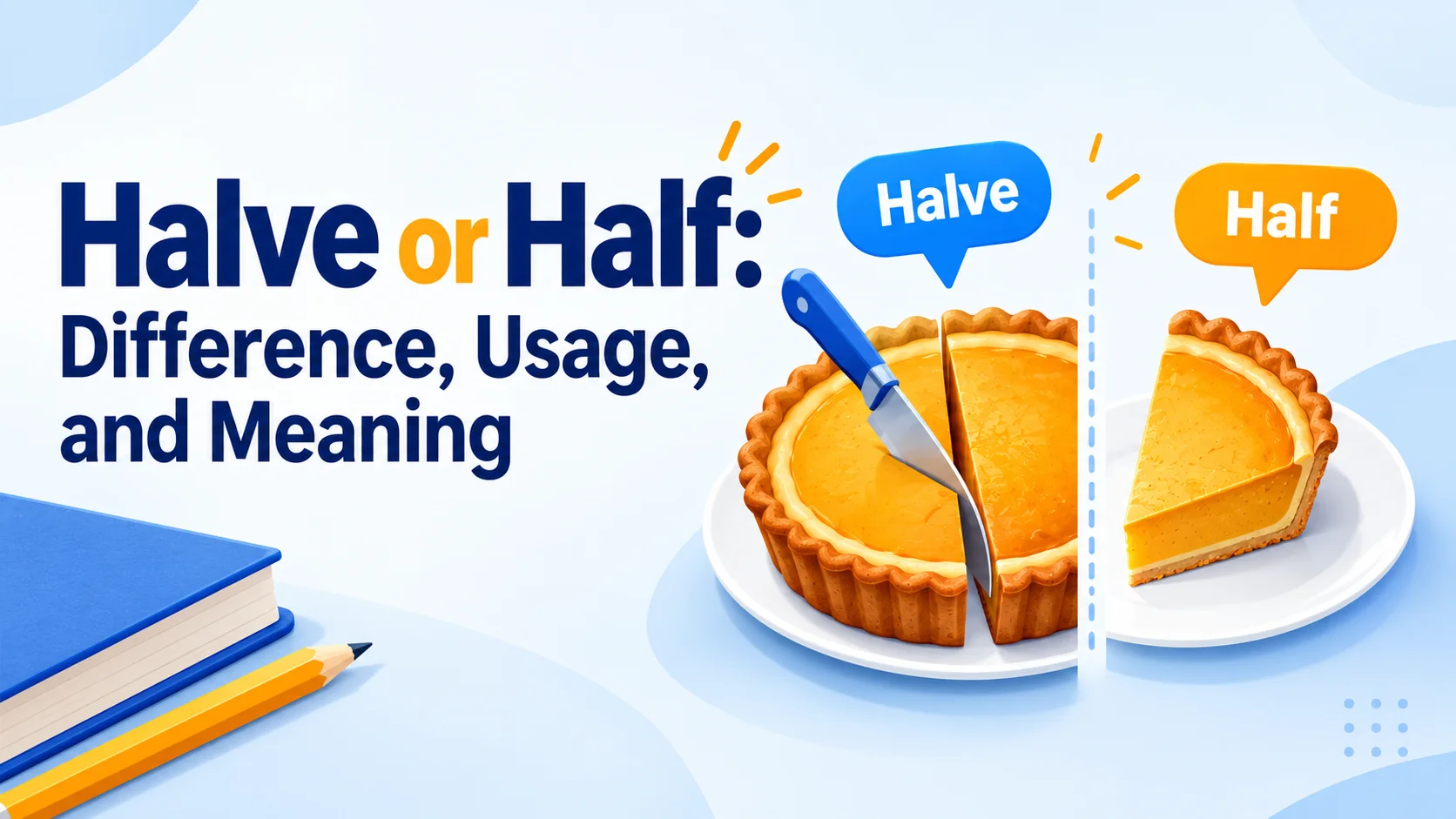
Halve or half can look like a small spelling question, but the two words perform different grammatical jobs. Half usually refers to one of two equal parts or 50% of something, while halve is a verb meaning to divide something into two equal parts or reduce it to 50%. Confusing them can change an entire sentence: “I ate half the cake” describes an amount, whereas “halve the cake” gives an instruction. The distinction becomes even clearer when you add halves and halves, two related forms that often cause mistakes. Understanding these forms makes your writing more precise.
For beginners, the easiest approach is to think about whether you are naming an amount or describing an action. If you are talking about a portion, use half: “half an hour,” “half the money,” or “one half of the pizza.” If you are telling someone to divide something, use halve: “halve the pizza,” “halve the recipe,” or “halve the number.” You will also encounter halves, the standard plural of half, and halved, the past-tense form of halve. These words are connected, but they cannot simply replace one another.
This guide explains half, halve, halves, and halved from both grammar and everyday-usage perspectives. You will see how they work as different parts of speech, why half becomes halves, how pronunciation differs, and which mistakes are most common. Practical examples from mathematics, cooking, time, business, sports, and ordinary conversation will make the distinction easier to remember. By the end, you should be able to choose the right form naturally rather than relying on a spelling rule alone.
Halve or Half: Quick Answer
The short answer is:
- Half is usually a noun, adjective, or adverb referring to one of two equal parts or 50%.
- Halve is a verb meaning to divide something into two equal parts or reduce it to half its original amount.
- Halves is the standard plural of half.
- Halved is the past tense and past participle of halve.
Compare these sentences:
Half the cake is gone.
Halve the cake before serving it.
The first sentence tells you how much cake remains. The second tells you what action to take.
| Word | Main grammatical role | Meaning | Example |
| half | Noun/adjective/adverb | One of two equal parts; 50% | “I ate half the apple.” |
| halve | Verb | Divide or reduce to half | “Halve the apple.” |
| halves | Plural noun / verb | More than one half / divides | “Cut the apples into halves.” |
| halved | Past tense/past participle | Divided or reduced to half | “The price was halved.” |
What Does “Half” Mean?
Half means one of two equal parts of a whole. It can also refer more generally to 50% of an amount, even when the thing being discussed is not physically divided.
For example:
- Half of 20 is 10.
- I drank half the water.
- The class spent half an hour studying.
- Half the students arrived early.
The important point is that half identifies the amount or portion, not the act of creating that portion.
Half as a Noun
As a noun, half refers to a part that represents one of two equal portions.
Examples:
- “I ate half of the sandwich.”
- “One half of the room was empty.”
- “She gave me half of the chocolate.”
- “The two halves were placed together.”
Common structures include:
half of + noun
Half of the money was saved.
a half + noun
We waited for half an hour.
one half of + noun
One half of the cake was left.
The noun half can stand alone when the context makes the whole thing clear: “You can have half.”
Half as an Adjective
Half can modify a noun by telling us that the noun represents half of a whole or quantity.
Examples include:
- half a cup
- half a mile
- half an hour
- half the population
- a half-day course
- a half-page answer
Notice that English commonly uses half a/an + noun:
We walked for half an hour.
She ate half an apple.
This construction is different from saying “a half of an apple,” which is possible in certain contexts but is less natural for many ordinary situations.
Half as an Adverb
Half can also modify an adjective, participle, or phrase.
Examples:
- “The door was half open.”
- “He was half asleep.”
- “The work is half finished.”
- “I half expected the result.”
Here, half does not identify a physical half of something. Instead, it can suggest partly, incompletely, or to some degree.
That distinction matters because English uses half more flexibly than the simple mathematical meaning might suggest.
Common Expressions with “Half”
Some familiar expressions include:
- halfway — at or near the middle
- half-time — the interval or point halfway through a game or event
- half-hearted — lacking complete enthusiasm
- half asleep — partly asleep
- half the time — on many or approximately 50% of occasions
- half of the — referring to 50% of a particular group or quantity
These expressions show why trying to translate half mechanically as “one of two pieces” does not always work.
What Does “Halve” Mean?
Halve is a verb. It means to divide something into two equal parts or reduce something to half its previous amount.
Examples:
- Halve the orange.
- Halve the recipe.
- The company halved its expenses.
- The number of errors has halved.
The verb can describe either a physical division or a numerical reduction.
That gives halve two especially useful patterns:
Physical division
Halve the melon before serving it.
Reduction to 50%
The discount effectively halved the cost.
The object does not necessarily have to be physically cut. A price, quantity, rate, or number can also be halved.
How to Use “Halve” in a Sentence
Because halve is a verb, it can appear in different tenses.
Present:
We halve the ingredients before cooking.
Imperative:
Halve the tomatoes.
Past:
She halved the amount of sugar.
Present perfect:
The company has halved its expenses.
Passive:
The recipe was halved to serve fewer people.
One particularly useful pattern is:
- halve + object
- Halve the quantity.
- Halve the distance.
- Halve the recipe.
- Another is:
something + has/had + halved
The number of complaints has halved.
In this construction, halve means the quantity itself has fallen to 50%.
Can “Halve” Mean “Reduce by 50%”?
Yes. In standard usage, halve something means reducing it to half its former size, amount, or value.
For example:
The new process halved the processing time.
This means the processing time became 50% of what it was before.
There is a subtle but useful distinction between:
The company halved its costs.
and:
The company reduced its costs by half.
Both communicate essentially the same numerical result. The first is simply more compact.
Half vs. Halve: The Key Difference
The most reliable way to distinguish them is grammatical rather than visual.
Half answers: How much? Which portion?
Halve answers: What should happen to it?
Consider this pair:
Half the students completed the assignment.
Here, half tells us how many students completed it.
Halve the number of students in each group.
Here, halve tells us to reduce each group to 50% of its previous size.
A Simple Test to Choose Between “Half” and “Halve”
Ask yourself what you are trying to express.
| If you mean… | Use… | Example |
| 50% of something | half | “Half the water is gone.” |
| One of two equal parts | half | “Take half of the cake.” |
| Divide something into two parts | halve | “Halve the cake.” |
| Reduce something to 50% | halve | “Halve the cost.” |
| More than one half | halves | “Divide the fruit into halves.” |
| Something was divided/reduced to half | halved | “The quantity was halved.” |
A useful memory shortcut is:
Half is the amount; half is the action.
It is not a perfect rule for every grammatical use of half, but it works extremely well for the central distinction.
Half, Halve, and Halves: Don’t Confuse These Three Words
These forms belong to the same word family, but their grammatical functions differ.
Half
Use half for one portion or 50%:
I need half of the paper.
Halves
Use halves when referring to two or more half-parts:
The two halves of the orange were equal.
It is also a verb form in some contexts:
The line halves the circle.
Here, halves is the third-person singular form of the verb halve.
Halve
Use halve as the base verb:
Halve the mixture.
Halved
Use halved for the past tense or past participle:
He halved the recipe.
The amount has been halved.
Why the Distinction Matters
These forms can look similar enough to cause quick-writing mistakes. Yet changing one letter can change both meaning and grammar.
Compare:
- half the cake — an amount
- halve the cake — an action
- two halves — plural portions
- halved the cake — past action
Once you identify the grammatical role, the correct form becomes much easier to select.
Why Is the Plural of “Half” Written “Halves”?
The standard plural of half is halves, not halfs.
This spelling belongs to a broader historical pattern in English in which some nouns ending in f or fe form plurals involving -ves.
Examples include:
- half → halves
- knife → knives
- leaf → leaves
- wife → wives
- wolf → wolves
However, it is important not to turn this into an absolute rule. English has plenty of nouns ending in f that simply take -s, such as roof → roofs and chief → chiefs.
So the best practical advice is not “every f becomes v.” Instead, learn the plural form of each word individually.
Why “Halfs” Is Usually Incorrect
If you are referring to multiple portions of something, use halves:
The apple was divided into two halves.
Both halves were equal.
Cut the sandwiches into halves.
Halfs is not the standard plural form of half in ordinary English. Writers who add -s automatically may produce it because many English plurals work that way, but half is one of the words whose standard plural has a different spelling.
Is “Halfs” Ever Correct?
For normal English writing, use “halves” as the plural of “half.”
You may occasionally encounter halves in unusual contexts, such as informal language, names, specialized terminology, or writing that intentionally preserves a particular form. Those cases do not change the standard grammar rule.
If your goal is a school assignment, professional document, article, email, or other standard English writing, halves is the appropriate choice.
How to Use “Half” and “Halve” in Different Contexts
The distinction becomes especially intuitive when you see how native English uses these words in different situations.
Mathematics and Fractions
Mathematics gives the clearest example:
Half of 12 is 6.
The shape was divided into two halves.
Halve 12 to get 6.
Here, half identifies the fraction or result, while half describes the operation.
A useful mathematical relationship is:
1 whole = 2 halves
and
halving a quantity = multiplying it by 1/2
So:
Halve 18 → 9
but:
Half of 18 → 9
The numerical result is the same, but the grammar differs.
Cooking and Recipes
Cooking instructions frequently use both forms.
Add half a cup of milk.
This tells you the quantity.
Halve the recipe if you are cooking for fewer people.
This tells you to reduce every relevant quantity to half.
You might also see:
Cut the peach into halves.
Here, halves refers to the resulting portions.
A practical writing tip for recipes: “halve the recipe” is usually clearer than listing every ingredient reduction individually when the intention is simply to make half the original quantity.
Time
Half appears constantly in expressions involving time:
- half an hour
- half past three
- half a day
- half the week
For example:
The meeting lasted half an hour.
Halve is less common here but can still describe an action:
We need to halve the meeting time.
The first sentence describes an existing duration. The second describes a targeted reduction.
Business, Prices, and Statistics
In business writing, halve is particularly useful because it expresses a precise 50% reduction concisely.
The company halved its operating costs.
The number of complaints has halved.
The new system could halve processing time.
By contrast:
Half of the customers chose the premium plan.
Here, half identifies a proportion.
One important point: halving is specifically a reduction to 50%, not merely any large reduction. If a price falls from $100 to $70, it has been reduced by 30%; it has not been halved.
Sports and Games
In sports, half is commonly a noun:
The team scored twice in the first half.
The second half begins at three o’clock.
You may also encounter halftime, which refers to the break between the two halves of certain games.
Halve has a different function:
The coach wants to halve the number of unnecessary penalties.
That means reducing the number by 50%, not dividing the game itself into halves.
Common Mistakes with “Half” and “Halve”
Using “Half” When You Need a Verb
A common mistake is using half when the sentence requires an action.
If you mean “divide into two equal parts,” halve is normally the correct verb:
Halve the onion before cooking.
Here, halve tells the reader what to do.
Using “Halve” When You Mean 50%
The opposite mistake also occurs.
Half of the students passed.
You would not normally replace half with halve because the sentence is identifying a proportion, not describing an action.
Writing “Halfs” Instead of “Halves”
Remember:
one half → two halves
not:
one half → two halfs
The spelling halves is the standard plural.
Confusing “Halves” and “Halved”
These words have completely different jobs:
The cake was cut into two halves.
She halved the cake.
Halves is a plural noun here. Halved is the past-tense verb.
Confusing “Half of” and “Halve”
Compare:
Half of the cake was eaten.
with:
Halve the cake before serving.
The first describes a portion. The second gives an instruction.
Half vs. Halve: Sentence Examples Side by Side
| Meaning | Correct sentence | Why |
| 50% of a quantity | “Half the water is gone.” | Half identifies an amount. |
| One equal portion | “I ate half the sandwich.” | Half is a noun. |
| Divide into two | “Halve the sandwich.” | Halve is a verb. |
| Reduce by 50% | “Halve the budget.” | Halve describes reduction. |
| Multiple portions | “The two halves fit together.” | Halves is plural. |
| Past action | “She halved the amount.” | Halved is past tense. |
| Resulting condition | “The amount was halved.” | Halved is a past participle. |
Pronunciation: How Do You Say “Half,” “Halve,” and “Halves”?
Pronunciation can help reinforce the spelling difference.
In standard English pronunciation, the l in “half” is silent, so it sounds roughly like “haf.”
In halve, the final sound is a v sound:
half → “haf”
halve → “hav”
Halves also contain the v sound.
The spelling therefore reflects a useful relationship:
half → halves
halve → halved
The exact vowel quality can vary somewhat between accents, especially between British and American English, but the important distinction is the f sound in half versus the v sound in halve/halves.
Half vs. Halve: British and American English
There is no major British-American difference in the basic distinction between these words.
In both varieties:
- half refers to a portion or 50%.
- halve means divide or reduce to half.
- halves is the standard plural.
- halved is the past form of halve.
Pronunciation can vary by accent, particularly in the vowel sound of half. British regional accents also differ from one another, just as American accents do.
For learners, there is no need to memorize separate British and American grammar rules for half vs. halve. The standard distinction works across both varieties.
Easy Ways to Remember the Difference
If you tend to hesitate between these words, use a four-part memory system:
Half = a portion
Half the cake.
Halve = an action
Halve the cake.
Halves = multiple portions
Two halves of the cake.
Halved = an action already completed
She halved the cake.
Another useful question is:
Am I talking about what something IS, or what I should DO to it?
If it is an amount or portion, half is likely right. If it is an instruction or action involving division or a 50% reduction, halve is likely right.
Tip: Don’t rely only on the letters f and v. Identify the word’s grammatical role first. That approach prevents mistakes with both halve and its related forms.
Quick Grammar Check: Which Word Is Correct?
Try choosing the correct word before checking the explanations.
- Please ___ the recipe.
- I ate ___ of the pizza.
- The two ___ were placed on separate plates.
- The company ___ its expenses last year.
- ___ an hour has passed.
- The amount has been ___.
Answers
- halve — it is an instruction.
- half — it identifies a portion.
- halves — it is the plural of half.
- halved — it describes a completed reduction.
- half — it identifies a duration.
- halved — it is the past participle of halve.
The fastest way to solve these is to look at the job the word performs in the sentence, rather than simply asking which spelling looks familiar.
Conclusion
Choosing between half and halve becomes straightforward once you stop treating it as a spelling problem and start treating it as a grammar-and-meaning problem. Use half for a portion, amount, or 50%; use halve for the action of dividing or reducing something to 50%. From there, the related forms follow naturally: halves is the plural of half, while halved is the past form of halve. One final actionable tip: when editing your sentence, ask whether you are naming an amount or describing an action. A common mistake to avoid is writing halfs as the ordinary plural of half—in standard English, halves is correct. Once these four forms become familiar, the distinction stops being a memorization exercise and becomes instinctive.
Frequently Asked Questions
Q1. Is it “halve” or “half”?
It depends on the meaning. Use half when referring to one of two equal portions or 50%: “Half the cake is gone.” Use halve when describing the action of dividing something into two equal parts or reducing it to 50%: “Halve the cake.”
Q2. What is the difference between half and half?
Half generally functions as a noun, adjective, or adverb, while halve is a verb. Half identifies an amount or portion; halve describes an action or change. Compare “half the distance” with “halve the distance.” The words are related but grammatically different.
Q3. Is “halves” the plural of “half”?
Yes. Halves is the standard plural form of half. For example, “The two halves were equal.” The spelling changes from f to v before the plural ending. Although many English words simply add -s, half belongs to a group with a different plural pattern.
Q4. Does “halve” always mean a physical division?
No. Halve can describe a numerical or proportional reduction without anything being physically cut. For example, “The company halved its expenses” means the expenses fell to 50% of their previous level. It can therefore apply to prices, quantities, rates, times, numbers, and other measurable amounts.
Q5. What is the past tense of “halve”?
The past tense is halved. For example, “She halved the recipe yesterday.” The same form can function as a past participle: “The recipe has been halved.” Do not confuse halved, which describes a completed action, with halves, which can be the plural of half.