

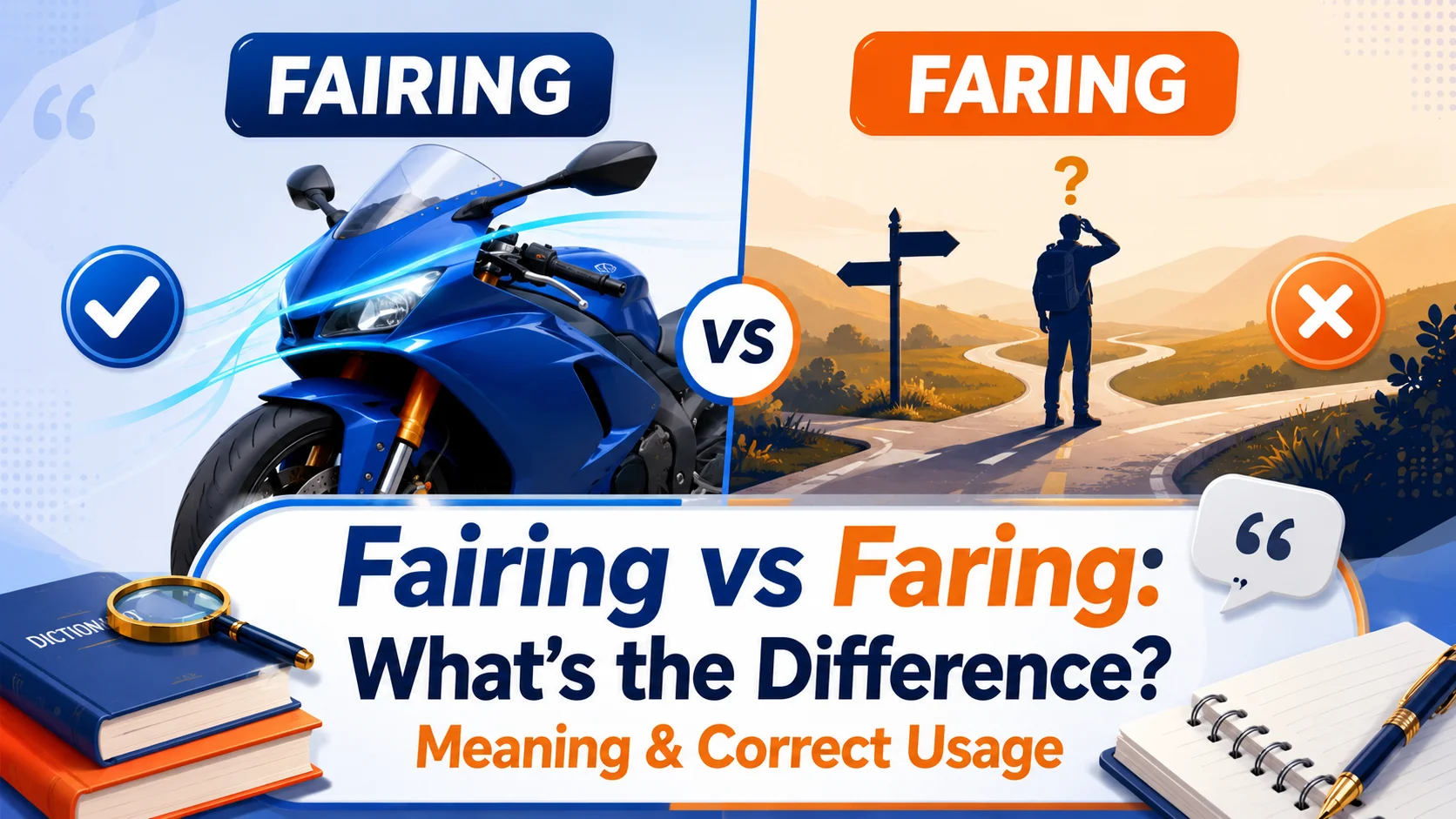
Fairing vs faring can be confusing because the two words sound the same in many varieties of English, yet they have completely different meanings. If you’re asking how someone is doing, the correct word is faring: “How are you faring?” If you’re talking about a streamlined covering on a motorcycle, aircraft, bicycle, or another vehicle, you need fairing. The difference becomes much easier once you connect each spelling to its meaning. Faring comes from the verb fare, while fairing is a noun for a physical structure. Understanding that distinction will help you avoid one of those small spelling errors that spellcheck often misses.
The confusion usually comes from pronunciation. When spoken aloud, faring and fairing may sound identical, so there’s no useful sound cue to tell them apart. Both are also legitimate English words, which makes automatic correction unreliable. The key is to look at the sentence’s meaning. Are you describing someone’s progress, performance, or circumstances? Use faring. Are you naming an aerodynamic covering or structural component? Use fairing. That simple distinction covers most situations, but there are useful details about grammar, word history, technical usage, and related words worth knowing.
In this guide, you’ll learn what faring and fairing mean, how they differ, when to use each one, and why “How are you faring?” is correct. You’ll also see examples from everyday conversation, business, education, transportation, motorcycles, aircraft, and engineering. We’ll examine the related words fare, fair, fared, and faring, look at common mistakes, and give you a practical memory trick that works without memorizing complicated grammar rules. By the end, choosing between fairing and faring should take only a few seconds.
Fairing vs Faring at a Glance
The fastest way to understand the distinction is to focus on what each word represents.
| Word | Meaning | Part of speech | Typical context | Example |
| Faring | Doing, progressing, or getting along | Verb form | People, businesses, teams, situations | “How are you faring?” |
| Fairing | A streamlined covering or structure | Noun | Motorcycles, aircraft, vehicles, engineering | “The motorcycle’s fairing was damaged.” |
Quick rule: If you could replace the word with doing or progressing, use faring. If you’re talking about a physical covering or aerodynamic structure, use fairing.
What Does “Faring” Mean?
Faring is the present participle of the verb fare. In this sense, fare means to get along, progress, or experience a particular result or situation.
When you say someone is faring well, you’re saying that things are going well for that person. Likewise, if a business is faring poorly, its performance or circumstances aren’t favorable.
You’ll often see faring followed by an adverb that describes the outcome:
- faring well
- faring poorly
- faring better
- faring worse
- faring successfully
- faring badly
For example:
“The new restaurant is faring well despite the competition.”
Here, faring has nothing to do with a physical object. It describes how the restaurant is doing.
“How Are You Faring?” Meaning
“How are you faring?” means essentially:
- How are you doing?
- How are things going?
- How are you managing?
- How are you getting along?
For example:
“How are you faring in your new job?”
This asks about the person’s experience and progress in the new position.
The expression is grammatically correct, although it can sound somewhat more formal or literary than “How are you doing?” In everyday casual conversation, most people would probably say:
“How are you doing?”
In professional writing, journalism, or more polished conversation, faring can sound perfectly natural:
“How is the company faring in the current market?”
Faring in Different Contexts
At work:
“How are you faring in your new position?”
At school:
“She is faring well in her advanced mathematics course.”
During difficult circumstances:
“The family is faring better than expected.”
In business:
“Small retailers are faring differently depending on their location.”
In sports:
“The team is faring well this season.”
In each example, faring describes performance, progress, or circumstances.
What Does “Fairing” Mean?
Fairing is primarily a noun used for a streamlined covering or structure designed to improve airflow, reduce drag, protect components, or create a smoother external shape.
You’ll encounter the word most often in technical contexts involving:
- Motorcycles
- Aircraft
- Bicycles
- Cars
- Boats
- Rockets
- Other vehicles and machines
For example:
“The mechanic replaced the motorcycle’s damaged fairing.”
Here, fairing refers to a physical part of the motorcycle.
Another example:
“The aircraft’s fairing was inspected before the flight.”
Again, it describes a physical structure.
Fairing in Motorcycles
Motorcycle fairings are among the most familiar examples.
A motorcycle fairing is a panel or set of panels that covers parts of the motorcycle and helps manage airflow. Depending on the motorcycle, a fairing may also provide some protection for mechanical components and the rider.
Common descriptions include:
- Full fairing
- Half fairing
- Front fairing
- Upper fairing
- Lower fairing
For example:
“The bike’s front fairing was cracked after the fall.”
You wouldn’t use faring here because you’re naming an object.
Fairing in Aircraft and Aerospace
Fairings also play an important role in aviation and aerospace.
Aircraft contain many components that could disrupt airflow if left exposed. A fairing can create a smoother transition around such components.
Examples include:
- Wing-root fairings
- Landing-gear fairings
- Engine-related fairings
- Antenna fairings
- Other aerodynamic coverings
The underlying principle is the same: the fairing helps create a smoother external shape.
Fairing in Other Engineering Contexts
The word isn’t restricted to motorcycles or airplanes.
Engineers may use fairings on:
- Bicycles
- Cars
- Boats
- Racing vehicles
- Rockets
- Mechanical equipment
So, if you’re reading a technical manual and see fairing, think physical structure or streamlined covering.
Fairing vs Faring: The Core Difference
The simplest distinction is this:
Faring = progressing or doing.
Fairing = a physical covering or streamlined structure.
Consider these two sentences:
“How are you faring after the move?”
“The motorcycle’s fairing needs to be replaced.”
The first sentence describes a person’s situation. The second names a physical component.
| Meaning | Correct word | Example |
| Doing well | Faring | “She is faring well.” |
| Experiencing difficulties | Faring | “They are faring poorly.” |
| Making progress | Faring | “The project is faring better than expected.” |
| Motorcycle covering | Fairing | “The fairing was scratched.” |
| Aircraft structure | Fairing | “The aircraft fairing was replaced.” |
| Aerodynamic covering | Fairing | “The new fairing reduces drag.” |
The distinction isn’t based on American versus British spelling. These are different words with different meanings.
Why Do People Confuse Fairing and Faring?
There are several reasons.
They Sound the Same
In many English accents, fairing and faring are homophones. When you hear either word, the pronunciation doesn’t necessarily tell you which spelling is intended.
That creates a problem in writing because you have to choose between two legitimate spellings.
Both Words Are Real
This is important.
A spellchecker may not flag fairing when you meant faring because fairing is a genuine English word. The same applies in reverse.
For example:
“How are you fairing?”
A basic spellchecker may accept fairing even though the sentence should use faring.
The software sees a valid word. It doesn’t necessarily understand your intended meaning.
The Spelling Looks Intuitive
People familiar with fair may instinctively write fairing when they mean “doing.”
But faring isn’t derived from fair. It comes from fare.
That connection is the most useful thing to remember.
Fare → faring
“How Are You Faring?” vs “How Are You Fairing?”
This is one of the most common points of confusion.
Why “How Are You Faring?” Is Correct
The verb is fare.
Its forms include:
- fare
- fared
- faring
So:
“How are you faring?”
is grammatically parallel to asking:
“How are you doing?”
You are asking about someone’s circumstances or progress.
Why “How Are You Fairing?” Is Wrong in This Context
Fairing doesn’t mean “doing.”
It refers primarily to a physical covering or structure.
Therefore:
❌ “How are you fairing?”
is incorrect if you’re asking about someone’s well-being.
✅ “How are you faring?”
is correct.
When “Fairing” Is Correct
Consider:
“The technician removed the fairing.”
That’s perfectly correct because the sentence refers to a physical component.
So the issue isn’t that fairing is a bad word. It’s simply the wrong word for the meaning intended in “How are you faring?”
Fare, Fair, Faring, and Fairing Explained
Understanding the larger word family makes the distinction much easier.
Fare
Fare can function as a verb or noun.
As a verb, it can mean to get along, progress, or do in a particular situation:
“How did you fare on the exam?”
As a noun, fare can refer to a transportation price:
“The bus fare increased.”
It can also refer to food or a type of entertainment in certain contexts:
“The restaurant serves traditional fare.”
Fair
Fair has several meanings.
It can describe something that is:
- Just
- Reasonable
- Impartial
- Acceptable
- Favorable
For example:
“That seems like a fair decision.”
Fair can also be a noun:
“We visited the county fair.”
But fair is not the source of faring in the sense discussed here.
Faring
Faring is the -ing form of fare:
fare → faring
It describes how someone or something is doing or progressing.
“The company is faring well.”
Fairing
Fairing is generally a noun referring to a streamlined covering or structure.
“The mechanic repaired the fairing.”
This gives you a simple four-word map:
| Word | Main idea |
| Fare | Get along/progress; also transportation price or other noun meanings |
| Fair | Just, reasonable, acceptable, or a public event |
| Faring | Doing or progressing |
| Fairing | Streamlined physical covering |
Fairing vs Faring Examples in Real Sentences
Examples Using “Faring”
- “How are you faring in your new role?”
- “The company is faring better than analysts expected.”
- “The students are faring well in the new program.”
- “The crops are faring poorly because of the lack of rain.”
- “The team is faring better this season.”
- “How is your project faring so far?”
- “The patient is reportedly faring well after the procedure.”
In every case, faring relates to circumstances, progress, or performance.
Examples Using “Fairing”
- “The motorcycle’s fairing was scratched.”
- “The mechanic removed the front fairing.”
- “The aircraft uses a lightweight composite fairing.”
- “The new fairing was designed to improve airflow.”
- “A damaged fairing can affect the appearance of the motorcycle.”
- “The engineer tested a redesigned aerodynamic fairing.”
- “The technician inspected the fairing for cracks.”
These examples involve physical objects or structures.
Faring vs Fairing in Different Contexts
Context can make the correct choice almost automatic.
| Context | Correct word | Example |
| Personal circumstances | Faring | “How are you faring?” |
| Education | Faring | “He is faring well in school.” |
| Business | Faring | “The company is faring better this year.” |
| Sports | Faring | “The team is faring well.” |
| Projects | Faring | “The project is faring better than expected.” |
| Motorcycles | Fairing | “The bike’s fairing is damaged.” |
| Aircraft | Fairing | “The aircraft fairing needs inspection.” |
| Aerodynamics | Fairing | “The fairing reduces aerodynamic drag.” |
| Mechanical structures | Fairing | “The protective fairing was removed.” |
Is Fairing or Faring the Correct Spelling?
Both spellings are correct, but they aren’t interchangeable.
That’s the important answer.
If you mean doing, progressing, or getting along, use faring.
If you mean a streamlined covering or structure, use fairing.
It’s therefore misleading to say that one spelling is universally “correct” and the other is universally “wrong.”
Use Faring When You Mean:
- Doing
- Progressing
- Managing
- Getting along
- Experiencing a particular result
Use Fairing When You Mean:
- A motorcycle body panel
- An aircraft covering
- An aerodynamic structure
- A streamlined enclosure
- A physical covering around a component
Common Mistakes With Fairing and Faring
Mistake 1: “How Are You Fairing?”
Incorrect:
“How are you fairing?”
Correct:
“How are you faring?”
The intended meaning is “How are you doing?”
Mistake 2: “The Motorcycle Needs a New Faring”
Incorrect:
“The motorcycle needs a new faring.”
Correct:
“The motorcycle needs a new fairing.”
The sentence refers to a physical motorcycle component.
Mistake 3: Assuming Fairing Means Doing Well
A writer may see fair and associate it with something favorable or acceptable.
But fairing doesn’t mean doing well.
The relevant word is faring, from fare.
Mistake 4: Choosing Based Only on Pronunciation
If both words sound identical in your accent, pronunciation can’t help.
Instead, ask:
“Am I describing progress, or am I naming an object?”
Mistake 5: Confusing Faring With Fair
Faring is related to fare, not the adjective fair.
Think:
fare → faring
not:
fair → faring
Is “Faring” Formal or Natural English?
Faring is standard English, but its tone can vary depending on the sentence.
Compare:
- “How are you doing?”
- “How are things going?”
- “How are you faring?”
The first two generally sound more conversational. The third can sound a little more formal, polished, or literary.
That doesn’t make it unnatural.
You may encounter faring in:
- Journalism
- Business reporting
- Academic prose
- Professional communication
- Formal correspondence
- Everyday conversation
For example:
“The industry is faring well despite higher operating costs.”
That sounds entirely natural in business writing.
Is Fairing Only Used for Motorcycles?
No.
Motorcycles are simply one of the most familiar places where people encounter the word.
Fairings can also appear in aircraft, bicycles, cars, boats, rockets, and other engineered systems.
The exact design varies, but the general purpose is similar: creating a smoother external shape around a component or structure.
For example, an aircraft may need a fairing where two structures meet so the transition is more aerodynamic. A motorcycle may use body panels to manage airflow and cover components.
So don’t memorize fairing = motorcycle part as an absolute rule.
A better definition is:
Fairing = a streamlined covering or structure, especially one used to reduce aerodynamic disruption or enclose a component.
American vs British English: Fairing and Faring
The distinction between these two words isn’t primarily a regional spelling issue.
Both American English and British English use faring in the sense of progressing or doing, and both use fairing for the technical noun.
There may be differences in pronunciation, frequency, or stylistic preference depending on the speaker and context, but you shouldn’t treat faring and fairing as American and British versions of the same word.
They are different words with different meanings.
How to Remember the Difference Between Faring and Fairing
Memory Trick for Faring
Think:
Faring = Fare + -ing
If you can replace faring with doing, progressing, or getting along, you’re probably looking for faring.
“How are you faring?”
→ “How are you doing?”
Memory Trick for Fairing
Think about a motorcycle fairing.
Picture a physical panel attached to a motorcycle or aircraft.
Fairing = physical thing
That mental image is more reliable than trying to remember the spelling by sound.
The 5-Second Context Test
When you’re unsure, ask yourself two questions:
1. Am I talking about how something or someone is doing?
Use faring.
2. Am I talking about a physical covering or aerodynamic structure?
Use fairing.
That’s usually all the decision-making you need.
Related Expressions and Word Forms
Fare Well
The expression fare well means to do well or experience a favorable outcome.
“I hope you fare well in your new position.”
This is directly connected to the meaning of faring.
Fared Well and Fared Poorly
The past tense of fare is fared.
“The company fared well last year.”
“The team fared poorly in the final.”
Notice that the spelling doesn’t use fair.
Fare Better and Fare Worse
You can also compare outcomes:
“The newer model fared better in testing.”
“Smaller businesses may fare worse during an economic downturn.”
These forms reinforce the connection:
fare → fared → faring
Practical Usage Guide: Which Word Should You Choose?
When editing your sentence, use the following decision table.
| If you’re talking about… | Choose | Example |
| Someone’s well-being | Faring | “How are you faring?” |
| A student’s progress | Faring | “She is faring well in college.” |
| A company’s performance | Faring | “The company is faring well.” |
| A team’s performance | Faring | “The team is faring better now.” |
| A project’s progress | Faring | “The project is faring well.” |
| A motorcycle body panel | Fairing | “The fairing was damaged.” |
| An aircraft component | Fairing | “The fairing was inspected.” |
| An aerodynamic covering | Fairing | “The new fairing reduces drag.” |
| A physical enclosure | Fairing | “The fairing covers the exposed component.” |
Quick Editing Checklist for Fairing vs Faring
Before you finalize your sentence, run through this short checklist:
- Does the word mean doing or progressing? → Use faring.
- Does it describe someone’s circumstances? → Use faring.
- Can you replace it with “doing”? → Faring is likely correct.
- Does it name a physical covering? → Use fairing.
- Are you describing a motorcycle or aircraft component? → Usually fairing.
- Are you relying only on pronunciation? → Stop and check the meaning.
- Did you confuse fair with fare? → Remember: fare → faring.
Conclusion
Fairing vs faring is a classic case where pronunciation can lead you astray. Both words are correctly spelled, but they belong to different meanings. Faring comes from fare and describes how someone, something, or a situation is doing or progressing. Fairing, on the other hand, is a noun for a physical or aerodynamic covering, commonly found on motorcycles, aircraft, bicycles, and other engineered structures. One final actionable tip: whenever you’re unsure, replace the word mentally with doing or progressing. If the sentence still makes sense, choose faring. If you’re naming a physical component, choose fairing. A common mistake to avoid is choosing the spelling based solely on sound. The words may sound alike, but their meanings don’t. Once you connect fare → faring and fairing → physical covering, the distinction becomes easy to remember.
Frequently Asked Questions
Q1. Is “How are you faring?” grammatically correct?
Yes. “How are you faring?” is grammatically correct and means “How are you doing?” or “How are things going?” The word faring comes from the verb fare. It can sound slightly more formal than “How are you doing?” but is completely standard English.
Q2. Is “fairing” a real word?
Yes. Fairing is a legitimate English noun. It usually refers to a streamlined covering or structure, particularly on motorcycles, aircraft, bicycles, and other vehicles or machines. For example, “The mechanic replaced the motorcycle’s fairing” uses the word correctly.
Q3. Is faring the same as doing?
In many contexts, yes. Faring can mean doing, progressing, managing, or getting along. For example, “How are you faring?” can be understood as “How are you doing?” The exact replacement depends on context, but the central idea is someone’s or something’s progress or circumstances.
Q4. Why is it called a fairing on a motorcycle?
A motorcycle fairing is a shaped covering that helps manage airflow and may protect components. The term belongs to a technical vocabulary associated with shaping or streamlining structures. It isn’t a spelling variant of faring, which describes how someone or something is doing.
Q5. Are fairing and faring homophones?
In many varieties of English, fairing and faring are homophones, meaning they have the same or nearly the same pronunciation while differing in spelling and meaning. This is why context matters so much. In writing, you must select the spelling based on what you intend to say.