

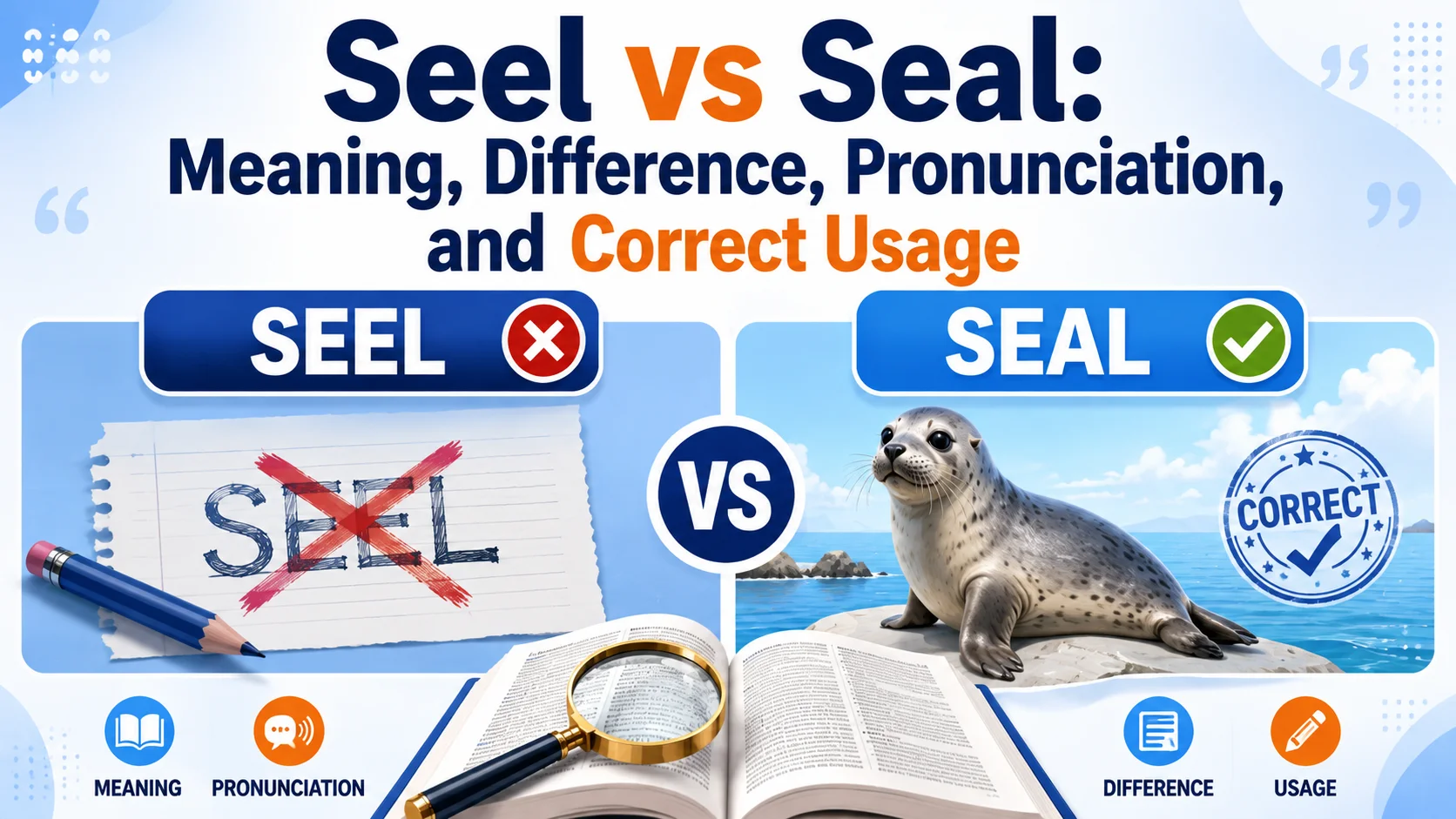
Seel vs seal can be confusing because the two words look almost identical and are generally pronounced the same. Yet they have different meanings, different histories, and very different levels of modern usage. If you’re writing a sentence about closing a package, authenticating a document, describing a marine animal, or finalizing an agreement, seal is the word you almost certainly need. Seel, on the other hand, is a rare historical verb associated primarily with falconry.
This distinction matters because English contains many words that sound alike but don’t perform the same job. A spelling that looks plausible isn’t necessarily appropriate for the context. In this guide, you’ll learn what seal means, what seel means, how the two words differ, why they’re confused, and when each spelling is actually correct. You’ll also see practical examples that make the distinction easier to remember.
The good news is that you don’t need to memorize a complicated rule. Once you understand the meaning and historical background of these words, the choice becomes straightforward. Modern English overwhelmingly favors seal for everyday situations, while seel belongs mainly to specialized or historical contexts. We’ll also examine pronunciation, related words such as sell and sealant, common mistakes, and a simple decision guide you can use whenever you’re unsure.
Seel vs Seal: Quick Answer
Seal is the standard modern English word. It can function as both a noun and a verb. As a noun, it can refer to a marine mammal, an official mark, or a closure. As a verb, it can mean to close something securely, authenticate something, prevent leakage, or make something final.
Seel is a much rarer word. As a historical verb, it refers to the practice of closing a bird’s eyes, particularly those of a hawk, by drawing threads through the eyelids. Merriam-Webster identifies its first known use as dating to the 15th century and labels its secondary sense, “to close up one’s eyes,” as archaic.
So, for ordinary modern writing, the practical rule is simple:
Use “seal” for almost every modern situation. Use “seel” only when the historical or specialized meaning specifically requires it.
Seel vs Seal at a Glance
| Word | Main meaning | Modern frequency | Typical context | Example |
| Seal | Close, secure, authenticate, finalize, or a marine mammal | Common | Everyday, business, technical, legal, wildlife | “Please seal the envelope.” |
| Seel | Historically, to close a bird’s eyelids | Rare | Historical writing and falconry | “The text describes how a falcon was seeled.” |
The important point isn’t simply that the spellings differ. Their meanings are not interchangeable.
If you write:
“Please seel the package.”
you’ve chosen the wrong word for modern English.
The correct sentence is:
“Please seal the package.”
By contrast, if you’re reading a historical passage about falconry and encounter seel, that unusual spelling may be intentional rather than an error.
What Does “Seal” Mean?
Seal as a Noun
The word seal has several established meanings. Which definition applies depends entirely on the context.
Seal as a Marine Animal
One of the most familiar meanings of seal is a marine mammal. Seals belong to groups of aquatic carnivorous mammals adapted for swimming and living in marine environments.
For example:
- “We saw a seal near the shoreline.”
- “The rescued seal was returned to the ocean.”
- “A group of seals was resting on the rocks.”
This meaning has a completely different history from the verb seal meaning “to close.” Merriam-Webster traces the animal noun to Old English seolh.
That distinction is useful when you’re studying English vocabulary because the same modern spelling can represent words with different historical origins.
Seal as an Official Mark or Emblem
A seal can also be an official mark used to authenticate or identify a document, institution, organization, or authority.
For example:
- “The certificate bears the university’s official seal.”
- “The document was stamped with the government seal.”
- “The organization’s seal appears at the bottom of the certificate.”
In this context, a seal communicates ideas such as authority, authenticity, approval, or identification.
Historically, seals were often impressed into wax or another material. Today, the term can refer to both physical and symbolic forms of authentication.
Seal as a Closure
Another common noun meaning refers to something that prevents air, liquid, gas, dust, or other material from passing through an opening.
You might encounter:
- rubber seal
- door seal
- window seal
- airtight seal
- watertight seal
- container seal
For example:
“The damaged rubber seal allowed water to enter.”
This usage is particularly common in engineering, construction, manufacturing, automotive maintenance, plumbing, packaging, and household products.
Seal as a Verb
As a verb, seal generally involves closing, securing, protecting, authenticating, or finalizing something.
For example:
“She sealed the envelope before mailing it.”
The verb can describe physical closure:
- seal a package
- seal an envelope
- seal a container
- seal a crack
- seal a leak
It can also describe making something official or final:
- seal an agreement
- seal a contract
- seal a deal
- seal someone’s fate
Oxford’s Advanced Learner’s Dictionary likewise defines seal as closing an envelope or container tightly and preventing air or liquid from entering or escaping.
Seal Can Mean “Make Final”
One of the most useful figurative meanings of seal appears in expressions such as “seal the deal.”
Here, nobody is physically putting wax on a contract. Instead, seal means to make something settled, confirmed, or final.
For example:
“Her final presentation sealed the deal.”
That means the presentation helped secure the agreement.
Similarly:
“The last goal sealed the team’s victory.”
Here, sealed means effectively made the outcome certain or final.
What Does “Seel” Mean?
The Historical Meaning of Seel
Seel is a genuine English word, but it is not a normal modern substitute for seal.
Merriam-Webster defines seel as a verb meaning to close the eyes of a bird, such as a hawk, by drawing threads through the eyelids. It also gives an archaic sense meaning to close one’s eyes.
The word is therefore closely connected with historical falconry terminology.
This is the kind of word you may encounter while reading:
- historical books
- older literature
- dictionaries
- descriptions of falconry
- historical accounts of bird training
- literary works using archaic vocabulary
Why Seel Looks Like Seal
The similarity between the two words is especially interesting because seel isn’t merely a misspelling that accidentally survived. It has its own history.
Merriam-Webster traces seel to Middle English silen, from Anglo-French ciller, ultimately related to Latin cilium, meaning “eyelid.”
That means seel and seal are not simply two interchangeable spellings of one modern word.
Their similar appearance can be misleading.
Is Seel Used in Modern English?
Yes, but very rarely.
The word still exists in dictionaries, and it may appear in specialized historical contexts. However, most people writing ordinary English today have no reason to use it.
You would generally not use seel when writing about:
- packages
- envelopes
- contracts
- doors
- windows
- containers
- leaks
- official documents
- marine mammals
In those situations, seal is the appropriate modern word.
Seel vs Seal: The Main Difference
The easiest way to understand the distinction is to focus on meaning and context rather than spelling.
| Feature | Seal | Seel |
| Part of speech | Noun and verb | Verb |
| Common today? | Yes | No, very rare |
| Marine mammal? | Yes | No |
| Close or secure something? | Yes | No |
| Official mark? | Yes | No |
| Finalize an agreement? | Yes | No |
| Historical falconry? | No | Yes |
| Pronunciation | Usually /siːl/ | Usually /siːl/ |
| Everyday writing | Appropriate | Generally inappropriate |
The difference can be reduced to one practical rule:
If you’re talking about closing, securing, authenticating, finalizing, or the animal, choose “seal.” If you’re discussing the historical falconry practice of closing a bird’s eyes, “seel” may be correct.
Why Do People Confuse Seel and Seal?
They Differ by Only One Letter
Visually, the words are extremely close:
seel
seal
A writer typing quickly can easily choose the wrong vowel, especially when relying on memory rather than context.
They Are Usually Pronounced the Same
Both words are generally pronounced with the long ee sound:
/siːl/
That means hearing the word doesn’t necessarily tell you how it should be spelled.
For example, if someone says:
“You need to ___ the box.”
the sound alone doesn’t tell you whether the writer knows the correct spelling. You need the meaning of the sentence.
Rare Vocabulary Creates False Familiarity
Another source of confusion is that readers sometimes encounter seel in historical writing and assume it must be an alternate spelling of seal.
That assumption isn’t safe.
A rare word can be legitimate without being interchangeable with a more common word.
Autocorrect Can Make Things Worse
Digital writing tools often recognize unusual words as legitimate dictionary entries. A spelling checker may therefore fail to tell you that seel is inappropriate in a particular sentence.
This illustrates an important writing principle:
Spell-checking checks spelling; it doesn’t always determine whether a word fits your intended meaning.
Seel vs Seal Pronunciation
How to Pronounce Seal
Seal is pronounced /siːl/.
It rhymes with:
- feel
- heel
- meal
- real
- steel
- wheel
Example:
“Please seal the box.”
How to Pronounce Seel
Historical seel is also pronounced /siːl/.
So the two words are generally homophones: words that sound alike but have different spellings and meanings.
This is why pronunciation isn’t a reliable way to distinguish them.
Why Context Is More Important Than Sound
Consider these sentences:
“The company will seal the agreement.”
and:
“The falconer may seel the bird.”
The pronunciation of the two target words can be identical, but their meanings are completely different.
When two words are homophones, the surrounding words provide the real clue.
Common Mistakes With Seel vs Seal
1: Writing “Seel” for “Seal”
Incorrect:
“Please seel the envelope.”
Correct:
“Please seal the envelope.”
The action is closing the envelope, so seal is required.
2: Treating Seel as a Modern Variant
It is incorrect to assume:
seal = seel
in ordinary contemporary English.
They are separate words with different meanings.
3: Correcting Historical Text Automatically
The opposite mistake can also happen.
If an old text contains seel, replacing it with seal without checking the context could erase an intentional historical meaning.
This matters when editing:
- archival material
- historical quotations
- literary texts
- academic research
- discussions of traditional falconry
4: Confusing Seal With Sell
Seal and sell are also commonly confused because they sound different only in the vowel sound for many speakers.
Compare:
“Please seal the package.”
with:
“Please sell the package.”
The first means close or secure. The second means exchange something for money.
Seal vs Sell vs Seel
These three words are worth comparing because spelling and pronunciation can cause different types of confusion.
| Word | Meaning | Example |
| Seal | Close, secure, authenticate, finalize, or marine mammal | “Seal the container tightly.” |
| Sell | Exchange something for money | “They sell handmade furniture.” |
| Seel | Historical verb related to closing a bird’s eyelids | “The historical text describes how to seel a hawk.” |
A Simple Memory Trick
Try this:
Seal = secure.
Both ideas begin with S, and a seal can secure something.
Then remember:
Sell = sale.
If money changes hands, think sell.
Finally:
Seel = specialized historical word.
If you’re not discussing an old or specialized context, you probably don’t need seel.
When Should You Use “Seal”?
Use Seal for Packages and Containers
Use seal whenever you mean to close something securely.
Examples:
- “Seal the package before shipping.”
- “The bottle is sealed.”
- “Make sure the bag is properly sealed.”
- “The technician sealed the opening.”
Use Seal for Documents
Use seal when referring to an official mark or authentication.
Examples:
- “The certificate has the school’s seal.”
- “The document carries an official seal.”
- “The letter was stamped with the organization’s seal.”
Use Seal for Agreements
Use seal when describing an agreement being finalized or secured.
Examples:
- “The companies sealed the agreement.”
- “The new contract sealed the partnership.”
- “The final payment sealed the deal.”
Use Seal for the Animal
Use seal when referring to the marine mammal.
Examples:
- “A seal surfaced beside the boat.”
- “The researchers observed several seals.”
- “The injured seal was taken to a rehabilitation center.”
When Should You Use “Seel”?
Use Seel in Historical Falconry Contexts
The main reason to write seel is when you’re referring specifically to its historical meaning.
For example:
“The historical account describes the practice of seeling a hawk.”
Here, seeling comes from the historical verb seel, not from seal.
Use It When Preserving Historical Language
If you’re quoting an old source, analyzing historical vocabulary, or explaining traditional falconry, seel may be necessary.
The important question is not:
“Does this spelling look strange?”
Instead, ask:
“Does the historical context require this word?”
That approach prevents you from modernizing a legitimate historical term incorrectly.
Seel vs Seal: Real-Life Examples
1: Mailing a Package
Wrong:
“I need to seel this box before I leave.”
Correct:
“I need to seal this box before I leave.”
The verb means close securely, so seal is correct.
2: Business Agreement
Wrong:
“The two companies seel the deal.”
Correct:
“The two companies sealed the deal.”
Here, sealed means finalized or secured the agreement.
3: Wildlife
Correct:
“We spotted a seal near the coast.”
The word refers to the marine animal.
4: Technical Maintenance
Correct:
“The mechanic replaced the damaged door seal.”
Here, seal refers to a component designed to prevent unwanted passage of air or water.
5: Historical Falconry
Correct in a historical context:
“The manuscript describes how a falcon was seeled.”
This is a specialized historical use of the word seel.
The sentence would make little sense if you replaced seeled with the ordinary modern verb sealed.
A Practical Decision Guide for Seel vs Seal
When you’re unsure, don’t stare at the spelling. Ask what you’re actually trying to say.
| What do you mean? | Correct word |
| Close an envelope | Seal |
| Close a package | Seal |
| Prevent a leak | Seal |
| Make something airtight | Seal |
| Authenticate a document | Seal |
| Official emblem | Seal |
| Marine mammal | Seal |
| Finalize an agreement | Seal |
| Historical falconry practice | Seel |
The Five-Second Test
Ask yourself:
- Am I talking about closing something?
- Am I talking about security or protection?
- Am I talking about an official mark?
- Am I talking about a marine animal?
- Am I talking about historical falconry?
If your answer is yes to one of the first four, choose seal.
If the fifth describes your context, seel may be appropriate.
Related Words That Cause Confusion
Sealant
A sealant is a substance used to create or improve a seal.
For example:
“Apply silicone sealant around the joint.”
Don’t confuse the noun sealant with the verb seal. The sealant is the material; sealing is the action.
Sealed
Sealed is the past tense and past participle of seal.
Examples:
- “The envelope was sealed.”
- “The container remained sealed.”
- “The agreement was finally sealed.”
Sealing
Sealing is the -ing form of seal.
Example:
“The workers are sealing the windows.”
Sell
Sell has nothing to do with closing something.
Example:
“The store will sell the product online.”
Remember:
seal = secure
sell = exchange for money
A Quick Checklist for Correct Usage
Before you use seel or seal, run through this checklist:
- Am I talking about a package or envelope?
- Am I talking about preventing leakage?
- Am I referring to an official mark?
- Am I talking about a marine animal?
- Am I describing an agreement being finalized?
- Am I discussing historical falconry?
- Did I choose the word based on meaning, rather than sound?
If the sentence concerns ordinary modern life, seal will usually be the correct answer.
Conclusion
The seel vs seal question looks like a minor spelling issue, but it actually illustrates an important feature of English: words that sound alike aren’t necessarily interchangeable. In contemporary writing, seal is the word you’ll need for closing a package, preventing a leak, authenticating a document, finalizing an agreement, or describing a marine mammal. Seel has a legitimate but highly specialized historical meaning connected with falconry and the closing of a bird’s eyelids. One final actionable tip: decide which word you need by identifying the meaning first, then check the spelling. A common mistake to avoid is treating seel as a casual alternative to seal. When you’re writing ordinary modern English, seal is almost always the right choice. Once you connect the word to its meaning, this confusing pair becomes surprisingly easy to handle.
Frequently Asked Questions
Q1. What is the correct word: seal or seel?
Seal is correct for ordinary modern meanings such as closing a package, securing an opening, authenticating a document, finalizing an agreement, or referring to a marine mammal. Seel is a rare historical verb associated mainly with closing a bird’s eyelids in falconry.
Q2. Is “seel” a real English word?
Yes. Seel is a legitimate English word, not merely a misspelling. Merriam-Webster defines it as a verb relating to closing the eyes of a bird, especially a hawk, and records its first known use in the 15th century. Its modern use is extremely limited.
Q3. Why do seel and seal sound the same?
Seel and seal are generally homophones, meaning they have the same pronunciation even though their spellings and meanings differ. Both are commonly pronounced /siːl/. Because speech doesn’t reveal the spelling, writers must use context to select the correct word.
Q4. Can I use “seel” instead of “seal” in modern writing?
Generally, no. Use seal when you’re writing about packages, documents, containers, agreements, leaks, marine mammals, or similar everyday subjects. Reserve seel for historical or specialized contexts where its traditional meaning is specifically intended.
Q5. How can I remember the difference between seel and seal?
Use this simple rule: seal = secure. If you’re closing, protecting, authenticating, finalizing, or describing the animal, choose seal. Think of seel as a rare historical word connected with falconry. That distinction will cover almost every modern writing situation.