
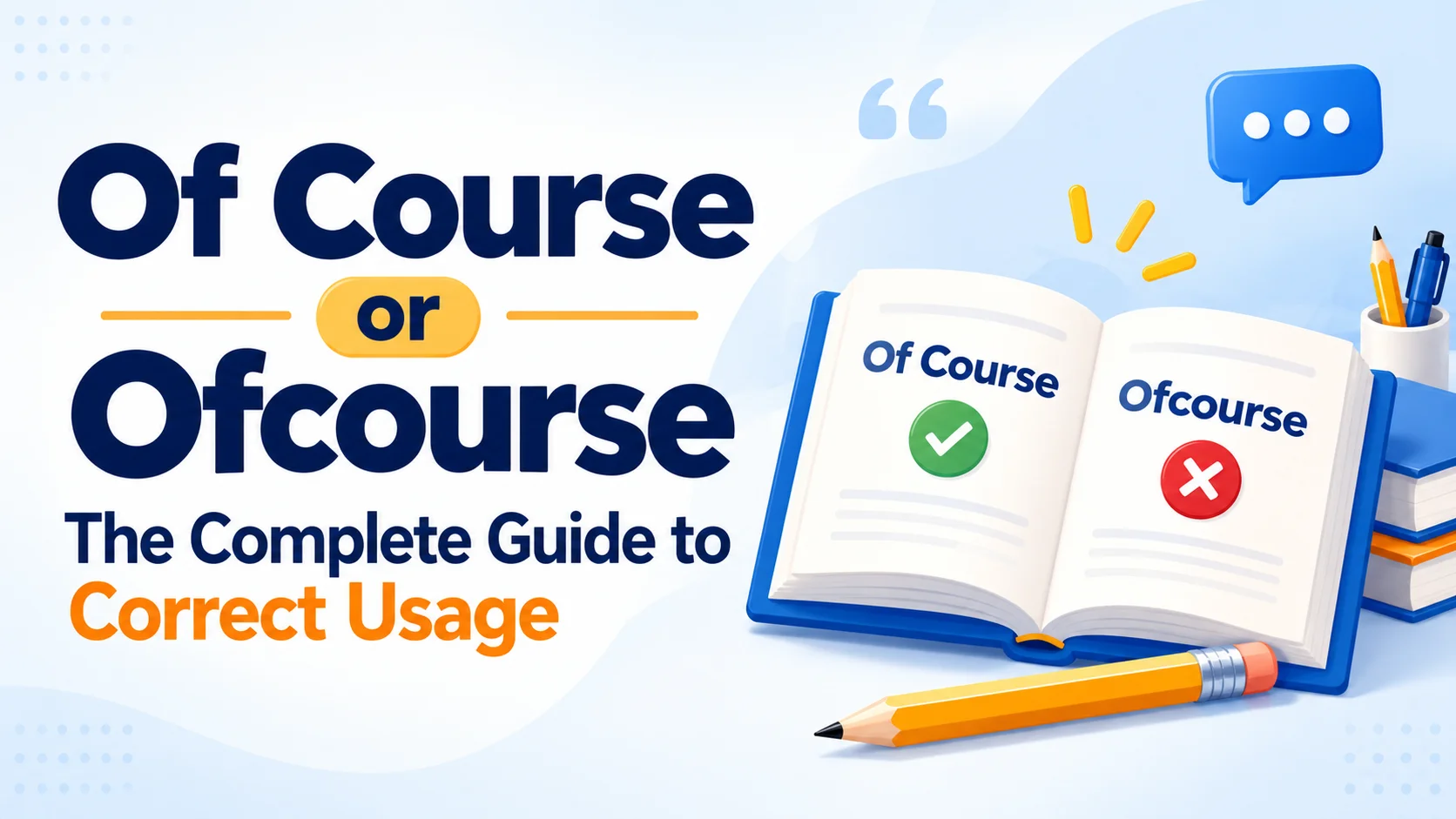
Of course or ofcourse? If you have ever hesitated over this spelling, you are not alone. The correct form is “of course,” written as two separate words. “Ofcourse” is not the standard spelling in English. The confusion is understandable because the phrase is usually pronounced smoothly, almost as though it were a single unit. In everyday typing, especially in quick messages, that sound can easily turn into one written word. This guide explains why the spelling is two words, what of course actually means, how to punctuate it, and when the phrase is appropriate.
The important point is that spelling is only part of the question. “Of course” can perform several jobs in a sentence, from giving permission and expressing agreement to signaling that information is expected or already known. Its punctuation can also depend on how the phrase functions in context. For example, “Of course, I’ll help” and “Of course I’ll help” can both be defensible, but they place slightly different emphasis on the phrase. Understanding that distinction is more useful than memorizing a rule that says to add a comma every time.
You will also learn how “of course,” “ofcourse,” and “off course” differ, which mistakes commonly appear in professional and academic writing, and which alternatives work better when you want a more formal tone. Examples throughout the guide show how the phrase behaves in conversations, emails, essays, and other everyday situations. By the end, you should be able to recognize the correct form instantly, use it naturally, and make sensible punctuation choices instead of relying blindly on autocorrect or a one-size-fits-all grammar rule.
Of Course or Ofcourse: Which Spelling Is Correct?
The correct spelling is of course—two words.
| Form | Standard English? | Meaning |
| of course | Yes | Certainly, naturally, or as expected |
| ofcourse | No | Common misspelling of of course |
| off course | Yes | Away from the intended route or direction |
| offcourse | No | Nonstandard spelling |
So, if you mean “certainly,” “naturally,” or “as expected,” use of course.
Correct: Of course, I can help you.
Incorrect: Ofcourse, I can help you.
The same rule applies whether you are writing a text message, school assignment, business email, article, or formal report. Informal writing may contain of course, but frequent online use does not make it the standard spelling.
Major dictionaries treat of course as a phrase or idiom rather than a single word. Cambridge describes it as an expression used for agreement, permission, obvious information, or situations that are not surprising. Merriam-Webster likewise defines it in terms of what is expected or follows the ordinary course of things.
Quick rule: If your intended meaning is “certainly” or “naturally,” write of course, never of course.
What Does “Of Course” Mean?
The meaning of course depends partly on the situation in which it appears. It is not simply a fancy version of “yes.”
Of Course as Agreement
The phrase can give a positive answer to a request or question.
“Can you send me the notes?”
“Of course.”
Here, of course, it means something like “certainly” or “yes, I can.”
Of Course as Permission
It can also grant permission.
“May I sit here?”
“Of course.”
In this use, the speaker is saying that the request is acceptable.
Of Course for Something Obvious or Known
The phrase can tell readers that information should already be understood or is not surprising.
The store was closed on Sunday, of course.
The speaker assumes the information is reasonably expected.
Of Course for an Expected Result
It can introduce a consequence that follows naturally from the circumstances.
She had forgotten her umbrella, so of course she got wet.
Here, of course, suggests that the result was predictable.
Cambridge specifically distinguishes these uses: of course can express agreement or permission, indicate that information is obvious or already known, and show that a situation is unsurprising.
Why Is “Of Course” Written as Two Words?
There is no spelling rule that turns of course into a single word of course. The standard expression consists of the separate words of and course.
One reason the mistake is so common is pronunciation. In natural speech, people do not necessarily pronounce every word with a strong pause between it and the next. Of course it can sound like one connected unit, particularly in rapid conversation.
The Phrase Is Easy to Hear as One Unit
Compare these:
- of course
- ofcourse
When spoken quickly, the boundary between the two words may seem less obvious than it looks in writing.
That does not mean the spelling boundary disappears. English contains many expressions whose words blend together in speech while remaining separate in writing.
Fast Typing Encourages the Mistake
People often type based on sound and muscle memory. Once someone repeatedly writes of course in informal messages, the incorrect form can become familiar.
This is particularly easy to overlook because the reader usually understands what the writer intended.
“Ofcourse” Looks Like a Possible Compound Word
English has many compound words:
- classroom
- notebook
- newspaper
- football
That can create the false impression that any frequently used combination should eventually become one word.
But word formation does not work that way. A frequently spoken phrase does not automatically become a compound word.
Does Informal Internet Use Make “Ofcourse” Correct?
No. A form may appear frequently online without being accepted as the standard spelling.
For schoolwork, professional communication, articles, applications, and other edited writing, use of course.
How to Use “Of Course” Correctly in a Sentence
Of course it is flexible. It can appear at the beginning, middle, or end of a sentence, and it can also stand alone as a response.
“Of Course” at the Beginning of a Sentence
A common construction is:
Of course, I remember your name.
The comma works naturally here when of course it acts as an introductory comment.
Another possibility is:
Of course I remember your name.
This version is also possible, especially when the phrase is closely connected to the statement that follows.
The difference is largely one of emphasis and rhythm rather than a simple “right versus wrong” distinction.
“Of Course” in the Middle of a Sentence
When the phrase functions as an aside, commas can set it apart:
The answer is, of course, more complicated than it appears.
Here, removing of course leaves the basic sentence intact:
The answer is more complicated than it appears.
That is a useful test. If the phrase behaves like an inserted comment, punctuation can help readers recognize it as such.
“Of Course” at the End of a Sentence
The expression can appear at the end:
You are welcome to join us, of course.
The punctuation depends on the entire sentence rather than on of course alone.
“Of Course” as a Standalone Response
A short response is completely natural:
“Can I borrow your pen?”
“Of course.”
You can also write:
“Of course!”
An exclamation mark can make the response sound warmer or more enthusiastic.
Does “Of Course” Need a Comma?
This is one of the trickier parts of the topic because “of course” does not always require a comma.
A common mistake is to learn the rule “always put a comma after of course.” That is too rigid. The Chicago Manual of Style notes that a comma after of course can be optional in some constructions and that punctuation can affect emphasis.
When a Comma Is Natural
Use a comma when of course functions as an introductory or parenthetical expression:
Of course, we can discuss the issue tomorrow.
The proposal is, of course, subject to approval.
The punctuation tells the reader that the phrase is functioning as a comment on the main statement.
When the Comma Can Be Omitted
Consider:
Of course we should check the figures first.
Here, of course, flows directly into the statement. The absence of a comma keeps the emphasis moving toward the following words.
This is why punctuation should not be treated as a mechanical “pause whenever you see of course” rule.
Why Context Matters
Compare:
Of course, she knew about the change.
This can give special emphasis to the speaker’s assumption.
Now compare:
Of course she knew about the change.
The second version can make the entire proposition feel obvious or expected.
The underlying meaning is similar, but the focus and rhythm differ.
Expert tip: If a grammar checker tells you that of course must always be followed by a comma, do not accept that suggestion automatically. Check how the phrase functions in the sentence.
“Of Course” vs “Ofcourse” vs “Off Course”
These forms look similar, but only one is the standard expression for agreement or certainty.
| Expression | Meaning | Example |
| of course | certainly; naturally; as expected | Of course, I’ll attend. |
| ofcourse | Nonstandard spelling | Avoid of course in edited writing. |
| off course | Away from the intended path or direction | The boat drifted off course. |
| offcourse | Nonstandard form | Do not use offcourse. |
Of Course vs Off Course: A Completely Different Meaning
This distinction is especially important.
Of course is an expression:
Of course, you can ask questions.
Off course describes something that has moved away from its planned route:
The aircraft was slightly off course.
You can remember the difference through the meanings:
- of course → certainty, agreement, expectation
- off course → away from the route
Changing of to off does more than alter the spelling. It changes the meaning of the phrase.
Common Mistakes With “Of Course”
Writing “Ofcourse” as One Word
This is the most straightforward error.
Wrong: I will ofcourse attend the meeting.
Correct: I will of course attend the meeting.
Writing “Offcourse”
Some writers add a second “f” because they have heard of it being pronounced quickly.
Wrong: Offcourse, I remember.
Correct: Of course, I remember.
Confusing “Of Course” With “Off Course”
This mistake is different because both of course and off course are legitimate expressions.
Agreement:
Of course, I agree with you.
Direction:
The ship was blown off course.
The meaning should determine which expression you choose.
Adding Commas Automatically
Another mistake is treating punctuation as a fixed spelling rule:
Of course, I agree.
This is fine.
But that does not mean every sentence containing of course requires the same comma pattern. Sentence structure and intended emphasis matter.
Assuming “Of Course” Always Sounds Polite
Context can change the tone dramatically.
“Can you help me?”
“Of course.”
This sounds cooperative.
But:
“You didn’t submit the form again?”
“Of course I did.”
Depending on the situation and tone, the second response can sound defensive or sarcastic.
The words themselves do not guarantee a particular attitude.
Examples of “Of Course” in Different Contexts
Everyday Conversation
“Are you coming with us?”
“Of course!”
“Can I ask you something?”
“Of course.”
Of course she remembered his birthday.
These examples show how naturally the expression works in ordinary speech.
Text Messages and Informal Writing
Correct spelling still matters in casual messages:
Of course 😂 I’ll send it tonight.
You may choose informal punctuation, abbreviations, or emojis in a personal message, but of course there remains a misspelling of the standard phrase.
Professional Emails
A professional message might say:
Of course, I can provide the updated document by Friday.
This is friendly and perfectly understandable.
However, if you want a more direct business tone, you could write:
Certainly, I can provide the updated document by Friday.
The choice depends on the relationship and desired tone.
Academic Writing
Of course it is grammatically acceptable in academic writing, but writers should use it thoughtfully.
The results are, of course, limited by the size of the sample.
That may work when the writer is acknowledging an obvious qualification.
In highly formal analytical writing, however, a more precise construction may sometimes be stronger:
The results are limited by the sample size.
The second version removes conversational commentary and states the limitation directly.
When Emphasis Is Important
Of course, the final decision belongs to the committee.
Here, the phrase signals that the statement should be regarded as expected or obvious.
Is “Of Course” Appropriate in Formal Writing?
Yes. “Of course” is not grammatically informal simply because people use it in conversation. The issue is usually tone, frequency, and context.
When It Works Well
It can be useful when:
- acknowledging an obvious point
- introducing an expected consequence
- making a brief parenthetical observation
- responding politely
- emphasizing agreement
When a More Precise Alternative Is Better
If the phrase does not add useful meaning, removing it can make the sentence more direct.
Compare:
Of course, the experiment had several limitations.
with:
The experiment had several limitations.
If the “obviousness” signaled by of course is not important, the shorter sentence may be stronger.
Does “Of Course” Sound Unprofessional?
Not automatically.
A sentence such as:
Of course, please let me know if you need further information.
can sound perfectly appropriate in a professional email.
The problem is overuse, not the existence of the phrase.
A document filled with of course, obviously, clearly, and similar expressions can sound as though the writer is repeatedly telling readers what they should already think.
Alternatives and Synonyms for “Of Course”
The best replacement depends on what you mean.
| Intended meaning | Useful alternative | Example |
| Agreement | Certainly | Certainly, I can help. |
| Permission | Certainly | Certainly, you may proceed. |
| Strong agreement | Absolutely | Absolutely, I agree. |
| Expected result | Naturally | Naturally, the delay affected the schedule. |
| Formal certainty | Certainly | The evidence certainly supports the conclusion. |
| Casual agreement | Sure | Sure, I’ll send it. |
| Obviousness | As expected | As expected, demand increased. |
Formal Alternatives
For professional or academic contexts, certainly, naturally, or as expected may sometimes communicate the intended idea more precisely.
Do not substitute mechanically, though. Certainly and of course overlap, but they are not interchangeable in every sentence.
Neutral Everyday Alternatives
Depending on context:
- certainly
- yes
- naturally
- definitely
- sure
Casual Alternatives
In relaxed conversation:
- sure
- absolutely
- definitely
The important question is not “Which synonym is best for SEO?” or even “Which word sounds more formal?” What meaning and tone do you want the reader to receive?
Easy Ways to Remember “Of Course” Is Two Words
The “Of + Course” Memory Trick
Think of the expression as two ordinary words:
of + course = of course
Do not invent a new word simply because the phrase sounds connected when spoken.
Use Meaning to Remember the Spelling
If you mean:
- certainly
- naturally
- yes
- as expected
→ write of course.
If you mean:
- away from a route
- outside the intended direction
→ use of course.
The Five-Second Proofreading Test
When proofreading, search your document for:
ofcourse
If you find it, ask whether you meant the standard phrase of course.
This is especially useful when editing long articles, assignments, emails, or documents because spelling mistakes can survive ordinary reading when the brain automatically supplies the intended meaning.
Quick Comparison: Correct and Incorrect Examples
| Incorrect or questionable | Better version | Why |
| Ofcourse, I’ll help. | Of course, I’ll help. | The phrase is two words. |
| Offcourse, that’s true. | Of course, that’s true. | Of course it has a different meaning. |
| The plane was of course. | The plane was off course. | Direction is intended. |
| Of course I can help. | Of course I can help. | Correct; comma is not automatically required. |
| Of course, I can help. | Of course, I can help. | Also correct; punctuation changes emphasis slightly. |
| I can help, of course. | I can help, of course. | Correct spelling is two words. |
Practice: Can You Choose the Correct Form?
Fill in the Blank
Choose of course, of course, or off course.
- ________, you can use my calculator.
- The plane was several miles ________.
- I will ________ attend the meeting.
- ________ is not the standard spelling.
- “Can I ask another question?” “________.”
Answers
- Of course
- off course
- of course
- Ofcourse
- Of course
The key is to identify the meaning before choosing the spelling. If the sentence expresses permission, agreement, certainty, or expectation, the answer will normally be of course. If it describes movement away from a route, of course is the appropriate expression.
Conclusion
The answer to “of course or ofcourse?” is straightforward: use of course, with a space. The phrase is a standard English expression meaning certainly, naturally, by permission, or as expected, depending on context. The spelling of course may appear in informal online communication, but it is not the standard form. Just as importantly, do not confuse of course with off course, which has an entirely different meaning related to direction or movement. Punctuation deserves a little more judgment. A comma can help when of course functions as an introductory or parenthetical expression, but it is not an automatic requirement in every sentence. Read the phrase in context and consider what you want to emphasize. One final actionable tip: whenever you proofread, search specifically for of course and replace it with of course when you mean “certainly.” A common mistake to avoid is assuming that pronunciation determines spelling. Spoken English may blend words together; careful writing keeps their standard forms intact.
Frequently Asked Questions
Q1. Is “ofcourse” one word or two?
“Of course” is two words in standard English. Of course is a common misspelling caused partly by the way the phrase sounds in rapid speech. Use the two-word form in schoolwork, professional writing, websites, emails, and edited documents.
Q2. Is “ofcourse” ever considered correct?
In standard English, of course is not the accepted spelling of the expression meaning “certainly” or “naturally.” You may encounter it in informal online writing, usernames, or unedited text, but frequent usage does not make it the standard written form.
Q3. Should there always be a comma after “of course”?
No. A comma is often appropriate, particularly when of course functions as an introductory or parenthetical expression, but it is not an absolute requirement. Punctuation can change emphasis. The Chicago Manual of Style specifically cautions against treating the comma as mandatory in every construction.
Q4. What is the difference between “of course” and “off course”?
Of course usually means “certainly,” “naturally,” or “as expected.” Off course means away from an intended route or direction. For example, “Of course, I’ll come” expresses agreement, while “The ship went off course” describes navigation.
Q5. Can I use “of course” in formal writing?
Yes. Of course it is grammatically acceptable in formal writing, but its usefulness depends on context. In academic or professional prose, use it when it contributes meaning—such as signaling an expected point or qualification. Remove it when it merely adds conversational padding.