

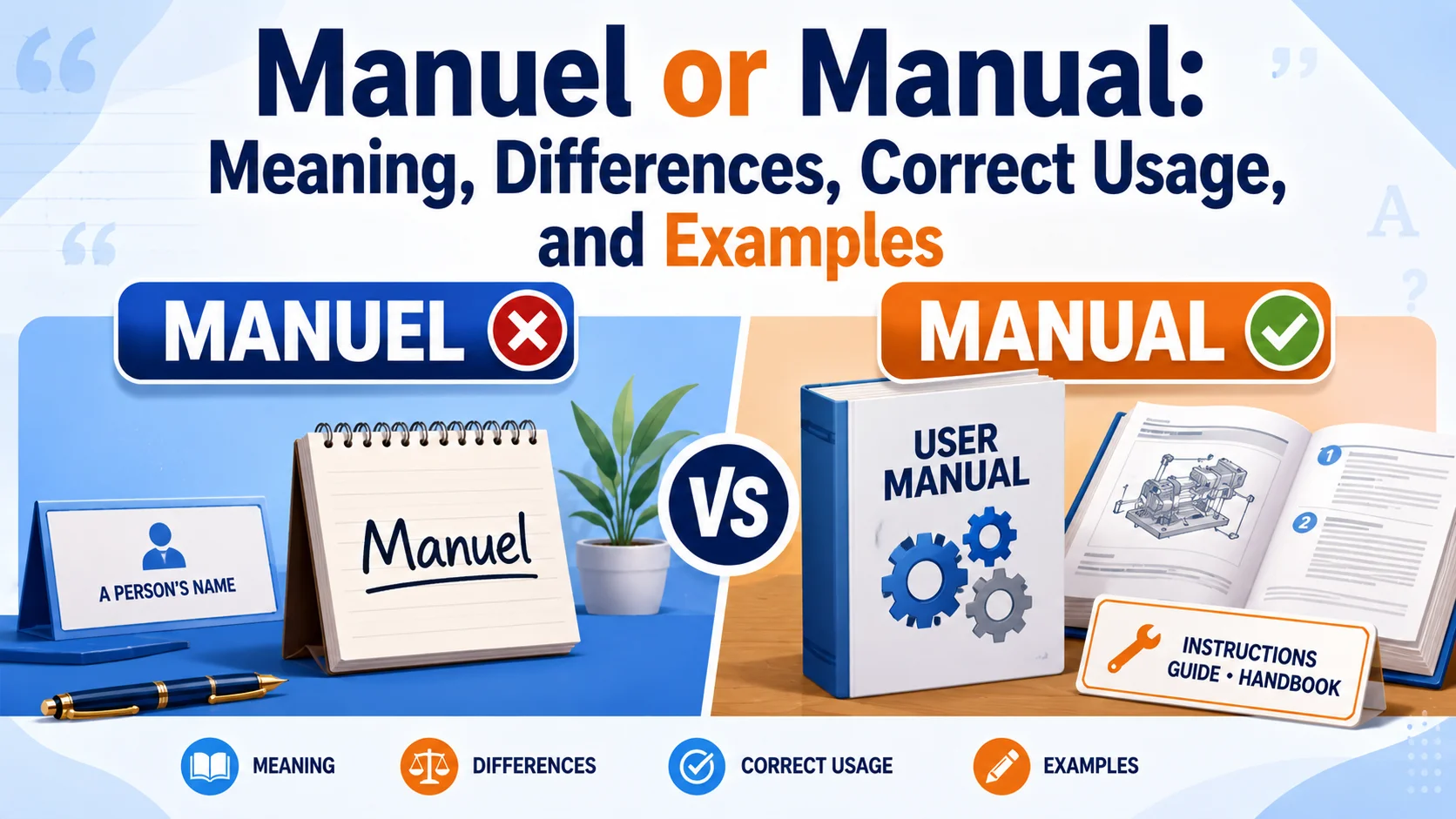
Manuel or manual can be confusing because the two forms look almost identical, but they have completely different uses. Manual is a common English word that can describe something done by hand, controlled by a person, or provided as a book of instructions. Manuel, on the other hand, is primarily a personal name.
The difference becomes especially important when you’re writing about instructions, technology, work, vehicles, or everyday activities. Writing Manuel when you mean an instruction book can change the meaning of your sentence completely. Likewise, writing manual when you’re referring to someone named Manuel is a spelling error.
In this article, you’ll learn exactly when to use manual and Manuel, how their meanings and grammatical roles differ, how they are pronounced, why people confuse them, and how to choose the right form quickly.
Quick Answer: Manuel or Manual?
Use manual when you mean something related to human effort, hand operation, nonautomatic processes, or an instruction book.
Use Manuel when you mean a person’s name.
| Word | Meaning | Example |
| manual | Done by hand, controlled by a person, or an instruction book | Please read the manual. |
| Manuel | A masculine personal name | Manuel called this morning. |
The easiest rule is:
Manual = hands, human control, or instructions.
Manuel = a person’s name.
What Does “Manual” Mean?
Manual is a standard English word that functions mainly as both an adjective and a noun. Its meanings are related to human action, physical effort, hand operation, or practical instructions.
Although the meanings vary by context, they are connected by the general idea of something being handled, performed, or controlled by people.
Manual as an adjective
As an adjective, manual commonly describes something that requires direct human action rather than being automatic.
For example:
- manual work
- manual control
- manual operation
- manual process
- manual entry
- manual adjustment
- manual transmission
Consider these examples:
The technician performed a manual inspection of the equipment.
The company still uses a manual process for approving applications.
The driver selected manual mode before changing the settings.
She prefers a car with a manual transmission.
In these examples, manual describes something performed or controlled by a person.
Manual as a noun
As a noun, manual commonly means a book, document, or digital resource containing instructions.
For example:
Please read the manual before operating the machine.
I can’t find the printer manual.
The technician checked the equipment manual before making the repair.
You can encounter manuals in many settings, including:
- technology
- manufacturing
- education
- workplaces
- vehicles
- appliances
- software
- machinery
- safety procedures
A manual explains how to use, operate, install, maintain, or understand something.
What Does “Manuel” Mean?
Manuel is primarily a masculine given name. It is especially associated with Spanish and Portuguese usage, although the name also occurs in other languages and cultures.
For example:
Manuel joined our team last week.
I spoke to Manuel after the meeting.
Manuel’s car is parked outside.
In each sentence, Manuel identifies a person.
Unlike the common English word manual, the name Manuel doesn’t mean “done by hand” or “instruction book.” The two forms aren’t interchangeable spellings of the same word.
Why is Manuel capitalized?
Because Manuel is a proper name, it is normally written with a capital M.
Correct:
Manuel sent the report.
Incorrect when referring to the person’s name:
manuel sent the report.
By contrast, the ordinary English word manual is normally lowercase unless it appears at the beginning of a sentence or in a title where capitalization is required by the chosen style.
Manuel vs. Manual: The Main Difference
The clearest way to understand the distinction is to look at their grammatical roles.
| Feature | Manual | Manuel |
| Type | Common English word | Proper name |
| Main uses | Adjective and noun | Personal name |
| Meaning | Done by hand, human-controlled, or an instruction book | A person’s given name |
| Capitalization | Usually lowercase | Usually capitalized |
| Common contexts | Work, technology, vehicles, instructions | Personal references |
| Example | Read the manual. | Manuel called me. |
So, if you’re talking about instructions, choose manual.
If you’re talking about work performed by people rather than automatically, choose manual.
If you’re talking about a person named Manuel, choose Manuel.
When Should You Use “Manual”?
Use manual whenever the context involves one of its established English meanings.
1. For an instruction book or guide
This is one of the most common uses of manual.
The manual explains how to install the software.
I lost the camera manual.
Read the instruction manual before using the device.
A manual can be printed or digital. The important feature is its instructional purpose.
2. For work performed by people
Manual can describe work that involves physical effort or human labor.
The factory still relies on manual labor.
The workers performed the task by manual methods.
The job requires experience with manual handling.
The expression manual labor is particularly common when discussing physically demanding work.
3. For human-controlled processes
Modern technology often uses manual to distinguish human-controlled actions from automated ones.
The administrator completed a manual review.
The information requires manual entry.
The technician made a manual adjustment.
Here, manual doesn’t necessarily mean that someone literally touches an object with their hands. Instead, it means the task requires direct human involvement or control.
4. For vehicles and machines
You may also see manual in discussions of vehicle transmissions and machine controls.
He learned to drive a manual car.
The vehicle has a manual transmission.
Switch the equipment to manual mode.
In these contexts, manual generally contrasts with automatic.
When Should You Use “Manuel”?
Use Manuel when you’re referring to someone whose given name is Manuel.
For example:
Manuel works in the accounting department.
I sent the documents to Manuel.
Have you spoken with Manuel today?
Manuel’s office is upstairs.
We invited Manuel to the meeting.
You should not use Manuel simply because it looks or sounds similar to manual.
For example:
❌ Incorrect: Please read the manuel before using the machine.
✅ Correct: Please read the manual before using the machine.
Here, the sentence is talking about an instruction book, not a person.
Manuel and Manual in the Same Sentence
One useful way to remember the difference is to use both words in the same sentence:
Manuel gave me the instruction manual.
The first word is a person’s name. The second is a document containing instructions.
Another example:
I asked Manuel to check the manual.
Again, the meanings are completely different.
This makes the distinction easy to see:
Manuel → person
manual → instructions
Why Do People Confuse Manuel and Manual?
The confusion is understandable because the words share most of their letters and can sound similar in some contexts.
Similar spelling
Compare:
MANUEL
MANUAL
Both begin with MANU-, and both contain the same first four letters.
When you’re typing quickly, your brain may recognize the general shape of the word without carefully checking the final letters.
Similar pronunciation
The pronunciation difference can also be difficult for some learners, especially when a person’s name is pronounced according to a language other than English.
English manual is commonly pronounced approximately:
MAN-yoo-uhl
A Spanish pronunciation of Manuel is closer to:
mah-NWEL
However, the pronunciation of a person’s name can vary according to language, family background, and personal preference.
Autocorrect doesn’t always help
Spellcheckers are designed primarily to identify words that don’t appear in their dictionaries. Both manual and Manuel can be legitimate forms, so software may not recognize that you’ve selected the wrong one for the sentence.
For example:
I need to read the Manuel.
A spellchecker might not flag this because Manuel is a valid name. But the context clearly calls for manual.
This is why proofreading requires attention to meaning, not just spelling.
Pronunciation: Manuel vs. Manual
Pronunciation can help you distinguish the two forms, but context is more reliable.
How to pronounce “manual”
In English, manual is commonly pronounced approximately:
MAN-yoo-uhl
It has three syllables in many standard English pronunciations:
man-u-al
How to pronounce “Manuel”
The pronunciation of Manuel depends on the language and the person.
In Spanish, it is commonly pronounced approximately:
mah-NWEL
The English pronunciation of an individual person’s name may differ. If you’re speaking to someone named Manuel, use the pronunciation that person prefers.
The important point is that you shouldn’t assume every person named Manuel pronounces the name in exactly the same way.
Manual vs. Automatic
One of the most useful ways to understand manual is to compare it with automatic.
| Situation | Manual | Automatic |
| Data entry | A person enters the information | A system enters or generates it |
| Machine control | A person operates the machine | The system operates it |
| Vehicle transmission | The driver changes gears | The vehicle changes gears |
| Review | A person checks the information | Software performs the check |
| Process | A person carries out the steps | A system carries out the steps |
For example:
The invoices are processed manually.
This means people perform the processing.
The invoices are processed automatically.
This means a system performs the process without the same degree of direct human involvement.
This contrast is especially common in business, software, engineering, manufacturing, and workplace communication.
Common Uses of “Manual” in Technology
The word manual remains very common in modern technology because people often need to distinguish human-controlled actions from automated ones.
You may see expressions such as:
- manual installation
- manual configuration
- manual testing
- manual review
- manual approval
- manual entry
- manual backup
- manual update
- manual override
- manual mode
For example:
The software normally updates automatically, but you can perform a manual update if necessary.
Here, manual means that the user initiates or controls the action directly.
This is an important point: manual does not always mean physical. In technology, it often means human-controlled rather than automated.
Manual in Education and Workplace English
You will also find manual in education, training, and professional settings.
Common expressions include:
- training manual
- laboratory manual
- employee manual
- safety manual
- operating manual
- technical manual
- student manual
- procedure manual
For example:
New employees receive a training manual during orientation.
The laboratory manual explains each experiment.
The safety manual outlines emergency procedures.
In each case, the manual provides information or instructions that help people perform a task correctly.
Related Forms of “Manual”
Understanding related forms can prevent additional mistakes.
Manually
Manually is the adverb related to manual.
It means that an action is performed by a person rather than automatically.
The information was entered manually.
The technician updated the software manually.
You can adjust the settings manually.
Notice that manually is not a variation of Manuel. It is formed from manual + -ly.
Manual labor
Manual labor refers broadly to work involving physical effort.
The construction job involves significant manual labor.
Manual transmission
A manual transmission is a vehicle transmission in which the driver controls gear changes rather than relying on an automatic transmission system.
My first car had a manual transmission.
Manual mode
Manual mode allows a person to control settings or operations directly.
Put the camera in manual mode to control the exposure yourself.
Common Mistakes With Manuel and Manual
Mistake 1: Using “Manuel” for an instruction book
❌ Incorrect: I read the manuel before assembling the desk.
✅ Correct: I read the manual before assembling the desk.
Why: The sentence refers to an instruction document.
Mistake 2: Using “manual” as someone’s name
❌ Incorrect: I spoke with manual yesterday.
✅ Correct: I spoke with Manuel yesterday.
Why: The sentence refers to a person whose name is Manuel.
Mistake 3: Forgetting capitalization
❌ Incorrect: manuel will join us later.
✅ Correct: Manuel will join us later.
Why: Personal names are proper nouns and are normally capitalized.
Mistake 4: Assuming spellcheck will catch the error
❌ I checked the manuel.
A spellchecker may accept this spelling because Manuel is a legitimate name.
The correct spelling depends on the intended meaning:
- Instruction book → manual
- Person → Manuel
Correct and Incorrect Examples
| Incorrect | Correct | Reason |
| Read the manuel. | Read the manual. | The sentence refers to instructions. |
| Manuel labor can be physically demanding. | Manual labor can be physically demanding. | The phrase means physical work. |
| I emailed manual yesterday. | I emailed Manuel yesterday. | The sentence refers to a person. |
| The manuel explains the procedure. | The manual explains the procedure. | A document is being discussed. |
| manuel will call later. | Manuel will call later. | A person’s name needs capitalization. |
Manual: Noun, Adjective, and Adverb Forms
A quick look at the word forms can make usage easier.
| Form | Function | Example |
| manual | Noun | Read the manual. |
| manual | Adjective | The system requires manual approval. |
| manually | Adverb | The data was entered manually. |
| Manuel | Proper noun | Manuel sent the message. |
This distinction is useful because manual and manually belong to the same English word family, while Manuel is a personal name.
Can “Manual” Be Used as a Verb?
In standard modern English, manual is not normally used as a verb.
You generally wouldn’t write:
❌ I will manual the machine.
Instead, use a suitable verb such as:
- operate
- adjust
- control
- configure
- inspect
- review
- handle
- enter
If you want to emphasize that a person performs the action, use manually:
I will manually configure the system.
The technician manually adjusted the settings.
This is the natural English construction.
The Etymological Connection Behind “Manual”
The meaning of manual is closely connected to the idea of the hand.
The English word ultimately traces back through French to Latin manus, meaning “hand.” This connection helps explain why modern English uses manual for things involving hand operation or human effort.
The same basic idea can be seen in several related meanings:
hand → done by hand → human operation → practical work → instructions for performing a task
The noun sense of manual developed into its familiar meaning of an instruction book or practical guide.
Understanding this connection can make the word easier to remember.
The Origin of the Name “Manuel”
Manuel has a separate history from the English word manual.
It is a form of the personal name Emmanuel, particularly associated with Spanish and Portuguese. It has also been used in other European languages and naming traditions.
That separate history is another reason not to treat Manuel as an alternative spelling of manual.
The two forms happen to look similar, but they belong to different linguistic categories:
- manual → English vocabulary word
- Manuel → personal name
How to Choose the Right Word
When you’re unsure whether to write Manuel or manual, focus on the meaning rather than the spelling.
Ask yourself: Am I referring to a person?
If yes, use:
Manuel
Example:
Manuel will help you with the installation.
Am I referring to instructions?
If yes, use:
manual
Example:
Read the manual before installing the software.
Am I describing human-controlled work?
Use:
manual
Example:
The company still performs manual reviews.
Am I describing something done by hand?
Use:
manual
Example:
The machine requires manual adjustment.
The three-second test
Ask these two questions:
1. Is this a person’s name?
Yes → Manuel
No → go to the next question.
2. Does it mean human-controlled, done by hand, or an instruction book?
Yes → manual
This simple test handles most everyday cases.
A Simple Memory Trick
The easiest way to remember the distinction is:
Manual = hands or instructions.
Manuel = human name.
You can also connect manual with manual work and manual instructions.
For Manuel, picture someone introducing himself:
“Hi, I’m Manuel.”
That creates a clear mental separation between the two spellings.
Another useful clue is capitalization:
Manuel → capital M because it’s a name.
manual → lowercase m because it’s an ordinary English word.
Capitalization alone shouldn’t be your only test, but it can provide a useful visual reminder.
Quick Decision Guide
| If you mean… | Use |
| An instruction book | manual |
| A user guide | manual |
| A training document | manual |
| Work done by people | manual |
| Work performed by hand | manual |
| Human-controlled operation | manual |
| A manual transmission | manual |
| A person named Manuel | Manuel |
| Someone called Manuel | Manuel |
Compare these sentences
Manuel read the manual.
The manual explains how to operate the machine.
Manuel operates the machine manually.
These examples show all three relevant forms:
- Manuel = a person’s name
- manual = instructions or human-controlled activity
- manually = the adverb describing how an action is performed
Conclusion
The difference between Manuel and manual becomes simple when you focus on meaning rather than appearance. Manual is the English word you need for instruction books, work done by hand, human-controlled processes, and nonautomatic operation. Manuel is primarily a personal name, especially associated with Spanish and Portuguese usage. If you’re writing about a machine, process, guide, or physical task, manual is almost certainly the form you need. If you’re referring to someone whose name is Manuel, use Manuel and capitalize it.
One final actionable tip: before you type either word, ask whether you’re talking about a person or a thing/process. A person is Manuel; instructions, human effort, or nonautomatic operation are manual. A common mistake to avoid is trusting spellcheck to make the decision for you. Both forms can be valid, so the real test is context. Remember “manual = hands or instructions; Manuel = a person,” and you’ll rarely confuse them again.
FAQs
Q1. What is the difference between Manuel and manual?
Manual is an English word used for something done by hand, controlled by a person, or a book containing instructions. Manuel is primarily a masculine personal name. They look similar but have different meanings, grammatical roles, capitalization, and uses.
Q2. Is Manuel a correct English word?
Yes. Manuel is a valid personal name that can naturally appear in English sentences. However, it isn’t an alternative spelling of the English word manual. If you mean an instruction book or human-controlled activity, use manual instead.
Q3. When should I use manual in a sentence?
Use manual when referring to an instruction book, work performed by people, hand-operated activity, or a process requiring direct human control. Common examples include instruction manual, manual labor, manual transmission, manual review, and manual entry.
Q4. Are Manuel and manual pronounced the same way?
No, they are generally pronounced differently, although the exact pronunciation of Manuel varies by language and speaker. English manual is commonly pronounced like “MAN-yoo-uhl,” while Spanish Manuel is closer to “mah-NWEL.” Personal names may have individual pronunciation preferences.
Q5. Why is it easy to confuse Manuel and manual?
The two forms share the first four letters and have similar overall shapes. Fast typing, unfamiliarity with the words, pronunciation differences, and spellcheck limitations can contribute to confusion. Because both forms can be legitimate, context and meaning are more reliable than spellcheck alone.