

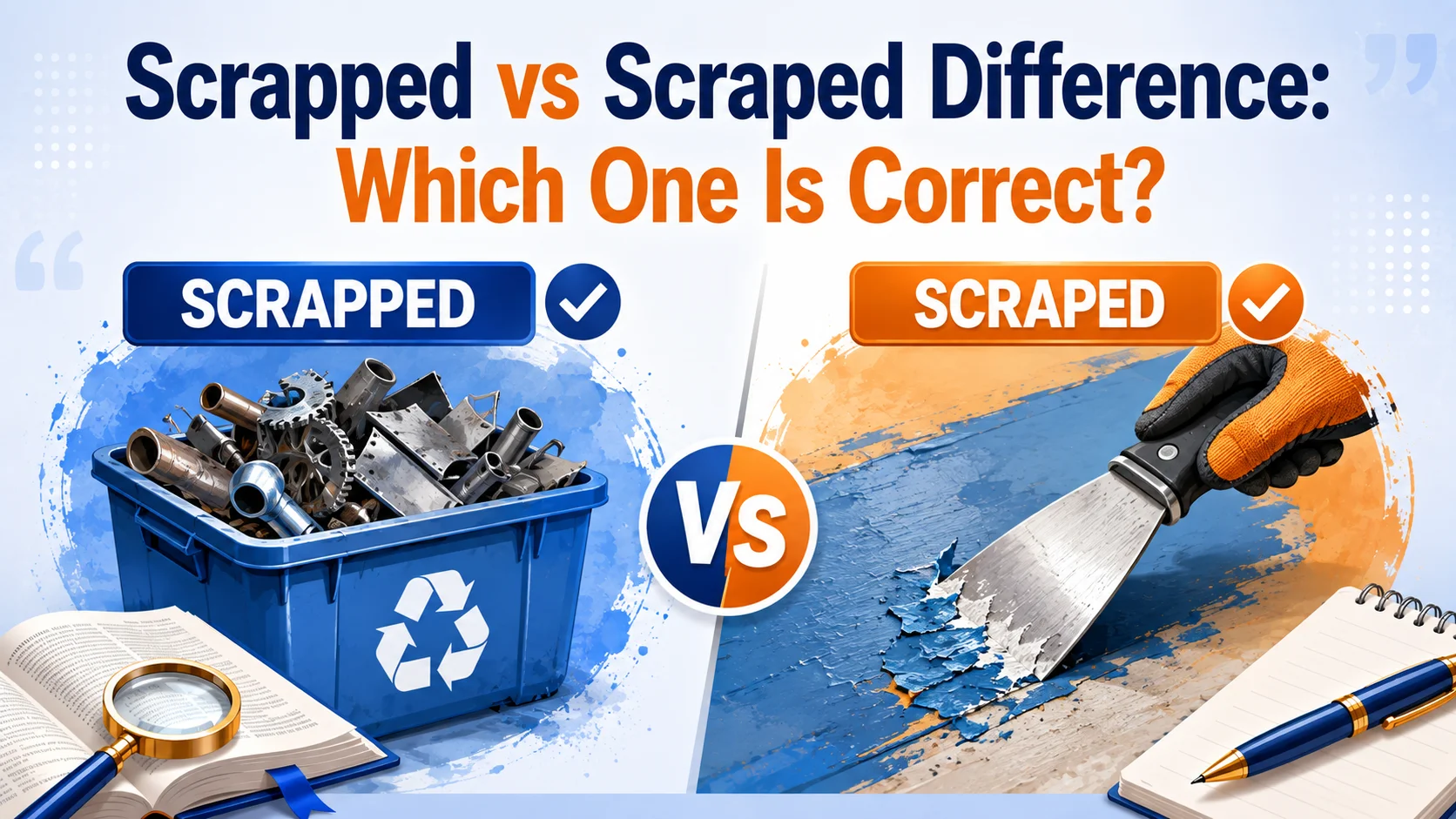
Scrapped vs scraped can look almost identical, but the extra p changes the word—and often changes the entire meaning of the sentence. If you write that a project was “scraped,” for example, you’re saying something very different from saying it was “scrapped.” One usually involves rubbing, removing, gathering, or barely succeeding, while the other commonly means discarding, canceling, or abandoning something.
The confusion is understandable because both words are past-tense forms, and both come from short verbs that differ by only one letter: scrape and scrap. The spelling rule behind their forms also explains why one has a single p and the other has a double p. Once you understand that distinction, choosing the right word becomes much easier.
In this guide, you’ll learn exactly when to use scraped and scrapped, how their meanings differ, why their spellings change, and how they work in everyday, professional, technical, and informal contexts. You’ll also see practical sentence corrections, common expressions, pronunciation guidance, and a few simple memory techniques. By the end, you should be able to tell immediately whether your sentence needs scraped or scrapped.
Scrapped vs Scraped: The Quick Answer
Scraped is the past tense and past participle of scrape. It usually means rubbing something against a surface, removing something from a surface, collecting something with effort, or succeeding only narrowly.
Scrapped is the past tense and past participle of scrap. It usually means discarded, abandoned, canceled, or thrown away.
| Word | Base verb | Main idea | Example |
| Scraped | scrape | Rub, remove, gather, or barely succeed | I scraped my knee. |
| Scrapped | scrap | Discard, cancel, abandon, or get rid of | They scrapped the old plan. |
Easy rule: If you’re dealing with friction, removal, or a difficult effort, think scraped. If you’re dealing with discarding or canceling something, think scrapped.
Neither spelling is inherently “more correct.” Both are correct English words, but they come from different verbs and therefore belong in different contexts.
What Does “Scraped” Mean?
Scraped is formed from the verb scrape. The verb has several related meanings, but they generally involve contact with a surface, removal, collection, or effort.
Scraped Meaning “Rubbed Against a Surface”
One common meaning is to move something across a surface in a way that causes friction.
For example:
- The chair scraped across the floor.
- Her shoe scraped against the pavement.
- The metal box scraped along the wall.
- His bicycle scraped against the gate.
Here, something physically comes into contact with another surface.
Scraped Meaning “Removed From a Surface”
Scrape can also mean to remove something by dragging a tool or object across a surface.
Examples include:
- She scraped the mud off her boots.
- He scraped the paint from the wall.
- I scraped the burned food from the pan.
- The worker scraped ice from the windshield.
The important idea is removal by rubbing or dragging.
Scraped Meaning “Suffered a Minor Injury”
You’ll often hear scraped when someone gets a superficial injury.
- I scraped my knee while playing basketball.
- She scraped her elbow on the wall.
- The child scraped his hand on the pavement.
A scraped knee is therefore correct. A “scrapped knee” would suggest something completely different and would sound incorrect in ordinary English.
Scraped Meaning “Collected or Gathered”
The verb can also describe collecting something, especially when the collection involves effort or comes from several sources.
For example:
- We scraped together enough money for the repair.
- She scraped up some extra cash.
- The researchers scraped information from several sources.
This last use is particularly important in technology. Web scraping refers to collecting information from websites, usually through automated software.
Scraped Meaning “Barely Succeeded”
In informal English, scrape by, scrape through, and related expressions describe managing to succeed with very little margin.
Examples:
- We scraped through the final exam.
- He scraped by with just enough money to pay the bill.
- The team scraped through to the next round.
Here, scraped doesn’t involve physically rubbing anything. The meaning has developed into the idea of managing to get through a difficult situation with limited resources or success.
What Does “Scrapped” Mean?
Scrapped comes from the verb scrap. Its central idea is getting rid of something, although the exact meaning depends on context.
Scrapped Meaning “Canceled or Abandoned”
This is probably the most important use to remember.
When an idea, plan, project, proposal, or event is scrapped, it has been abandoned or canceled.
Examples:
- The company scrapped the proposed expansion.
- Officials scrapped the plan after reviewing the costs.
- The studio scrapped the original ending.
- The school scrapped the old policy.
In each case, something that had been planned or considered is no longer going ahead.
Scrapped Meaning “Discarded”
Scrap can also mean to throw away or dispose of something because it is no longer useful.
- The mechanic scrapped the damaged machine.
- They scrapped the old equipment.
- The factory scrapped several outdated vehicles.
A scrapped car, for example, is a vehicle that has been discarded, dismantled, or sent for recycling rather than continuing in normal use.
Scrapped Meaning “Removed From Use”
Sometimes the word doesn’t mean literally throwing an object into a trash pile. It can simply mean that something has been eliminated from a system or process.
For example:
- The editor scrapped the final paragraph.
- The team scrapped the original design.
- Management scrapped the previous procedure.
The shared idea is that the thing is no longer being used or pursued.
Scrapped as an Informal Fighting Expression
There is another meaning of scrap as a noun and verb related to fighting.
In informal English, a scrap can mean a brief fight or physical confrontation. The verb scrap can therefore describe fighting, especially in British informal usage.
For example:
- The two men scrapped outside the pub.
This is a separate sense from “discard,” so context matters.
Scraped vs Scrapped: The Main Difference
The simplest distinction is this:
Scraped = scrape → rubbed, removed, gathered, or barely managed.
Scrapped = scrap → discarded, canceled, abandoned, or eliminated.
Consider these two sentences:
I scraped the old paint off the door.
The paint was removed from a surface.
I scrapped the old painting.
The painting itself was discarded.
The difference becomes especially clear when you visualize the action. Scraping usually involves something being moved against or removed from a surface. Scrapping usually involves deciding that something is no longer wanted or useful.
Comparison Table: Scraped vs Scrapped
| Feature | Scraped | Scrapped |
| Base verb | Scrape | Scrap |
| Spelling | One p | Two p’s |
| Physical contact | Often | Not usually |
| Removing material | Yes | No |
| Canceling a plan | No | Yes |
| Discarding an object | Sometimes indirectly, but not the normal verb | Yes |
| Minor injury | Yes | No |
| Web data collection | Yes | No |
| Barely succeeding | Yes | No |
| Abandoning a project | No | Yes |
| Example | She scraped her knee. | They scrapped the project. |
Why Do People Confuse Scraped and Scrapped?
The confusion comes from more than similar spelling.
First, both words are past-tense and past-participle forms. Second, the verbs scrape and scrap are visually very close. Third, English spelling rules make the past forms look even more similar:
- scrape → scraped
- scrap → scrapped
There is also a pronunciation issue. Depending on accent and speaking speed, the distinction between the vowel sounds in scrape and scrap can be easy for learners to miss.
Finally, both verbs can relate loosely to getting rid of something. You might scrape something away from a surface, while you scrap the object, plan, or system itself. That overlap in the broad idea of removal can create uncertainty.
Why Is “Scrapped” Spelled With Two P’s?
The double p isn’t random.
The base verb is scrap, which ends in a short vowel sound followed by a single consonant. When forming the past tense by adding -ed, the final consonant is doubled:
scrap + ed → scrapped
The same pattern appears in many English verbs:
- stop → stopped
- plan → planned
- drop → dropped
- rub → rubbed
- chat → chatted
The spelling helps preserve the pronunciation pattern of the original short vowel.
By contrast, scrape ends in a silent e:
scrape + d → scraped
The final e is dropped before the d is added.
So:
scrap → scrapped
scrape → scraped
This is a useful spelling distinction because it connects the past-tense form directly to the base verb.
Why Is “Scraped” Spelled With One P?
The base word is scrape, not scrap.
When you form the past tense, the silent e is removed before adding -ed:
scrape → scraped
You don’t double the p because the spelling structure is different.
Compare:
- scrape → scraped
- tape → taped
- hope → hoped
- shape → shaped
The final e already signals the long vowel in the base word, so the past form doesn’t require a doubled consonant.
Scraped Knee or Scrapped Knee?
Scraped knee is the correct expression when you mean a knee with a minor abrasion.
I scraped my knee when I fell.
He has a scraped knee from the accident.
A scrapped knee isn’t the normal expression because scrapped means discarded or abandoned.
The same principle applies to other body parts:
- scraped elbow
- scraped hand
- scraped arm
- scraped shin
You may also say I scraped my knee, which is often more natural than saying “I got a scraped knee.”
Scrapped Metal vs Scraped Metal
These expressions can both be grammatically possible, but they don’t mean the same thing.
Scrapped metal refers to metal that has been discarded or designated as scrap.
The company sold the scrapped metal for recycling.
Scraped metal describes metal that has been scraped or rubbed, or from which material has been removed.
The machine left scraped metal along the edge.
So the surrounding noun doesn’t automatically determine the answer. You need to ask what happened to the metal.
Was it discarded? → scrapped
Was its surface rubbed or material removed? → scraped
“Scraped Through” vs “Scrapped Through”
These are not interchangeable.
Scraped Through
Scraped through means succeeded narrowly or with difficulty.
She scraped through the qualifying round.
We scraped through the inspection despite several problems.
It suggests that success was uncertain, limited, or achieved by a small margin.
Scrapped Through
Scrapped through isn’t the standard expression for barely succeeding.
If you mean “barely succeeded,” use scraped through.
❌ The team scrapped through the tournament.
✅ The team scraped through the tournament.
The second sentence conveys the intended meaning.
“Scraped Together” vs “Scrapped Together”
The standard phrase is scraped together.
It means gathering small amounts of something—especially money, resources, or materials—until you have enough.
We scraped together enough money to replace the computer.
She scraped together the materials needed for the project.
Scrapped together doesn’t normally convey this meaning.
This is an especially useful phrase to memorize because the meaning isn’t obvious from the individual words. When you see scraped together, think of collecting limited resources with effort.
Scraped Data vs Scrapped Data
Technology creates another area where these words can cause confusion.
Scraped Data
Scraped data is data collected from a source, often automatically.
For example:
The researchers scraped data from publicly accessible webpages.
Here, scraped comes from the concept of extracting information from a source.
The related noun is web scraping, a technical process in which software collects structured or unstructured information from websites.
Scrapped Data
Scrapped data means data that has been discarded, abandoned, or removed from consideration.
For example:
The company scrapped the data after discovering serious errors.
The data isn’t being collected. It’s being discarded.
| Phrase | Meaning |
| Scraped data | Data collected or extracted |
| Scrapped data | Data discarded or abandoned |
| Scraped from a website | Extracted from the website |
| Scrapped from the project | Removed or discarded as part of a decision |
The difference is only one letter, but in a technical document it can completely change the meaning.
Common Mistakes With Scraped and Scrapped
Mistake 1: “I Scrapped My Knee”
If you’re describing a minor injury, the correct phrase is:
❌ I scrapped my knee.
✅ I scraped my knee.
You scrape your knee; you don’t normally scrap it.
Mistake 2: “They Scraped the Project”
If a team canceled or abandoned a project, use scrapped:
❌ They scraped the project.
✅ They scrapped the project.
The project wasn’t physically rubbed against a surface. It was abandoned.
Mistake 3: “We Scrapped Together the Money”
The correct phrase is:
❌ We scrapped together the money.
✅ We scraped together the money.
The phrase means that you gathered whatever resources you could.
Mistake 4: “The Team Scrapped Through”
For barely succeeding, use:
❌ The team scrapped through.
✅ The team scraped through.
The expression scrape through describes narrow success.
Mistake 5: “The Program Scrapped the Data” When You Mean Collected It
If software gathered information from websites, scraped is the appropriate word:
❌ The program scrapped product information.
✅ The program scraped product information.
However, if the program discarded the information, scrapped may be correct.
Real Sentence Corrections
The fastest way to understand the distinction is to examine the intended meaning rather than the spelling.
| Incorrect or confusing sentence | Better sentence | Why |
| I scrapped my elbow. | I scraped my elbow. | A minor injury involves scraping. |
| They scraped the proposal. | They scrapped the proposal. | The proposal was canceled. |
| We scrapped together enough cash. | We scraped together enough cash. | Resources were gathered with difficulty. |
| The car was scraped for parts. | The car was scrapped for parts. | The vehicle was discarded/dismantled. |
| She scrapped through the exam. | She scraped through the exam. | She barely succeeded. |
| The software scrapped website data. | The software scraped website data. | Information was collected. |
| He scrapped paint from the door. | He scraped paint from the door. | Paint was physically removed. |
| The company scraped the old policy. | The company scrapped the old policy. | The policy was abandoned. |
Scraped vs Scrapped in Different Contexts
The right word often becomes obvious when you identify the context.
Everyday Conversation
Scraped commonly describes injuries and physical contact:
I scraped my hand on the fence.
Scrapped can describe abandoned plans:
We scrapped our weekend plans because of the weather.
Workplace Writing
In business communication, scrapped often appears with:
- plans
- proposals
- projects
- policies
- strategies
- designs
- budgets
- initiatives
For example:
Management scrapped the proposed restructuring plan.
Meanwhile, scraped can appear in technical or physical contexts:
The technician scraped the residue from the surface.
Academic and Research Writing
Academic writing may use scraped in discussions of data collection:
The researchers scraped publicly available information for analysis.
It may also describe physical processes:
The sample was scraped from the surface.
Scrapped is appropriate when a study, method, hypothesis, or proposal is abandoned:
The researchers scrapped the original methodology after identifying a major flaw.
News and Public Affairs
News writing frequently uses scrapped when reporting canceled policies, plans, or programs:
Officials scrapped the proposed regulation.
Scraped is more likely when describing physical damage, collection, or a narrow result:
The team scraped through to the final.
American vs British English
The basic distinction between scraped and scrapped remains the same in both American and British English.
You don’t normally choose one spelling based simply on whether you’re writing for a U.S. or U.K. audience.
What can differ is which meanings or expressions are especially common.
For example, scrap has a familiar informal sense connected with fighting in British English:
The two men had a scrap.
American English speakers understand this expression, but another word such as fight may be more natural in everyday U.S. conversation.
The spelling distinction itself does not change:
- scrape → scraped
- scrap → scrapped
So don’t treat this as an American-versus-British spelling issue. It’s primarily a word-choice and verb-formation issue.
Pronunciation: Scraped vs Scrapped
The two words are also pronounced differently because their base verbs have different vowel sounds.
- scraped: sounds like “skraypt”
- scrapped: sounds roughly like “skrapt”
The vowel is the biggest clue.
Scraped has the long a sound found in words such as shape and late.
Scrapped has the short a sound found in words such as trap and map.
When speaking quickly, however, the final consonant sounds can make the words feel more similar than they look. If you’re unsure while writing, don’t rely on pronunciation alone. Return to the base verb:
scrape → scraped
scrap → scrapped
That method is more reliable.
A Simple Decision Rule for Choosing the Right Word
When you’re stuck between scraped and scrapped, ask one question:
What happened?
Something was rubbed, removed, collected, or barely achieved?
→ scraped
Something was discarded, canceled, abandoned, or eliminated?
→ scrapped
Here’s a practical decision table:
| If your sentence means… | Choose |
| Rubbed against something | scraped |
| Removed material | scraped |
| Suffered a minor abrasion | scraped |
| Collected online information | scraped |
| Barely succeeded | scraped |
| Gathered limited resources | scraped |
| Canceled a plan | scrapped |
| Abandoned a project | scrapped |
| Discarded equipment | scrapped |
| Sent a vehicle for disposal/recycling | scrapped |
| Eliminated a proposal | scrapped |
| Fought informally | scrapped |
How to Remember Scraped vs Scrapped
A complicated mnemonic isn’t necessary. Start with the base verbs.
Think “Scrape = Surface”
Scrape often involves a surface.
You scrape:
- your knee
- paint
- ice
- food from a pan
- residue from a surface
So remember:
SCRAPE → SURFACE → SCRAPED
Think “Scrap = Throw Away”
Scrap often involves deciding that something isn’t worth keeping.
You scrap:
- a plan
- a project
- a proposal
- old equipment
- an outdated design
So:
SCRAP → DISCARD → SCRAPPED
Remember the Extra P
The spelling itself can reinforce the meaning:
scrap → scrapped
The base verb already has one p, and the past-tense form doubles it.
scrape → scraped
The final e disappears before -d is added.
If you’re writing quickly, identifying the base verb first is usually safer than trying to memorize the completed words independently.
Scraped, Scratched, Scuffed, or Scrapped?
Another source of confusion is the word scratched. These words overlap, but they aren’t interchangeable.
| Word | Typical meaning | Example |
| Scraped | Rubbed against or removed from a surface | I scraped my knee. |
| Scratched | Marked or damaged with a sharp edge | The cat scratched the sofa. |
| Scuffed | Left a superficial mark through rubbing | My shoes got scuffed. |
| Scrapped | Discarded or canceled | They scrapped the proposal. |
The distinction matters because physical damage can be described with several different verbs.
A scraped knee usually means the skin was rubbed away.
A scratched phone has a thin mark or line on its surface.
A scuffed shoe has a rubbed or worn mark.
A scrapped phone would normally mean the phone was discarded—not physically scratched.
Related Forms You Should Know
Understanding the word family makes the distinction easier.
Scrape
- scrape
- scraped
- scraping
- scraper
Examples:
Don’t scrape the table.
She scraped the residue away.
He is scraping the paint off.
Scrap
- scrap
- scrapped
- scrapping
- scraps
Examples:
They decided to scrap the plan.
They scrapped the old equipment.
The team is scrapping the original design.
We used leftover scraps of wood.
Notice the spelling change in scrapping: the final p is doubled before -ing, just as it is in scrapped.
Is “Scrapped” Ever Used for Physical Things?
Yes. This is an important nuance.
Scrapped can refer to physical objects when the object is discarded, dismantled, or treated as scrap.
For example:
The damaged vehicle was scrapped.
That doesn’t mean someone rubbed the vehicle against a surface. It means the vehicle was taken out of useful service and disposed of or dismantled.
Similarly:
The factory scrapped the outdated machines.
The machines were discarded.
By contrast:
The machine scraped the wall.
Here, the machine physically rubbed against the wall.
The object itself doesn’t determine the verb. The action does.
Is “Scraped” Ever Used for Plans or Projects?
It can be possible in unusual or highly specific contexts, but it isn’t the normal choice when you mean canceled or abandoned.
If you mean that a project will no longer happen, use:
The company scrapped the project.
If you’re describing an unusual physical action involving a document, plan, or printed material, scraped could theoretically describe something being physically scraped. But that’s a different meaning.
For ordinary communication, don’t replace scrapped with scraped when you mean “canceled.”
Common Phrases With “Scraped”
Here are several useful expressions:
- scraped my knee
- scraped the paint off
- scraped the bottom
- scraped the surface
- scraped together enough money
- scraped by
- scraped through
- scraped data
- scraped from a website
Some are literal, while others are idiomatic.
For instance, scrape the surface can be literal:
The tool scraped the surface.
But it can also be figurative:
We have only scraped the surface of the problem.
In the figurative expression, it means dealing with only a small part of a larger subject.
Common Phrases With “Scrapped”
Useful expressions include:
- scrapped the plan
- scrapped the project
- scrapped the proposal
- scrapped the policy
- scrapped the design
- scrapped the old equipment
- scrapped the vehicle
- scrapped the idea
- scrapped the program
These expressions generally communicate elimination, cancellation, or disposal.
One subtle point is that scrap doesn’t always imply that something was useless. A perfectly reasonable plan can be scrapped because circumstances changed.
For example:
The company scrapped the launch plan after the market changed.
The plan wasn’t necessarily bad. It simply wasn’t going forward.
A Short Practice Test
Choose scraped or scrapped in each sentence.
- I ___ my knee while climbing over the fence.
- The committee ___ the proposal after a lengthy discussion.
- We ___ together enough money for the repair.
- The software ___ information from several websites.
- The factory ___ several outdated machines.
- She ___ the burned food from the bottom of the pan.
- The team ___ through the final round.
- Officials ___ the planned construction project.
Answers
- scraped
- scrapped
- scraped
- scraped
- scrapped
- scraped
- scraped
- scrapped
The pattern should now be clear: scraped describes an action of scraping or a related figurative sense, while scrapped describes disposal, cancellation, abandonment, or—in informal usage—fighting.
Final Checklist: Which Word Should You Use?
Before submitting an email, assignment, report, or article, use this quick check:
- Did something rub against a surface? → scraped
- Was something removed from a surface? → scraped
- Was someone’s skin injured by rubbing? → scraped
- Was information extracted from a source? → scraped
- Did someone barely succeed? → scraped
- Were resources gathered with difficulty? → scraped
- Was a plan canceled? → scrapped
- Was a project abandoned? → scrapped
- Was an object discarded? → scrapped
- Was equipment taken out of service? → scrapped
The Base-Verb Test
If you’re still unsure, strip the ending away:
scraped → scrape
scrapped → scrap
Then ask which base verb expresses the action you mean.
This works because the spelling difference isn’t arbitrary. The two words come from two different verbs.
Scrape → scraped = rub, remove, collect, or barely succeed.
Scrap → scrapped = discard, cancel, abandon, or eliminate.
Conclusion
The difference between scraped and scrapped comes down to their base verbs: scrape and scrap. When something is rubbed, removed, collected, or achieved only with difficulty, scraped is usually the word you need. When a plan, project, object, or proposal is discarded, canceled, or abandoned, choose scrapped. One final actionable tip: when you’re unsure, remove the -ed ending and ask whether your sentence needs scrape or scrap. That simple test is more reliable than guessing from pronunciation. A common mistake to avoid is treating the words as interchangeable simply because they look similar. They aren’t. One extra p represents a different verb, a different meaning, and often a completely different sentence. Once you connect each spelling to its base verb, the distinction becomes straightforward.
FAQs
Q1. Is “scrapped” the correct spelling?
Yes. Scrapped is the correct past-tense and past-participle form of scrap. It usually means discarded, canceled, or abandoned. For example, “The company scrapped the proposal.” The double p follows the spelling pattern used when forming the past tense of scrap.
Q2. Is it “scraped my knee” or “scrapped my knee”?
The correct phrase is “scraped my knee.” It means you injured the skin by rubbing it against a rough surface. Scrapped would imply discarding or abandoning something, so it doesn’t normally describe a minor physical injury.
Q3. Should I say “scraped the project” or “scrapped the project”?
Use “scrapped the project” when you mean the project was canceled or abandoned. “Scraped the project” doesn’t normally express that meaning. If you’re describing physically removing something from a project document, the context could differ, but cancellation requires scrapped.
Q4. Is “scraped together” or “scrapped together” correct?
The standard expression is “scraped together.” It means collecting small amounts of money, materials, or other resources until you have enough. For example, “We scraped together enough money for the repair.” Scrapped together isn’t normally used with this meaning.
Q5. Is “scraped data” the same as “scrapped data”?
No. Scraped data means information that has been collected or extracted, often through web scraping. Scrapped data means information that has been discarded or rejected. In technical writing, choosing the wrong form can reverse the intended meaning, so check the action carefully.