

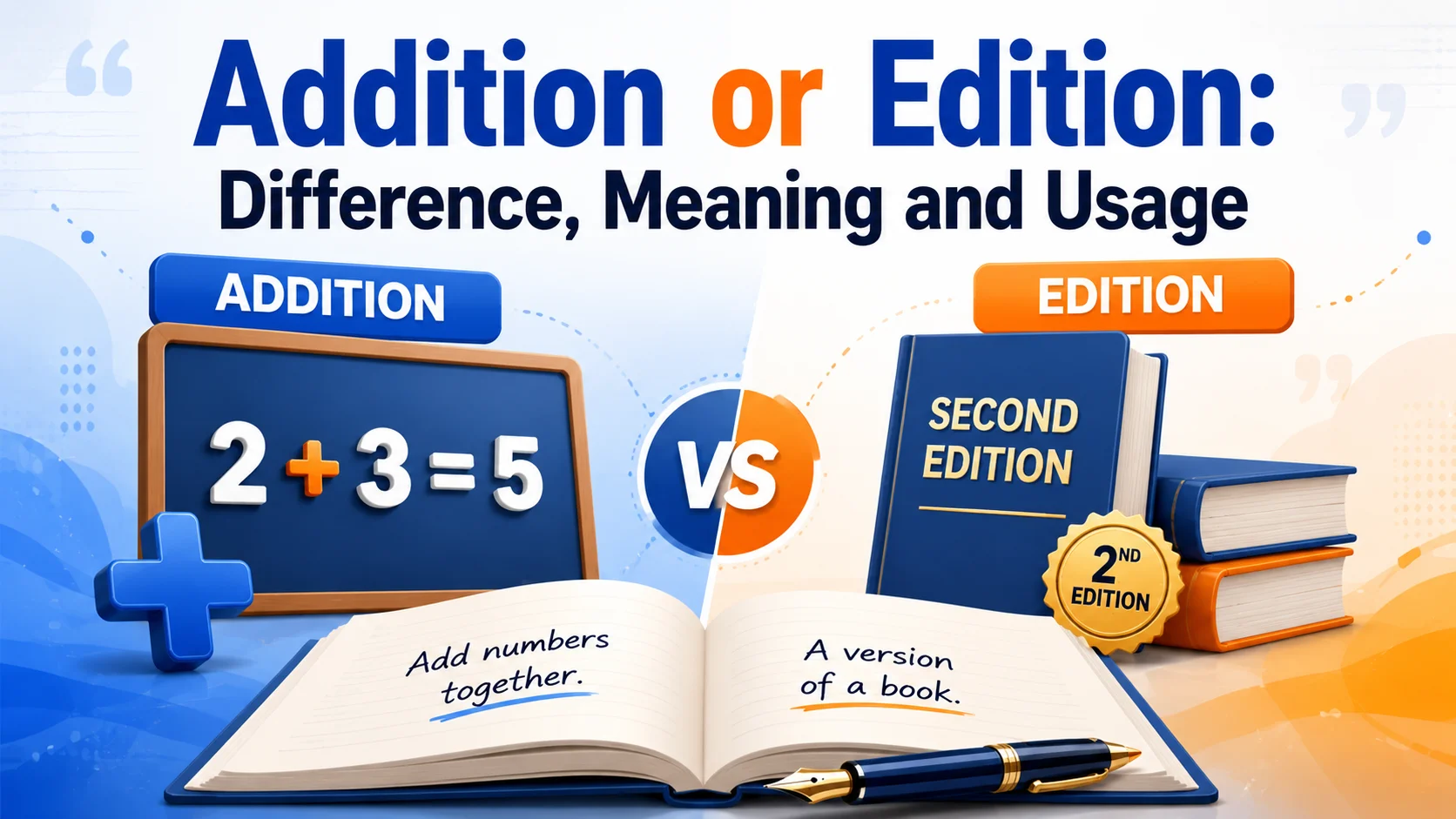
Addition or edition can be confusing because the two words look and sound similar, but they describe very different ideas. Addition is connected to adding something, while edition usually refers to a particular version or release of a book, publication, product, or other work.
That one-letter difference can change the meaning of an entire sentence. For example, you might talk about the addition of a new chapter to a book, but you’d call the updated book a new edition. The words can even appear together when you’re discussing how a publication has changed.
Understanding this distinction will help you choose the right word in school assignments, business writing, publishing, mathematics, everyday conversation, and professional communication. In this guide, you’ll learn what addition means, what edition means, how they differ, when to use each one, common mistakes to avoid, and a simple trick for remembering the difference.
Addition or Edition: Quick Answer
Both addition and edition are correct English words. The correct choice depends entirely on what you mean.
- Addition means something that is added or the act of adding.
- Edition means a particular version or release of something, especially a book, newspaper, magazine, or other published work.
Compare these examples:
- “The addition of a new chapter made the book more useful.”
- “I bought the latest edition of the textbook.”
- “The house has a new addition at the back.”
- “This is the third edition of the dictionary.”
- “In addition to the report, she submitted a presentation.”
A useful rule is:
If you mean “something added,” use addition. If you mean “a particular version,” use edition.
The words aren’t interchangeable, even though they share the ending -dition.
Addition vs Edition at a Glance
| Feature | Addition | Edition |
| Basic meaning | Something added or the act of adding | A particular version or release |
| Related verb | Add | Edit |
| Part of speech | Noun | Noun |
| Common contexts | Mathematics, writing, construction, groups, extra information | Books, newspapers, magazines, software, products, broadcasts |
| Example | “The addition of a new room increased the home’s value.” | “The second edition contains revised material.” |
| Common phrase | “in addition to” | “first edition” |
| Main idea | Adding | Version/release |
The easiest decision test
When you’re unsure, replace the word mentally.
If “something added” makes sense, choose addition.
If “version” or “release” makes sense, choose edition.
For example:
- “The ___ of another employee strengthened the team.”
“Something added” works → addition.
- “I need the latest ___ of the manual.”
“Version” works → edition.
This simple substitution test handles most everyday cases.
What Does “Addition” Mean?
Addition is the noun related to the verb add. It generally describes either the process of putting something together with something else or the thing that has been added.
Its meaning changes slightly depending on context, but the central idea stays the same: something becomes greater because something has been added.
Addition as Something That Is Added
You can call a person, object, feature, piece of information, or physical structure an addition when it has been added to something that already exists.
Examples:
- “The new sofa is a welcome addition to the living room.”
- “Maria was a valuable addition to the research team.”
- “The website’s new search tool is a useful addition.”
- “The final paragraph is an important addition to the report.”
Notice that addition doesn’t necessarily mean the new thing was physically attached. It can refer to anything that becomes part of an existing whole.
Addition as the Act of Adding
Addition can also describe the act or result of adding things together.
For example:
- “The addition of salt changed the flavor.”
- “The addition of new evidence changed the argument.”
- “The project requires the addition of several new features.”
Here, the emphasis is on the process or effect of introducing something extra.
Addition in Mathematics
In mathematics, addition is the operation of combining numbers to find their total.
For example:
8 + 7 = 15
This is an addition problem. The numbers being combined are called addends, and the result is called the sum.
You might say:
- “Students are learning addition and subtraction.”
- “The problem requires basic addition.”
- “Practice addition facts until they become automatic.”
This mathematical meaning has nothing to do with a book’s edition.
Common Expressions With “Addition”
Some expressions containing addition are particularly common.
“In addition”
This phrase means also or as well as something else.
“The hotel has a swimming pool. In addition, it offers a fitness center.”
“In addition to”
This means as well as.
“In addition to English, she speaks Spanish.”
A common mistake is writing “in edition to.” That is incorrect.
“An addition to”
This describes something added to an existing thing.
“The balcony is a beautiful addition to the apartment.”
“A valuable addition”
This describes a person, object, idea, or feature that improves or strengthens an existing group or system.
“The new editor has been a valuable addition to the team.”
What Does “Edition” Mean?
Edition refers to a particular version or release of something. It is especially common when talking about books, newspapers, magazines, dictionaries, textbooks, and other publications.
The key idea isn’t simply that something was added. Instead, an edition identifies a particular form of a work.
Edition as a Particular Version of a Book
Suppose a textbook is published and later updated. The publisher may release a second edition containing corrections, new examples, updated research, or reorganized chapters.
You might say:
“I’m using the fourth edition of the textbook.”
That tells the reader which version you have.
An edition may differ from an earlier one because of:
- New information
- Corrections
- Revised explanations
- Updated references
- Additional chapters
- Removed material
- Changes in organization or presentation
Therefore, a book can contain additions while also being a new edition.
Edition in Newspapers and Magazines
The word edition can also identify a particular issue or release of a publication.
Examples include:
- “The morning edition”
- “The evening edition”
- “The international edition”
- “The weekend edition”
- “The special edition”
The exact meaning depends on the publication.
Edition for Products and Software
Modern usage extends beyond traditional publishing.
Companies may use edition to distinguish versions of products or software.
Examples include:
- Standard Edition
- Professional Edition
- Special Edition
- Collector’s Edition
- Limited Edition
Here, edition identifies a defined version or release rather than simply an extra feature.
Common Expressions With “Edition”
You will frequently see phrases such as:
- first edition
- second edition
- revised edition
- new edition
- updated edition
- special edition
- limited edition
- collector’s edition
For example:
“The revised edition includes updated statistics.”
The word edition tells us that we’re dealing with a particular version of the work.
Addition vs Edition: The Real Difference
The clearest distinction is this:
Addition = something is added.
Edition = a particular version is identified.
Consider a textbook.
A publisher adds two new chapters. Those chapters are additions to the content.
The publisher then releases the updated book as the fifth edition.
So you could accurately write:
“The fifth edition includes the addition of two new chapters.”
Both words work because they describe different things.
- Addition describes the new material being introduced.
- Edition identifies the published version containing that material.
This distinction is important because writers sometimes treat edition as a fancy synonym for “addition.” It isn’t.
Why Do People Confuse Addition and Edition?
The confusion is understandable. The words have similar structures and both contain the ending -dition.
Their spelling looks similar
Compare:
addition
edition
Only the first vowel and initial letter pattern separate them visually. When you’re typing quickly, especially while relying on memory, it’s easy to choose the wrong one.
Their pronunciation can sound similar
In normal speech, the unstressed first syllables can make the words harder for some learners to distinguish.
If you’ve mostly encountered one word in writing and the other in conversation, the difference can be even less obvious.
Their word families provide the best clue
The strongest way to separate them is to connect each word to its related verb:
add → addition
edit → edition
That relationship gives you a useful mental shortcut.
If you’re talking about adding, think addition.
If you’re talking about editing or producing a particular version, think edition.
How to Use “Addition” Correctly
Addition in Everyday Writing
Use addition when you’re describing something extra that becomes part of an existing situation.
“The new lamp was a nice addition to the bedroom.”
“The garden is a recent addition to the property.”
“Her suggestion was a useful addition to the discussion.”
The word works naturally for both physical and abstract things.
Addition in Academic Writing
Addition is particularly common in formal writing because writers often introduce multiple supporting points.
For example:
“In addition to the survey results, the researchers examined interview responses.”
“The addition of a control group improved the study design.”
Be careful with the distinction between addition and additional:
- addition = noun
- additional = adjective
Correct:
“The report contains an additional section.”
Also correct:
“The new section is an addition to the report.”
Addition in Construction and Design
A physical extension of a building is often called an addition.
“The owners built an addition onto the house.”
“The kitchen addition created more space.”
This is a particularly useful example because edition would make no sense here.
A house can have an addition. It doesn’t have an edition.
Addition in Teams and Groups
You can use addition when someone joins an existing group.
“The new designer is a strong addition to the team.”
“The two players were important additions to the squad.”
Again, the central concept is something being added to an existing whole.
How to Use “Edition” Correctly
Books and Textbooks
Use edition when identifying a specific published version.
“The latest edition of the grammar book is easier to understand.”
“My professor requires the third edition.”
“The first edition is now difficult to find.”
Revised and Updated Publications
An updated publication may receive a new edition.
“The revised edition includes several new examples.”
“The publisher released an updated edition last year.”
The important distinction is that the edition is the resulting version, while changes made to it may include additions, deletions, corrections, and revisions.
Newspapers and Magazines
Use edition when referring to a particular release or issue.
“The story appeared in the weekend edition.”
“The international edition contains different articles.”
Special and Limited Releases
Edition is also common when a product is released in a deliberately differentiated form.
“The company released a limited edition of the product.”
“She bought the collector’s edition.”
In these examples, edition signals a particular release rather than something merely being added.
Addition or Edition? Common Sentence Corrections
Understanding incorrect examples is often more useful than memorizing definitions.
“I bought the latest addition of the textbook.”
❌ Usually incorrect if you mean the latest published version.
✅ “I bought the latest edition of the textbook.”
However, addition could be correct if you’re specifically talking about something added to the textbook:
“The new chapter is an important addition to the textbook.”
“In edition to English, she speaks French.”
❌ Incorrect.
✅ “In addition to English, she speaks French.”
In addition to is the established expression.
“The new edition to the house looks beautiful.”
❌ Incorrect if you mean a physical extension.
✅ “The new addition to the house looks beautiful.”
A house can have an addition, not an edition.
“The latest addition contains revised chapters.”
This sentence isn’t automatically wrong, but it can be unclear.
If you’re identifying the entire updated publication, edition is more precise:
“The latest edition contains revised chapters.”
If you’re talking about something newly inserted into an existing publication:
“The latest addition contains several revised chapters.”
Context determines the better choice.
Addition vs Edition in Real-World Contexts
| Situation | Correct Word | Example |
| Mathematics | Addition | “We’re learning addition.” |
| New information | Addition | “The new data is a useful addition.” |
| House extension | Addition | “They built an addition to the house.” |
| New team member | Addition | “She was a valuable addition to the team.” |
| Book version | Edition | “I need the latest edition.” |
| Revised textbook | Edition | “The third edition contains updated material.” |
| Newspaper release | Edition | “The story appeared in the evening edition.” |
| Special product release | Edition | “He purchased the limited edition.” |
| Formal transition | Addition | “In addition, the study examined costs.” |
Addition vs Edition in School and College Writing
Students encounter both words frequently, but for different reasons.
If you’re discussing mathematics, use addition:
“The lesson covers addition and multiplication.”
If you’re discussing a textbook version, use edition:
“The assignment is based on the sixth edition.”
If you’re describing new material added to a paper:
“The addition of a conclusion strengthened the essay.”
This distinction matters in academic settings because textbook editions can contain meaningful changes. Saying that you need the “latest addition” when you mean the latest textbook version may confuse your instructor or classmates.
Addition vs Edition in Business Writing
Professional communication also uses both words, although the contexts differ.
Addition is useful when describing:
- New employees
- New features
- New information
- New departments
- New equipment
- Extra sections of a report
For example:
“The analytics dashboard is a valuable addition to the platform.”
Edition is useful when distinguishing versions:
“Please use the latest edition of the employee handbook.”
A simple editing question can prevent mistakes: Am I describing what was added, or am I identifying which version exists?
Addition vs Edition in Publishing
Publishing provides one of the clearest examples of how the two concepts work together.
Imagine a grammar textbook originally contains 300 pages. The publisher updates it and adds a new chapter about digital communication.
The new chapter is an addition.
If the publisher formally releases the updated book as a new version, that book may be called the second edition.
So:
Addition describes a change in content.
Edition identifies the resulting version.
This distinction becomes especially important when discussing academic books, reference works, manuals, dictionaries, and technical publications.
Grammar and Word Forms
Addition as a Noun
Addition is a noun.
“The addition was unexpected.”
“The addition of new evidence changed the conclusion.”
It can refer to an object, concept, action, or result.
Edition as a Noun
Edition is also a noun.
“This edition is more comprehensive.”
“I ordered the latest edition.”
It identifies a particular version, release, or issue.
Related Forms of Addition
The word family includes:
- add — verb
- added — past tense/past participle
- adding — present participle
- addition — noun
- additional — adjective
- additive — noun/adjective in relevant contexts
Examples:
“Please add your name.”
“She added another example.”
“The addition improved the report.”
“We need additional information.”
The connection between add and addition is your spelling clue.
Related Forms of Edition
The related word family includes:
- edit — verb
- edited — past tense/past participle
- editing — present participle
- editor — person who edits
- editorial — relating to an editor or editorial content
- edition — noun referring to a particular version/release
For example:
“The editor edited the manuscript.”
“The publisher released a revised edition.”
The words aren’t synonyms, but their shared relationship to editing helps explain the spelling and meaning of edition.
Plural Forms
The plural forms are straightforward:
- addition → additions
- edition → editions
Examples:
“Several additions were made to the building.”
“Different editions of the dictionary are available.”
Pronunciation: Addition vs Edition
Although spelling is usually the main problem, pronunciation can contribute to the confusion.
How to pronounce “addition”
Addition is commonly pronounced approximately:
uh-DISH-un
The stress falls on the middle syllable.
How to pronounce “edition”
Edition is commonly pronounced approximately:
ih-DISH-un
Again, the middle syllable carries the main stress.
The most noticeable difference is at the beginning:
- addition → “uh-”
- edition → “ih-”
If you’re learning English, don’t rely solely on pronunciation to choose the spelling. Use the meaning as your primary guide.
British English vs American English
There is no major British-versus-American spelling difference between these words.
Both varieties use:
- addition
- edition
So if you’re wondering whether edition is British English and addition is American English, the answer is no.
The distinction is semantic, not regional.
You can use addition and edition in both British and American English.
Regional differences may appear in other vocabulary surrounding these words, but the spellings themselves remain standard.
Common Mistakes to Avoid
Mistake 1: Using “edition” for something added
Incorrect:
“The new employee is a great edition to the company.”
Correct:
“The new employee is a great addition to the company.”
A person joining a company is something added to the organization.
Mistake 2: Using “addition” for a book version
Incorrect:
“Please buy the fourth addition of the textbook.”
Correct:
“Please buy the fourth edition of the textbook.”
You’re identifying a specific version of the textbook.
Mistake 3: Writing “in edition”
Incorrect:
“In edition to the main course, dessert is included.”
Correct:
“In addition to the main course, dessert is included.”
Mistake 4: Assuming every change creates an “addition”
A new edition doesn’t necessarily mean that material was simply added. A revised edition can also contain deletions, corrections, reorganizations, or rewritten material.
That’s why “edition” is broader when you’re identifying a published version.
Mistake 5: Choosing based only on pronunciation
If you’re unsure how the word is spelled, first determine what it means.
Ask:
Am I adding something, or am I identifying a version?
Meaning is a more reliable guide than sound.
Related Words That Are Easy to Confuse
Addition vs Additional
These words are related but have different grammatical functions.
Addition is a noun:
“The addition was helpful.”
Additional is an adjective:
“We need additional information.”
Addition vs Addendum
An addendum is supplementary material added to a document, usually after the main document has been completed.
For example:
“The contract includes an addendum.”
An addendum is therefore a specific type of addition, but the two words aren’t always interchangeable.
Edition vs Version
Edition and version overlap in some contexts, but they aren’t identical.
A version can refer broadly to a particular form of something, including software, documents, statements, or designs.
An edition is especially common for published works and deliberately distinguished releases.
For example:
“the latest edition of the textbook”
“the latest version of the software”
Both are natural, but the nouns are preferred in different contexts.
Edition vs Revision
A revision focuses on the act or result of changing something.
An edition identifies a particular published version.
A revised manuscript can eventually become a new edition of a book.
How to Remember Addition vs Edition
You don’t need a complicated mnemonic. The word families give you the answer.
The “ADD” memory trick
Think:
ADD → ADDition
If you’re adding something, you’re dealing with an addition.
Add a room → an addition to the house.
An addition to the team → add a person.
Add information → an addition to the report.
The “EDIT” memory trick
Think:
EDIT → EDITion
If you’re thinking about an edited, revised, or published version, edition is usually the word you need.
Edit a book → a new edition.
Revise a textbook → a revised edition.
Release a special version → a special edition.
Easy rule: ADD = addition. EDIT = edition.
A Five-Second Decision Guide
When proofreading your sentence, run through this checklist:
- Does the word mean something extra was added?
→ Use addition. - Does it describe the act of adding?
→ Use addition. - Are you talking about mathematics?
→ Use addition. - Are you identifying a particular book or publication version?
→ Use edition. - Are you describing a special, revised, or limited release?
→ Use edition. - Does the phrase begin “in ___ to”?
→ It is in addition to. - Can you connect the word to “add”?
→ addition. - Can you connect it to “edit” or a particular published version?
→ edition.
Quick Practice: Choose the Correct Word
Try choosing the correct word before looking at the answers.
- “The new chapter is a useful ___ to the book.”
- “I need the latest ___ of the dictionary.”
- “___ to the regular lessons, students receive writing practice.”
- “The company released a special ___ of the product.”
- “The garage was a major ___ to the house.”
- “The second ___ contains several corrections.”
Answers
- addition
- edition
- In addition
- edition
- addition
- edition
The pattern becomes much easier once you focus on meaning rather than spelling alone.
Conclusion
Addition and edition are both correct words, but they answer different questions. Addition is about adding something—whether that’s a new room, a team member, information, a feature, or a mathematical quantity. Edition is about identifying a particular version or release, especially a book, publication, product, or special release. One final actionable tip: connect each word to its family. ADD → addition and EDIT → edition. If you’re describing something being put into an existing whole, addition is usually the right choice. If you’re naming a specific version, edition is the better fit. A common mistake to avoid is treating edition as a synonym for addition. A new edition may contain additions, but an addition isn’t automatically an edition. Once you separate adding from version, this spelling pair becomes much easier to handle accurately.
FAQs
Q1. Is it “addition” or “edition” of a book?
Use edition when you mean a particular published version of a book, such as the first or second edition. Use addition when you’re referring to something that was added to the book, such as a new chapter, appendix, example, or section.
Q2. Is “in addition to” the correct phrase?
Yes. In addition to is the standard expression meaning “as well as.” For example, “In addition to English, she studies French.” In edition to is incorrect. The phrase is always formed with addition.
Q3. Is an addition the same as an edition?
No. An addition is something added or the act of adding, while an edition is a particular version or release. A new edition of a book may contain additions, but the two words describe different concepts.
Q4. Is “new edition” the same as “new addition”?
No. A new edition is a new or revised version of something. A new addition is something newly added to an existing thing. A revised textbook could be a new edition because it contains new additions, corrections, and other changes.
Q5. Are addition and edition different in British and American English?
No. Addition and edition are standard spellings in both British and American English. The difference isn’t regional. You choose between them based on meaning and context, not on which variety of English you’re using.